
Group Coaching vs Individual Coaching: Which Format Fits

Coachful
Your calendar is almost full, but prospective clients keep asking when you'll have space. You could add more individual sessions, raise your prices, or turn your most repeatable work into a cohort. The uncomfortable question isn't whether a group would sell. It's whether you could serve more people without weakening the work that earned their trust.
The useful comparison in group coaching vs individual coaching is therefore bigger than session price. Look at the outcome each participant achieves, the coach time required to achieve it, and whether the people sharing the room can help each other learn.
Group and Individual Coaching Side by Side
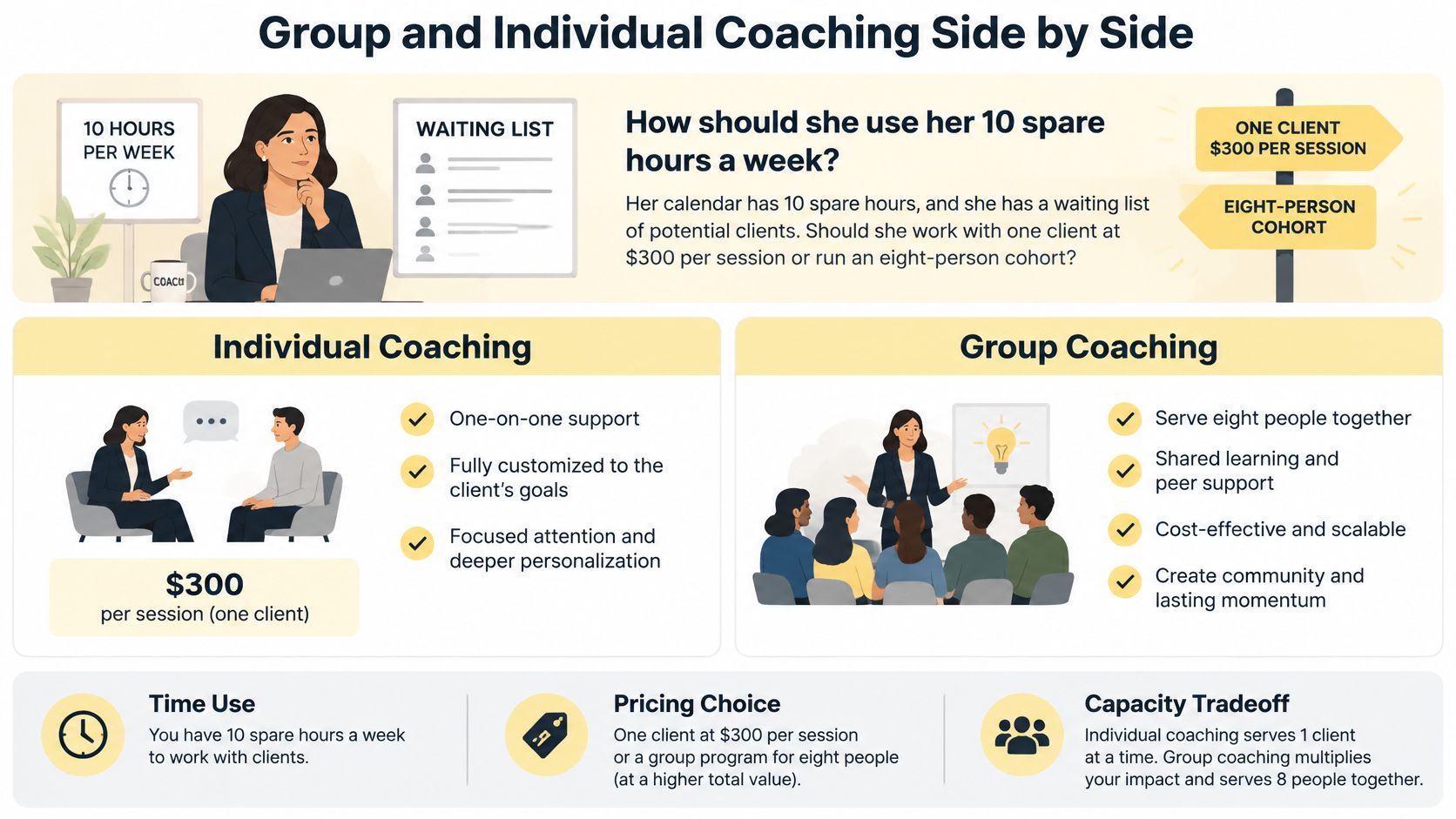
Say you have 10 spare hours a week and a waiting list. Your immediate choice is to accept another individual client at $300 per session, or build an eight-person cohort. Those are hypothetical offer designs, not market benchmarks, but they expose the decision: sell concentrated access or organize shared progress.
Individual coaching gives you direct access to one person's plan, assumptions, and obstacles. Group coaching spreads coach time across participants and adds peer learning, with less room for personal detail.
Individual vs group coaching across six criteria
| Criterion | Individual coaching | Group coaching |
|---|---|---|
| Outcomes | Strong, adaptive goal work for one person | Comparable goal results in some comparisons; stronger fit for shared content and standardized curricula |
| Price and delivery cost | Highest-access price tier; one coach hour per client | Lower delivery cost per participant; room for scholarships or margin |
| Logistics | One calendar slot per client; rescheduling affects one person | Shared calendar slot; attendance and make-up policies must work for everyone |
| Client fit | Confidential, complex or high-stakes goals | Shared goals, peer learning and standardized curricula |
| Engagement | Direct coach accountability between sessions | Peer accountability that requires active facilitation |
| Scalability | Revenue constrained by coach hours | Revenue grows with cohort enrollment; ceiling set by facilitation quality |
The capacity tradeoffs are easier to see when the offers sit alongside each other.
Choose the constraint before the format
The table alone can't settle the choice because the same criterion can favor different formats depending on client complexity and confidentiality needs. A leadership curriculum may be easy to share, while a participant's dispute with their employer needs a private conversation.
You might worry that a group means giving clients less. A more useful design question is what clients need direct access for. Don't spend private-session time repeating material everyone could learn together, but don't make a client disclose sensitive context to access individualized help.
Consider a business coach teaching service positioning. Participants can critique sample offers together, while someone negotiating a difficult partnership exit needs a separate track. Both clients need business coaching; they don't need the same delivery arrangement.
Before comparing offers, write down your top two decision criteria. If they're privacy and adaptability, prioritize client fit. If they're reach and sustainable delivery, examine cost per outcome and the work outside live sessions.
What Outcome Research Shows for Each Format
The surprising finding is that more exclusive access doesn't automatically produce better measured outcomes. A meta-analysis summarized by the Society for Psychotherapy examined 67 studies directly comparing individual and group psychotherapy and found no statistically meaningful difference across primary and secondary outcomes, with equivalent pre-to-post results.
That finding needs boundaries. The studies differed substantially by diagnosis, intervention design, and outcome measure, and psychotherapy isn't interchangeable with commercial coaching. It challenges the assumption that groups are weaker, not the need to evaluate a particular program.
Knowledge and goal attainment aren't the same outcome
The randomized comparison of individual coaching and group training reported the following results, including higher content-knowledge scores for group training and no statistically significant difference between formats on goal attainment.
Randomized comparison of individual coaching and group training
| Measure | Individual coaching | Group training | Reading |
|---|---|---|---|
| Content-knowledge score, mean and SD | 2.90, SD 1.29 | 4.30, SD 1.65 | Group higher; p = 0.006 |
| Knowledge effect of format | Comparison condition | Medium-to-large effect, eta-squared 0.18 | F(1,45) = 9.75, p = 0.003 |
| Goal attainment vs control | Stronger direct gains | Not significantly different from individual coaching, p = 0.243 | Individual gains relative to control don't establish superiority over group training |
| Best-fit use, practical interpretation | Personalized diagnosis and accountability | Standardized curriculum and peer learning | Design around the intended outcome |
Notice the distinction: group training isn't identical to group coaching. This comparison helps separate knowledge acquisition from personalized goal work, but it doesn't establish that every coaching cohort will reproduce the training result.
For example, a career coach might teach interview frameworks collectively, then use individual sessions to investigate why a client avoids applying. Knowing the framework and acting on it are different objectives. Build the offer around the objective you're promising.
Interpret no difference carefully
A multinational randomized evaluation published as an NBER working paper found no statistically significant efficacy differences between group and individual coaching across economic outcomes in Uganda, the Philippines, and Bangladesh. These were economic-development programs, so they don't establish equivalent results for executive or life coaching.
A non-significant difference isn't a guarantee of equivalence for your offer. It's a reason to test your assumptions rather than sell them as facts.
A strong group program can still underperform a strong individual engagement. Define goal attainment before enrollment, then track attendance and completed milestones alongside it. Use the guide to interpreting coaching ROI to distinguish evidence of client improvement from claims about financial return.
Cost Per Client Versus Cost Per Outcome
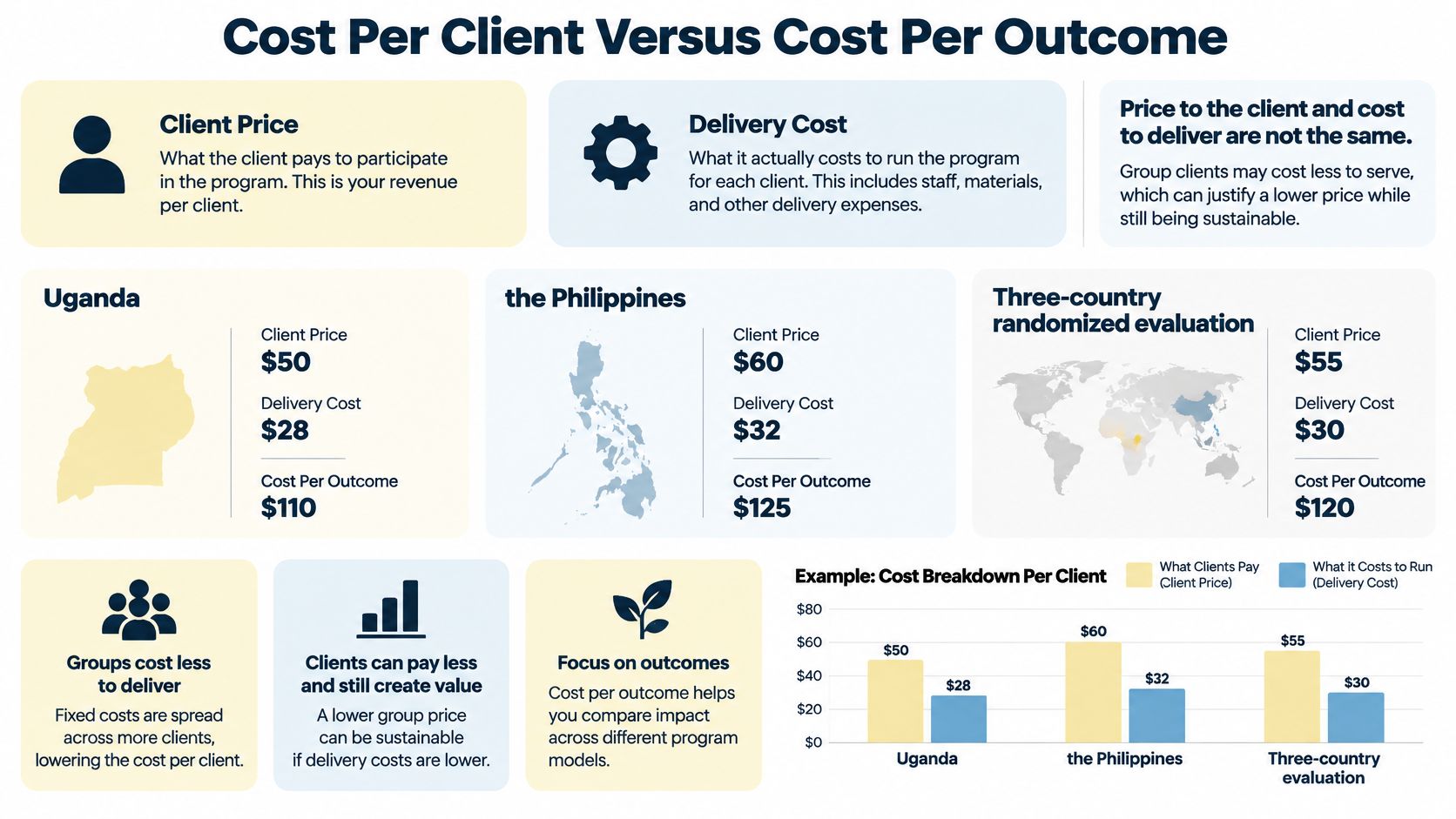
A group seat should not cost less just because participants share a room. Price the defined work, access, and support clients receive; assess delivery cost separately. The useful comparison is not just the price per client, but the cost of helping each participant make progress and the revenue generated per coach hour.
A Northwestern Institute for Policy Research working-paper summary describes a randomized evaluation in Uganda, the Philippines, and Bangladesh. Group coaching cost approximately 15% to 20% less, with impacts close in magnitude to individual coaching. It was more cost-effective for an aggregate outcomes index, consumption, food security, and subjective well-being. These findings concern program economics, not a discount rate for every coaching practice.
Work through the coach-hour arithmetic
Use these illustrative assumptions, not market rates: an individual session earns $300 for one hour. A 12-week group of eight costs $600 per participant, with a 90-minute weekly meeting. The comparison is based on live delivery time, not total work.
The individual session generates $300 per live coach hour. The cohort brings in $4,800 over 18 live coach hours, or approximately $267 per live coach hour. That figure excludes preparation, sales, administration, private support, and expenses.
Revenue per coach hour, illustrative assumptions
| Format | Coach hours | Assumed revenue | Revenue per live coach hour |
|---|---|---|---|
| Individual session | 1 coach hour | $300 | $300 |
| 12-week group of eight | 18 coach hours | $4,800 | Approximately $267 |
The group has higher total revenue, but lower revenue per live coach hour under these assumptions. Neither figure is profit. Add preparation, follow-up, administration, and any private support to the hours counted; more individual attention can narrow or erase the cohort's time advantage.
Decide what any surplus should fund: a scholarship, added accountability touchpoints, a lower entry price, or retained margin. A coaching-package pricing guide can help you set the offer's price in relation to its scope and support, rather than discounting by default.
Protect the individual offer
A cohort and an individual engagement can serve different needs. Keep the cohort focused on a shared, bounded problem, while reserving the individual offer for confidential context or substantial adaptation. Moving a client who needs private work into a group seat may improve the arithmetic, but it weakens the fit between the promise and the service.
For another perspective on the format decision, consider this video.
Track coach hours per client, completion rate, and revenue per coach hour. Then calculate cost per completed milestone, using the same definition of a milestone and your actual delivery costs across formats. These measures connect the price of a seat to the resources used and the progress participants complete.
Pricing rule: A higher hourly yield is useful only when the client receives the support the offer promises.
Revenue per coach hour is a capacity measure, not proof of impact. The stronger efficiency test is whether participants complete meaningful milestones at a cost your practice can sustain.
Logistics, Capacity and Scheduling Trade-offs
Consider a hypothetical 20-hour coaching week. Scheduling 10 to 15 individual clients for 60-minute sessions leaves the remaining time for preparation, notes, and follow-up. Alternatively, a 90-minute group slot could serve six to 12 participants; three cohorts of eight would use 4.5 live hours for 24 people.
Those are planning assumptions, not recommended caseload standards. Group delivery shifts the scheduling problem toward attendance, time zones, and make-up work.
Set the operating rules before enrollment
- Publish fixed start dates. Include the whole meeting schedule before participants commit.
- Rotate global meeting times. Agree on the rotation upfront so the same members aren't always attending at night.
- Plan recordings with consent. Record teaching segments for absentees, but exclude confidential discussion unless participants explicitly agree.
- Define individual make-ups. For example, offer a 30-minute make-up call under a stated cancellation policy.
- Set a discussion cap. An initial cap of eight to 10 participants is a testable design choice, not a universal optimum.
An individual no-show can leave a reserved hour unused. A group no-show doesn't cancel the meeting, but the absent member can't contribute to peer discussion.
| Workload | What to budget |
|---|---|
| Per session | Preparation, facilitation, notes |
| Per participant | Reminders, progress updates, renewals, support |
| Per program | Enrollment, resources, evaluation |
Before selecting delivery software, use Zee Palm's Kajabi and Skool comparison to frame your platform questions. Then total preparation, follow-up, and administration, not just live contact.
Client Fit and Group Composition Checks
The best cohort isn't necessarily the most homogeneous one. The group-coaching research published in SAGE identifies peer learning, social support, critical reflection, belonging, and mutual emotional support as relevant mechanisms, alongside findings that subject-area similarity can strengthen the coaching relationship, differences in openness can be beneficial, and similarity in conscientiousness is associated with more positive evaluations.
Don't turn those findings into personality-based admissions rules. Use them to distinguish shared relevance from identical personalities. Participants need enough common context to understand each other, but they don't need matching perspectives.
Screen for contribution and safety
The intake question isn't whether someone wants the curriculum. Ask whether this particular group gives them a workable place to pursue it.
- Goal alignment: Can participants use the same core exercises while pursuing distinct personal milestones?
- Confidentiality expectations: What information must remain private, and what limitations of group confidentiality will you explain?
- Communication style: How will you accommodate reflective participants without letting more vocal members dominate?
- Readiness to participate: Can the person complete preparation and offer constructive feedback?
- Time zone and access: Can they attend reliably and use the required tools?
- Power differences: Does anyone control another participant's promotion, pay, reputation, or access to work?
Say three managers from the same company apply together. One supervises another, while the third is competing for the same promotion. Their shared context makes the curriculum relevant, but their workplace relationships may make honest reflection costly.
Separate cohorts or individual tracks may be more appropriate. Don't assume a confidentiality agreement removes the practical consequences of disclosure.
Know when private work is the safer choice
Favor individual coaching when disclosure risk, status gaps, or unresolved interpersonal conflict would prevent useful participation. Trauma-related concerns also require care: assess your competence and coaching scope, and refer to an appropriate qualified professional when necessary rather than treating private coaching as a substitute for clinical care.
Design for permission to participate, not pressure to disclose.
A quiet participant may be reflecting, confused, uncomfortable, or unwilling to discuss something publicly. Offer private check-ins and anonymous feedback before interpreting silence as disengagement.
Close intake with these questions:
- Desired change: What would you need to do differently for this program to be worthwhile?
- Shared context: Which challenges would you find useful to explore with peers?
- Participation: How do you prefer to contribute and receive feedback?
- Constraints: What scheduling, confidentiality, or relationship issues might limit participation?
- Support needs: What would make you request an individual conversation or a different service?
Then ask a separate permission question: What are you willing to share with this group, and what should remain between you and your coach? Record the boundary and revisit it without treating initial consent as permanent.
Engagement Tactics That Work in Each Format
A full calendar isn't proof of engagement. Give participants something observable to do between meetings, and distinguish attendance from progress.
The working environment matters less than the follow-through you design around it.
Use different accountability mechanisms
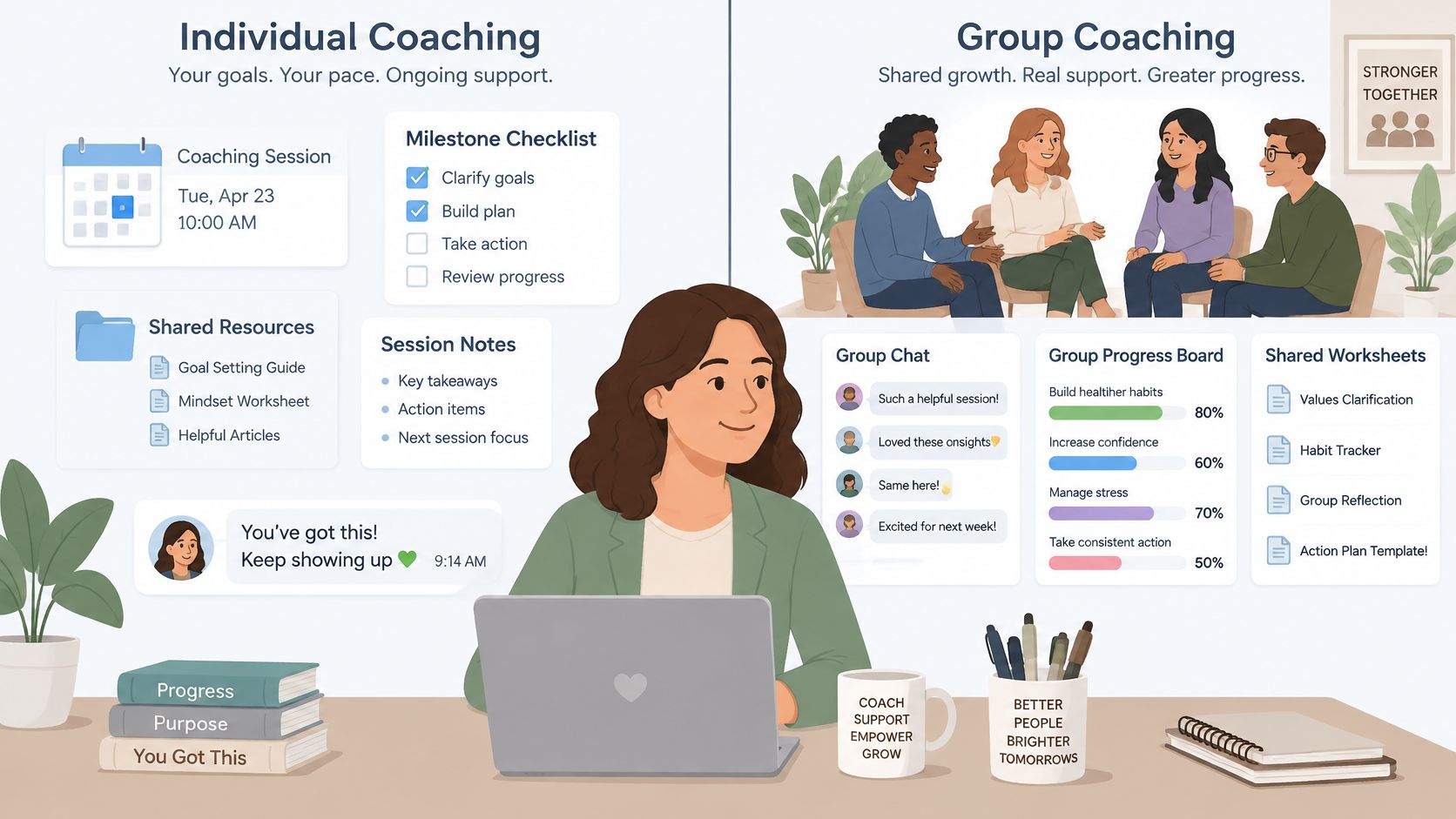
For individual coaching, end with a written milestone, an agreed action, and a check-in date. Put session notes and relevant resources somewhere the client can retrieve them, and make accountability messages specific to the action they chose.
For example, a client preparing to delegate could draft a briefing document before your next meeting. Your check-in asks whether they sent it and what happened, rather than whether they feel motivated.
For group coaching, use peer pairs for weekly commitments, a structured pre-session assignment, and rotating responsibility for summarizing learning. Keep professional facilitation with the coach rather than handing sensitive conversations to unprepared members.
Add mid-program anonymous feedback and a visible progress board, with participant permission. Public boards should show agreed milestones, not confidential notes or comparative rankings. The cohort engagement strategies guide offers a practical reference for organizing those touchpoints.
Keep well-being claims narrow
A randomized trial in the Journal of the American Board of Family Medicine tested four months of online group coaching for ambulatory faculty physicians and found reductions in depersonalization of 1.72 points (95% CI −3.26 to −0.17; p = 0.03) and impostor-syndrome scores of 0.82 points (95% CI −1.47 to −0.18; p = 0.01), plus an increase in flourishing of 0.35 points.
The trial didn't find significant changes in loneliness, moral injury, self-compassion, or the other burnout domains measured. It compared group coaching with a control condition, not individual coaching, so it can't tell you which format is better for those outcomes.
Define the target outcome before delivery and measure it at baseline and follow-up. Don't market a selected improvement as a universal well-being benefit, and establish referral routes when a participant's needs exceed coaching's scope.
Run a repeatable engagement loop
Use this operational rule as a starting point, then adjust it to your program:
- Set one visible milestone per participant. Make completion observable without exposing private context.
- Assign a task before the next session. Specify the deliverable, not just the topic to reflect on.
- Arrange a midweek peer check-in. Let participants agree on appropriate boundaries and contact methods.
- Flag two missed assignments. Review the dashboard and reach out privately before drawing conclusions.
Ask what blocked the work: an unclear task, excessive workload, a poor group fit, or a goal that no longer matters. The response should address the obstacle, not merely demand more activity.
Confirm the Right Format for Your Practice
Choose a lead format for the work you deliver, not the business model you feel you should have.
Recommended format by coaching situation
| Situation | Lead format | Main reason | Watch for |
|---|---|---|---|
| Solo coach with confidential, complex client work | Individual | Privacy and depth outweigh the cost advantage | Add a group tier once outcomes repeat across clients |
| Coach selling a repeatable program on one goal | Group cohort | Shared curriculum lowers delivery cost per participant | Intake screening for fit and composition |
| Coaching school or academy | Cohorts plus individual supervision | Standard content and personal practice both matter | Cost per milestone across cohorts |
| Executive coach with senior leaders | Individual by default | Status differences can suppress candor in groups | Peer group only after screening the mix |
| Consultant with information products | Group cohort with individual escalation | Expands reach while keeping premium access | Clear, documented escalation paths |
| Coach with emotionally demanding clients | Individual, or small group with referral paths | Group well-being evidence supports selected outcomes | Defined outcome and referral when needs exceed scope |
Test before expanding
Compare cost per completed milestone, outcome change per participant, completion rate, and cohort composition, rather than session price alone. Keep a note of who benefits and who needs additional support.
As a practical pilot, run an individual track and a cohort toward the same goal for eight to 12 weeks. This won't be a controlled experiment, but consistent definitions will make your operational comparison more useful.
Use goal attainment, milestone completion, and revenue per total coach hour as your primary measures; record attendance as diagnostic context. Pick the format to test this month, write down those three measures, and put the review date on your calendar.
Coachful offers individual and cohort program management, including onboarding, scheduling, shared resources, messaging, and progress tracking. Visit Coachful to explore how you could organize your pilot and review participant progress alongside delivery workload.


