Randomize Multiple Choice Questions to Enhance Quizzes

Coachful
You finish building the quiz for your coaching program and feel good about it for about ten minutes.
Then the practical questions start. If the correct answer keeps landing in the same spot, will clients start guessing patterns instead of thinking? If one person screenshots the quiz, will the next person get the same sequence? If a client misses a question, are they showing a knowledge gap or just reacting to how the options were arranged?
That's the moment when many coaches realize quiz design isn't only about writing good questions. It's about creating a fair learning experience. When you randomize multiple choice questions, you're not adding a gimmick. You're protecting the value of the assessment and making it more likely that the result reflects understanding rather than habit, memory, or luck.
This matters in every kind of coaching program. A leadership coach might use short knowledge checks after a communication module. A health coach might test whether clients can distinguish habits from outcomes. A driving instructor preparing learners with resources like help with the Ontario driving test has the same core challenge. People need practice that prepares them to think, not just recall where the answer sat last time.
If you're tightening up your own assessment flow, it can help to benchmark your quiz approach against tools built for coaches, such as this readiness quiz format, then adapt the same logic to your lessons, onboarding, or certification checkpoints.
Your Quiz Deserves More Than Static Questions
A static quiz gives away more than most coaches realize.
When every client sees the same question order and the same answer order, the quiz starts teaching the wrong lesson. It trains recall of surface patterns. Someone remembers that the third answer looked familiar, or that the final two questions always covered the same topic. That can inflate confidence without improving understanding.
A better quiz asks the learner to retrieve the idea, not the layout.
What static quizzes accidentally reward
Consider a business coach running a group program with weekly lessons. By week three, clients have talked in the community, shared notes, and compared wins. That's healthy. But if the quiz is identical for everyone, “compare notes” can become “compare answers.”
The same issue shows up in self-paced courses. A client retaking a quiz may not be mastering the material. They may be memorizing sequence.
A quiz should reinforce thinking. It shouldn't reward remembering where the answer sat on the screen.
Randomization changes that dynamic. It makes each attempt feel fresh enough that the learner has to slow down and read. That small pause is useful. It nudges them back toward comprehension.
Why coaches care about this more than schools sometimes do
In coaching, a quiz often does double duty. It checks knowledge, but it also shapes motivation. If the quiz feels obviously predictable, sharp clients notice. They may still complete it, but they won't trust it as a meaningful benchmark.
A well-randomized quiz sends a different message:
- This assessment is fair. Everyone gets an equivalent experience, even if the presentation varies.
- This program is thoughtfully designed. The coach has considered integrity, not just convenience.
- This result means something. Passing reflects attention and understanding, not pattern gaming.
That's why randomization belongs in professional coaching programs. It protects your curriculum, yes. More than that, it protects the learning signal your quiz is supposed to capture.
The Psychology of a Fair and Effective Quiz
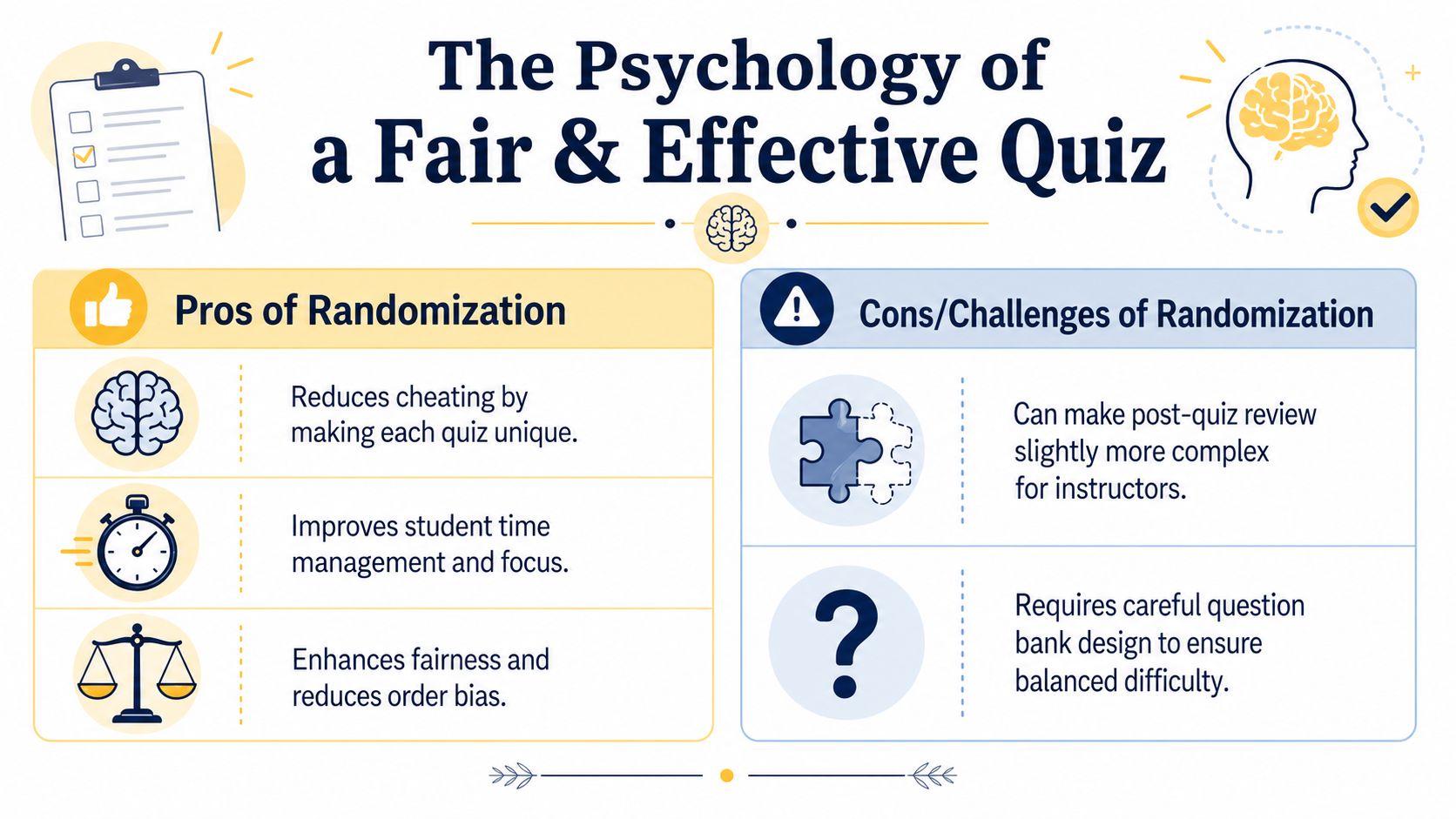
Coaches often ask whether randomization is worth the extra setup. It is, because quizzes don't happen in a psychological vacuum. Learners react to sequence, familiarity, and perceived patterns even when they don't mean to.
Order changes behavior
Randomization is a long-established control technique because it reduces order effects and response bias, which can distort results when the same option repeatedly appears in the same position. In survey and assessment tools, teams often pair shuffling with answer recoding so a choice like “D” still maps to the same underlying value after the display order changes. Practitioners warn that if recode values change with the shuffled order, results get “messed up” according to this Qualtrics discussion on multiple-choice randomization.
That point matters more than it first appears to.
If you coach with graded quizzes, behavior assessments, or confidence scales, you need the display to change without corrupting the scoring. Otherwise you've solved one problem and created another.
Fairness isn't only about cheating
The immediate focus often turns to test security, but fairness is broader than that. Learners feel a quiz is fair when they believe they had a genuine chance to demonstrate knowledge without hidden traps or predictable shortcuts.
Randomization helps by reducing subtle advantages. The client who learned the pattern from a previous attempt loses that edge. The client who tends to click the first plausible option has to engage more carefully. The client who received answers from a peer can't rely on “number three is B” style shortcuts.
Practical rule: If your quiz result informs feedback, progression, certification, or confidence, the presentation should not be predictable.
Security and validity go together
When coaches randomize only because they're worried about copying, they undersell the point. Randomizing the correct-answer position is also a test-security and validity control. It reduces the ability to exploit answer-key patterns, and one study identified randomization as the most effective method for making the answer key difficult to exploit through successful guessing in this research on multiple-choice test-key construction.
That means the quiz is doing a cleaner job of measuring what you intended to measure.
A client who succeeds in a randomized environment is more likely to have earned that result through recognition, reasoning, or recall. That creates better coaching conversations afterward because you can trust the signal more.
Choosing Your Randomization Method
The right randomization method depends on what you are protecting. Sometimes the goal is attention. Sometimes it is fairness across retakes. Sometimes it is confidence that the score reflects learning rather than memory for patterns.
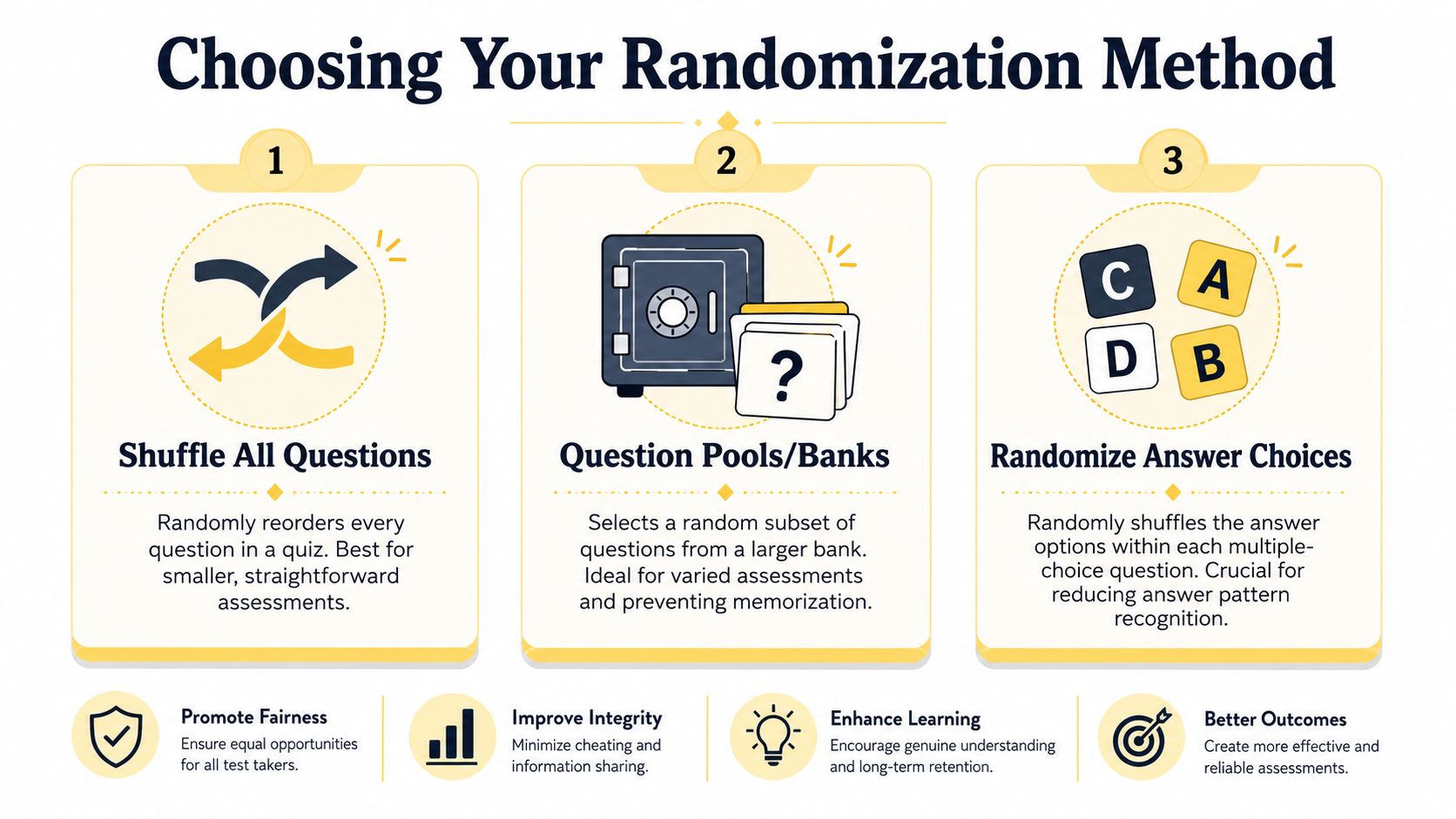
I usually choose from three methods. Each one changes the learner experience in a different way, and each one has trade-offs.
Shuffle answer choices
This keeps the question sequence fixed while rotating the options inside each question.
It is often the best fit for lesson checks built around a deliberate teaching flow. If a client reads a short scenario, watches a clip, and then answers a question tied to that moment, the question should stay where it is. Shuffling the answers still interrupts lazy guessing and pattern habits without disrupting the learning path.
This method works best when the main risk is answer-position bias. It also asks the least of your platform setup.
Check the scoring logic before you publish. The correct answer needs to stay attached to the option itself, not to its position on the screen. That matters more than coaches expect, especially in simpler tools. If you are still deciding which tool fits your program, compare the quiz options in this online course platform comparison for coaches.
Randomize question order
This changes the sequence learners see from one attempt to the next.
Use it for quizzes where each question stands on its own and the order does not carry meaning. A longer module review, a knowledge check before a group call, or a certification prep quiz usually fits that rule. Random order reduces the advantage of memorizing the flow instead of learning the material.
There is a real trade-off here. Question order can support recall when topics build on each other. If one item depends on a case study introduced in the previous item, keep them together. Randomization should increase fairness, not cognitive friction.
Use question pools or banks
Question pools create the strongest form of variation.
Instead of showing every learner the exact same set, you build several equivalent questions for each objective and let the platform draw a subset. That is the method I use when a quiz affects certification, progression, or retakes. It protects integrity, but it also improves learning if the bank is written well. Clients are less likely to memorize one wording and more likely to study the concept.
The hard part is quality control. Pooled questions need to be reliably comparable in difficulty, clarity, and scope. If one version is much easier, randomization creates a fairness problem instead of solving one.
A quick decision guide
| Goal | Best method | Coaching example |
|---|---|---|
| Reduce answer-position guessing | Shuffle answer choices | End-of-module check in a self-paced course |
| Reduce memorization of quiz flow | Randomize question order | Mid-program review quiz in a group cohort |
| Create comparable but different attempts | Question pools or banks | Certification-style assessment or retakes |
Start with the lightest method that solves the problem. For many coaches, that means shuffling answer choices first, then adding question order or pools only when the stakes justify the extra setup.
How to Randomize Questions on Popular Platforms
The setup matters more than the feature list. I have seen coaches turn on randomization, publish the quiz, and only notice later that a sequence-based question now makes no sense or that retake results are harder to interpret than expected.
What works best depends on the stakes. A quick lesson check needs speed and clarity. A certification quiz needs cleaner variation, stronger controls, and a review process you trust.
Google Forms
Google Forms is a good fit for coaches who want a fast, low-friction way to reduce answer-pattern guessing.
Open each multiple-choice question and turn on shuffle option order. That randomizes the answer choices inside that specific question. It does not give you the same control as a full LMS, but it handles many practical coaching uses well.
Use it for short quizzes such as:
- onboarding diagnostics
- post-lesson knowledge checks
- pre-call questionnaires
- simple self-paced module reviews
Check each question before you publish. If an option says “all of the above,” refers to “the first step,” or depends on a fixed sequence, shuffling can weaken the question instead of improving it.
Run the form several times yourself. That quick test catches most avoidable mistakes.
Canvas or Moodle style LMS workflows
Canvas, Moodle, and similar systems give you more control over fairness across attempts.
Most let you shuffle answer choices, randomize question order, and pull questions from banks. That matters when quizzes affect completion, progression, or team reporting. The goal is not just variation for its own sake. The goal is to make retakes feel fair while reducing the chance that learners memorize the order.
If you are still choosing a system, this online course platform comparison is a useful starting point for deciding whether you need basic quiz settings or a more feature-rich assessment setup.
For coaches serving school-age learners or exam-prep audiences, it also helps to study how dedicated practice environments handle assessment controls. Exam Practice for GCSE is one example of how timed conditions and structured delivery can support more consistent practice.
D2L Brightspace and similar systems
Platforms like D2L Brightspace are better suited to higher-stakes assessments because they let you combine multiple layers of randomization. You can build question pools, draw a set number of items, and shuffle parts of the quiz while keeping the overall structure intact.
That balance matters. Learners should feel that the quiz is fair, not chaotic. If every attempt is slightly different but still measures the same objective, clients are more likely to trust the result and focus on the material instead of comparing answers with the person next to them.
A short visual example helps if you're setting this up for the first time:
Use this level of control if learners retake assessments, if managers or sponsors review outcomes, or if completion has real consequences inside your program.
Custom websites and membership areas
Custom sites often do not offer a clean shuffle setting. That does not rule out randomization, but it does change the work.
Three pieces need to be in place:
- Reliable answer mapping so the correct answer stays correct after the display order changes.
- A rule for variation by user, session, or attempt.
- A review screen and reporting view that still make results easy to understand.
Build the scoring logic before you style the quiz. A polished interface that mis-scores shuffled answers creates more damage than a plain one that works properly.
In practice, many coaches decide to stop customizing at this stage, choosing a quiz plugin or LMS instead. That trade-off usually saves time, reduces support issues, and gives you cleaner data on what clients know.
Beyond Shuffling Best Practices for Quiz Integrity
Randomization improves a quiz, but it doesn't rescue a weak one.
The stronger lever is often the quality of the question itself. If the wrong answers are obviously weak, clients won't need a pattern to guess correctly. They'll eliminate the distractors and move on.
Better distractors matter more than extra distractors
Research on multiple-choice design shows that reducing distractors from four or five to three often does not significantly change discrimination or item quality. In a randomized study of 198 medical-exam multiple-choice questions, researchers found no statistically significant differences in the share of items with point-biserial above 0.30 across distractor counts, question type, item-writing flaws, or low-functioning distractors, according to this study on multiple-choice item design.
For coaches, that means this: don't obsess over stuffing in more options if they aren't plausible.
A good distractor should sound like something a partially informed client might choose. In a leadership course, a weak distractor is a clearly absurd answer. A strong distractor is a common but flawed management habit.
Know when not to randomize
Some quizzes should keep parts of their structure intact.
If a set of questions walks through a case study, a client story, or a decision sequence, randomizing the order can make the experience worse. The learner spends mental energy reconstructing context instead of demonstrating knowledge.
Use judgment in situations like these:
- Scenario chains: Keep related questions together when they rely on the same setup.
- Process instruction: Don't shuffle steps in a question about sequence unless the task is to identify the sequence itself.
- Accessibility concerns: Avoid answer options like “A and C” or “all of the above” if shuffling could make the wording confusing.
A helpful benchmark is tools built for serious practice environments, such as Exam Practice for GCSE, which highlight how assessment mode and review experience matter alongside question delivery.
Use partial randomization when full randomization is too much
Experienced quiz design looks different from basic quiz design.
Sometimes the right move is to randomize inside topic blocks instead of shuffling the entire assessment. Keep the “communication” questions together, but vary their order. Keep the capstone case study intact, but randomize the independent recall questions around it.
The best quizzes aren't the most shuffled. They're the ones that preserve meaning while removing predictable shortcuts.
That's the balance coaches should aim for.
Integrate Smart Quizzes into Your Coaching Workflow
The best quizzes don't sit at the end of a program as a formality. They support the coaching process from start to finish.

Where randomized quizzes fit best
Use randomized assessments in places where clarity and consistency matter:
- Before coaching starts: A short diagnostic can reveal what the client already understands and where they're guessing.
- Inside each module: A brief knowledge check helps lock in core ideas while the lesson is still fresh.
- Between sessions: Quizzes create accountability without requiring another live call.
- During certification or completion review: A more controlled assessment protects the credibility of the program.
Assessment designers increasingly need block-aware randomization strategies, because simple answer randomization reduces order bias but doesn't eliminate answer-pattern cues across the whole quiz. That's why modern tools now support more granular controls, including partial randomization at multiple levels, as described in this UserTesting guide on randomization settings.
That idea applies neatly to coaching. You don't need chaos. You need enough variation to keep the assessment honest.
A simple operating rhythm for coaches
A practical workflow might look like this:
- Create a baseline quiz for onboarding.
- Add short shuffled checks at the end of each lesson.
- Group related questions into blocks when sequence matters.
- Pull from pools when clients may retake the assessment.
- Review misses for coaching patterns, not just scores.
If your audience also studies for structured credentials, resources that boost your Azure AI exam readiness can be a useful contrast. They show how varied practice supports recall under testing conditions, which is the same principle coaches can adapt for learning retention.
For coaches refining their niche and assessment style together, a tool like this niche quiz can help clarify what kind of learning checks fit the audience you serve.
If you want one place to organize quizzes, client progress, programs, and follow-up without stitching together multiple tools, take a look at Coachful. It's built for coaches who want a cleaner delivery system and a more professional client experience.