Accessible Online Coaching for Clients Live Sessions Leave Behind

Think about the clients who quietly fade out of your programs. The nurse on rotating shifts who can never make the Tuesday group call. The client whose English is their second language, who nods along on video and then does not do the homework. The parent who joins from a phone in a parked car with a weak signal. The client who is hard of hearing and catches half of every group discussion. It is easy to read them as uncommitted. They usually read it the other way: this program was not built for someone like me. Either way, they leave, and they rarely tell you why.
The International Coaching Federation describes these clients plainly: "Others need asynchronous support because schedules are fragmented by caregiving, shift work, or multiple jobs. Some require translation, transcription, or accessibility features that allow full participation. These are not edge cases. They are the conditions most of the world's workforce navigates."
The short answer: design every program so its core can be completed without attending live, on a phone, in plain language, with a written version of anything that is spoken. Ask what each client needs at intake instead of finding out when they drop away. And set communication norms that do not depend on being online at the same moment as you. Build that once and it helps every client, not just the ones who asked.
Coachful details were checked on 3 October 2026.
Accessible online coaching starts at intake
Most access problems are invisible until a client struggles. A few intake questions surface them on day one:
- Language: "Which language do you think and write most comfortably in?"
- Hearing and reading: "Do captions, transcripts or written summaries help you?"
- Time: "When can you reliably take part, and are there weeks when live calls are not possible?"
- Device and connection: "Will you mostly use a phone, a computer or both? Is your connection ever unreliable?"
- Contact: "How do you prefer to hear from me between sessions?"
Ask without asking anyone to explain or justify a need. The answers tell you which of the options below each client will rely on. For how the first days of a program are delivered, see client portal vs email onboarding.
Captions, transcripts and plain language for anything spoken
The ICF piece notes that "Captioning improves inclusion." It also helps clients in noisy homes, clients reviewing a session later and clients working in a second language.
- Live calls: turn on live captions if your call setup offers them, speak one at a time in groups, and describe anything you share on screen.
- After every session: send a short written recap of what was agreed. A transcript is useful; a few clear bullet points are often more useful.
- Recorded lessons: add captions or a transcript, and put the key steps in writing below the video.
- Plain language: short sentences, no idioms, one instruction per line. This matters more in coaching than in most fields because reflective questions are easy to misread.
The University of Vermont's Center on Disability and Community Inclusion introduces captions and transcripts for accessible video and audio. Source: YouTube.
Coaching clients in another language
"Translation tools widen access across languages," the ICF article says. Use them with care:
- Let clients write reflections in their stronger language, and translate to understand them rather than asking them to work in yours.
- Translate key materials, such as worksheets and program instructions, and have a fluent speaker check the important ones.
- Confirm understanding with a reflection question rather than "does that make sense?"
- Think before pasting confidential session content into any translation or AI tool, and tell clients what you use. See AI session notes and client consent.
If language differences come with time-zone and currency differences too, see charging international coaching clients.
Mobile-first coaching for clients on the move
"Mobile-first delivery makes support more accessible for people managing dynamic schedules or inconsistent infrastructure." Design for the phone first:
- Short lessons and one clear action per day.
- Forms and check-ins that are quick to complete with a thumb.
- Audio or text alternatives when video is heavy for a weak connection.
- Everything in one app or portal, so clients do not hunt through emails on a small screen.


Asynchronous coaching that still counts as taking part

"Asynchronous models make developmental support realistic where live sessions are difficult to sustain." The key is giving the async path the same weight as the live one:
- Every live session has an async route: the recording or recap, one reflection prompt, and a reply from you within a set time.
- Regular written check-ins: short daily or weekly prompts clients answer when they can.
- Group participation in writing: a community thread for each live session, so people who missed it can still add their voice.
- Count engagement, not attendance: a client who answers every prompt but never makes a call is taking part.

For more on staying connected between sessions without being on call around the clock, see keeping clients engaged between sessions and between-session support boundaries.

Objections coaches raise about accessible delivery
- "Won't async dilute the coaching?" Only if the async path gets no attention from you. A thoughtful written reply to a reflection is coaching.
- "This sounds like double the work." Most of it is built once: recap templates, captioned recordings, a prompt per session. The recurring work is replying, which you do anyway.
- "My clients have never asked for this." People rarely ask. They adapt, or they leave. Intake questions make asking easy.
- "What about confidentiality in group threads?" Set the rules first. See group coaching confidentiality expectations.
Mistakes that shut clients out
- Making live attendance the only way to complete a program.
- Sharing long videos with no written version.
- Designing worksheets that only work on a laptop.
- Scheduling every group call in your own time zone's evening.
- Treating a quiet client as a disengaged one without asking what would help.
Accessible delivery with Coachful
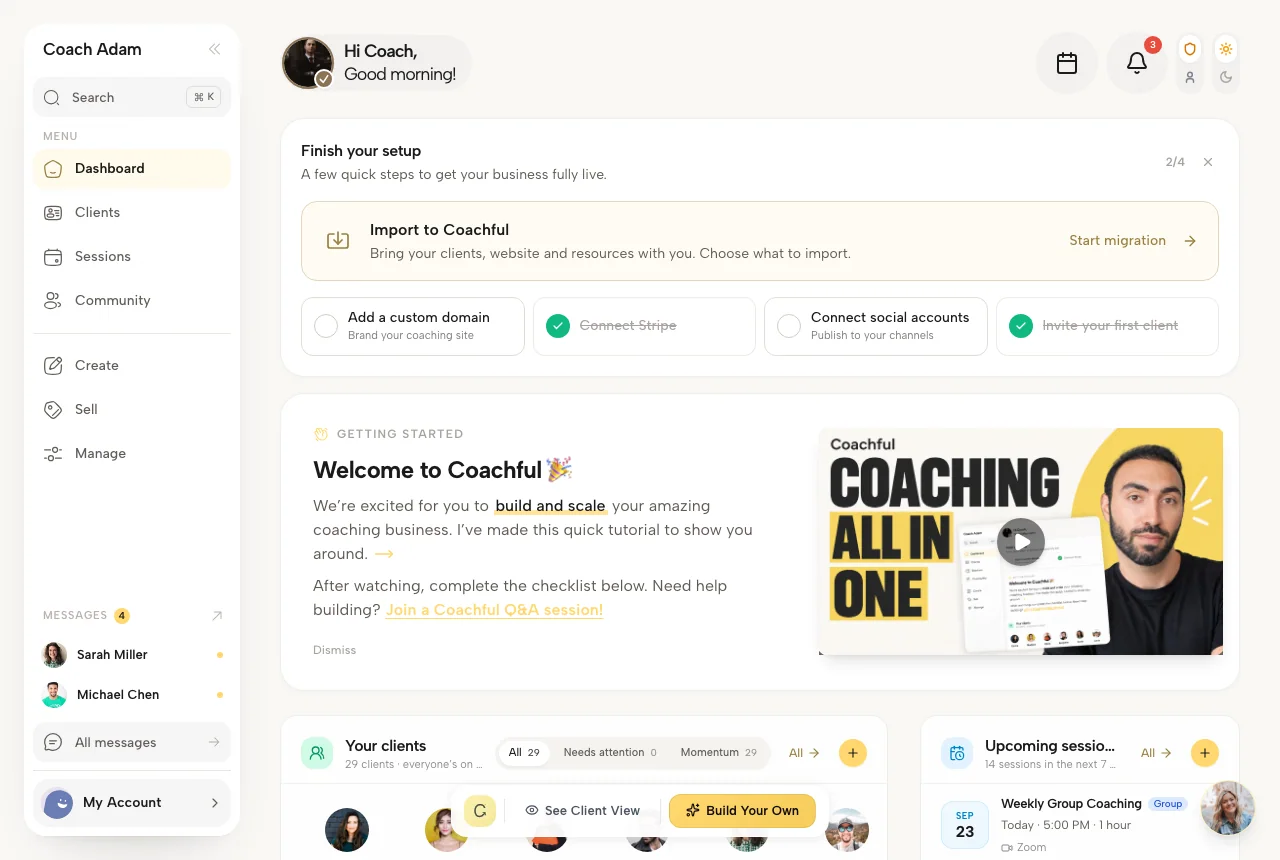
Coachful will not make your materials accessible for you; captions, translation checks and plain language are still your work. What it gives you is a delivery setup that does not depend on live attendance:
- Eight interface languages: English, Spanish, French, German, Italian, Portuguese, Brazilian Portuguese and Arabic.
- Mobile and web: a branded client home on the web and in the iOS and Android app.
- Async participation: programs with daily tasks, habits with morning and evening check-ins, worksheets and questionnaires, courses with short lessons, drip release and saved progress, plus a community feed, group chat and direct messages.
- Written versions of sessions: session recordings can be transcribed and summarized, and session notes can be shared with the client.
- Scheduling across time zones: booking pages detect each client's time zone, and calls run on built-in video included in the subscription, so there is no separate video tool to pay for.
- Reminders: email reminders, plus SMS and WhatsApp reminders once messaging is enabled.
To build self-paced lessons for your async path, see the online course platform for coaches. For choosing between live, group and self-paced formats in the first place, see how to choose your online coaching program format. Coachful has a 7-day free trial, card required, no charge during the trial, cancel in one click.
Frequently asked questions
How do I make online coaching accessible?
Ask about language, captions, time, devices and contact preferences at intake. Then make sure every part of the program has a written version, works on a phone and can be completed without attending live, with replies from you on the async path.
Should I caption coaching calls?
Yes, where your call setup supports live captions, and always follow a session with a short written recap. Captions and recaps help clients who are deaf or hard of hearing, clients working in a second language and anyone reviewing the session later.
Can coaching work asynchronously?
Yes. Recorded or summarized sessions, written reflection prompts, regular check-ins and community threads let clients with shift work, caregiving or several jobs take full part, as long as you respond to their async work as carefully as you would in a live session.
How do I coach a client whose first language is different from mine?
Use plain language, let them reflect in their stronger language, translate key materials with a human check, and confirm understanding with reflection questions. Be careful about putting confidential content into translation tools, and tell clients what you use.
What should a mobile-first coaching program include?
Short lessons, one clear daily action, quick check-ins and forms, low-bandwidth alternatives to video, and everything in one app or portal so clients are not searching through emails on a small screen.
Does accessible delivery mean more work for the coach?
Mostly at the start: recap templates, captioned recordings and a prompt for each session. After that, the recurring work is replying to clients, which the async path simply moves to a time that suits them.