
Affiliate Payout Statement Template for Coaches: A Worked Example

Coachful
Editorial Team
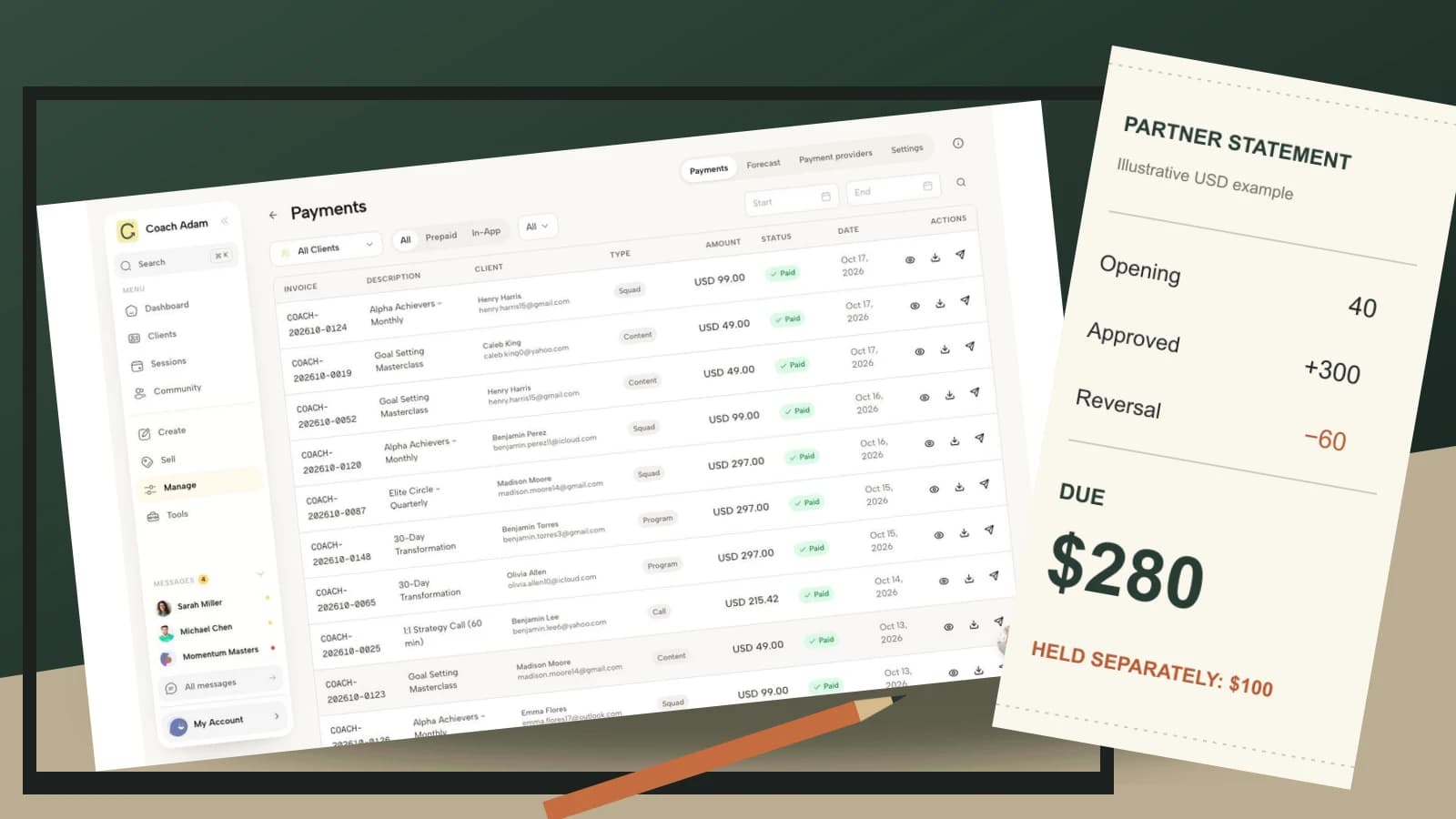
How do you explain an affiliate payout when one coaching client pays in installments, another receives a refund and a third payment is still on hold? Send a statement that separates the underlying payment, the commission calculation, the amount approved and the amount actually paid. A single number labelled “your earnings” leaves too much room for disagreement.
An affiliate payout statement should identify the partner, period, currency and agreement version; itemize eligible transactions and adjustments; reconcile the opening balance to the amount due; and explain held amounts separately. Mark it paid only after you have payment evidence. Below is an original, filled example you can adapt for a small coaching practice.
This is a commercial record template, not a tax invoice, legal agreement or permission to pay referral fees. Confirm that your arrangement is appropriate first. Our guide to whether coaches can pay referral fees addresses that earlier ethical decision. The method here begins after the relevant terms have been agreed.
What an affiliate payout statement is, and what it is not
A payout statement explains how a particular partner balance was calculated for a defined period. It is useful when an affiliate, complementary provider or contracted marketer earns a fee under a written arrangement. Use the role and terminology in your actual agreement rather than relabelling every paid introduction as affiliate marketing.
The statement is not the agreement itself. It cannot introduce a new refund rule, reduce a previously agreed rate or quietly exclude an offer. If the contract is unclear, resolve that question before presenting your preferred interpretation as a settled calculation. Our coaching marketer commission agreement guide covers the terms to decide before work begins.
It is also not proof of payment. “Approved,” “scheduled for payment” and “paid” describe different events. Nor does it necessarily satisfy invoicing or tax-reporting requirements. Ask your accountant which documents you and the partner must provide in your jurisdictions, including any relevant self-billing, tax or withholding requirements.

A copyable affiliate payout statement template
Use one statement per partner, period and currency. Keep the underlying working file more detailed than the partner-facing document, especially when it contains customer identifiers. The following fields are a practical starting point, not a universal compliance standard.
Header and payment summary
- Paying business: [legal or trading identity and appropriate contact details].
- Partner: [agreed business identity and partner reference].
- Statement: [unique reference], [version], prepared [date].
- Period: [start date] to [end date], using [agreed cutoff and time zone].
- Currency: [one currency for this statement].
- Agreement: [reference and version or effective date].
- Opening approved unpaid balance: [amount].
- New approved commissions: [amount].
- Adjustments to approved balance: [separate signed amounts and reasons].
- Approved amount due: [amount and agreed due date].
- Held separately: [amount, reason and next review condition].
- Payment status: [not paid, processing or confirmed paid], with [payment reference and date when available].
Transaction detail
For each line, record a commercial reference, relevant offer, source payment date and reference, eligible commission base, rate, calculated commission and current status. An adjustment should link to the original commission line. Include a short reason and the agreement rule used, so the partner can understand a deduction without reconstructing your spreadsheet.
Keep the payment reference distinct from the client reference. An installment plan can have several payments for one engagement. A refund can affect one of those payments rather than the entire relationship. One row per relevant payment event is usually easier to reconcile than one lifetime total per client.
Queries and corrections
Add a monitored contact and a clear query route: “If a line does not match your records, contact [address] with the statement reference and line reference.” Apply any review period already agreed. Do not invent a short deadline in a statement to remove rights the partner otherwise has.
1. Start with the actual commission rule
Before filling in numbers, translate the written agreement into a short rule you can apply consistently. Identify eligible offers, the commission base, attribution conditions, rate, approval conditions, payment timing and treatment of refunds. Also check whether renewals, installments, discounts, taxes and processing fees change the calculation.
For this article's fictional Northline Coaching example, assume both parties agreed to a 20% commission on eligible cash collected for named offers. Amounts awaiting an agreed approval condition are held separately. Refunds reverse only the commission attributable to the refunded eligible payment. All example amounts are USD and exclude taxes and fees for simplicity.
The 20% rate is an illustration, not a market benchmark or recommendation. The example does not establish which deductions you may make. If your agreement pays a fixed fee per qualifying sale, use that rule instead of inserting a percentage. If taxes or fees are excluded, calculate and document the base consistently.

If you sell a bundle of sessions, course access and resources, name the eligible bundle and its calculation rule explicitly. Do not pay commission once on the bundle and again on each included component unless that is genuinely what both parties agreed. A list price for each component does not establish separately collected revenue.

Keep a dated copy of the rule used for the period. If you change your commercial terms prospectively, do not overwrite the version that explains earlier earnings. An old transaction may still need its original rule when a later refund, correction or attribution dispute occurs.
2. Establish attribution without opening private coaching records
Check that the partner is entitled to the transaction before calculating commission. Use the evidence and exclusions agreed for the arrangement: a tracked referral, an accepted introduction or another specified source. A coupon appearing on a purchase is not automatically decisive if your terms require additional conditions.
Likewise, a discovery call is not necessarily a qualifying sale, and a new enquiry is not necessarily new to your practice. Resolve duplicate claims, existing-contact exclusions and conflicting source evidence using the agreed process. Do not award the same commission twice merely because two systems each show a promising lead.

Your working reconciliation can retain the evidence needed to investigate a line. The partner-facing copy should contain only what is necessary and appropriate to explain their commercial entitlement. Do not send session notes, personal goals, health information or the client's private reason for cancelling.
A coded reference can reduce unnecessary exposure but is not automatically anonymous. If the partner can connect it to a person, it may still be personal data. Establish an appropriate basis for any sharing and respect the coaching confidentiality arrangements. The partner's financial interest does not create a right to coaching updates.
3. Calculate each collected installment separately
In the fictional September period, two eligible payments have met the agreed approval conditions. A third payment has been collected but remains held under the example agreement. These are not three promised package values; they are three specific payment events.
- Line L1, payment PAY-201: eligible collected payment of $600 at 20%, producing $120 approved commission.
- Line L2, payment PAY-202: eligible collected payment of $900 at 20%, producing $180 approved commission.
- Line H1, payment PAY-203: eligible collected payment of $500 at 20%, producing $100 held commission. It is not included in the new approved total.
The new approved commission is therefore $120 + $180 = $300. The held commission is $100. If the client has agreed to pay further installments, those future amounts do not enter this example's cash-collected calculation before collection and approval.

Do not substitute the invoice issue date for the date or event specified by your agreement. An invoice may be unpaid, partly paid or paid after the reporting cutoff. Reconcile to actual payment evidence and check refunds, disputes and settlement status where relevant to your terms.
For spreadsheet implementation, use clearly labelled input columns rather than typing a final commission into an unexplained cell. Retain the payment reference and agreement version beside the calculation. If your system rounds each line to the smallest currency unit, use that convention consistently and explain any rounding difference.
4. Reverse commission, not the entire customer refund
Assume an earlier eligible payment receives a $300 refund during September. The example agreement permits reversing the associated commission, previously calculated at 20%. The adjustment is therefore a $60 commission reversal, not a $300 deduction from the partner's earnings.
Record the original payment and commission reference, the refunded eligible amount, the applicable rate and the resulting negative commission line. Label it “prior-sale refund reversal” rather than hiding it inside a smaller new-sales total. The partner should be able to follow the calculation without learning why the coaching client requested a refund.
For a partial refund, check which part of the original commission base was refunded. For a dispute still being investigated, distinguish a permitted temporary hold from a final reversal. A chargeback allegation is not automatically a settled loss, and your agreement and applicable rules determine the treatment.
If a reversal would produce a negative balance, do not silently debit the partner's bank account or assume repayment is automatically due. Apply the agreed carry-forward, repayment or dispute process and obtain advice where needed. A spreadsheet formula cannot create a contractual right.
5. Reconcile the balance before sending the statement
The fictional partner starts September with $40 of approved, unpaid commission carried forward. Add $300 of new approved commission, then deduct the $60 permitted reversal. There are no other adjustments or in-period payments in this example.
$40 + $300 − $60 = $280 approved for payment.
The $100 held commission remains outside that bridge. Do not include it in approved earnings and then deduct it again as an additional hold. Equally, do not forget it next month. Retain its original reference, reason and next review condition in the separate held balance.

More generally, reconcile opening approved unpaid balance plus new approved commissions, plus or minus approved adjustments, less payments already made during the period. The result is the closing approved unpaid balance. Show held items separately so the reader can distinguish money potentially becoming payable from money already approved.
If your agreement has a minimum payout threshold, show the approved balance and the actual payment due separately. An approved balance below the threshold does not disappear. If you make a payment of the full $280 in this example, the approved unpaid balance becomes $0 after confirmed payment, while the separate $100 hold remains unresolved.
6. Review, pay and preserve the audit trail
Use a short pre-payment review, even if you are the only person running the practice. Check partner identity and payment details through a trusted route, confirm that the statement period does not overlap a prior paid batch, and inspect the source evidence for every adjustment. A last-minute change of bank details deserves independent verification.
Keep approval and execution separate in your records. Before transfer, the statement says approved and not yet paid. When the payment provider reports processing, record that status accurately. Mark confirmed paid only when you have appropriate evidence, saving the reference and date beside the statement.

Save the source snapshot, calculation version, approved statement and payment evidence. If you discover a mistake, preserve the original and issue a clearly numbered correction or adjustment rather than quietly replacing a PDF the partner already received. Document who checked the revision and how it affects the balance.
A small practice can run this manually with a controlled workbook and secure records. More partners, multiple currencies, recurring commissions and frequent refunds create more reconciliation work. Consider dedicated affiliate or accounting tools when the manual process becomes unreliable, but test their actual rules and exports before trusting an automated total.
A short email to accompany the statement
Keep the message factual and the attachment minimal. Here is original wording for the fictional, approved-but-not-yet-paid statement:
Subject: September partner statement ST-009 for review
Hi [partner name], attached is your September statement in USD under [agreement reference]. It shows $280 approved for payment and $100 held separately pending [agreed review condition].
The approved balance includes $40 carried forward, $300 new approved commission and a $60 reversal linked to the earlier refunded payment. The statement is not confirmation that a transfer has been completed.
Payment is due on [agreed date]. If a line differs from your records, please contact [monitored address] with ST-009 and the relevant line reference so we can review it securely.
[Name and paying business]

After payment, provide the appropriate confirmation and reference through your agreed channel. Do not circulate full banking details unnecessarily. If the partner raises a question, investigate the commercial line instead of forwarding the client's private correspondence as proof.
Frequently asked questions
Is an affiliate payout statement the same as an invoice?
No. A statement explains the calculation and status of a partner balance. Whether the partner must issue an invoice, or whether a self-billing arrangement is appropriate, depends on the applicable rules and your arrangement. Confirm the required documentation with your accountant rather than renaming a statement “tax invoice.”
Should a coach include client names on the statement?
Not by default. Use the least information needed for an appropriate, agreed reconciliation. Commercial references may be sufficient, but they can still identify someone indirectly. Confidentiality, data protection and the actual disclosure arrangement matter more than making a statement convenient to read.
What happens to held commission next month?
Review the original hold against the agreed condition. If it becomes approved, move it into the approved calculation once, retaining its source reference. If it remains unresolved, carry it separately with an accurate status. Do not assume a new calendar month automatically makes the amount payable.
Can different currencies go on one statement?
You can summarize separate currency balances, but do not add them into one money total without an agreed conversion method. Separate statements are often simpler for a small practice. If conversion applies, record the rate source, date, relevant fees and the rule both parties agreed.
Close the month before you grow the partner list
The useful test is whether a partner can trace an amount from an eligible payment to an approved balance and then to actual payment evidence without seeing private coaching work. If they cannot, more partners will multiply the same uncertainty.
Start with one completed period. Verify the offer, attribution, collected payment, adjustment and communication steps using dummy information before using real partner data. The Coachful demo surfaces above help you inspect the supporting commercial records; they are not a promise of automatic commission calculation, statement generation or affiliate payouts.
To assess those source-record and communication surfaces before choosing your process, try the interactive Coachful demo. Keep the agreement, calculation review and payment confirmation explicit whichever tools you choose.












