
Agitate and Solve: A Coach's Guide to Winning Clients

Coachful

You know the feeling. A client gets strong results in your sessions, thanks you profusely, says your work changed how they think, then your next post goes out and nothing happens. A few likes. Maybe a polite comment. No serious inquiry.
So you write safer copy. More polished. More professional. More forgettable.
Most coaches don't have a lead problem first. They have a messaging problem. Their copy describes the offer, but it doesn't enter the prospect's internal world. It says what the coach does, not what the buyer fears, avoids, resents, or secretly wishes would stop.
That’s where agitate and solve earns its place. Used well, it doesn't make your marketing louder. It makes it sharper. It helps a hesitant prospect feel, often within a few lines, that you understand the full cost of staying stuck and that you have a credible path forward.
Your Coaching Is Brilliant Why Does Your Marketing Fall Flat
A lot of coaches write like they’re trying not to offend anyone. The result is copy that sounds respectable and lands softly. Phrases like “realize your potential,” “gain clarity,” and “step into alignment” aren’t wrong. They’re just too clean to create movement.
A hesitant buyer usually isn't waiting for inspiration. They're wrestling with friction. They’re thinking, “I’m already behind,” “I’ve tried this before,” or “I can’t justify another program unless this changes something.” If your copy stays broad, it can't meet that inner dialogue.
Safe copy sounds polished but says very little
Here’s what flat marketing often looks like:
- It names the category, not the pain: “I help leaders perform at their best.”
- It jumps to benefits too early: “Feel more confident and productive.”
- It avoids stakes: It never answers what happens if nothing changes.
- It hides the buyer: The copy centers the coach’s method, credentials, and philosophy.
That’s why so many smart coaches keep searching for content tactics when the issue is message depth. A practical plan like this Viral.new social media strategy can help you choose channels and content rhythms, but strategy only works when the message itself grips the reader.
Agitate and solve works because it mirrors how people decide
Agitate and solve starts with a problem the prospect recognizes. Then it deepens that problem into consequences they’ve felt but may not have named. Then it offers a solution that feels proportionate to the pain.
In one 2023 case study, a coaching program used this framework in email sequences and boosted enrollment by 50% within two months according to The Copy Cartel on problem agitate solve.
That result doesn't happen because the copy is dramatic. It happens because the reader feels seen.
Practical rule: If your copy could apply to ten different coaching niches, it’s too vague to convert.
Compare these two openings:
- “I help ambitious professionals create balance and success.”
- “You don't need another productivity hack. You need a way to stop winning at work while quietly disappointing yourself at home.”
The second line has tension. It enters the buyer’s private conflict.
If your goal is to attract ideal coaching clients, this is the shift that matters most. Stop trying to sound helpful in general. Start naming the pressure your best-fit client already carries.
The Psychology of Connection Not Manipulation
The biggest objection coaches have to agitate and solve is moral, not tactical. They worry that naming pain too directly will feel predatory. That fear makes sense. Many coaches built their business to help, not to pressure.
But ethical agitation isn't manipulation. It's clarification.

Manipulation distorts reality. Good copy reveals it
Manipulative copy invents urgency, overstates risk, or corners someone emotionally. Empathetic copy does the opposite. It helps the prospect see the full weight of a problem they’re already living with.
A stressed executive doesn't only have a calendar issue. They may be losing trust with their team, carrying dread into Sunday night, and second-guessing whether their success is sustainable. A life coaching prospect doesn't only feel “stuck.” They may feel ashamed that they keep making promises to themselves they don't keep.
When you say that clearly, the prospect often relaxes. Not because the situation feels better, but because someone finally described it accurately.
Why this approach pulls harder than generic benefit copy
A 2024 analysis of 500 landing pages found that PAS-structured copy averaged 28% higher conversions than AIDA models, especially in B2B coaching contexts, according to Target Internet’s guide to using the PAS formula.
The psychological point is simple. People act faster when they understand what continued inaction costs them. Coaches often prefer to emphasize possibility. Prospects often need help confronting loss.
That doesn't mean your copy should be dark. It means it should be honest.
When a prospect thinks, “That’s exactly what this feels like,” resistance drops.
The line between empathy and pressure
Use these tests before you publish:
| Check | Ethical version | Manipulative version |
|---|---|---|
| Reality | Names a lived problem | Exaggerates or invents consequences |
| Tone | Calm, specific, respectful | Alarmist, guilt-heavy, dramatic |
| Goal | Help the reader self-recognize | Push the reader into a rushed decision |
| Solution | Offers a clear next step | Uses fear without a grounded answer |
A useful phrasing pattern is this:
- Connection: “You’re not lazy. You’re carrying too many open loops.”
- Consequence: “And every week that stays unresolved, your confidence takes another hit.”
- Invitation: “There’s a better way to structure this.”
That sequence doesn't shame. It validates, then sharpens, then guides.
For coaches, this matters because trust isn't built by being endlessly gentle. It’s built by being accurate, caring, and brave enough to name what the prospect hasn't fully admitted out loud.
Nailing the Problem to Pinpoint Your Client’s Core Pain
Most weak copy fails in the first move. It solves the symptom the prospect mentions, not the problem that actually drives action.
A prospect says, “I need time management.” What they may mean is, “I’m dropping balls, I know it, and I’m scared the people I care about can see it.”

Stay with one pain long enough to find the real one
Expert copywriters recommend identifying only 1 to 3 precise pain points, because spreading your message across too many issues fragments it and weakens engagement, as explained in StoryPrompt’s breakdown of the PAS storytelling framework.
That’s why “I help with burnout, confidence, boundaries, mindset, productivity, visibility, purpose, leadership, and fulfillment” tends to underperform. It sounds exhaustive. To the buyer, it sounds blurry.
Pick one active pain cluster.
For example:
- Surface problem: “I need to manage my team better.”
- Root problem: “I avoid hard conversations, and my team can feel it.”
- Emotional truth: “I’m worried they’ve already stopped seeing me as a strong leader.”
Use interviews like a copywriter, not a therapist
You don't need long, complicated research. You need language.
Ask questions that pull out lived experience:
“What have you already tried?”
This shows frustration, failed solutions, and objections.“What’s the hardest part of this day to day?”
This gives you texture, not theory.“What happens when this problem is at its worst?”
This reveals stakes.“What are you worried will happen if this doesn't change?”
This gives you future consequence language.“What feels embarrassing to admit about this?”
This often uncovers the underlying buying trigger.
If you create proposals for corporate coaching or L&D work, the same principle applies. General value statements rarely land. Specific stakes do. This guide on how to write business proposals is useful because it reinforces the same discipline: tie your recommendation to the buyer’s concrete business pain, not a generic promise.
Field note: The best copy usually comes from the sentence a prospect says right after they stop trying to sound polished.
A simple pain-finding drill
Use the 5 Whys loosely. Not mechanically.
Take this statement: “I need better work-life balance.”
Ask:
- Why?
- “Because work keeps bleeding into evenings.”
Why does that matter?
- “Because I’m mentally absent with my family.”
Why does that matter?
- “Because I feel guilty all the time.”
Why does that matter?
- “Because success is starting to feel expensive.”
Now you have copy.
“Success is starting to feel expensive” is stronger than “struggling with balance.” It carries emotional charge.
If you're still refining your niche, Coachful's client attraction strategies can help you narrow who you're speaking to. That matters because pain gets easier to name when the audience is specific. Executive buyers, life coaching buyers, and HR leaders don't describe pressure the same way.
How to Agitate with Empathy and Escalate the Stakes
Once you’ve identified the problem, your next job is not to repeat it louder. Your job is to trace its consequences.
That’s the difference between bland empathy and persuasive empathy. Bland empathy says, “I know this is hard.” Persuasive empathy says, “I know exactly how this keeps leaking into the rest of your life.”
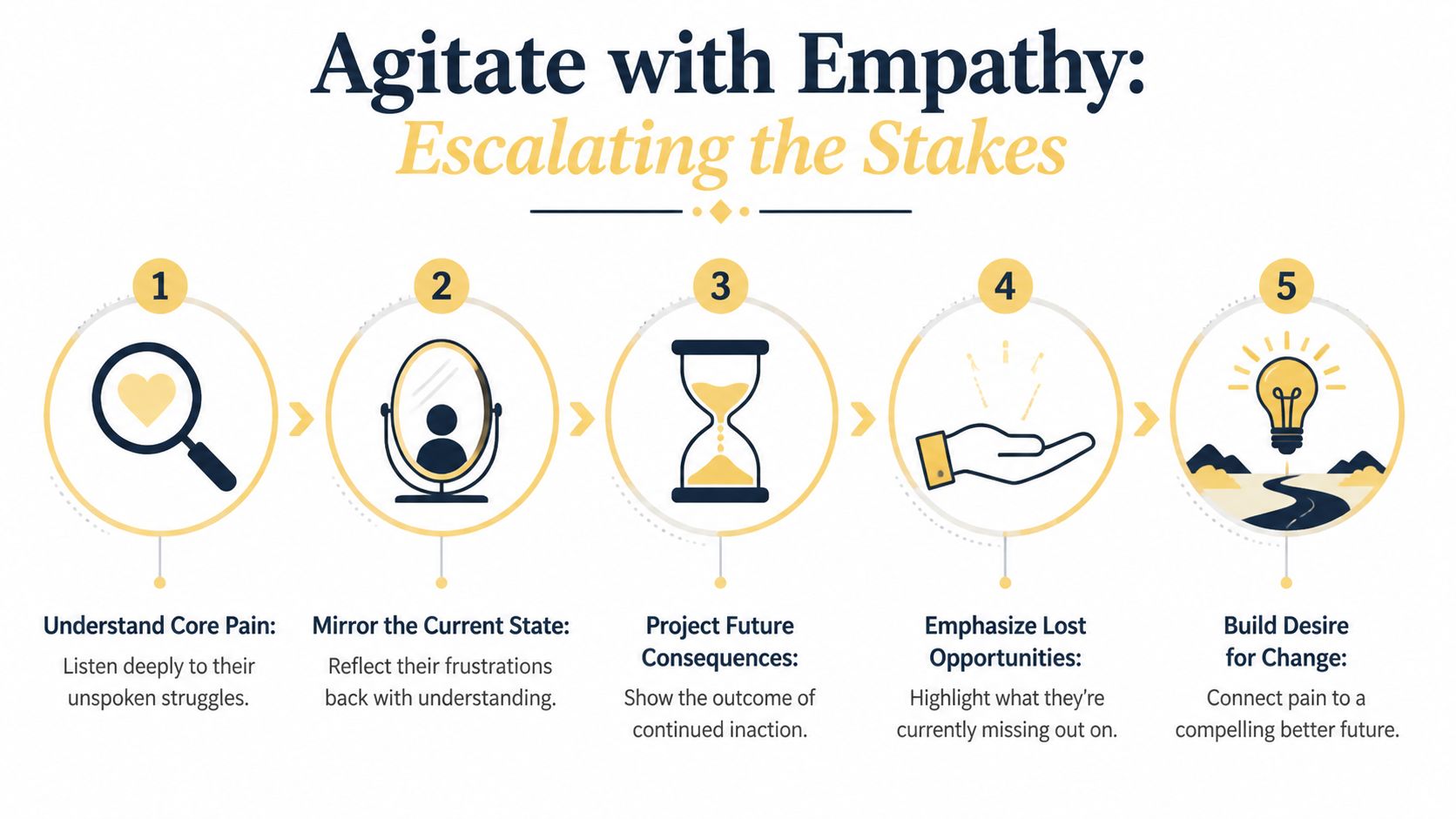
Escalation works when it follows a believable chain
Effective agitation in B2B coaching often moves from an immediate pain to a longer-term risk. That depth matters. According to Blaksheep Creative’s article on the problem agitate solution formula, pages that use this layered escalation saw 65% scroll completion versus 40% on others.
The reason is intuitive. Readers keep going when the copy unfolds. It doesn’t just state a problem. It shows where that problem leads.
A clean escalation sequence looks like this:
| Level | What you name | Example |
|---|---|---|
| Immediate pain | What hurts now | “You’re spending too much energy chasing follow-up.” |
| Operational consequence | What breaks next | “Clients lose momentum between sessions.” |
| Identity consequence | What it starts to mean | “You begin questioning whether your process is strong enough.” |
| Long-term risk | What keeps compounding | “Renewals drop, referrals slow, and growth becomes unpredictable.” |
Phrases that agitate without sounding aggressive
Here are lines that work well because they stay grounded in the reader’s experience:
- For life coaches: “It’s not just that you feel stuck. It’s that you’re starting not to trust your own promises.”
- For executive coaches: “The issue isn't one hard conversation. It’s the pattern of avoiding them, then paying for that silence later.”
- For corporate L&D buyers: “A coaching initiative can look good on paper and still fade if managers don't reinforce it.”
Notice the structure. Each line starts with the obvious problem, then reveals the deeper cost.
Try these sentence starters:
“At first, this looks like…”
Good for naming the surface issue before deepening it.“But what it creates over time is…”
Good for linking present pain to future impact.“The part people rarely say out loud is…”
Good for surfacing the hidden emotional layer.“If this continues, it doesn't stay contained to…”
Good for showing ripple effects.
The strongest agitation often sounds like relief, because the prospect finally feels understood at full depth.
Three examples from different coaching contexts
Life coach example
Problem: “You keep postponing the changes you say matter.”
Agitation: “So every month starts with intention and ends with the same private disappointment. It gets harder to believe yourself, and that erosion follows you into decisions that have nothing to do with goals.”
Executive coach example
Problem: “You’re carrying leadership pressure alone.”
Agitation: “That isolation changes how you lead. You delay feedback, overthink meetings, and compensate by working longer. From the outside, you still look capable. Internally, the cost keeps rising.”
Corporate L&D example
Problem: “Your coaching program isn't sticking.”
Agitation: “Participants attend sessions, but without visible reinforcement and follow-through, progress stays scattered. Then the program gets judged as a soft initiative instead of a performance tool.”
What doesn't work
Avoid these mistakes:
- Overdramatizing: If every line sounds catastrophic, readers stop trusting you.
- Repeating the same pain in different words: Escalation needs progression, not echo.
- Using abstract language: “Misalignment,” “limiting beliefs,” and “blocked energy” may fit some brands, but they often weaken urgency.
- Agitating without a bridge: If the prospect feels exposed but not guided, the copy feels cruel.
Keep your tone steady. The goal is not to make them feel worse. The goal is to help them see more clearly why change matters now.
Positioning Your Coaching as the Inevitable Solution
After strong agitation, the wrong move is a jarring pivot into pitch mode. “That’s why I offer a twelve-week container with worksheets, Voxer support, and six bonus trainings” is not a satisfying resolution. It feels like a brochure interrupting a confession.
The solution should feel like the natural answer to the problem you’ve just clarified.

The bridge is logic plus relief
When coaches agitate around client churn, then present concrete solutions like automated reminders and progress tracking, retention gains can reach 35%, as noted earlier in the source material from Target Internet. The lesson isn't “mention software.” The lesson is “make the fix tangible.”
Your prospect wants to know three things:
- Does this solution match the problem you just described?
- Can I picture how it works?
- Will this help me become the version of myself your copy just made me want?
Translate features into outcomes the buyer can feel
Weak solution copy lists deliverables.
Strong solution copy interprets them.
Compare these:
- Feature-first: “You’ll get weekly calls, messaging support, and a customized plan.”
- Transformation-first: “You’ll stop carrying this alone. Each week, we’ll turn vague pressure into clear decisions, visible progress, and accountability that doesn’t collapse after motivation fades.”
For a life coach, that might sound like: “Instead of repeating the same promises every Monday, you’ll build a structure that makes follow-through feel normal again.”
For an executive coach: “You won’t just prepare for difficult conversations. You’ll practice a repeatable way to lead them with steadiness.”
For an L&D buyer: “This won't sit beside the business. It will connect coaching goals to visible behavioral progress managers can reinforce.”
Offer test: If your solution paragraph could be copied into another coach’s sales page with only minor edits, it isn't inevitable enough yet.
Make the path visible
A good solution lowers uncertainty. It doesn't reveal every detail, but it shows a believable route.
Use this sequence:
- Re-state the core pain in plain language
- Name the mechanism of change
- Describe the immediate felt shift
- Tie it to a larger transformation
Example:
“You don't need more insight without follow-through. You need a structure that catches the moment you usually drift. Through focused sessions, between-session accountability, and clear progress markers, coaching becomes more than reflection. It becomes a way to rebuild consistency.”
If you're creating your own online presence, the page itself should reinforce this clarity. A polished site helps the solution feel organized and credible, especially when the copy and structure support each other. If you need the infrastructure piece, you can build a coaching website around the transformation you’re promising instead of around a generic services list.
The key is this: the reader shouldn't feel sold to. They should feel that staying where they are now makes less sense than moving forward with you.
Sector-Specific Examples and Mistakes to Avoid
Theory gets easier when you can see the pattern side by side. The wording changes by niche, but the engine stays the same. Name the friction, deepen the consequence, then present a solution that directly resolves that specific pain.
Agitate and Solve Examples by Coaching Niche
| Coaching Niche | Agitated Pain Point | Solution Snippet |
|---|---|---|
| Life coaching | “You’re not just procrastinating. You’re teaching yourself that your own commitments don't hold weight.” | “Our work rebuilds self-trust through small, visible follow-through that compounds.” |
| Executive coaching | “The issue isn't workload alone. It’s that pressure is narrowing your judgment, and your team is starting to work around your hesitation.” | “Coaching gives you a place to think clearly, make cleaner decisions, and lead difficult moments without avoidance.” |
| Corporate L&D | “The program isn't failing loudly. It’s fading quietly because coaching conversations aren't translating into daily management behavior.” | “The solution is a coaching system tied to visible goals, manager reinforcement, and consistent follow-through.” |
If you want to study how specific outcomes are framed in a trust-building way, it helps to browse 1 on 1 macro coaching results. Not to copy the wording, but to notice how concrete language reduces skepticism.
Mistakes that weaken agitate and solve
The most common failure isn't being too bold. It's being too generic, then compensating by becoming too intense.
Watch for these:
- You agitate the wrong pain: The prospect says “time management,” but the underlying issue is shame, inconsistency, or leadership avoidance.
- You overuse dramatic language: If every sentence sounds urgent, none of them feel true.
- You offer a detached solution: The copy describes a painful problem, then presents a package that feels generic.
- You confuse empathy with vagueness: Gentle language isn't always kind. Sometimes it's evasive.
- You skip examples: Prospects trust what they can picture.
A quick self-edit helps. Read your copy and ask:
- Would my ideal client say, “Yes, that’s me” by the second paragraph?
- Does each agitation line add a new layer of consequence?
- Does the solution answer the exact pain I built?
- Have I written at least one sentence that sounds like my buyer’s private thoughts?
That final question matters more than most coaches realize. People buy when they feel recognized, not when they feel impressed.
Coachful gives coaches one place to run the work behind the promise, from onboarding and scheduling to payments, reminders, progress tracking, cohorts, and client accountability. If you want your marketing to make a stronger promise and your delivery to back it up, explore Coachful.