
Find Your Ideal Model of Coaching Guide

Coachful

You know the feeling. A session ends, the client says it was helpful, and yet a quiet question follows you into the rest of the day: Was that coaching, or was that just a good conversation?
Most coaches hit this point. Early on, instinct carries you. You listen well, ask thoughtful questions, and clients often leave with insight. But over time, intuition alone starts to show its limits. Some sessions move fast. Others drift. One client leaves with a concrete plan, another leaves with a vague sense of motivation, and you can't always explain why.
That is where a model of coaching stops being academic language and starts becoming professional infrastructure. A model gives you a repeatable way to create clarity, movement, and accountability without flattening the humanity out of the work. It helps you coach on purpose instead of hoping a conversation lands somewhere useful.
Beyond Just Talking Why Every Coach Needs a Model
A lot of coaches resist structure because they associate structure with stiffness. They worry that if they use a model, they'll sound scripted or lose the natural flow that makes coaching feel alive.
In practice, the opposite is usually true.
When you don't have a model, your brain is doing too many jobs at once. You're tracking rapport, listening for emotion, spotting patterns, deciding what question to ask next, and trying to remember what happened last session. That's when sessions become loose, repetitive, or over-reliant on charisma. The coach works harder, not better.
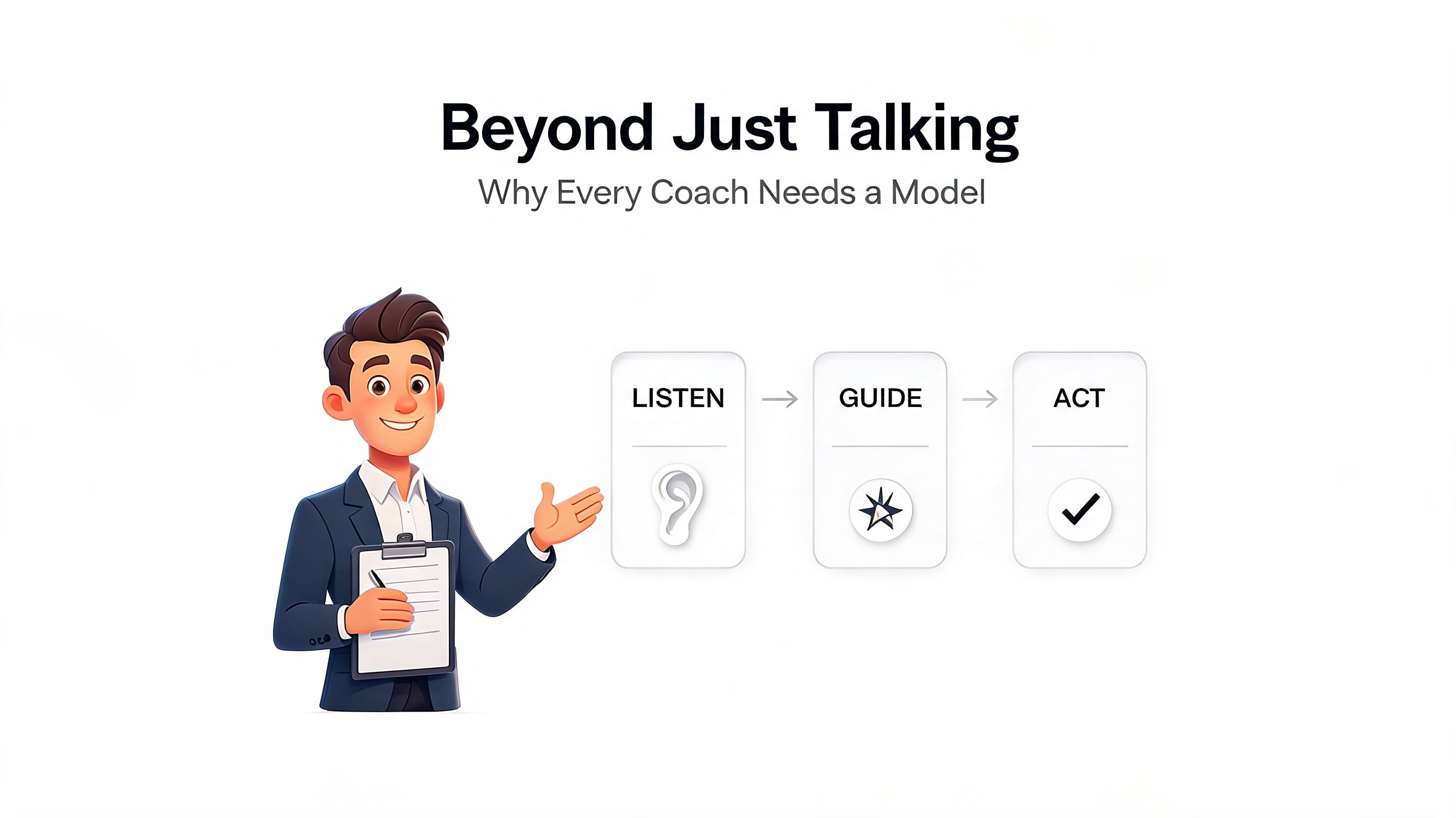
Structure creates freedom
A coaching model gives you a sequence for thinking. It doesn't tell you what personality to have. It tells you what kind of work needs to happen in the conversation.
That matters because clients rarely need more discussion. They need progression.
Here is the practical difference between an unstructured session and a structured one:
- Unstructured coaching: The session follows energy. If the client is emotional, the session stays emotional. If they're analytical, the session becomes analysis. Good rapport, uneven outcomes.
- Structured coaching: The session still allows emotion and nuance, but it moves through defined stages such as clarifying the goal, examining the current reality, surfacing options, and securing commitment.
Practical rule: If you can't explain why you asked your last five questions, you need a stronger model.
The business case is hard to ignore. Structured coaching models deliver dramatically superior ROI compared to unstructured approaches. Research shows that 86% of companies report positive ROI from coaching programs when structured models are used, compared to just 23% for unstructured coaching approaches, according to Cody Thomas Rounds' guide to workplace coaching frameworks.
What changes when you stop winging it
A good model does three things at once:
- It reduces drift so sessions don't become thoughtful circles.
- It improves consistency so clients know what progress feels like.
- It protects coach energy because you stop reinventing your process every hour.
That last point matters more than many coaches admit. Burnout often doesn't come from caring too much. It comes from carrying too much cognitive load in every session.
Clients can feel the difference, too. When the coach has a method, they relax. They don't have to wonder whether today's conversation will produce anything usable. They can engage the process.
And if you're building a real practice, not just having occasional breakthrough conversations, that's the shift. A model is not a cage. It's your operating system.
What a Coaching Model Really Is and Is Not
Think of a coaching model the way a chef thinks about a recipe. The recipe doesn't replace the chef's judgment. It doesn't decide how to plate the dish, how to respond to a missing ingredient, or how to adjust for the person sitting at the table. It provides order, proportion, and sequence so quality doesn't depend on improvisation alone.
A model of coaching works the same way. It gives you a process for moving a client from where they are to where they want to go. It doesn't replace your presence, intuition, or relational skill. It gives those strengths somewhere to land.
A model is a framework, not a script
Many coaches get tangled at this point. They treat model, technique, and style as if they mean the same thing. They don't.
Here is the clean distinction:
| Term | What it means | Example |
|---|---|---|
| Model | The structure of the coaching conversation or journey | GROW, SOAR, CLEAR |
| Technique | A specific tool or intervention used inside the process | Active listening, scaling questions, reframing |
| Style | Your personal way of showing up as a coach | Calm, challenging, warm, direct, reflective |
If you blur those categories, you'll either become too loose or too rigid. A coach who mistakes technique for model often collects clever questions but lacks progression. A coach who mistakes model for script starts sounding mechanical.
A strong model tells you where the conversation is going. Your style determines how the client experiences the ride.
Why this matters now
The coaching field is too mature for vague process. The global coaching industry is projected to grow to $5.8 billion in 2026, with approximately 122,974 professional coaches operating worldwide, according to Luisa Zhou's coaching industry statistics roundup. As the field professionalizes, clients and organizations expect a method they can understand, trust, and repeat.
That doesn't mean every coach should use the same framework. It means serious coaches should be able to name their framework and explain why they use it.
What a model does not do
A coaching model does not:
- Replace listening: If you hide behind a sequence and stop hearing the person, the model becomes a shield.
- Guarantee transformation: A framework can hold a process. It can't force readiness, honesty, or action.
- Eliminate adaptation: Different clients need different pacing, emphasis, and depth.
For example, a client who arrives highly motivated but scattered may need more time on goal definition. Another who already knows the goal but keeps sabotaging follow-through may need deeper work on obstacles, beliefs, and commitment.
The model helps you make those calls with discipline.
The best test
Ask yourself two questions after a session:
- Could I map what happened?
- Could I repeat what worked with another client in a relevant way?
If the answer is no, your work may still be valuable, but it isn't yet systematized. And until it's systematized, it's hard to scale, hard to teach, and hard to improve deliberately.
That's the core promise of a coaching model. Not rigidity. Reliability.
Comparing the Most Effective Coaching Models
Once coaches accept that they need structure, the next question arrives fast: Which model of coaching should I use?
The wrong answer is the one that looks smartest on paper. The right answer is the one that fits the type of change your client needs to make.
Some models are built for clarity and forward motion. Others are better when the client needs confidence, perspective, or relational processing. You don't need twenty frameworks memorized. You need a few that you can apply cleanly.
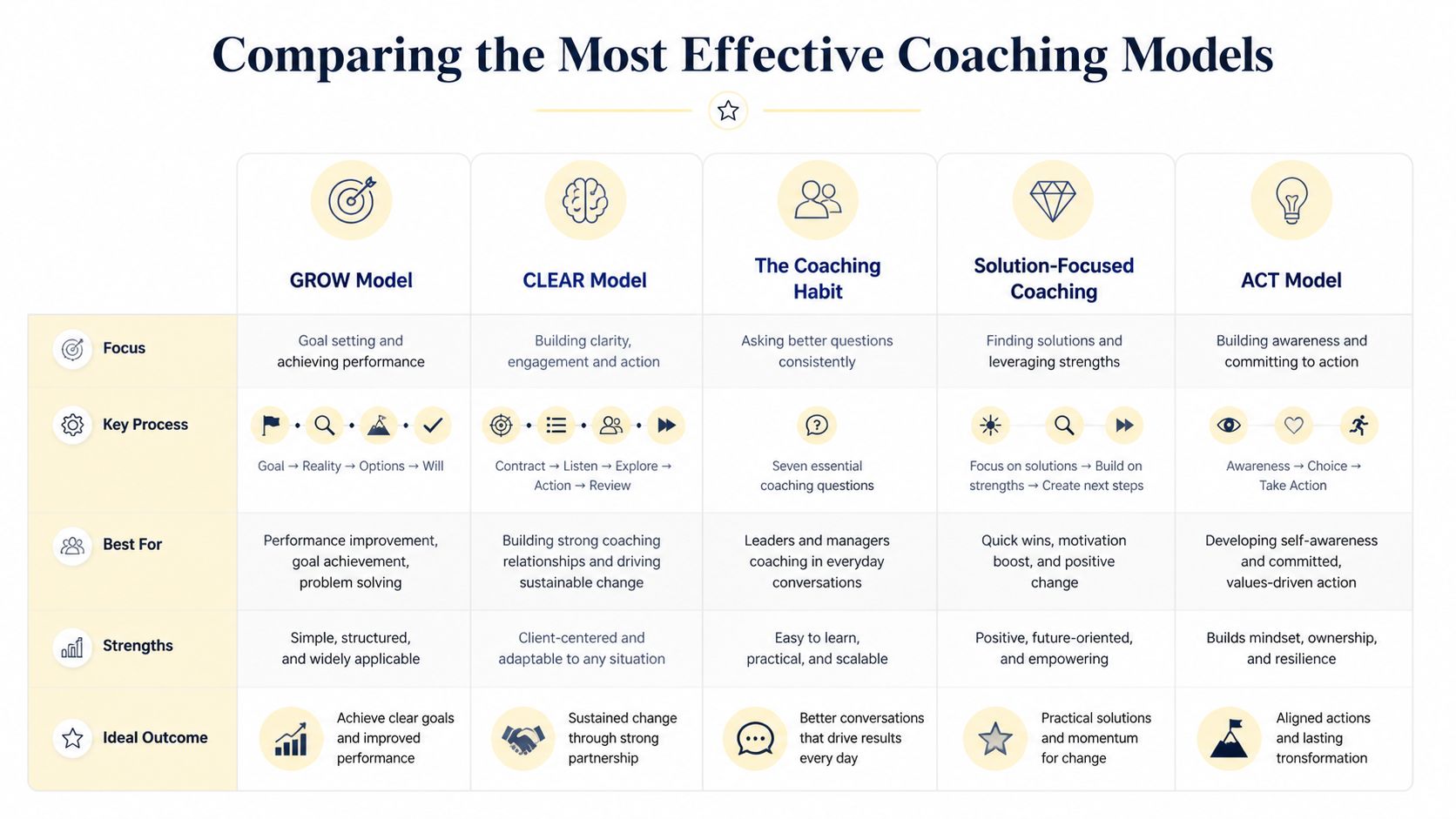
The three most practical starting points
The models below show up repeatedly because each solves a different coaching problem.
| Model | Stands For | Core Philosophy | Best For |
|---|---|---|---|
| GROW | Goal, Reality, Options, Will | Progress comes from clarifying the outcome, examining the current situation, generating choices, and committing to action | Clients who feel stuck, need direction, or want a clear action path |
| SOAR | Strengths, Opportunities, Aspirations, Results | Change is more sustainable when it starts from strengths and possibility rather than deficit and correction | Clients who feel discouraged, underconfident, or energized by positive framing |
| CLEAR | Contract, Listen, Explore, Action, Review | Coaching works best when expectations, reflection, and accountability are explicit throughout the relationship | Complex situations, leadership coaching, or clients managing multiple stakeholders |
GROW when the client needs traction
GROW is popular for a reason. It's clean, memorable, and practical. If a client comes in saying, "I know something needs to change, but I can't get moving," GROW gives the session shape quickly.
Use it when the client needs to answer questions like:
- What do I want?
- What is happening?
- What are my real options?
- What will I do next?
A mid-level manager preparing for promotion is a classic GROW client. They often need clarity, not therapy. If the conversation drifts into endless analysis, GROW pulls it back toward decision and action.
The trade-off is that GROW can become too linear in the hands of a coach who rushes. If you move to options before the client has really named the reality, you get shallow action plans.
SOAR when the client is tired of being fixed
SOAR changes the emotional tone of coaching. Instead of starting with what's broken, it starts with what's already working, what opportunities exist, what the client aspires to, and what results matter.
That makes it especially useful in moments when clients feel diminished by constant evaluation. A founder after a rough quarter, a team lead recovering from conflict, or a professional questioning their own capability may respond better to strength-based inquiry than to gap analysis.
This model often releases energy fast. The client remembers resources they had stopped seeing.
The trade-off is subtle. If you use SOAR with a client who is avoiding hard reality, it can become inspirational without being corrective. A strengths-based frame still needs honesty.
When a client is depleted, possibility can be more useful than pressure. But possibility without consequence doesn't hold.
CLEAR when the work is relational and layered
CLEAR is often the better choice when the coaching challenge isn't just individual execution. It works well in leadership, team dynamics, and settings where expectations, context, and reflection all matter.
Its sequence creates room for contracting and review, which many coaches underuse. That matters when you're working with a department head, an executive, or a people manager who has to manage politics, history, and accountability in public view.
Examples where CLEAR often fits better than GROW:
- A leader managing conflict across teams
- A coach working inside an HR or L&D program
- A client with repeated patterns who needs more reflection and review, not just another action list
Its trade-off is time. CLEAR usually asks for more patience from both coach and client. If someone needs a tight, action-oriented conversation on a single issue, it may feel heavier than necessary.
How to choose in live practice
If you're deciding in real time, use this simple lens:
- Choose GROW when the client needs movement.
- Choose SOAR when the client needs confidence and resource activation.
- Choose CLEAR when the client needs containment for a more complex situation.
Another useful test is to listen for the client's opening language.
If they say, "I need to figure out what to do," start thinking GROW.
If they say, "I've lost sight of what I'm good at," SOAR may serve them better.
If they say, "There are a lot of people involved and I keep repeating the same pattern," CLEAR often gives you stronger footing.
No model is universally superior. A skilled coach doesn't marry the framework. The coach matches the framework to the job.
A Coaching Session in Action The GROW Model Step-by-Step
Theory matters. But most coaches don't get confident until they can hear the session in their heads.
So take a realistic scenario. A client, Maya, is a capable team lead. She says she wants to become more strategic at work, but her weeks disappear into reactive tasks, and she keeps postponing the higher-level work that would make her visible for promotion.
This is good GROW territory. There is a clear aspiration, a practical bottleneck, and likely enough agency to move.
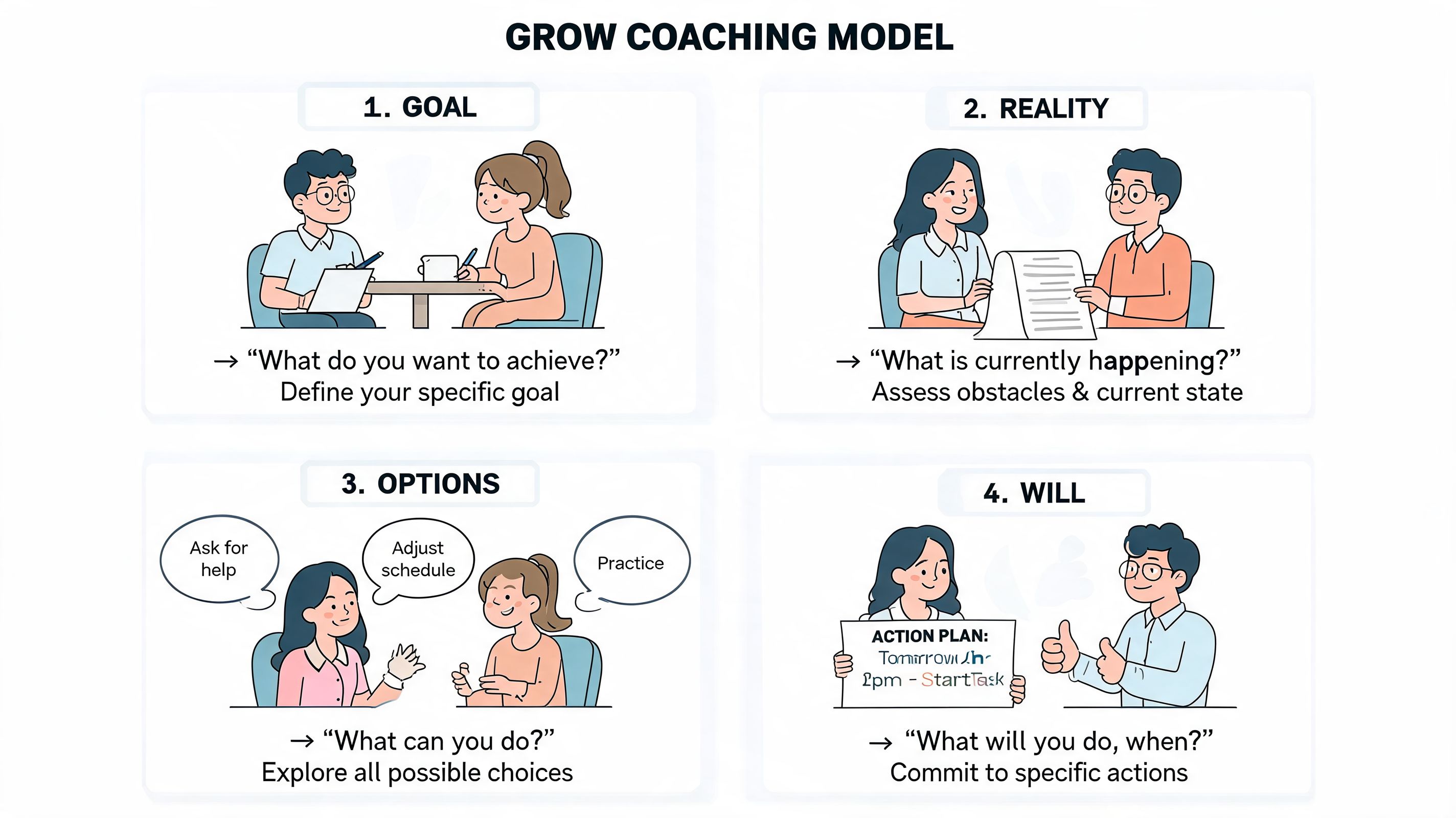
Goal
A weak start sounds like this: "So, what do you want to work on today?"
A better GROW start narrows the field without taking control away.
You might ask:
- What would make this conversation valuable by the end?
- If this issue improved, what would be different in your work week?
- What are you aiming for specifically, not generally?
Maya says, "I want to be seen as more strategic, not just reliable."
That is still broad. So the coach helps her sharpen it.
"How would you recognize progress in that?"
Now Maya gets more concrete: "In the next month, I want to lead one planning conversation instead of just executing everyone else's plan."
That is the point. The goal becomes visible enough to coach.
Reality
Now the coach resists the temptation to solve. At this juncture, newer coaches often rush. They hear the issue and start offering productivity advice.
Instead, they explore what is true.
Questions might include:
- What's happening now that keeps this from occurring?
- When does the week usually go off course?
- What are you saying yes to that pulls you away from strategic work?
- What assumptions are you making about your role?
Maya says she spends most days firefighting because people come to her for answers. She also admits she hasn't asked to lead planning because she assumes her director already sees her as operational, not strategic.
This is useful. The problem isn't just calendar management. It is role behavior and self-positioning.
The reality stage isn't there to collect complaints. It's there to separate facts, habits, assumptions, and constraints.
A skilled coach listens for all four.
Options
Once the situation is clear enough, the coach opens possibility without collapsing into advice. In this context, Socratic questioning matters. According to Simplifaster's piece on learning-based technical coaching, effective coaching integrates verbal instruction, visual demonstration, and Socratic questioning, helping clients internalize concepts and build autonomy.
That principle is easy to apply here. The coach can stay in dialogue, then add a visual planning prompt or shared framework if needed.
For Maya, options might sound like:
- What are three ways you could create strategic visibility without waiting for permission?
- If you kept supporting the team but changed one pattern, what would it be?
- Where do you already have influence that you haven't used?
- What would someone more strategic than reactive do in your position?
Maya identifies several options:
- Block one hour each week for planning before team requests flood in.
- Bring a proposed agenda to the next planning meeting instead of attending passively.
- Redirect repeat operational questions back to team members with guidance instead of solving them herself.
- Ask her director if she can facilitate part of the next monthly review.
Notice that the coach doesn't evaluate too quickly. The aim is range before selection.
Sometimes a digital whiteboard, note template, or shared action document helps. Some clients think better when they can see their options listed. Others need to hear themselves say the ideas aloud. Coaches who are mastering communication skills in coaching learn to match the format to how the client processes.
Will
Coaching stops being elegant and becomes useful.
The coach now moves from possibility to commitment:
- Which option will you take?
- What will you do first?
- When, specifically?
- What could interfere?
- How will you handle that when it happens?
Maya decides on two commitments. She will send her director a message by Thursday offering to facilitate one portion of the monthly review. She will also create a recurring planning block on Monday mornings and protect it unless there is a true emergency.
Then the coach tests commitment.
"On a practical level, how likely are you to follow through?"
Maya hesitates on the calendar block. She knows people will interrupt it. That reveals the underlying issue. She doesn't yet trust herself to defend strategic time.
So the coach asks one more question: "What boundary will make the calendar block real?"
Maya decides she will mark the hour as unavailable and tell her team she is using that time for forward planning.
That is a good coaching moment. The action got stronger because the coach stayed with the commitment long enough to make it credible.
What this sounds like in a strong session
A strong GROW session usually has these signs:
- The goal becomes specific enough to observe.
- Reality includes behavior and assumptions, not just circumstances.
- Options come from the client first, even if the coach later contributes structure.
- Will turns into scheduled action, not abstract intention.
And yes, sometimes the coach adds tools beyond questions. A visual workflow, a reflection prompt, or a short demonstration can help the client integrate the learning. The point isn't to remain verbally pure. The point is to help the client internalize and act.
Integrating Coaching Models Into Your Practice with Coachful
A coaching model in your notebook is useful. A coaching model built into your operating system is much more powerful.
Many good coaches frequently get stuck. They know how they want to coach, but their process lives in scattered notes, memory, inbox threads, and whatever they happen to remember before the next call. That makes consistency hard. It also makes measurement almost impossible.
Turn stages into visible client journeys
Take a model like GROW. Each stage maps naturally into platform-based workflow.
- Goal: Create a defined outcome and milestone structure so the client can see what they're working toward.
- Reality: Capture session notes that separate observations, constraints, beliefs, and current behaviors.
- Options: Store action ideas, reflection prompts, and relevant resources in one shared place.
- Will: Assign next steps, deadlines, and accountability check-ins between sessions.
That sounds simple because it is. The mistake is keeping those steps informal.
When the process is visible, clients engage differently. They stop experiencing coaching as a series of conversations and start experiencing it as a guided progression.
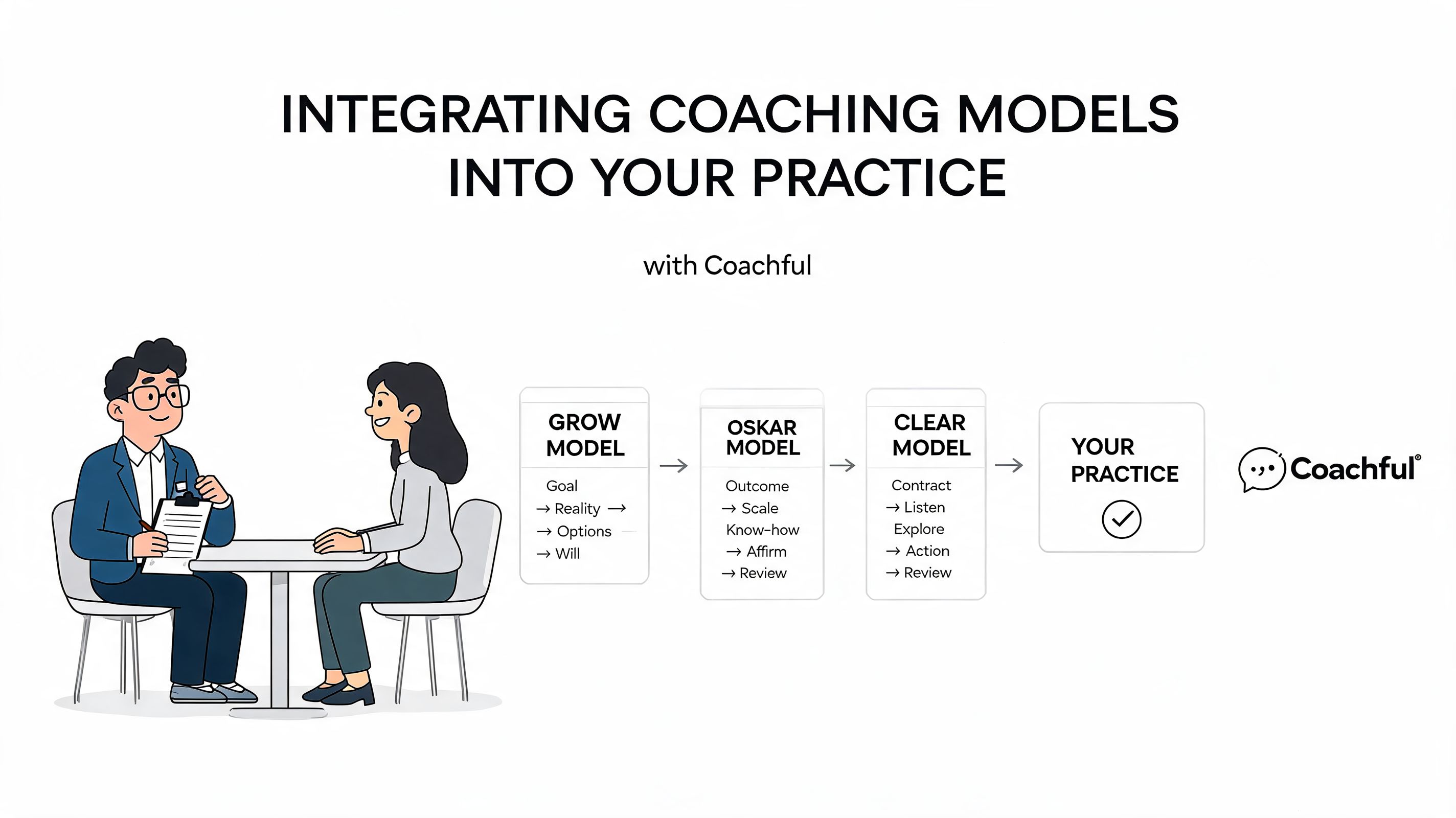
Measure what changed, not just what was discussed
A coaching model shouldn't only organize the session. It should make outcomes trackable.
According to Personio's explanation of coaching models and measurement, effective coaching models are validated by tracking both outcome metrics and activity metrics, and dashboards should connect performance data with specific coaching conversations. That distinction matters.
If you're coaching a sales leader, the outcome might be team quota performance, but the activity layer could include whether they are holding regular one-to-ones, delegating differently, or completing agreed development actions. If you're coaching an independent professional, the outcome might be career transition progress, while the activity layer could include outreach behavior, application consistency, or decision deadlines met.
If you only track outcomes, you may miss whether the client is changing behavior. If you only track activity, you may confuse motion with progress.
What this looks like in real practice
A platform-supported process helps with the parts coaches often under-manage:
| Coaching need | Platform expression |
|---|---|
| Consistency | Reusable session templates by model |
| Accountability | Assigned actions, due dates, reminders |
| Reflection | Shared notes and between-session prompts |
| Resource delivery | Central library of tools, worksheets, videos |
| Evidence of progress | Dashboards showing behavior and outcome trends |
This matters even more if your coaching connects to organizational goals. Teams using expert OKR coaching often discover that goal-setting only works when reflection, accountability, and progress review are built into the rhythm of work. The same principle applies to broader coaching engagements.
For solo practitioners, schools, and internal coaching teams, the operational upside is obvious. Less admin friction. Better continuity. Cleaner handoffs. More confidence that your chosen model is being delivered the way you designed it.
If you want to see what that kind of system looks like in practice, coachful is built around the workflows coaches typically try to patch together with separate tools.
Elevating Your Coaching Beyond Standard Frameworks
Once a coach gets competent with a core model, a deeper question appears: what do you do when the client's issue isn't only about goals, decisions, or performance?
Because eventually, every serious coach runs into the whole person.
A client says they want better execution, but they're exhausted. Another says they need stronger leadership presence, but they're carrying anxiety they can barely name. A high performer asks for accountability, yet their pattern is driven by fear, overextension, or isolation. If the coach only knows how to move from goal to action, important signals get missed.
Performance isn't the whole brief
A mature model of coaching leaves room for well-being without turning every session into therapy. That distinction matters.
You are still coaching. You are still working toward goals. But you're no longer pretending that health, safety, resilience, and emotional steadiness are separate from sustained performance.
That shift reflects what the field is learning. Million Coaches' discussion of coaching frameworks and wellbeing argues that frameworks ignoring whole-person needs can miss important well-being signals, while models that explicitly prioritize health and safety create safer and more consistent coaching experiences.
How advanced coaches adapt standard models
You don't need to throw away GROW, SOAR, or CLEAR. You need to deepen how you use them.
For example:
- In GROW, expand the reality stage. Don't only ask what is happening externally. Ask what the current pattern is costing the client physically, emotionally, or relationally.
- In SOAR, examine strengths with care. A so-called strength may be overused. Reliability can turn into over-functioning. Ambition can become chronic self-pressure.
- In CLEAR, review for sustainability. Don't just review whether the action happened. Review how the client experienced the action and whether the pace is supportable.
Strong coaching doesn't only ask, "Can you do this?" It also asks, "What will this require from you, and is that requirement sustainable?"
Signals coaches should not ignore
A performance-focused coach can still listen for well-being clues. Watch for patterns like these:
- Chronic urgency: The client treats every task as equally immediate.
- Flat affect or detachment: They describe meaningful goals with no emotional connection.
- Repeated self-betrayal: They commit, overcommit, then disappear into shame.
- Narrow identity: Their worth appears tied to output alone.
Those moments don't mean you abandon your model. They mean you use it with more range.
A standard question like "What's getting in the way?" can become "What internal state tends to show up before this pattern repeats?" A question like "What will you commit to?" may need to become "What level of commitment is ambitious but still responsible?"
That is advanced work. Not because it's complicated, but because it requires restraint, sensitivity, and precision.
Mastery is adaptive, not decorative
Many coaches think mastery means collecting more frameworks. Usually it means using a few frameworks more intelligently.
The best coaches adapt the model to the human in front of them. They know when to challenge and when to regulate pace. They know when accountability is useful and when the client first needs steadiness. They know how to pursue results without treating the person as a machine for producing them.
That is what takes a model from competent to masterful.
Choosing Your First Model and Making It Your Own
If you're still hesitating, keep it simple. Don't try to pick the perfect model for the rest of your career. Pick one strong model for the next month.
That is enough to change how you coach.
Start with the model that fits the kind of client work you do most often. If your clients need clarity and forward movement, begin with GROW. If they often arrive discouraged or stuck in deficit thinking, start with SOAR. If your work is layered, relational, or organizational, begin with CLEAR.
A practical way to begin
Use this approach:
- Choose one model and use it deliberately for a defined period.
- Create a short session template so you don't rely on memory.
- Review your sessions afterward and ask where the model helped and where you forced it.
- Adjust your language, not the spine of the model so it starts to sound like you.
That last part matters. You are not trying to become a robotic practitioner of someone else's framework. You are trying to internalize a structure sufficiently that it supports your presence instead of competing with it.
If you want help identifying the approach that fits your natural way of working, Coachful's style assessment is a useful starting point.
The best model of coaching is not the one you admire from afar. It's the one you can deliver cleanly, consistently, and with enough flexibility to serve the actual person in front of you.
If you're ready to turn your coaching model into a structured client experience with goals, notes, accountability, and progress tracking in one place, explore Coachful.