10 Essential Characteristics of a Good Coach That Drive Real Results in 2026

Coachful
You've mastered your coaching framework. You show up for every session, prepared and professional. Yet, you might have that nagging question: 'Am I really making a difference? Why do some clients have breakthroughs while others seem to stay stuck?' The answer rarely lies in another certification or a slicker website. It’s found in the core characteristics you embody. Great coaching isn't about dispensing perfect advice; it's about creating the precise conditions for a client’s own profound insights.
Delving deeper than mere tactics, what truly separates a good coach from a great one lies in a refined set of skills. For leaders, mastering these essential coaching skills for leaders can transform their influence and impact. This article moves beyond generic lists to provide a detailed look at the 10 essential characteristics of a good coach. We'll get inside your head, addressing the common doubts and questions you face daily.
You will receive actionable ways to assess and cultivate these critical traits. This guide is designed to help you move from being a knowledgeable expert to a genuinely powerful, transformational partner for every client you serve. Let's explore the qualities that define coaching excellence.
1. Active Listening
Among all the characteristics of a good coach, active listening is the cornerstone upon which trust and client transformation are built. It's the disciplined practice of fully concentrating on what a client is saying, understanding the explicit and implicit messages, and reflecting that understanding back with empathy. This skill goes far beyond simply hearing words; it involves deciphering tone, observing non-verbal cues, and sensing the emotional undercurrent to grasp what clients truly need, even when they struggle to articulate it themselves.

True active listening creates a secure space where clients feel seen and valued, allowing for deeper vulnerability and honesty. When a coach demonstrates they are genuinely present, clients are more willing to explore challenging topics, leading to significant breakthroughs.
How Active Listening Works in a Session
A coach practicing active listening isn't just waiting for their turn to speak. They are mentally quieting their own assumptions and judgments to make room for the client's full experience.
- Executive Coach: After a client vents about a project's failure, the coach pauses before reflecting, "It sounds like the missed deadline is frustrating, but I'm hearing a deeper concern about your team feeling disengaged. Is that accurate?" This shifts the focus from a symptom to a root cause.
- Life Coach: The coach notices a client's voice gets quiet when discussing a new relationship. Instead of moving on, they gently probe: "I noticed a change in your energy when you mentioned David. What came up for you in that moment?"
How to Develop Active Listening Skills
Improving this skill requires conscious effort and consistent practice. It's about training yourself to listen for what is not being said as much as what is.
Coach's Inner Dialogue: "Am I just hearing the problem, or am I sensing the feeling behind it? I have a great idea for how they can fix this, but hold on. My job isn't to fix it; it's to listen. Did I just assume I knew what they meant, or did I ask a clarifying question to be sure?"
Actionable Tips:
- Practice the 70/30 Rule: Aim for your client to speak 70% of the time. If you find yourself dominating the conversation, consciously pull back.
- Document Key Phrases: Use your session notes in Coachful to write down the client's exact words. Referring back to their specific language ("You mentioned feeling 'stuck in the mud'...") shows you've been paying close attention.
- Use Reflective Statements: Start sentences with "What I'm hearing is..." or "It sounds like you feel..." to confirm your understanding and give the client a chance to correct you.
- Schedule Buffer Time: Avoid back-to-back sessions. Give yourself 15 minutes to mentally reset so you can offer your full, undivided attention to the next client.
2. Clear Goal Setting and Accountability
Another key characteristic of a good coach is the ability to transform a client's abstract desires into concrete action plans. Effective coaches guide clients in defining specific, measurable, achievable, relevant, and time-bound (SMART) goals. Just as crucial is establishing accountability structures that convert these intentions into real-world progress. This system bridges the gap between sessions, ensuring clients stay motivated and on track.
Accountability is the engine of change; clients who know their progress is being monitored are far more likely to follow through on their commitments. This process turns vague aspirations into a clear roadmap with measurable milestones.
How Goal Setting and Accountability Work in a Session
A coach doesn't just ask, "What do you want?" They co-create a detailed blueprint for success, breaking down overwhelming ambitions into manageable steps and clarifying what achievement looks like.
- Business Coach: A client says, "I want to grow revenue." The coach presses for specifics, helping them define the goal as, "Increase monthly recurring revenue by 25% ($50K) within 12 months by expanding our enterprise contracts."
- Life Coach: A client wants to "get healthy." The coach helps them break this down into, "Commit to 3 workouts per week and one hour of meal prep on Sundays for the next 30 days." They then schedule a check-in to track progress.
How to Develop Goal Setting and Accountability Skills
Mastering this skill involves creating a system that is both structured and supportive. It’s about building momentum and celebrating small wins along the way to a larger objective.
Coach's Inner Dialogue: "Is this goal specific enough to be tracked? Or is it still too vague? How can I frame accountability as a form of support, not judgment, if they miss a target? I need to make sure this feels empowering, not like I'm their boss."
Actionable Tips:
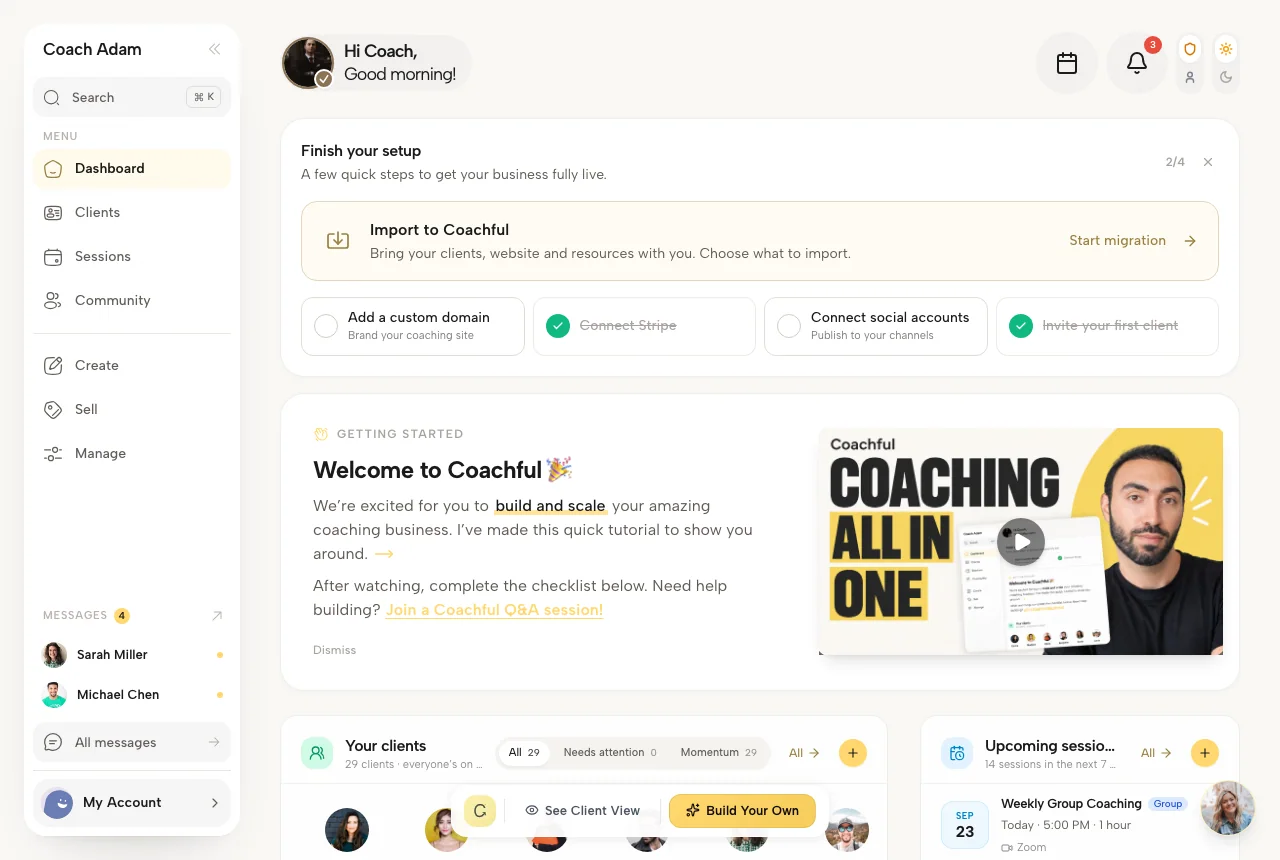
- Formalize the Plan: Use Coachful's goal-setting and milestone features to create a shared, visible plan. This ensures both coach and client are aligned on the objectives.
- Automate Check-ins: Schedule automatic reminders via Coachful to keep goals top-of-mind. A simple prompt can reignite a client's focus between sessions.
- Structure for Momentum: Create a 30-60-90 day goal structure. This balances immediate, achievable wins with the client's long-term vision.
- Frame Accountability as Support: When a client misses a mark, approach it with curiosity. Ask, "What got in the way?" instead of "Why didn't you do it?" This fosters trust and problem-solving.
3. Emotional Intelligence (EQ)
Emotional intelligence (EQ) is a critical characteristic of a good coach, representing the ability to recognize your own emotions and skillfully respond to your client's emotional state. Coaches with high EQ create psychological safety, navigate difficult conversations with grace, and adapt their approach based on the emotional context of a session. This capacity is often more predictive of coaching success than technical knowledge because it directly governs the quality and depth of the coaching relationship.

When a coach demonstrates EQ, they model emotional awareness for the client, helping them build their own capacity to understand and manage their feelings. This creates a space where challenging truths can be explored without judgment, leading to more profound and sustainable change.
How Emotional Intelligence Works in a Session
A coach with strong EQ uses their emotional awareness as a powerful tool. They can distinguish their own feelings from their client's, allowing them to remain a stable, supportive presence even when conversations become intense.
- Executive Coach: The coach notices a client's voice tighten when discussing a specific colleague. They pause the agenda and ask, "I sense some emotion there. What's that about?" This opens a dialogue about underlying relationship dynamics that are impacting performance.
- Life Coach: Recognizing their own frustration because a client is repeating the same self-sabotaging pattern, the coach takes a breath. Instead of reacting with judgment, they ask with genuine curiosity, "What do you notice about why this keeps happening?"
How to Develop Emotional Intelligence
Building EQ is an ongoing practice of self-awareness and intentional regulation. It requires tuning into both your inner world and the subtle cues of others.
Coach's Inner Dialogue: "My client seems shut down. Am I feeling impatient, or am I sensing their fear? Let me check my own feelings first so I can respond to theirs cleanly. I'm feeling a pull to 'fix' this for them, but my job is to sit with them in their discomfort."
Actionable Tips:
- Practice Self-Regulation: When you feel an emotional trigger (like frustration), take a silent, deep breath before you respond. This small pause can prevent a reactive comment.
- "Name It to Tame It": Actively help clients put a name to their feelings. Ask, "What emotion is underneath that thought?" This models emotional literacy.
- Reflect in Session Notes: Use Coachful’s notes to track emotional patterns, both yours and your client’s. Post-session, ask yourself: "When did I sense a shift? When did I feel disconnected?"
- Seek Supervision: Regularly engage in peer coaching or formal supervision to process challenging client dynamics and understand your own emotional reactions.
4. Powerful Questioning
While active listening builds the foundation, powerful questioning is the skill that erects the entire structure of client growth. It is the art of asking questions that shift perspective, unlock insight, and guide clients toward their own solutions rather than simply accepting advice. This characteristic of a good coach is crucial; it builds client capability, ownership, and sustainable change by putting them in the driver's seat of their own discovery.

These questions are open-ended, non-leading, and genuinely curious. They challenge assumptions and empower clients, demonstrating the coach's belief in their inherent resourcefulness. This moves the coaching relationship from telling to true partnership.
How Powerful Questioning Works in a Session
A coach using powerful questioning resists the urge to provide answers and instead crafts queries that create new possibilities for the client to explore. This requires knowing how to ask better questions to foster deeper insights.
- Executive Coach: Instead of saying, "Your communication style is ineffective," the coach asks: "How do you think your team perceived the feedback you gave in that meeting? What impact do you want to have?"
- Life Coach: A client is considering a major career pivot but feels stuck. The coach asks: "What would the version of you who has already made this transition successfully tell you right now?"
How to Develop Powerful Questioning Skills
Mastering this skill means shifting from problem-solver to thought-partner. It’s about creating space for the client's wisdom to emerge, not showcasing your own.
Coach's Inner Dialogue: "Am I asking a question to get information for myself, or to provoke new thinking for my client? Am I leading them to my answer, or clearing a path for them to find their own? I really want to just tell them what to do here, but that's not my role. What question would help them see the answer?"
Actionable Tips:
- Practice the 'Pause and Wait' Technique: Ask a deep question and become comfortable with 20-30 seconds of silence. This gives the client time to think.
- Use “What Else?”: After a client answers, a simple "Tell me more about that" or "What else?" can uncover a deeper layer of truth.
- Document Questions Mid-Session: In Coachful, jot down powerful questions that arise in your mind as the client speaks. You can deploy them at the perfect moment without interrupting the flow.
- Ask "What Would Need to Be True?": This question is excellent for uncovering and challenging limiting beliefs that hold a client back.
5. Presence and Authenticity
Presence and authenticity are characteristics of a good coach that create genuine human connection. Presence is the art of being fully engaged and available to the client in the moment, while authenticity is showing up as a real person, not hiding behind a professional mask. This combination builds psychological safety, allowing clients to be vulnerable and explore deeper issues. It also models the very authenticity clients often seek to develop in themselves.

When a coach is grounded and real, it gives the client permission to be the same. Clients can sense when a coach is distracted or just going through the motions, which can break trust and stall progress.
How Presence and Authenticity Work in a Session
A present and authentic coach isn't performing a role; they are a partner in the client's journey. They bring their whole self to the conversation while keeping the focus squarely on the client.
- Life Coach: The coach demonstrates presence by turning off notifications, making full eye contact, and noticing subtle shifts in the client's energy, which shows deep engagement.
- Executive Coach: Instead of pretending to have all the answers, the coach admits, "I also struggled with delegation early in my leadership journey. What I learned was..." This shares a relevant insight without making the session about their own story.
- Business Coach: When faced with an unfamiliar topic, the coach says, "I don't have deep expertise in that specific area, but here's what I'm curious about from a coaching perspective..." This models honesty and maintains trust.
How to Develop Presence and Authenticity
Building these skills means committing to self-awareness and mindful practices. It's about managing your own state so you can be fully available for your clients.
Coach's Inner Dialogue: "Am I fully here with this person, or is my mind on my next appointment? Am I showing up as my genuine self, or am I wearing my 'perfect coach' mask? Oops, I made a mistake. It's okay to admit that. It makes me more human and relatable."
Actionable Tips:
- Create Pre-Session Rituals: Take five minutes before each call to meditate, review client notes, or set a clear intention to arrive present and focused.
- Eliminate Distractions: Turn off all notifications and close unrelated browser tabs during your sessions to offer undivided attention.
- Schedule Buffer Time: Use Coachful's scheduling features to build in at least 15 minutes between sessions. This prevents you from feeling rushed and allows for a mental reset.
- Admit When You're Not Perfect: If you get distracted or misunderstand something, acknowledge it. Saying, "My apologies, I lost my focus for a moment. Could you repeat that?" humanizes you and repairs the connection.
6. Adaptability and Personalization
Among the key characteristics of a good coach, adaptability is what allows a great methodology to become a life-changing experience for a specific individual. Every client arrives with a unique blend of personality, learning style, and context. An effective coach recognizes this reality and adjusts their approach, rather than forcing a client into a rigid, one-size-fits-all framework. This flexibility means shifting techniques, varying between directive and non-directive styles, and personalizing the entire coaching journey.
True adaptability creates a partnership where the coaching process feels custom-built for the client, which dramatically increases engagement and results. When clients see that their coach is modifying the approach to fit their specific needs, they feel understood on a deeper level.
How Adaptability and Personalization Work in a Session
An adaptable coach is constantly gathering data on what is and isn't working, willing to pivot at a moment's notice. They treat their toolkit of frameworks not as a script, but as a palette from which to paint a unique picture for each client.
- Executive Coach: When working with a data-driven CFO, the coach provides metrics dashboards and tracks outcomes quantitatively. For a creative marketing director, the same coach uses visualization exercises and intuitive frameworks to spark new ideas.
- Life Coach: A client experiencing high anxiety benefits from a structured session with a clear agenda and defined next steps. Another client who is highly self-directed and needs room to explore receives a low-structure session focused on open-ended inquiry.
How to Develop Adaptability and Personalization
Improving this skill involves curiosity and a willingness to let go of your favorite methods if they aren't serving the client. It’s about being more committed to the client's progress than to your own process.
Coach's Inner Dialogue: "This structured approach worked for my last three clients, but I can see it's stifling this person's creativity. What would serve them best right now, even if it's not my default method? My favorite tool isn't working; I need to drop my attachment to it and meet them where they are."
Actionable Tips:
- Use Onboarding Assessments: Incorporate tools like StrengthsFinder or DISC during onboarding to gain early insight into a client's natural style and preferences.
- Ask Directly: Start the relationship by asking, "How do you learn best? What kind of communication works for you, and how much structure feels helpful?"
- Build a Diverse Toolkit: Master 3-5 different coaching frameworks (e.g., solution-focused, cognitive, Socratic) so you can select the right tool for the job.
- Document Client Preferences: Use a tool like Coachful to note down a client's communication style or preferred session format, ensuring a consistent and personalized experience.
- Vary Session Structures: Intentionally mix your session formats. Some can be agenda-driven, others purely exploratory, and some dedicated to tactical problem-solving.
7. Continuous Learning and Self-Improvement
The coaching field is dynamic; neuroscience reveals new insights, client needs shift, and best practices evolve. Among the essential characteristics of a good coach is a deep-seated commitment to their own growth. This isn't just about collecting certificates; it's about embodying a growth mindset, staying current with evidence-based methods, and actively seeking feedback to refine their craft. This dedication models the very process of development they guide their clients through.
When coaches invest in their own development, they ensure their support remains relevant, sophisticated, and effective. This commitment signals to clients that growth is a lifelong journey, reinforcing the value of the coaching process itself and building trust in the coach’s expertise.
How Continuous Learning Works in Practice
A coach dedicated to self-improvement actively integrates new knowledge and feedback into their work, rather than relying on outdated or static methods. They are reflective practitioners who consistently analyze their own performance.
- Executive Coach: After attending a workshop on systemic coaching, the coach begins to map out organizational dynamics with a client, asking, "Beyond your direct team, what other departmental pressures might be influencing this situation?" This broadens the client's perspective.
- Life Coach: A coach joins a monthly peer supervision group. They present a challenging case (anonymously) and receive feedback, gaining new strategies for helping a client who feels stuck.
How to Develop Continuous Learning Habits
Building a habit of lifelong learning requires intention and structure. It’s about creating a personal system for growth that goes beyond passive consumption of information.
Coach's Inner Dialogue: "Am I just using the same tools I learned five years ago, or am I challenging my own methods? How can I use client feedback not as criticism, but as data to become a better coach? This client's problem is complex; maybe it's time to read up on the latest research in this area."
Actionable Tips:
- Set Annual Learning Goals: Commit to one new certification, reading three impactful books in the field, or attending a major industry conference each year.
- Schedule Feedback: Ask clients directly, "What's the most helpful part of our sessions? What could I do differently to better support you?"
- Analyze Your Outcomes: Use a tool like Coachful to track client progress against their goals. Look for patterns: which of your approaches correlate with the most significant client breakthroughs?
- Join a Peer Group: Start or join a small group of fellow coaches to discuss cases, share resources, and provide mutual accountability for professional development.
8. Boundary Setting and Professional Integrity
Among the most important characteristics of a good coach is the ability to maintain clear professional boundaries. While warmth and empathy are vital, professional integrity is what creates the safety and structure for effective coaching to occur. This involves defining the scope of the coaching relationship, establishing clear policies, upholding confidentiality, and knowing when to refer a client to another professional. Strong boundaries prevent confusion and protect both the client and the coach, paradoxically allowing for deeper, more honest work.
A well-defined professional container gives clients confidence that the relationship is secure and focused on their growth. When clients understand the rules of engagement, they feel more comfortable exploring vulnerable topics, knowing the space is held with professionalism.
How Boundary Setting Works in Practice
A coach with strong boundaries is proactive, not reactive. They establish the framework for the relationship from the very beginning, ensuring mutual understanding and respect.
- Life Coach: During an initial consultation, the coach clarifies, "Our work is focused on your future goals. While we can touch on past events, our sessions are not a substitute for therapy. If deep-seated trauma emerges, I will recommend a specialist to support you."
- Executive Coach: A client consistently tries to extend sessions past the scheduled time. The coach gently but firmly states, "I want to honor our time agreement. Let's make a note of this topic to ensure we begin with it in our next session."
How to Develop Stronger Boundaries
Strengthening your professional integrity requires clarity, consistency, and the confidence to uphold your policies. It’s about respecting your own limits as much as you respect your client's potential.
Coach's Inner Dialogue: "Is this request outside the scope of our coaching agreement? Am I bending my rules in a way that could compromise the professional nature of this relationship? Saying no to this client might be the best way to serve them. I feel bad saying 'no,' but I know it's necessary to keep this relationship healthy and professional."
Actionable Tips:
- Create a Comprehensive Agreement: Use Coachful’s templates to build a coaching agreement that outlines your policies, scope, confidentiality, and cancellation terms. Have clients sign it before your first session.
- Define Your Availability: Clearly state your working hours and response times for messages. This prevents expectations of 24/7 access and protects your personal time.
- Build a Referral Network: Actively connect with therapists, financial advisors, and other specialists. Referring a client when their needs are outside your expertise increases your credibility.
- Practice Graceful Declination: Prepare a script for turning down clients who are not a good fit. For example: "Based on what you've shared, I believe your needs would be better met by a coach specializing in [X]. I'd be happy to provide a referral."
9. Cultural Competence and Inclusivity
Among the most vital characteristics of a good coach is the commitment to cultural competence and inclusivity. Coaching effectiveness depends on recognizing that clients come from diverse backgrounds, with unique cultures, identities, socioeconomic contexts, and life experiences. This means being aware of your own assumptions, actively learning about clients' contexts, and adapting your approach to create a space where every client feels valued, seen, and understood, regardless of their background.
True inclusivity goes beyond avoiding stereotypes; it's about explicitly acknowledging and respecting the different realities clients face. When a coach demonstrates this competence, they build a foundation of psychological safety that allows for honest, authentic exploration, which is critical for meaningful progress.
How Cultural Competence Works in a Session
A culturally competent coach actively considers how a client's identity intersects with their goals and challenges. They don't assume a one-size-fits-all path to success and are open about the limits of their own perspective.
- Executive Coach: When working with a woman of color in leadership, the coach explicitly discusses the unique pressures she might face regarding likability and assertiveness, asking, "How do you experience these dynamics in your role, and how can we strategize accordingly?"
- Life Coach: In an initial session with an immigrant client, the coach asks, "What aspects of your cultural values are important for me to understand as we define what 'success' looks like for you?"
How to Develop Cultural Competence
Building this skill is an ongoing process of education, self-reflection, and humility. It requires a willingness to be uncomfortable and to prioritize the client's lived experience over your own ingrained beliefs.
Coach's Inner Dialogue: "Am I viewing their situation through my own cultural lens? Did I just make an assumption based on their background, or did I ask a question to truly understand their unique perspective? I'm worried about saying the wrong thing, but it's more important to be open and learn than to pretend I know everything."
Actionable Tips:
- Educate Yourself: Commit to ongoing learning by reading books from authors like Ibram X. Kendi or Robin DiAngelo, and attending trainings on racial equity, LGBTQ+ issues, and disability awareness.
- Ask Directly and Respectfully: Openly invite clients to share what’s important. A simple question like, "What should I know about your background or identity that would help me coach you better?" can be very powerful.
- Examine Your Materials: Review your website, session examples, and marketing content. Use Coachful to ensure your branding uses inclusive imagery and language that reflects a diverse clientele.
- Build a Referral Network: Have trusted relationships with coaches from different backgrounds. Acknowledging you aren't the right fit and referring a client to someone who is is a mark of a great coach.
10. Systems Thinking and Strategic Perspective
Among the most impactful characteristics of a good coach is the ability to apply systems thinking and a strategic perspective. This means understanding that clients do not operate in a vacuum; they exist within complex systems like organizations, families, and markets. Instead of just treating symptoms, a coach with this skill identifies how problems are interrelated, addresses root causes, and helps clients see the bigger picture and leverage points for meaningful, lasting change.
This approach elevates coaching from simple problem-solving to strategic intervention. It helps clients recognize patterns, consider long-term implications, and make decisions that account for multiple interconnected factors. A coach who thinks in systems helps their client see the forest, not just the trees in front of them.
How Systems Thinking Works in a Session
A coach with a strategic perspective guides the client to zoom out, moving beyond the immediate frustration to analyze the underlying structure causing it. They connect dots the client might not see on their own.
- Executive Coach: A CEO is struggling with delegation. Rather than just work on leadership style, the coach asks, "What in the organizational structure makes it hard to delegate? Do your teams have the information they need to succeed without you?" This shifts the focus to fixing the system, not just the person.
- Business Coach: When a client’s business growth has stalled despite immense effort, the coach looks at the entire system: "It’s clear you're working hard. Let's examine the business model itself and your market positioning. Is the model designed for the growth you want?"
How to Develop a Strategic Perspective
Building this skill involves training your mind to look for connections, patterns, and unintended consequences. It's about asking "Why?" multiple times to get to the root.
Coach's Inner Dialogue: "Is this client's burnout a personal time management issue, or is it a symptom of a company culture that rewards overwork? What unseen force is keeping this problem in place? If we only 'fix' the client's behavior, the system will just create the same problem in someone else. We need to look bigger."
Actionable Tips:
- Ask Systems Questions: Use prompts like, "Who else is affected by this decision?" or "How is this challenge related to the goal you mentioned last month?"
- Map the System: Visually map out the stakeholders, dependencies, and influences related to a client's problem. This often reveals hidden leverage points for change.
- Identify Interconnected Goals: Use Coachful’s holistic view of client goals to spot connections. Show the client how progress on their "team communication" goal directly impacts their "product launch timeline" goal, creating an integrated strategy.
- Think in Patterns: When a client describes a challenge, ask, "Where else in your life or work does this same pattern appear?" This helps uncover core beliefs or behaviors.
Top 10 Coaching Competencies Comparison
| Item | Implementation Complexity 🔄 | Resource Requirements ⚡ | Expected Outcomes ⭐ | Ideal Use Cases 💡 | Key Advantages 📊 |
|---|---|---|---|---|---|
| Active Listening | Medium — sustained focus & practice 🔄 | Low — time, attention, occasional supervision ⚡ | High ⭐⭐⭐⭐ — deeper trust & clearer needs | General coaching; rapport-building; early sessions | Reveals root issues; increases engagement; reduces miscommunication |
| Clear Goal Setting & Accountability | Medium — requires structure & follow-up 🔄 | Medium — tracking tools, time for monitoring ⚡ | High ⭐⭐⭐⭐ — measurable progress & follow-through | Performance coaching; corporate programs; growth plans | Tangible ROI; sustained action; focused sessions |
| Emotional Intelligence (EQ) | High — ongoing self-work & reflection 🔄 | Medium — training, supervision, personal practice ⚡ | High ⭐⭐⭐⭐ — safer relationships; better conflict navigation | Leadership, difficult conversations, resistant clients | Builds psychological safety; models emotional health; improves rapport |
| Powerful Questioning | Medium — craft non-leading, deep questions 🔄 | Low — prep time and reflection ⚡ | High ⭐⭐⭐⭐ — client insight & ownership | Discovery sessions; indecision; behavior change work | Generates client-led solutions; fosters lasting change |
| Presence & Authenticity | Medium — personal development + boundaries 🔄 | Low–Medium — rituals, self-care, supervision ⚡ | High ⭐⭐⭐⭐ — strong trust and deeper engagement | Transformational coaching; trust-sensitive work | Creates psychological safety; differentiates coach; reduces performance strain |
| Adaptability & Personalization | High — mastery of multiple approaches 🔄 | Medium — assessments, templates, ongoing learning ⚡ | High ⭐⭐⭐⭐ — higher satisfaction & fit | Diverse clients; scaling programs; cross-cultural work | Tailored impact; improved retention; broader market applicability |
| Continuous Learning & Self-Improvement | Medium — sustained commitment to growth 🔄 | High — time & financial investment in training ⚡ | High ⭐⭐⭐⭐ — evolving effectiveness over time | Career coaches; long-term practitioners; program leads | Keeps practice evidence-based; prevents stagnation; builds credibility |
| Boundary Setting & Professional Integrity | Low–Medium — clear policies and communication 🔄 | Low — templates, legal/ethical guidance ⚡ | High ⭐⭐⭐⭐ — safer, sustainable practice | Private practice; corporate contracts; high-risk contexts | Protects legally/ethically; prevents burnout; clarifies scope |
| Cultural Competence & Inclusivity | High — humility, ongoing learning 🔄 | Medium — training, feedback, accessibility resources ⚡ | High ⭐⭐⭐⭐ — inclusive, equitable outcomes | Diverse clientele; global coaching; DEI initiatives | Expands reach; reduces harm; builds trust with marginalized clients |
| Systems Thinking & Strategic Perspective | High — complex context mapping 🔄 | Medium — frameworks, stakeholder data, research ⚡ | High ⭐⭐⭐⭐ — root-cause impact & long-term change | Executive & org coaching; systemic change projects | Addresses root causes; identifies leverage points; strategic outcomes |
From Knowing to Being: Your Path to Transformational Coaching
We have journeyed through ten foundational characteristics of a good coach, from the focused intensity of active listening to the broad perspective of systems thinking. Each element represents a critical pillar in building a practice that doesn't just guide clients but genuinely helps them achieve meaningful, lasting change. It's a comprehensive map of what effective coaching looks like in action.
You might be looking at this list and feeling a familiar sense of pressure. Your internal dialogue could be saying, "This is a lot. How can I possibly master all ten of these qualities at once? I feel like I'm already falling short." That feeling is completely normal. The purpose of this guide isn't to present an impossible standard of perfection you must meet overnight. Instead, view these characteristics as a developmental path, a continuous journey of refinement rather than a final destination.
Turning Insight into Impact
The real work begins now, moving from simply knowing these concepts to truly being a coach who embodies them. Mastery isn't about ticking off a checklist; it's about intentional practice and integration. Here’s how you can start:
- Choose Your Focus: Don't try to tackle everything. Select just one characteristic from the list that either resonates deeply with you or represents your biggest growth opportunity. Perhaps it’s improving your Powerful Questioning to move beyond the surface, or strengthening your Boundary Setting to protect your energy and model healthy professional conduct.
- Commit to Deliberate Practice: Dedicate the next 30 days to focusing on that single skill. Before each session, set a small, specific intention related to it. For example, "In this session, I will hold back from offering advice and instead ask at least two more open-ended questions."
- Track Your Progress: After each coaching call, take five minutes to reflect. Ask yourself: How did I apply the principle of Adaptability today? Where did I demonstrate Presence and Authenticity? Making notes in a client management system can help you see patterns and celebrate small wins, building momentum for your development.
A good coach knows the way. A great coach shows the way. A transformational coach walks the way, modeling the very self-awareness, discipline, and growth they inspire in their clients.
Ultimately, internalizing these characteristics of a good coach is about more than just becoming a better practitioner. It's about building a sustainable, fulfilling career where your work creates a powerful ripple effect. When you commit to this path of continuous learning, you not only unlock profound breakthroughs for your clients, you also find deeper meaning and resilience in your own professional life. The journey from knowing to being is where the true impact of coaching is forged.
Ready to build the systems that support your growth as a coach? Coachful is designed to help you manage your clients, track sessions, and maintain the professional integrity we’ve discussed, so you can focus on what matters most: becoming an exceptional coach. See how our platform simplifies the business of coaching at Coachful.