How Much Cash Reserve Does a New Coach Need for Slow Months?

It is the 24th. One client has gone quiet on an invoice, a package ended last week with no renewal, and nobody new has booked a call since the start of the month. Rent does not care about any of that. You open your banking app, do the sum in your head, and start wondering whether to drop your price for the next person who asks.
That moment is where good coaching practices get damaged. A coach with no cushion discounts in a panic, says yes to a client who is a poor fit, or chases someone for money in the same week they are supposed to be coaching them. Some close a practice that was working because two thin months in a row felt like a verdict.
How much cash reserve should a new coach build for slow months and late client payments? Start from what you need and leave revenue out of it. Add up the personal bills your practice has to cover and your fixed business costs for one month. Hold three months of that figure as a floor before you depend on coaching income, and build toward six months if coaching is your only income or your clients pay on invoice. Then add the largest amount you are normally waiting on from clients. Tax money sits in a separate account and never counts.
A plain way to size your reserve, decide what counts toward it, build it from uneven income, and know when to spend it.
The three-to-six-month range is a planning rule of thumb used in this guide. It is not a statistic, and it is not financial or tax advice. Your own number depends on who else pays the household bills, how your clients pay, and how much of your income comes from one or two people.
Why a new coaching business needs a cash reserve
SCORE, the US small-business mentoring nonprofit, wrote its guide Operating a Consulting Business for consultants. The warning in it fits a solo coaching practice just as well:
There may be many dry spells of no income and delayed pay, so it is essential to be able to cope by creating reserves so that you will have funds to tide you over the slow periods.
The same passage says that even good marketing takes time before people know and trust you, and it cautions against treating one big contract as proof that a full-time business is on solid footing. Both points describe year one of coaching. Your calendar fills unevenly, and the client who pays most can also be the one who pays latest.
Thin cushions are common, which is part of the problem. When the JPMorgan Chase Institute studied 597,000 US small businesses in 2016, the median business held 27 cash buffer days, meaning it could cover about 27 days of outgoings if money stopped coming in. A quarter held fewer than 13 days. That research covers small businesses in general and is ten years old, so read it as context and not as a coaching benchmark. Still, a month is not long when a new client can take weeks to move from a first conversation to a first payment.

A reserve changes what you do in a bad month:
- You can turn down a client who is wrong for you.
- You can hold your price when someone pushes on it.
- A late invoice becomes an admin task you handle on Tuesday, and stops being the thing you think about during sessions.
- Your marketing gets enough months to show whether it is working before you abandon it.
How much cash reserve a new coach should build
Work it out in three steps. It takes about twenty minutes with your bank statements open.
Step 1: find your survival number
- Personal essentials the practice must cover. Housing, food, utilities, insurance, transport and minimum debt payments. If a partner's salary or a part-time job pays some of these, count only the share that coaching has to fund.
- Fixed business costs. Software, insurance, phone, professional fees, and anything else billed whether or not a client shows up.
- Add them together. That monthly total is your survival number.
Leave out ad spend, training, new equipment and anything you could pause for a quarter. The reserve protects the practice. It does not fund its growth. If you run your practice on Coachful, video calls are included in the subscription, so a separate video tool is an optional line here and not a fixed cost.
Step 2: choose your months of cover
| Your situation | Months of your survival number to hold |
|---|---|
| Coaching is a side income, and a job or partner covers the essentials | 1 to 3 |
| Coaching is your main income, and clients mostly pay by card before sessions | 3 to 4 |
| Coaching is your only income, or one or two clients make up most of it | 6 |
| You sell to organizations that pay on invoice terms | 6, plus the float in step 3 |
These ranges are this guide's planning judgment. Pick the row closest to you, and round up if your income has already surprised you once.
Step 3: add a late-payment float
Look back over the last three months and find the largest total you were owed at any one time. Hold that amount on top of your months of cover. If you invoice a company at the end of the month on 30-day terms, assume a full month of that client's fees can be missing when rent is due.
A worked example
Dana is an illustrative first-year career coach, not a real client. Coaching is her only income.
- Personal essentials the practice must cover: $2,600 a month
- Fixed business costs: $400 a month
- Survival number: $3,000 a month
- Floor, three months: $9,000. Target, six months: $18,000
- Two employer-sponsored clients pay $1,500 a month between them on 30-day invoices, so her float is $1,500
- Reserve floor: $10,500. Full target: $19,500. Her tax money is separate from both.
If the full target makes your stomach drop, look at the floor first. If even the floor is out of reach right now, treat that as a signal to keep or find a second income while you build. It says nothing about whether you are a good coach.
What counts toward a coaching cash reserve and what does not
The most common mistake is counting money that is already spoken for. A reserve that looks like four months on paper can turn out to be six weeks.

| Money | Counts toward the reserve? | Why |
|---|---|---|
| Cash in a separate savings account | Yes | You can reach it in a day or two and nobody else has a claim on it. |
| Money set aside for tax | No | It is already owed. |
| Unpaid invoices | No | A promise to pay cannot cover this week's rent. |
| A credit card limit or line of credit | No | Borrowing is a backstop with a cost. A slow quarter plus interest is harder than a slow quarter. |
| Prepaid fees for sessions you have not delivered | With care | You still owe the work, and your agreement may require a refund if the client leaves. |
| Household emergency savings | Keep separate | A broken boiler and a slow month can arrive together. |
Keep coaching tax money out of the reserve
Client payments usually arrive with no tax taken out. In the US, the IRS says that if you have taxable income from a payer that does not withhold tax for you, you should check whether you need to make estimated tax payments during the year. Coaches elsewhere should check the rules of their own tax authority.
Ask an accountant what share of each payment to set aside. Move it the day the payment lands, and treat that account as empty whenever you measure your reserve. Our guide to the financial setup every coach needs after the first payment covers the bank split in detail.
How to build a coaching cash reserve when income is uneven
You cannot save a fixed amount from an income that swings. You can follow fixed rules.
- Pay yourself the same amount on the same day. Make it your survival number. Whatever lands above it stays in the business account until you decide where it goes.
- Fund the reserve from good months. Send a set share of anything above your survival number to the reserve until you reach the floor. Half is a reasonable starting point. Choose a share you will keep doing.
- Shorten the gap between the work and the cash. Take card payment at booking, charge ongoing clients automatically, and ask organizations for a deposit and shorter terms. See how to stop chasing late coaching payments and recurring weekly sessions with automatic billing.
- Keep a bridge income while you are under the floor. Part-time or contract work does the same job as savings. It covers the survival number while the practice grows, so coaching income can build the reserve.
Size the late-payment float from what coaching clients owe you
Count only money that has landed. An invoice you expect on Friday has not paid for anything yet, and a client who is two weeks late is often just disorganized. Your rent is due on the same day either way.

Once a week, write down two figures: the total you are owed, and the age of the oldest unpaid invoice. If the total keeps growing, your float is too small or your terms are too loose. When a client stops answering, follow a set sequence. Our guide on what to do when a coaching client does not pay has the steps and scripts.
Spot a slow coaching month before it reaches your bank account
A slow month rarely arrives without notice. Before it shows in your balance it shows as fewer booked discovery calls, follow-ups you have not sent, and packages ending with no renewal conversation.

Add one more line to the weekly check: how many sales conversations are in progress, and which packages end in the next 30 days. If both look thin, act now. Start the renewal conversation with current clients, and work through a 50-name outreach list before you touch the reserve.
When to spend your coaching cash reserve
- Spend it on the survival number only. Use it in a month when cash received falls short. Ads, a rebrand and a new course are growth spending and come from somewhere else.
- Set a tripwire in a calm month. For example: "If the reserve drops below two months, I take on contract work and spend two weeks on outreach." Write it down. You will not make that decision well late at night on the 24th.
- Refill it before you raise your own pay.
Objections new coaches raise about a cash reserve
"I can't wait until I have six months saved"
You do not have to. Start coaching alongside other income and build the floor as you go. The target matters most on the day you give up that other income.
"Shouldn't I spend on marketing instead?"
It is a real trade-off. Money in savings is money not spent on getting clients. Below the floor, favor outreach that costs time and not cash. Above it, splitting spare cash between the reserve and marketing is reasonable. If you are still pricing your launch, see how much it costs to start a coaching business.
"I have a credit card for emergencies"
That helps, and it costs interest in exactly the months when income is low. Decide in advance how much you would borrow and for how long.
"Saving feels like I don't believe in the business"
A reserve is what lets you hold your price and your standards through a quiet quarter. The opposite error exists too. If you already hold six months and you are still not making offers, the missing piece is conversations with buyers, and more savings will not supply them.
Where Coachful fits for coaching payments, and where it does not
Coachful publishes this guide, so weigh this section accordingly. A reserve lives in a bank account. A spreadsheet and a separate savings account are enough to run everything above.
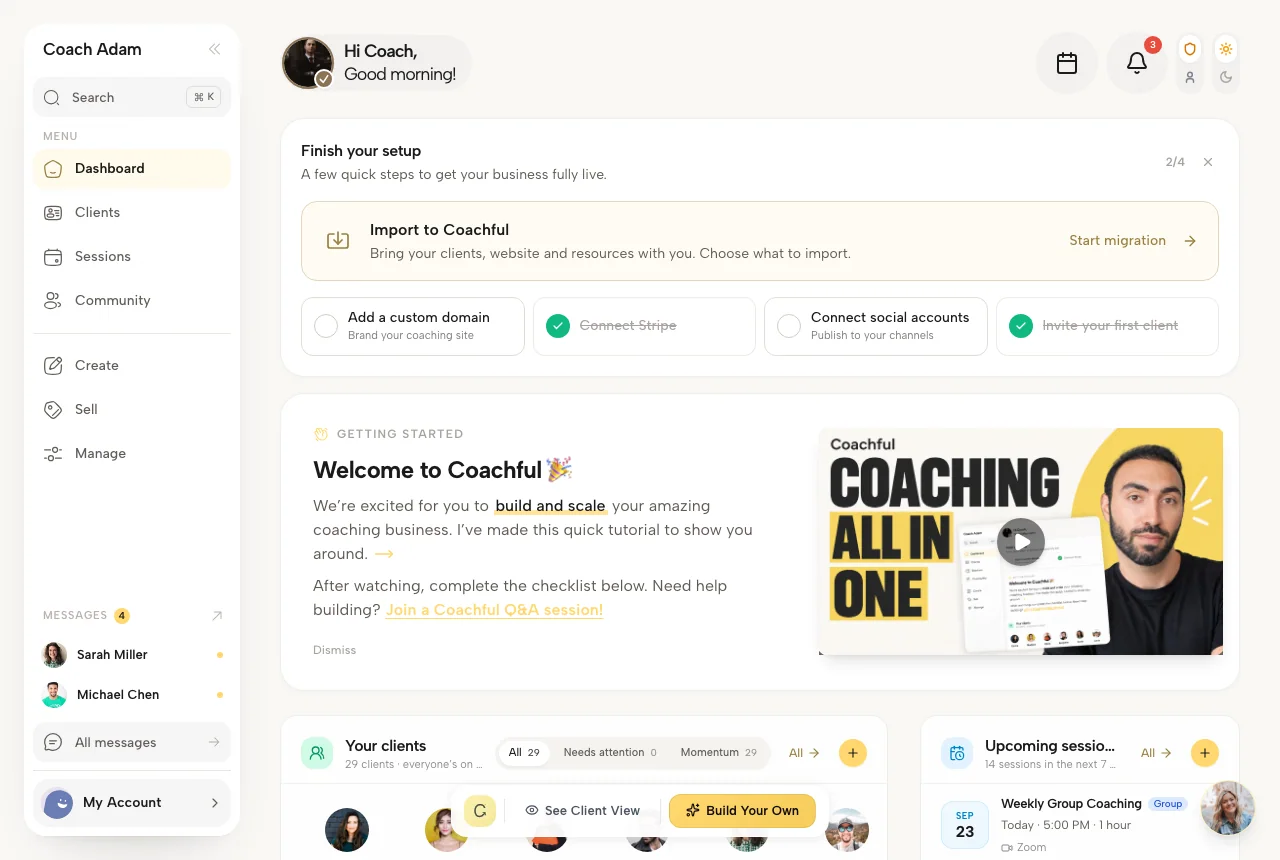
Where software helps is the gap between doing the work and holding the cash. With Coachful's payment tools you can take card payments through Stripe Connect or Razorpay, sell one-time packages, subscriptions and payment plans, and issue invoices. The Invoices screen shows outstanding, overdue and paid totals in one place. Coachful charges no platform fee on those payments, and Stripe or Razorpay processing fees still apply. The Leads view keeps follow-ups visible, which makes a quiet pipeline harder to miss. Video calls are part of the subscription.
Coachful does not hold your savings, replace your accountant or bookkeeping software, forecast your cash, or make a client pay on time. If you have two or three clients who pay by bank transfer without reminders, you may not need payment software yet.
Frequently asked questions about a coaching cash reserve
How many months of expenses should a new coach save before going full time?
Use three months of your survival number as the floor and six months as the target if coaching will be your only income. The survival number is the personal bills the practice must cover plus fixed business costs, so it is usually far smaller than your revenue goal. These are planning ranges from this guide. If a partner's income or part-time work covers the essentials, a smaller reserve can be reasonable.
Does a coaching cash reserve include money set aside for taxes?
No. Tax money is already owed, so counting it makes the reserve look bigger than it is. Keep it in its own account and move it there the day a payment lands. In the US, the IRS advises people with income that has no tax withheld to check whether they need to make estimated tax payments during the year. An accountant can tell you what share to set aside.
Should I count unpaid coaching invoices as part of my reserve?
No. An unpaid invoice is money you hope to receive, and it cannot pay this month's rent. Measure the reserve using cash already in your account. Then add a late-payment float equal to the largest amount you were owed at one time over the last three months. If clients pay by card before sessions, that float can be close to zero.
Can a credit card or line of credit replace a cash reserve?
Treat borrowing as a backstop. A credit limit can cover a gap, but every month you lean on it adds interest to a period when income is already low. Decide in a calm month how much you would borrow and for how long, for example no more than one month of your survival number, then keep building cash.
What if I cannot save anything from my coaching income yet?
Then the practice is not yet covering your survival number, and the reserve has to come from somewhere else for now. Keep or add part-time income, pay yourself a fixed amount, and move a set share of any good month into savings, even if the first transfers are small. One month of cover is a meaningful first milestone because it turns a late invoice into an inconvenience.
Should I pay off debt or build my coaching reserve first?
It depends on the interest rate and how exposed your income is, so take this one to an accountant or financial adviser. One approach is to hold a small starter reserve first, such as one month of your survival number, so a slow month does not push you into more borrowing. After that, split spare cash between the debt and the reserve.
Does Coachful help with slow months and late client payments?
Coachful takes card payments through Stripe Connect or Razorpay, runs subscriptions and payment plans, issues invoices, and shows outstanding and overdue totals on the Invoices screen. Its Leads view tracks follow-ups, which helps you see a quiet pipeline early. Video calls are included in the subscription, so they are not a separate required cost. It does not hold your savings, forecast your cash or guarantee that clients pay.
This article is general business education. It is not financial, tax or legal advice. Speak to a qualified professional about your own situation.