Find Your First Coaching Clients With a 50-Name Outreach List

You have been posting for months. A few likes, one of them from your sister. No inquiries. The savings you set aside to get the practice going are a little smaller every month, and a quiet voice has started asking whether coaching is going to work for you at all.
You know the alternative is to reach out to people directly. But your own inbox is full of "Hey, quick question" messages from strangers, and you would rather have no clients than sound like that.
One reply in an r/lifecoaching thread on how coaches market themselves gave the version that works: "Make a list of your top 50 “would be amazing to work with them” people, craft an offer that is specific to their needs and start a conversation."
The short answer: outreach works when it is narrow. Write down 50 real people who share one problem you are good at solving. Shape one offer around that problem. Open each conversation with something specific to that person and no pitch. Give every name a stage and a dated next step, follow up twice at most, and review the list once a week. When someone says yes, send a booking link the same day. Think of it as fifty conversations rather than a campaign.
Coachful details were checked on 3 October 2026.
Why posting and waiting stalls new coaches
With no audience, content reaches almost nobody who needs you. Months pass, money and confidence both run down, and you conclude that coaching does not work, when the plainer explanation is that the people you could help have never heard from you.
The opposite mistake costs more. Sending the same template to hundreds of strangers gets ignored, can get an account restricted, and attaches your name to exactly the kind of message you delete yourself.
A list of 50 sits between the two. It is small enough that every message can be personal, and large enough that a handful of silences will not sink it. It is slower per day than anything automated, and the care that takes is the point.
Who belongs on a coach's 50-name outreach list
Named people only. "HR managers" is a market. "Priya, who ran the leadership offsite I spoke at" is a line on the list.

A name earns a place when three things are true:
- You would be glad to work with them.
- You have evidence they have the problem you solve: something they said, wrote or are visibly going through.
- You have an honest route to them: a shared history, a mutual contact, a community you are both in, or public work of theirs you can respond to.
Look in places you already belong before anywhere new: former colleagues, people from your previous career, alumni groups, communities and events you have taken part in, and friends who can answer "who do you know who is dealing with this?"
Leave off anyone you would have to trick into replying, and do not buy or scrape lists. The number 50 is the commenter's, and it is a sensible one: enough names that a few silences do not matter, few enough that you can spend ten minutes learning about each.
| Column | What goes in it |
|---|---|
| Name and route | Who they are and how you can honestly reach them |
| Evidence of the problem | The post, comment or situation that put them on the list |
| Opening | The specific thing you will mention first |
| Stage | Researched, contacted, replied, call booked or decision |
| Next step and date | What you will do and when |
One problem and one offer for the whole coaching prospect list
If the 50 people do not share a problem, you will need 50 different pitches and you will write none of them. Pick the problem first, then fill the list with people who have it.
The offer follows from the problem. Write who it is for, the result in the words they would use, the format and length, the price and the first step. Keep it small enough to say in one sentence that the person could repeat to someone else at dinner.

You will not send the offer in your first message. You need it ready for the moment someone asks, "So what do you actually do?" Our guides to structuring coaching packages and building an offer page cover the details.
How to write the first outreach message to a coaching prospect
- Open with something specific and true about them. A post they wrote, a change in their role, an event you both attended.
- Say who you are in one clause. Hiding that you are a coach is the trick people resent.
- Ask one question they can answer in a line.
- Leave out the link, the calendar and the PDF. Those come after they reply.
- Keep it short enough to read on a phone without scrolling.

An example of the difference, with invented names:
- Deleted on sight: "Hey Dana! Love your content. I help ambitious leaders 10x their impact. Got 15 minutes this week?"
- Likely to get a reply: "Hi Dana, your post about managing people who used to be your peers stayed with me. I coach new managers through that first year, which is why it caught my eye. What has been the hardest part so far?"
When they reply, have the conversation. Ask, listen and be useful. Offer a call only once the problem is on the table: "Would it help to talk it through for 30 minutes? No charge, and I will tell you honestly if I am not the right person."
If you write by email, keep it one to one and personal, and stop the moment someone says no. Rules on commercial email and messaging differ by country, so check the ones that apply to you and to the person you are writing to. For the subject line, see our networking email subject lines.
Mark Coles made the video below for online fitness coaches whose messages to prospects get no reply or whose conversations stall. The niche is different from most life and business coaching, and the steps for fixing a message carry over.
Mark Coles on why coaches' messages to prospects go unanswered and how to improve them. Source: Mark Coles on YouTube.
Track each coaching prospect through five stages with a dated next step
Outreach tends to fall apart around week three, when you can no longer remember who replied, who is waiting on you and who you already nudged.

- Researched: you know why they are on the list and what you will open with.
- Contacted: first message sent, with the date.
- Replied: a conversation is open. Note what they said.
- Call booked: a time is in the calendar.
- Decision: yes, not now or no.
Two rules keep the list honest. Every open name has a next step with a date. And you follow up twice at most, about a week apart, each time adding something new such as an article or a thought on what they said. A message that only says "just bumping this" adds nothing. After two follow-ups with no reply, close the name. You can pick the conversation up again if they come back.
The weekly review that keeps coaching outreach going
Set aside 30 minutes on the same day each week.
- Start a fixed number of new conversations. At five a week, 50 names take ten weeks.
- Send the follow-ups that are due and close the names that have had two.
- Compare the openings that got replies with the ones that got silence, and change the wording before you change the volume.
- Add a new name for every one you close.
Count four things: messages sent, replies, calls and clients. There is no honest universal reply rate to measure yourself against, so your first 50 become your own benchmark. If 50 thoughtful messages produce no real conversations, the list or the problem is off. Ask five of those people what they are actually struggling with, then rebuild around the answer. Our guide to tracking which activities bring clients shows how to compare outreach with everything else you do.
What to do when a coaching prospect says yes to a call
- Send a booking link the same day, while the conversation is warm.
- Ask one or two questions on the booking form so you arrive prepared.
- Run the call for their benefit. Our comparison of a discovery session and a paid first session covers the format.
- Follow up within a day. See how to follow up after a discovery call.

Decide in advance how many clients you can take, so a good month of replies does not leave you overbooked. Our guide to defining a full coaching roster walks through the sum.
Objections coaches raise about direct outreach
"It feels pushy." Pitching strangers from a template is pushy. Writing to one person about a problem you can see they have, and asking a question, is an ordinary professional act.
"I only know twelve people." Start with twelve. Ask each for one introduction to someone facing the same problem, and the list grows from people who already trust you.
"What if nobody replies?" Some will not. Two follow-ups is the limit, and silence tells you something about the opening or the fit.
"Should I automate it?" At 50 names, automation saves minutes and removes the specificity that earns replies. Bulk unsolicited messages can also break platform rules and email law.
"I have coached before and I am coming back." Then start with the people who already know your work. Our guide to restarting a coaching practice after a break covers that list.
Running the outreach list in Coachful
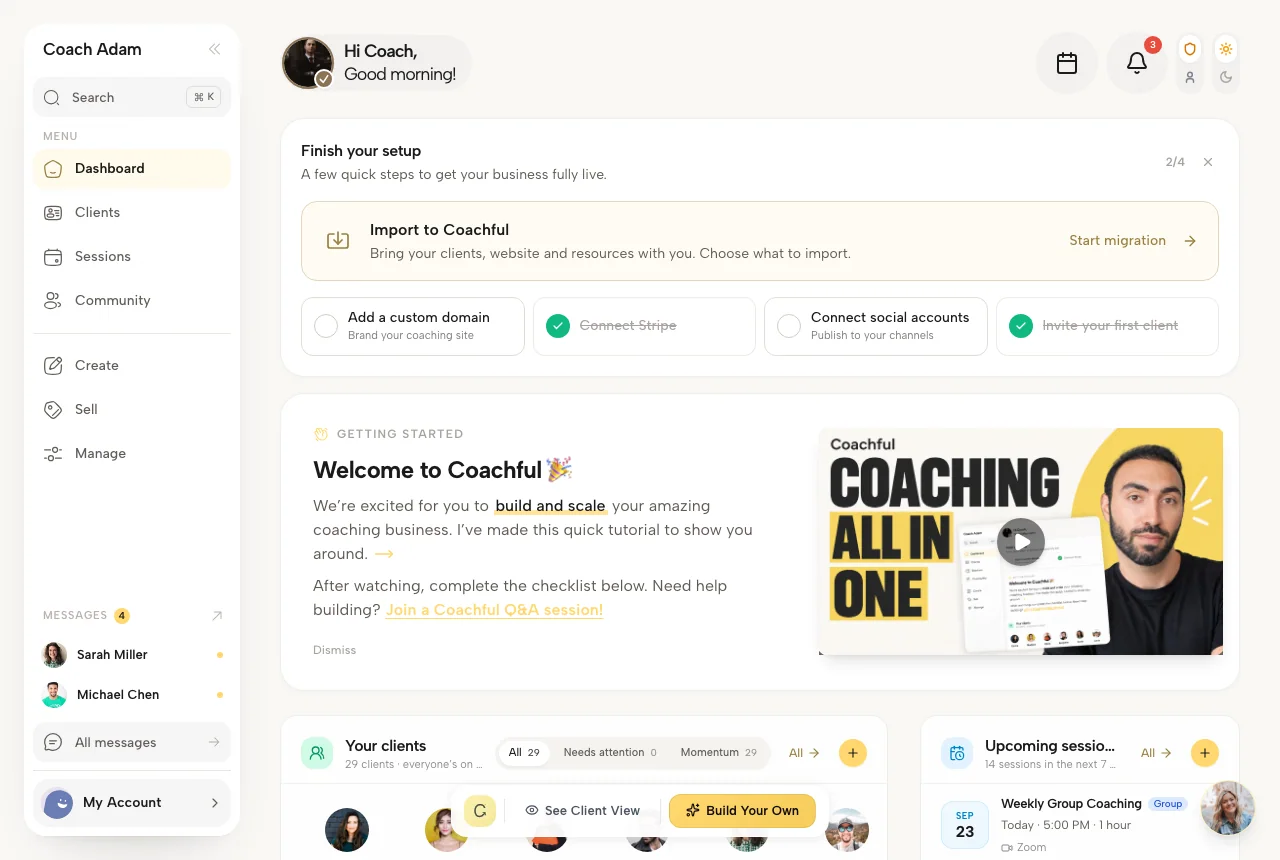
We make Coachful, so weigh this section accordingly. Coachful does not find prospects and does not send cold outreach for you. The messages are yours to write and send. What it does is hold the list once it exists.
- One leads list: prospects you add by hand sit alongside leads from funnels, link in bio and booking pages, with the source recorded on each.
- Stages on a board: leads move through stages, including a Not a Fit ending, and a stage can remind you to follow up when a lead enters it.
- Hot, warm or cold: a temperature you set yourself.
- From lead to client: a lead becomes a client on the same record, so nothing is typed twice.
- The call: booking pages detect time zones, and discovery calls run on built-in video that is part of the subscription, so there is no separate video tool to pay for.
A spreadsheet is enough for 50 names, and you should start there if it is what you have. Move to a pipeline when follow-ups start slipping. See lead management in Coachful for how the board works. There is a 7-day free trial: card required, no charge during the trial, cancel in one click.
Frequently asked questions
How do I reach out to potential coaching clients without being spammy?
Write to one person at a time about something specific to them. Say you are a coach, ask one question, and leave the pitch and the booking link out of the first message. Limit yourself to people with a problem you can see and an honest route to them.
Who should be on a list of 50 coaching prospects?
Named people you would be glad to work with, who share one problem you solve, and whom you can reach through a shared history, a mutual contact, a community or their public work. Leave off bought or scraped contacts.
What should the first outreach message say?
One specific observation about them, one clause on who you are, and one question they can answer in a line. For example, mention a post they wrote, say that you coach people through that situation, and ask what has been hardest.
How many times should a coach follow up with a prospect?
Twice, about a week apart, and each follow-up should add something new. After two with no reply, close the name and move to the next. You can always pick the conversation up if they come back.
How long does it take to work through 50 names?
At five new conversations a week, ten weeks. The pace matters less than the weekly review: new messages sent, follow-ups done, and a fresh name added for each one closed.
Is it legal to email or message people who have not asked to hear from me?
The rules on commercial email and messaging differ by country and platform, and this article is not legal advice. Check the rules where you and the recipient are, keep messages personal and one to one, and stop at once when someone says no.
Do I need a separate video tool for discovery calls on Coachful?
No. Calls run on built-in video included in the subscription. Zoom, Google Meet or Teams links can be created automatically if you prefer them.