Restart Your Coaching Practice After a Break With One Clear Offer

Coming back to coaching after time away brings a specific kind of doubt. You know you are good at the work. But the people who used to refer you have moved on, your website still describes the coach you were, and your background now spans enough jobs and skills that you are not sure what to call yourself. A coach put it plainly on Reddit: "Took a bit of a pause in coaching for the past year... want to start up my coaching business again - but I feel like the 'jack of all trades' - which doesn't lend itself well to marketing my coaching skills."
The usual advice is to post every day until people notice you again. For a coach restarting, that is the slowest route and the quickest way to burn out: weeks of content about everything you can do, aimed at people who do not know you yet, while the people who already trust you hear nothing.
The short answer: restart in this order. Choose one offer built on the problem you have the most proof of solving. Tell the people who already know you, one by one. Run a small pipeline of real conversations with dated follow-ups for a few weeks. Only then return to regular content, because by then you will know exactly what to say and who it is for.
Coachful details were checked on 3 October 2026.

Restarting a coaching practice: why "jack of all trades" feels like the problem
Broad experience is usually an asset in sessions. It lets you connect a client's career, health and relationships in ways a narrow specialist might miss. The marketing problem is different: when you describe everything you can help with, nobody can repeat it. A past client who wants to refer you needs one sentence they can pass on, such as "she helps people plan a career change before they quit," not a list.
So the fix is not deleting your experience. It is choosing which part of it leads. Everything else stays in the room once someone is a client.
Choose one credible coaching offer to lead with
Work from evidence, not from what sounds marketable:
- List the people you have helped, in coaching and in your other roles, and the problem each one came with.
- Group them by problem. Ignore job titles. "Felt stuck in a career they had outgrown" and "wanted to lead a team without burning out" are problems.
- Pick the group with the most proof: results you can describe, stories you can tell, people who would vouch for you.
- Check you still want it. A restart built on work you have lost interest in will stall again.
- Write it in one sentence a friend could repeat: who it is for, the problem and the change.
- Make it buyable: a fixed length, a clear format and a price. See life coaching package examples for structures.
Choosing one lead offer is not a life sentence. It is the first thing people hear. If you need ideas for how others frame their focus, see the coaching niches list, and if you want to test the choice with paying clients before committing, see how to validate a coaching niche.
Reconnect with warm relationships before strangers

The people who already know your work are the fastest route back. Build a list in three circles:
- Past clients, including people you coached before the pause.
- Colleagues and contacts from your other roles, who have seen how you work.
- Referral partners: people who serve the same audience without competing, such as therapists, HR contacts, accountants or other coaches with a different focus.
Then write to them personally, one at a time, not as a bulk announcement. A message along these lines works because it is honest and easy to answer:
"I'm opening my coaching practice again after a year focused on other work. I'm concentrating on [one-sentence offer]. If that sounds like anyone you know, I'd be grateful for an introduction, and if it sounds like you, I'd love to catch up."
Personal messages to people you know are different from adding them to a marketing list. If you want to email your whole list about the restart, follow the consent rules in our guide to announcing an offer to existing contacts.

Past clients: the warmest part of the list
Someone you helped before may be facing the next version of their problem. Ask how they are doing before mentioning your offer, and if it fits, offer a single catch-up session as an easy way back in. A short sequence of messages over a few weeks keeps the follow-up from depending on your memory.

Rebuild a coaching pipeline you can keep up with
A pipeline is just the list of people you are in conversation with and the next step for each. For a restart, keep it small and visible:
- Set a weekly conversation target you can hit even in a busy week, and count conversations, not posts.
- Give every conversation a next step and a date: send the overview, book a call, check back in a month.
- Use one booking link for discovery calls, so "let's talk" turns into a time without email ping-pong.
- Follow up once, kindly, on schedule. See following up after a discovery call.
- Review every week: who moved, who went quiet and what people asked. Their questions become your content later.

Justin Janowski describes what he would do if he had to start his coaching business over, a useful companion to a restart plan. Source: YouTube.
When to return to regular coaching content
Content works much better once you have had a few weeks of real conversations, because you are no longer guessing. Return to it when:
- You can describe your offer in one sentence without rewriting it each time.
- You have a list of questions prospects actually asked.
- You know which channel your warm contacts already use.
Then start with one channel and a pace you can keep, turning those questions into posts or emails. Our guides to tracking which visibility activities bring clients and segmenting a coaching newsletter help you keep it focused.
Mistakes that slow a coaching restart
- Relaunching with a list of everything you do. Nobody can repeat it, so nobody refers you.
- Waiting for the perfect niche. Choose the strongest proof you have now; you can adjust after real conversations.
- Announcing to strangers before telling friends. The people who know you will act faster and refer better.
- Treating posting as progress. Count conversations and booked calls instead.
- No follow-up dates. Warm leads go cold quietly when the next step lives only in your head.
- Rebuilding every tool before talking to anyone. A booking link and a simple list are enough to start.
Restarting with Coachful
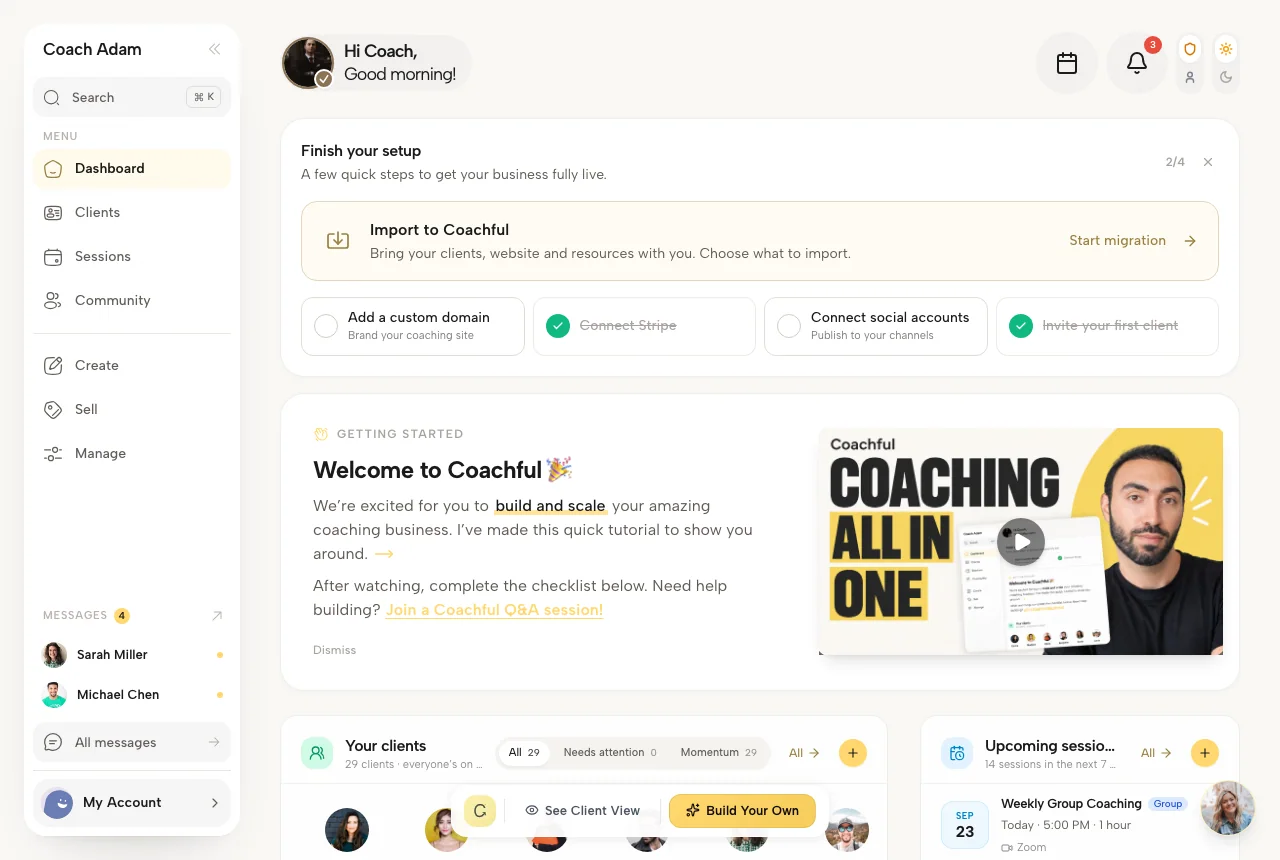
You do not need new software to restart. A list, your email and a calendar can carry the first few weeks. When conversations pick up and you want everything in one place, Coachful covers the restart path:
- Leads and follow-ups: a leads view with sources, pipeline stages, dated follow-up reminders and an import option for your existing contacts.
- Email: an inbox for replies, plus broadcasts, lists and multi-step sequences for when you are ready to email your list.
- Win-back journeys: coaching flows that can run a short, timed sequence for past clients.
- The offer itself: booking pages, booking and checkout funnels, programs and a website builder, with calls on built-in video, so there is no separate video subscription to add back.
- Clients: a branded client home on the web and in the mobile app once people say yes.
Coachful has a 7-day free trial, card required, no charge during the trial, cancel in one click.
Frequently asked questions
How do I restart my coaching business after a long break?
Choose one offer based on the problem you have the most proof of solving, tell past clients and contacts personally, then run a small pipeline of conversations with dated follow-ups. Return to regular content once you know what prospects ask and how you describe your offer.
How do I market myself as a coach if I'm a "jack of all trades"?
Lead with one problem and one audience, chosen from where you have the most evidence, while keeping your broader experience for the coaching itself. People refer what they can repeat in one sentence.
Should I contact past clients when I restart coaching?
Yes, personally. Ask how they are doing first, share what you are focusing on now, and offer an easy way back in, such as a single catch-up session. For bulk emails, follow consent rules for your list.
Do I need to post content every day to restart?
No. Daily content aimed at strangers is the slowest route back. Start with conversations with people who know you, then add content on one channel at a pace you can sustain.
How long should I give a coaching restart before changing my offer?
Give it enough real conversations to learn something, not enough time to drift. Review weekly: if people understand the offer but do not buy, look at format and price; if they do not understand it, rewrite the sentence.
What if my old website and profiles describe a different coach?
Update the headline and the main offer first so they match your one-sentence description, and add a clear booking link. A full rebuild can wait until your restart offer has been tested in conversations.