How Many Clients Is a Full Coaching Roster? Find Your Number

A good-fit client emails on a Thursday and wants to start next week. You look at your calendar, see a couple of gaps, and say yes, because turning down money feels reckless when you are not sure next month is covered. Three weeks later you are prepping sessions at 10pm, your group is waiting on feedback, and the corporate sponsor wants a progress summary by Friday.
The question underneath came up in a Reddit thread for life coaches: "Roughly how many active clients do you work with? Do clients usually pay per session, buy packages, or pay a monthly retainer?" One reply named the step most coaches skip: "It’s good practice to determine what a ‘full roster’ is for you. Lots of coaches don’t decide, so they’re never actually fully booked or know what that would look like. I like 8 rolling clients. I do 3 months containers, Bi-weekly 90m sessions. I take on a limited number of 12mo clients as well."
The short answer: a full roster is a number of committed hours you decide in advance, split into slots for each kind of work you sell. Count hours, because a 1:1 client, a group cohort, a corporate contract and a 12-month client each take a different amount of your week. Start with the hours you can coach well, hold some back as a buffer, work out what each offer costs you per week, and give each offer a fixed number of slots. When every slot is taken you are full, and the next person gets a start date or a waitlist place instead of a squeezed-in yes.
Coachful details were checked on 3 October 2026.
What a full coaching roster means when clients pay in different ways
"Active client" sounds obvious until you try to count. Someone who booked one session in August and might come back is on your list, but they have no claim on your calendar. A retainer client who has not booked this month still does. How people pay you decides how much of your time is already spoken for.
| How the client pays | What you have committed | How to count it |
|---|---|---|
| Per session | Nothing beyond the next booking | Count the sessions you deliver in a typical week, not the names on your list |
| Package or fixed container | A set number of sessions by an end date | One slot from start date to end date |
| Monthly retainer | Ongoing access until they cancel | One slot with no end date, reviewed at set points |
| Group program | Calls and feedback for a whole cohort | One cohort slot, plus time per person for anything individual |
| Corporate engagement | Several coachees plus a sponsor | One slot per coachee, plus time for the organisation |
| 12-month client | A year of your calendar | One slot, inside a cap you choose |
This is why two coaches with "15 clients" can have completely different weeks. One has 15 people on bi-weekly packages. The other has 6 retainer clients, a cohort of 8 and one executive paid for by an employer. The headcount tells you nothing about either workload.
What it costs coaches to leave the roster number undefined
If you never decide what full is, every inquiry becomes a fresh negotiation with yourself, usually at a moment when you are worried about money. The costs arrive later and quietly.
- You overfill without noticing. Each yes looks small. The damage shows up as skipped prep, late notes and sessions where you are thinking about the next call. Clients feel that before they can name it, and you hear about it at renewal time.
- Your long-term clients pay for your newest ones. The client who trusted you with a year gets the tired version of you because three new starts landed in the same fortnight.
- You never feel booked, so you keep selling from anxiety. Without a finish line, 11 clients feels the same as 6.
- You cannot tell whether the problem is marketing or the model. If a full roster at your current prices would still not cover what you need to earn, more leads will not fix it. You only find that out by doing the sum.
- You set the cap too low out of caution. The opposite mistake is real too. A cap that protects your energy but cannot pay your bills moves the stress somewhere else.

How to work out your full coaching roster in five steps

- Set your weekly delivery hours. This is the time you can spend on client work and still do it well: sessions, prep, notes, feedback and messages. It is smaller than your working week, because marketing, sales calls, admin and rest all need room. Pick the number for an ordinary week, not your best one.
- Hold back a buffer. Reschedules, a client in a hard stretch, a sponsor who wants an extra meeting, a week when you are ill. Keep part of your delivery hours unsold on purpose.
- Cost each offer in hours per week. For every offer, add the live time, the prep, the notes and the support between sessions, then average it per week. Use what it really takes. One week of honest time tracking is enough to start.
- Give each offer a slot count. Divide the hours you have left among your offers and write the result down as slots: this many 1:1 containers, this many cohorts running at once, this many corporate coachees, this many 12-month clients.
- Check the money. Multiply the slots by what each one brings in per month. If a full roster covers what you need to earn, you have a target you can hit. If it does not, the fix is price or format, and one more client will not get you there. Our guide to earning 20k a month as a coach goes deeper on the revenue side.
A worked example from the Reddit reply
Take the coach quoted above: 8 rolling clients on bi-weekly 90-minute sessions. Eight clients seen every two weeks is four sessions a week, which is 6 hours of live coaching. Suppose prep and notes add 30 minutes per session (an assumption for illustration, yours will differ). That is 2 more hours, so those 8 clients take about 8 hours a week before messages and admin.
The same example shows what "full" still asks of you. With 8 slots on 3-month containers, on average two or three of the eight come to an end in any given month. A full roster does not end the sales conversations. It tells you how many you need: two or three renewals or new starts a month to stay at eight.
For the same sum from the income side, this short lesson from Tandem Coaching builds a capacity ceiling from available hours, non-client work and unbilled time, then shows how retainers, corporate work and team coaching move it.
Video: The 1:1 Capacity Ceiling: When Coaching Hours Cap Your Income, Tandem Coaching on YouTube.
Counting 1:1, group, corporate and long-term coaching clients
1:1 containers
The simplest slot: one client, a fixed cadence, a start date and an end date. The trap is open-ended messaging between sessions. If you offer it, count it, because eight clients who each send a long voice note every week add hours that never appear on your calendar.
Group programs
Count the cohort as one block of hours, then add time per person for anything individual. The calls take the same time whether 6 or 12 people attend. Written feedback, hot seats and private messages grow with every seat. If individual feedback is part of the promise, your seat cap comes from the feedback time. Our group size guide covers caps by format.
Corporate engagements
Each coachee is a 1:1 slot, and the organisation is extra. Sponsor check-ins, progress summaries, contracts and scheduling around executive calendars all take time a private client never asks for. Add a line for that time on every engagement. If you are still shaping the offer, see how to package an employer-paid coaching pilot.
12-month clients
A year-long client brings steady income and a deep working relationship. It is also a slot you cannot reprice, reshape or reopen for twelve months, which is why the coach in the thread takes "a limited number" of them. Decide the cap before anyone asks, and keep enough shorter containers that a new price or a new offer can reach most of your roster within a few months.

How per-session, package and retainer payments change coaching capacity
The thread asked how clients pay because the payment model decides how predictable your roster is.
- Per session gives clients the most freedom and you the least visibility. Nobody has reserved anything, so you cannot say you are full. If you sell this way, cap the weekly session slots you open for booking and treat that as your roster.
- Packages and fixed containers give every slot an end date. You can see openings weeks ahead, so "my next 1:1 place opens in November" is a real answer. The price is renewal work each time a container ends. See how to structure coaching packages.
- Monthly retainers keep a slot filled until the client cancels, which steadies income and cuts renewal conversations. The risk is drift: with no end date, a retainer can run on after the work is done and hold a slot someone on your waitlist needs. Put a review point in the calendar. Our guide to recurring sessions with automatic billing covers the setup.
Whichever you use, keep one list of every active engagement with its type, its weekly hours and its end or review date. That list is your roster, and it is the only thing you need to look at when someone asks to start.

Rules for accepting a new coaching client when you are nearly full
Decide these on a calm day so you are not deciding them in the middle of a discovery call.
- Match the request to a slot type. A free 1:1 slot is not a free corporate slot. If the type they want is full, they wait or choose a format that has room.
- Offer a start date instead of squeezing them in. "I can start you on the 14th" is still a yes, and it gives you time to onboard them properly.
- Never sell the buffer. It is what lets you handle a bad week without letting anyone down.
- Keep a waitlist with dates. Write down who is waiting, for which offer, and when the next slot of that type opens. Tell them the date.
- Allow one exception, with an end. If you go one over for a client you really want, name the date the roster returns to normal, for example when a current container finishes.
- Treat a full roster as a pricing signal. If every slot is taken and people are waiting, your next new client can start at a higher price. Our guide to raising coaching rates without losing trust covers how to do it carefully.
Objections coaches raise about capping a coaching roster
"I cannot afford to turn anyone away." Then the number matters even more. Do step five first. If your full roster does not pay enough, saying yes to everyone gets you to the same ceiling, only more tired. Change the price or the format.
"A waitlist feels pretentious for a small practice." A waitlist is an honest start date. Nobody needs to know whether three people are on it or thirty.
"My weeks are too uneven to plan." That is usually a sign of per-session selling. Moving regulars onto packages or a retainer is what makes the weeks even enough to plan.
"What if I cap it and then lose two clients?" Then you have two open slots and you know it the day it happens, which beats discovering a quiet month halfway through it. The end dates on your list tell you when to start those conversations early.
When a full coaching roster means changing the model
If you are full and still short on income or energy, working more hours is the one option that will not hold. The other choices each cost something.
- Raise prices for new clients. Same hours, more income. It takes effect slowly when most of your roster is on long containers.
- Move some delivery to a group. One block of hours serves several people. You give up some depth per person, and not every client wants a group.
- Shorten or space out sessions. This frees hours quickly, but only if the results hold up, so try it with new clients before changing terms for current ones.
- Bring in a second coach. You add capacity without adding your own hours, and you take on management, quality control and shared systems. Read what breaks before you add a second coach first.
For the operational side of growing past your own hours, our guide to scaling a coaching practice without losing quality covers what to automate and what to keep personal.

Keeping your coaching roster visible in Coachful
We make Coachful, so weigh this section accordingly. No software picks your number for you. What it can do is keep the roster in front of you and stop the calendar from drifting past it.
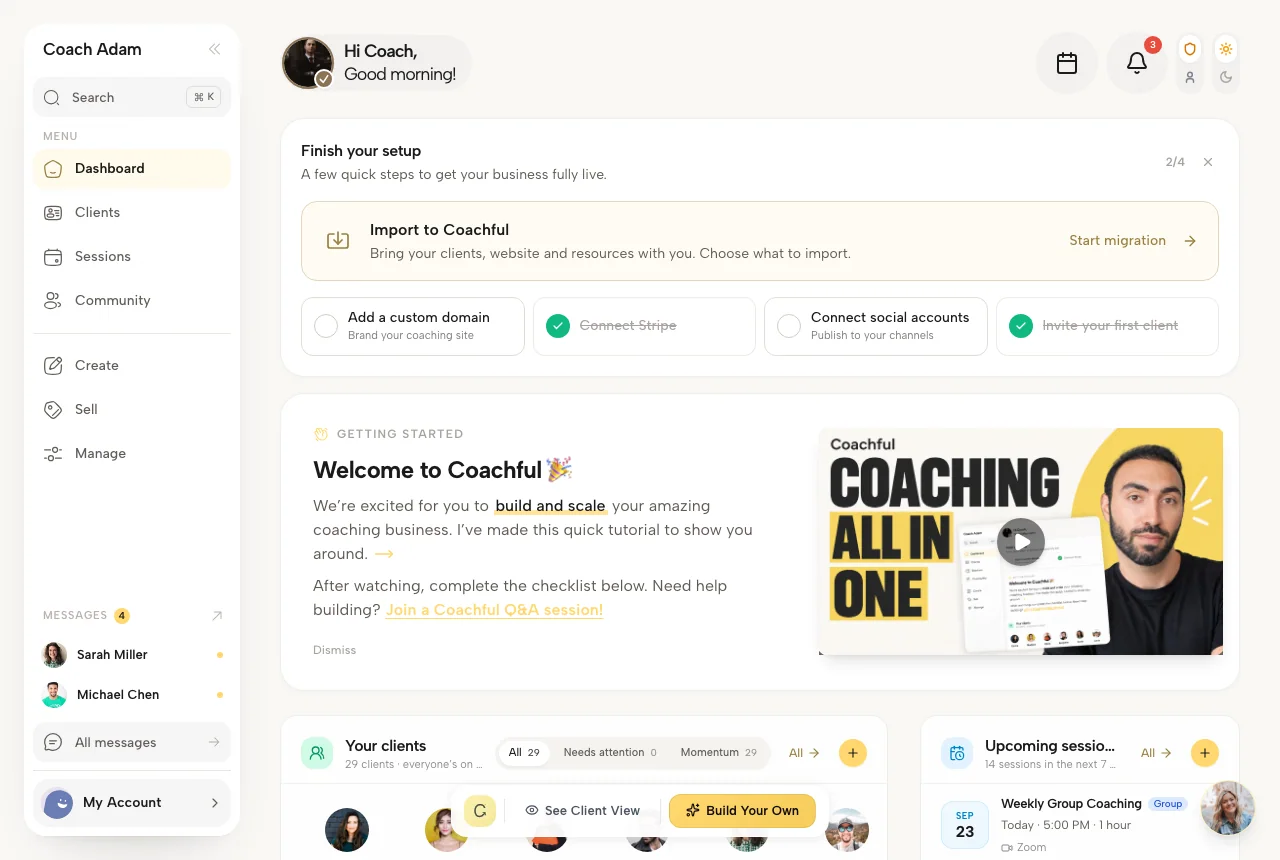
- Offers by type: programs are marked 1:1 or group and show their active clients, so the slot count per offer is something you can read off one page.
- Bookable hours: booking pages follow your availability rules and buffers, so clients can only book inside the delivery hours you set.
- Packages: session credits fix how many sessions a client can book from a package.
- Payment models: one-time payments, subscriptions and payment plans cover per-session, package and retainer clients, with an invoice for each transaction and a 0% platform fee (Stripe or Razorpay processing fees still apply).
- Groups: cohort groups are created on enrollment, with group calls and a community space.
- Calls: sessions run on built-in video that is part of the subscription, so a fuller roster does not add a separate video bill. Zoom, Google Meet or Teams links can be created automatically if you prefer them.
- A second coach: team plans add coach seats with per-coach availability and staff permissions.
If you coach a handful of clients and a spreadsheet plus a calendar is working, keep it. The roster rule matters more than where you write it down. If you are comparing tools, our review of online coaching platforms covers the options. Coachful has a 7-day free trial: card required, no charge during the trial, cancel in one click.
Frequently asked questions
How many active clients should a full-time coach have?
There is no standard number, because it depends on session length, cadence and how much support you give between sessions. The coach quoted above runs 8 rolling clients on bi-weekly 90-minute sessions, which is about 6 hours of live coaching a week. Work out your own from delivery hours, minus a buffer, divided by what each offer takes per week.
Does a group coaching program count as one client or many?
Count it as one block of hours for the calls, plus time per member for anything individual, such as written feedback or private messages. A cohort of 10 with no individual feedback can take less of your week than three 1:1 clients. A cohort of 10 with weekly written feedback can take more.
Should coaching clients pay per session, by package or on a monthly retainer?
For capacity planning, packages and retainers are easier, because each one reserves a slot you can count. Packages give you end dates and visible openings. Retainers give steadier income with a risk of drift, so add review points. Per-session selling suits occasional clients, as long as you cap the weekly slots you open for it.
How many 12-month coaching clients should I take?
Fewer than your total 1:1 slots. A year-long client is stable income, and it is a slot you cannot reprice or reopen for a year. Set a cap in advance, as the coach in the thread does with "a limited number," and keep the rest of your slots on shorter containers.
What should I say when a good client wants to start and my roster is full?
Give a date. Look at your list, find the next end date for that kind of slot and offer it: "My next 1:1 place opens on 14 November, and I can hold it for you." If they need to start sooner, offer a format that has room, such as your group.
How do corporate coaching clients count toward capacity?
Count each coachee as a 1:1 slot, then add weekly time for the organisation: sponsor check-ins, progress reporting, contracts and scheduling. That extra time is easy to forget, and it is why a six-person corporate engagement can take more of your week than six private clients.
Can Coachful show how full my coaching roster is?
Coachful lists each program as 1:1 or group with its active clients, and booking pages only offer times inside the availability rules and buffers you set. Session credits limit bookings per package. The cap itself is your decision. Calls run on built-in video included in the subscription, so you do not need a separate Zoom plan.