Package an Employer-Paid Coaching Pilot HR Can Say Yes To

The dream is easy to picture: a company signs once, pays for coaching for a whole team, and you stop hunting for clients one at a time. The reality most coaches meet first is silence. An email to HR offering "life coaching for your employees" gets no reply, and every unanswered pitch makes you wonder whether corporate work is only for coaches with big names and bigger networks.
A coach asked exactly this on Reddit: "What's the easiest way to get corporate clients as a life coach? Like coaching everyone in a company and the company pays for it. How often is this done?" One reply cut to the problem: "You need a strong niche and compelling program. It would likely be organic growth from coaching one person in the org and that being successful and that person then selling you to the company. Organizations do not invest in their employees very often so you would need to speak to the company's bottom line and the impact you would have on their profits and overall success."
The short answer: do not pitch coaching for everyone. Pitch a small pilot with five things decided in advance: one business problem the company already cares about, the person who owns that problem and can approve spend, a fixed delivery scope, a success signal both sides agree on before it starts, and the next step if it works. A pilot like that is a small, low-risk decision for the buyer. "Coaching for our people" is a large, vague one, and vague decisions get postponed.
Coachful details were checked on 2 October 2026.

Why "coaching for everyone" rarely gets a yes from HR
- No owner. A program for everyone belongs to no one in particular, so nobody fights for the budget.
- No problem. "Wellbeing" and "growth" are good things, but they do not compete well against problems with a cost attached, such as new managers struggling or a team losing people after a reorganisation.
- No limit. An open-ended offer means an open-ended budget and an open-ended risk if it disappoints.
- No way to judge it. If nobody agreed what success looks like, nobody can defend renewing it.
A pilot fixes all four. It is small enough to approve, specific enough to measure and short enough that a disappointing result does not cost anyone their credibility.
The five parts of an employer-paid coaching pilot

1. One business problem, in the company's language
Start with a problem a manager would recognise in their own week, then name what it costs the business in terms they already track. Some examples of how to frame it:
- "Newly promoted managers are struggling with their first difficult conversations," linked to team retention and how quickly new managers get up to speed.
- "Parents returning from leave are finding the transition hard," linked to keeping experienced people.
- "A team after a restructure has lost confidence and momentum," linked to delivery and morale.
Choose a problem that matches your niche. The Reddit advice starts with "a strong niche and compelling program" for a reason: a coach who works with new managers is easier to buy for a new-manager problem than a coach who helps anyone with anything.
2. The buyer, not just HR
Corporate decisions involve several people, and they want different things:
- The champion: someone inside who believes in you. As the Reddit reply suggests, this is often a person you have already coached.
- The problem owner: the manager or leader who lives with the problem every week.
- The budget holder: sometimes HR or learning and development, sometimes the problem owner's own budget.
- The gatekeepers: procurement, legal and IT or data security, who check contracts, invoices and the tools you use.
Write the pilot for the problem owner and the budget holder, then make it easy for your champion to forward.
Angelique Rewers explains how independent trainers and coaches win corporate clients, including who to approach inside a company. Source: YouTube.

3. A delivery scope with edges
State exactly what the company is buying:
- Who: a named group, for example one cohort of new managers, sized so you can coach everyone properly.
- Format: group sessions, 1:1 sessions or a mix, and whether calls happen in working hours.
- Length: a fixed number of weeks with a start and end date.
- Included and excluded: materials, between-session support, any assessments, and what is not part of the pilot.
- Confidentiality: what the company will see (attendance and aggregate progress) and what it will not (what any individual says in coaching). Agree this in writing before anyone enrolls; participants need to hear it too.
Our guide to stakeholder alignment meetings covers how to keep sponsors informed without breaking confidentiality.

4. A success signal agreed before day one
Do not promise a profit figure you cannot measure. Agree a small set of signals you can actually observe, plus one business indicator the company tracks itself:
- Participation: attendance and completion of between-session work.
- Progress: participants' own ratings on the pilot's focus, before and after.
- Observed change: short feedback from the problem owner at the midpoint and the end.
- Business indicator: something the company already measures and owns, such as retention in the group or time for new managers to settle in, reported by them, not claimed by you.
Schedule a midpoint check and an end-of-pilot review in the proposal, so the conversation about what comes next is already on the calendar.

5. The next step if it works
Name the rollout options before the pilot starts: another cohort, a wider program, or 1:1 coaching for the people who need more. A pilot that ends with "let's see" usually ends there. A pilot that ends with "as agreed, the next cohort starts in two months" turns into a contract.
Pricing and paperwork for a coaching pilot
Quote the pilot as one fixed fee for the defined scope, not an hourly rate. A fixed fee is easier for a budget holder to approve and easier for procurement to process. Expect purchase orders, supplier forms and invoice terms; our guide to company-funded coaching billing covers that side, and pricing a corporate workshop covers how to separate facilitation, group size and materials. Put the scope, confidentiality terms and payment terms in a written agreement; see the coaching agreement template.
A one-page coaching pilot proposal
- The problem: one paragraph in the company's words.
- Who it is for: the named group and its size.
- What happens: format, length, start and end dates.
- How we will know it worked: the agreed signals and review dates.
- Confidentiality: what the company sees and what it does not.
- Investment: one fixed fee and payment terms.
- What comes next: the rollout options if the pilot succeeds.
For full proposal layouts, see coaching proposal examples. If you are still unsure your niche is the right one to lead with, validate it with a paid pilot first.
Mistakes that stall corporate coaching pitches
- Promising ROI you cannot prove. It invites a question you cannot answer. Promise observable signals instead.
- Pitching only HR. The person with the problem is often a better first conversation.
- Leaving confidentiality vague. Employees will not open up if they think their manager will read their notes.
- Making the pilot free. A free pilot has no budget owner, and nobody has to report on it.
- No next step. A good result with no follow-on plan quietly expires.
Running an employer-paid pilot in Coachful
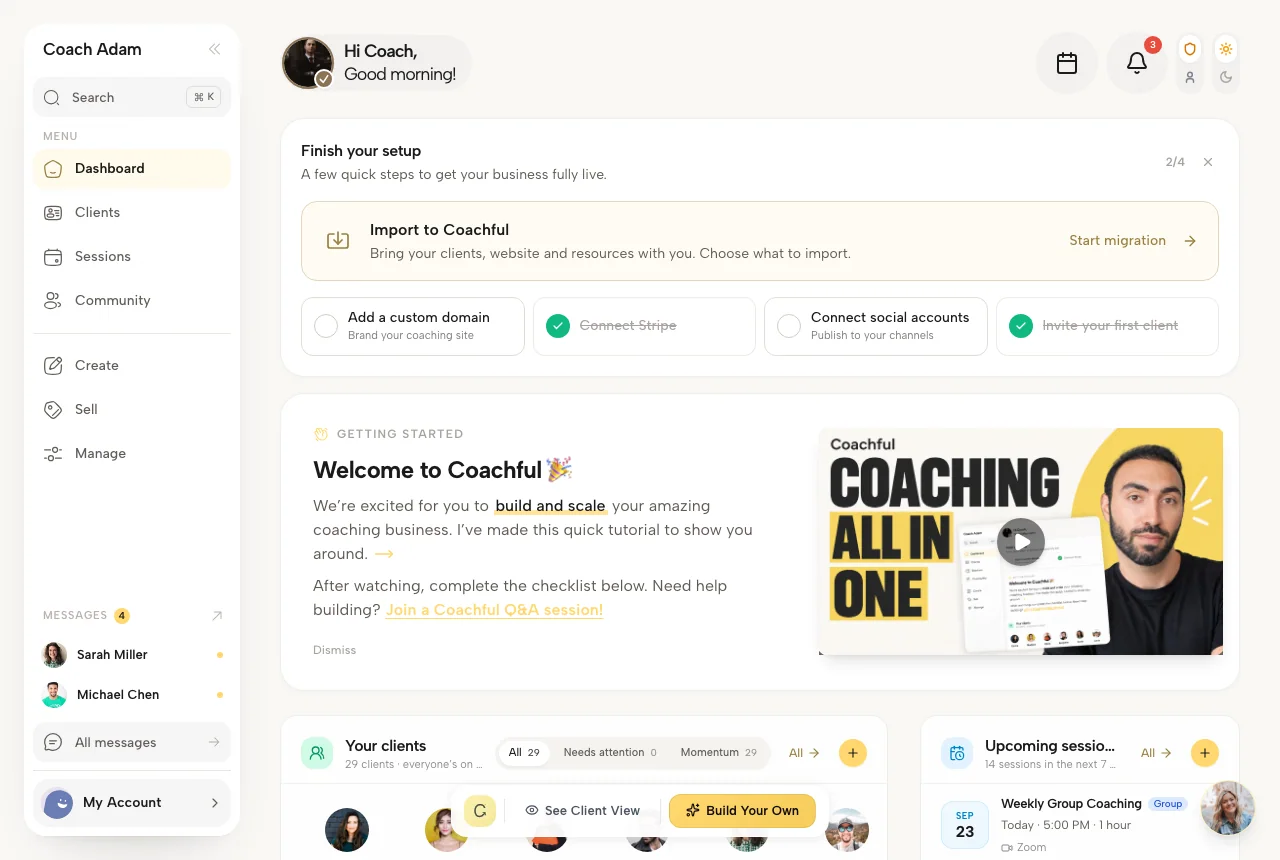
Coachful lets you deliver and report on a corporate pilot from one place:
- Programs and cohorts: multi-week programs with weekly goals, daily tasks and notes, delivered 1:1 or as cohort groups with group calls.
- Video included: calls run on built-in video, so neither you nor the company needs a separate video subscription.
- Progress you can summarise: goals with progress bars, weekly check-ins, and client activity and engagement analytics, so an aggregate pilot report does not depend on session content.
- Paperwork: agreements with e-signature and manual invoices with catalog products for billing the employer.
- Participant experience: a branded client home on the web and in the mobile app.
- Growing the work: Studio and Agency plans add coach seats and staff permissions if the rollout needs more coaches.
The fair trade-off: Coachful is GDPR-ready with full data export but is not HIPAA-certified. If an employer's program involves health information covered by HIPAA, check the requirement before you propose any tool. For other platforms built for team coaching, see coaching platforms for teams. Coachful has a 7-day free trial, card required, no charge during the trial, cancel in one click.
Frequently asked questions
What is the easiest way to get corporate coaching clients as a life coach?
Start from someone you already know inside a company, ideally a person you have coached, and offer a small pilot that solves one problem their team has. A specific, fixed pilot passed on by an internal champion is a far easier decision for a company than a cold pitch to coach everyone.
How do I pitch coaching to HR?
Lead with the business problem, not coaching itself. Show who the pilot is for, what it includes, how long it runs, how success will be judged and what it costs as one fixed fee. Keep it to one page so your contact can forward it to the budget holder.
Should a corporate coaching pilot be free?
No. A paid pilot, even a modest one, has a budget owner who wants it to succeed and will report on it. A free pilot is easy to accept and just as easy to forget.
How do I measure the success of a corporate coaching pilot?
Agree the signals before it starts: participation, participants' before-and-after ratings on the pilot's focus, feedback from the problem owner, and one business indicator the company already tracks and reports itself. Avoid promising profit figures you cannot measure.
What can I share with the employer about individual employees?
Only what everyone agreed in writing before the pilot began. One workable approach is to share attendance and aggregate progress while keeping what individuals say in coaching confidential. Tell participants the rules at the start.
How long should an employer-paid coaching pilot run?
Long enough for the agreed signals to show change and short enough to stay a small decision for the buyer. Set fixed start and end dates, a midpoint check and an end review, and agree the next step before you begin.