How to Price a Corporate Coaching Workshop

Coachful
Editorial Team

Am I charging for a three-hour workshop and quietly donating two days of preparation? Price a corporate coaching workshop as a defined engagement, not just time in the room. Estimate discovery, design, administration, delivery and follow-up; add direct costs and a realistic allowance for uncertainty; then quote a fixed fee with explicit limits on participants, revisions, travel and reuse.
Your internal calculation establishes whether the work is viable. The buyer-facing quote explains what the company receives. Those are different documents. A low preparation estimate cannot be rescued by calling the fee “value based,” and a detailed timesheet does not explain why a sponsor should buy the workshop.
This guide shows how to build both documents, with a worked example and wording you can adapt. All dollar amounts and time estimates below are hypothetical planning assumptions, not market averages, recommended rates or Coachful customer results.
What should a corporate workshop price include?
Include the work required to deliver the agreed participant experience, not every service a company might eventually want. A useful quote separates five decisions:
- Development: discovery, adaptation, exercises, materials and review rounds.
- Delivery: session length, format, participant cap, facilitator responsibilities and location.
- Participant support: pre-work, access to resources and any individual or group follow-up.
- Expenses and rights: travel, venue responsibilities, licensed assessments, recording and internal reuse.
- Commercial terms: payment dates, cancellation, rescheduling, scope changes and quote validity.
A company buying a practical leadership workshop needs to understand what employees will actually do. “Build confidence” is difficult to evaluate. “Practice a delegation conversation using an agreed brief, then leave with a draft conversation plan” is a more concrete workshop purpose. It is still not a guarantee of a business outcome.

1. Get a sponsor brief before naming the fee
Do not let “Can you send your half-day rate?” become the entire discovery process. A repeat of an existing workshop and a bespoke session built around an internal restructuring may occupy the same morning while requiring very different preparation.
Ask the sponsor for the information that changes your design and cost:
- What situation should participants be better equipped to handle afterward?
- Who will attend, how many people are expected, and what relevant experience do they have?
- Is the company buying education, facilitated practice, group coaching or a combination?
- Will participants bring their own situations, use fictional scenarios or complete pre-work?
- Who approves the brief and materials, and how many people need to review them?
- Is delivery remote or in person? Who supplies the room, technology and accessibility arrangements?
- Does the buyer expect a recording, branded workbook, report, assessment or follow-up?
- What is the purchasing process, budget context and required payment timetable?
Ask about budget without treating it as a secret number to extract. “Is there an approved budget range and a purchasing deadline I should design within?” can prevent a beautifully scoped proposal that nobody has authority to buy.
Collect only information needed for planning. A sponsor brief does not need employee health histories, private coaching notes or a list of personal difficulties attributed to named staff. Agree confidentiality and reporting boundaries separately when coaching is involved.

2. Calculate your internal workshop cost floor
Start with the whole engagement. Your live facilitation rate, if you have one, is not automatically the right rate for every development hour. For a first estimate, however, a consistent internal labor allowance makes hidden work visible.
Illustrative workload for one three-hour workshop:
- Sponsor discovery and agreement of the brief: one hour.
- Adapting exercises and preparing the session: five hours.
- Participant materials and accessibility checks: two hours.
- Live delivery: three hours.
- Scheduling and delivery administration: one hour.
- Agreed follow-up and sponsor review: two hours.
That is 14 hours, before travel. At an assumed internal labor allowance of $100 an hour, labor is $1,400. Add $300 of direct costs and a $300 planning allowance: the illustrative internal floor is $2,000.

If you quote $2,500, that leaves $500 above this model. Do not label it net profit. You may still need to account for overhead, payment costs, insurance, taxes, sales time or other costs omitted from the assumptions. Equally, do not count an expense twice if your labor allowance already includes it.
The $300 planning allowance is an authored example, not a universal contingency percentage. Use your own evidence: how often do sponsor revisions expand, how much preparation does a new exercise take, and what tends to go wrong? A written scope is usually more useful than padding an estimate without understanding the risk.
If your reasonable floor exceeds the available budget, change the scope, reuse more established material, propose a different format or decline. Hope is not a cost-control method. The SBA’s cost-planning guidance is a useful reminder to include the costs of operating the business, not only the most visible delivery expense.
3. Choose a fixed fee, per-person fee or a minimum plus extras
A fixed company fee fits a defined session bought by one sponsor for a capped group. It gives procurement a total to approve and protects you from a fee collapsing when attendance changes slightly. State what happens if the company adds another department or repeats the session.
A per-person fee can fit an open-enrollment event where individuals buy their own places. For a corporate engagement, it may also make sense when substantial licensed materials or individual follow-up genuinely scale with each participant. State a minimum commitment if you would otherwise carry the preparation risk.
A base fee plus defined extras fits an engagement with a stable core and genuine options. The base might cover one workshop for an agreed group; separately priced options might include another delivery, a co-facilitator or an additional follow-up. Avoid a menu so long that the buyer has to design the service for you.
Headcount is not simply a multiplier. Twelve people practicing in pairs and forty people watching a demonstration receive different experiences. Price the format you can deliver, and explain the boundary. Our workshop group-size guide addresses that design decision in more depth.

4. Separate development from repeat delivery
A first run may require research, stakeholder interviews, new exercises and a tailored workbook. A repeat should not automatically carry the same development workload, but it still needs preparation. Check the new audience, sponsor priorities, accessibility needs and whether the original examples remain appropriate.
For the hypothetical estimate, suppose an unchanged repeat reduces development by five hours. That leaves nine hours of work, or $900 at the same assumed internal labor allowance, before direct costs and any other provision. This is an internal comparison, not a repeat-session price recommendation.
You can offer a series price when dates, audiences, content and responsibilities are agreed together. Do not discount on the strength of “There could be lots more work.” Quote the confirmed engagement, with a separately stated option for additional sessions. A possible rollout is not a purchase order.
Some coaches absorb development into the first fixed fee; others show development and delivery separately. Either can work if the buyer understands the total and the conditions. Avoid charging a fresh bespoke-design fee while promising a straightforward repeat, or silently giving away a new workshop when the company changes its brief.

5. Price customization, co-facilitation and follow-up explicitly
“Tailored to your team” needs edges. It might mean one sponsor call, adapting two scenarios and adding the company’s terminology. It need not mean unlimited stakeholder interviews, a new curriculum, brand-agency-quality design and approval by six departments.
Example scope wording: “Includes one sponsor briefing, adaptation of two practice scenarios and one consolidated review round. Additional interviews, new modules or further review rounds require written agreement on the fee and delivery date.”
If a co-facilitator is needed, agree their role before quoting: preparation, live facilitation, technology support, debriefing and follow-up are different commitments. Confirm their availability, fee, cancellation terms and confidentiality obligations. Do not assume a colleague will join cheaply because the event looks interesting.

Follow-up is another common leak. A promised “check-in afterward” can become a form, individual feedback, an extra group call and a sponsor report. Specify the channel, quantity, duration and end date. If you include a written response to each participant, estimate the time for the actual number of people.
Reserve individual coaching for an appropriately agreed coaching relationship. An employer buying a workshop does not automatically obtain employees’ private reflections, personal plans or session disclosures. The ICF Code of Ethics overview (PDF) includes agreements about roles, financial arrangements and confidentiality; it does not prescribe a workshop price.
6. Treat recordings and material reuse as separate rights
“Can we record it?” can materially change the purchase. Recording a teaching segment for a named internal audience is different from recording personal practice, circulating the workshop across a company or turning your material into a permanent training library.
Before accepting, agree what may be recorded, who may access it, for how long, where it is stored and whether editing or redistribution is allowed. Consider participant consent, confidentiality, third-party materials and your own intellectual-property rights. Get suitable legal advice where the rights or contract are consequential.
A practical starting position is to supply the agreed participant materials for the stated workshop audience and reserve broader reuse for a separate written agreement. Do not invent a universal licensing multiplier. The value and risk depend on the use being requested.

Software access is not an intellectual-property license. A buyer being able to open a resource does not mean they may copy, resell or train other facilitators with it. Write the permission in the agreement rather than relying on an interface to communicate it.
7. Put travel, cancellation and payment terms beside the price
For an in-person workshop, decide who books travel and accommodation, whether travel time is chargeable, which expenses need advance approval and whether the quoted figure includes them. A low headline fee with unknown expenses attached is difficult for a budget holder to defend.
State who provides the venue, equipment, printing and any on-site support. Clarify what happens when the location, headcount or delivery mode changes. Remote delivery may reduce travel costs without eliminating preparation or facilitation work.
For the hypothetical $2,500 quote, a 50% initial payment would be $1,250. That is an example, not a required payment structure. Corporate buyers may require supplier onboarding, a purchase order and payment after an approved invoice. Decide whether you can carry those terms before reserving dates or committing non-refundable costs.
Cancellation and rescheduling terms should address reserved delivery time, development already completed and committed expenses. Keep them reasonable and consistent with applicable law and the signed agreement. Do not assume that writing “non-refundable” settles every possible dispute.

A corporate coaching workshop quote you can adapt
The following is a fictional example of a buyer-facing summary. Replace every assumption and have the commercial terms checked for your circumstances. It is not a legal contract or a current Coachful offer.
- Purpose: help new managers prepare and practice a delegation conversation using a shared brief.
- Audience and format: one three-hour remote workshop for up to 12 participants, with paired practice and facilitated debriefs. No promise of individual coaching for every attendee.
- Included preparation: one sponsor call, adaptation of two scenarios, a digital participant worksheet and one consolidated review round.
- Included follow-up: one 30-minute sponsor review within two weeks, covering agreed aggregate observations, not private participant disclosures.
- Fee: $2,500 for the stated scope, with applicable taxes and any approved expenses clearly identified before acceptance.
- Payment: the agreed invoice dates and purchasing requirements, confirmed before the booking is final.
- Rights: participant materials for the named audience’s own use. Recording, wider distribution and facilitator reuse are excluded unless separately agreed.
- Changes: additional sessions, more participants, new modules and further review rounds require an updated written scope and fee.
- Dates and acceptance: proposed delivery date, genuine quote-validity date, cancellation terms and the person authorized to accept.
Notice what the quote does not promise: improved employee retention, a measurable revenue increase or a guaranteed behavior change. Those outcomes may matter to the sponsor, but the workshop description should distinguish intended learning from business results you cannot establish.
How to respond when the company asks for a lower fee
First ask which constraint needs solving: the total budget, payment timing or uncertainty about the scope. Those require different responses. Cutting the fee without changing anything teaches neither side what the real problem was.
Budget response: “We can keep the practice component and reduce customization by using my existing scenarios. That removes the additional design work. Alternatively, we can retain the tailored version and reduce the follow-up. Which matters more for this group?”
Scope response: “If you need individual feedback for every participant, I would propose smaller groups or another facilitator. I would not promise that experience by simply increasing the headcount in the same session.”
A discount may be a deliberate business choice, but write down the reason, limit and cost. Do not treat exposure, speculative future work or access to employees as guaranteed compensation. The practitioner discussion of corporate workshops from Wholeheartedly Laura is useful context on different business purposes; it is not an independent rate survey.
Keep the accepted scope connected to delivery
Once the company accepts, turn the quote into a short delivery checklist: sponsor approval, participant communication, materials, calendar commitments, payment requirements and the agreed review. Keep a separate record of changes so a friendly conversation does not silently rewrite the engagement.
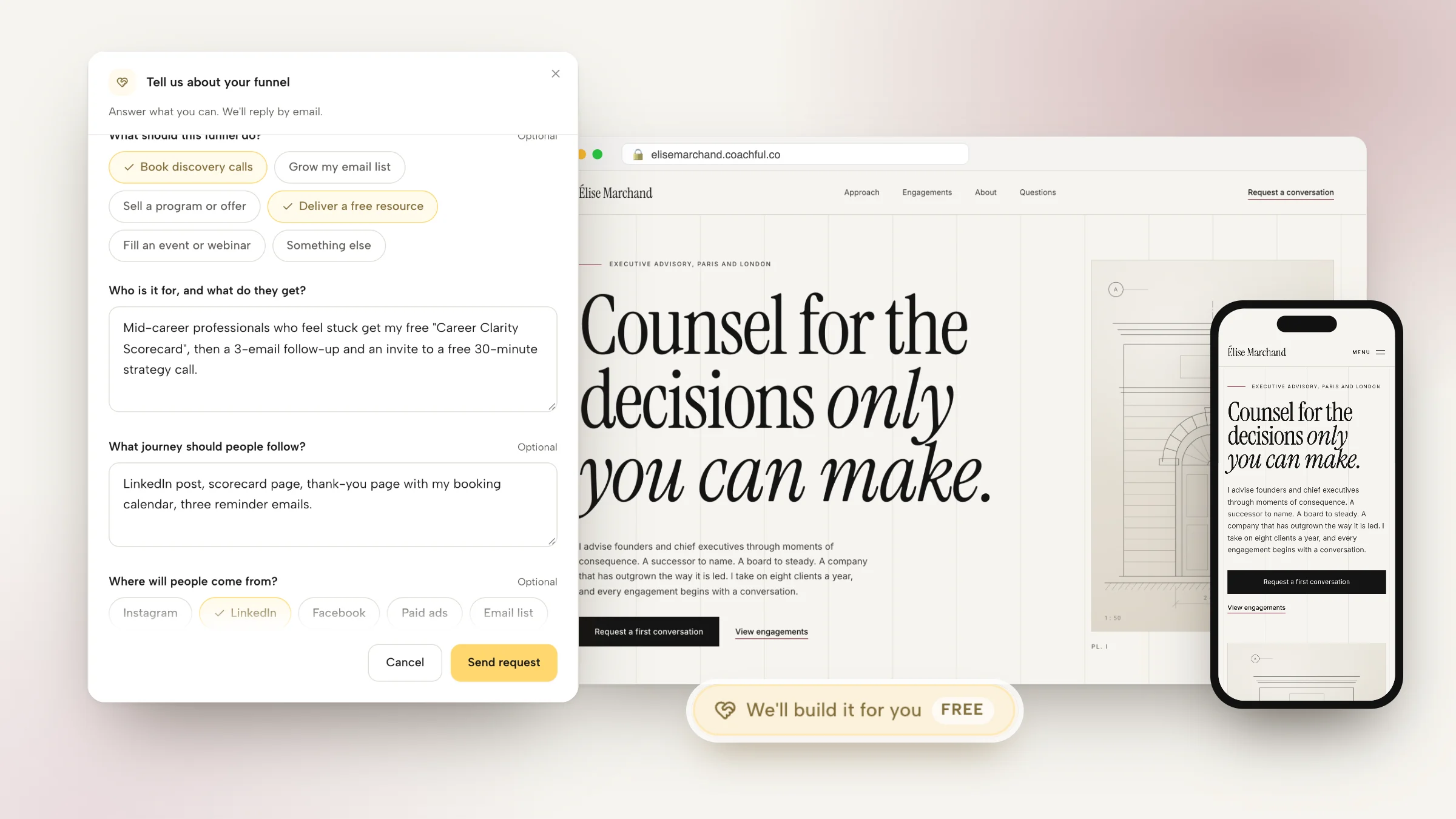
Coachful’s demo provides real form, program, scheduling, team and payment surfaces to examine against that checklist. The screenshots above show those workspaces, not a promise that a particular quote, licensing rule or procurement process is automatically enforced.
If you are evaluating software for this work, Try the interactive demo with one actual workshop brief beside you. Check how you would organize its materials, delivery and payment administration, then identify which contract and purchasing steps still need your own process. That is a more useful test than browsing without an engagement to fulfill.
Frequently asked questions
How much should I charge for a half-day corporate workshop?
There is no defensible universal fee established by this guide. Estimate the complete workload and costs, compare relevant alternatives in your market, and quote a clearly bounded engagement. “Half-day” describes delivery time, not the total work required.
Should I show the company my internal hourly calculation?
You can explain development and delivery components without handing over your entire cost model. The buyer needs a clear total, deliverables and terms. Your internal calculation is primarily a viability check, not proof of the value to the company.
Should a larger group always cost more?
Not automatically in direct proportion to attendance. Larger groups may change facilitation, materials, support and staffing. Quote the design you can deliver rather than offering the same personal experience to an unlimited number of people.
Can I charge less for a repeat workshop?
Yes, when there is genuinely less development or administration. Recheck the audience and brief first. A new sponsor, new scenarios or a request for broader recording rights can make an apparent repeat a different engagement.
Price the work you are agreeing to do, and put the boundaries where the buyer can see them. A workshop fee is sustainable when the company understands the purchase and you can deliver it without subsidizing hidden commitments.