
How to Earn 20k a Month as a Coach in 2026

Coachful

You've got a full calendar, a growing audience, and a bank account that still doesn't reflect the value you create. You add another certification, publish more content, and accept another low-priced client, yet your monthly revenue remains stuck. The uncomfortable question isn't whether you're working hard enough. It's whether your coaching business was designed to reach $20,000 a month.
That target means about $240,000 a year before taxes, a level far above typical coaching income. The International Coaching Federation's 2023 Global Coaching Study reports average annual U.S. coaching income of $52,800, while a 2025 NBHWC annual survey says 67% of full-time coaches earn between $50,000 and $99,999 annually. Earning $20k a month requires a different business architecture, not just more sessions.
The Real Reason Most Coaches Never Hit 20k a Month
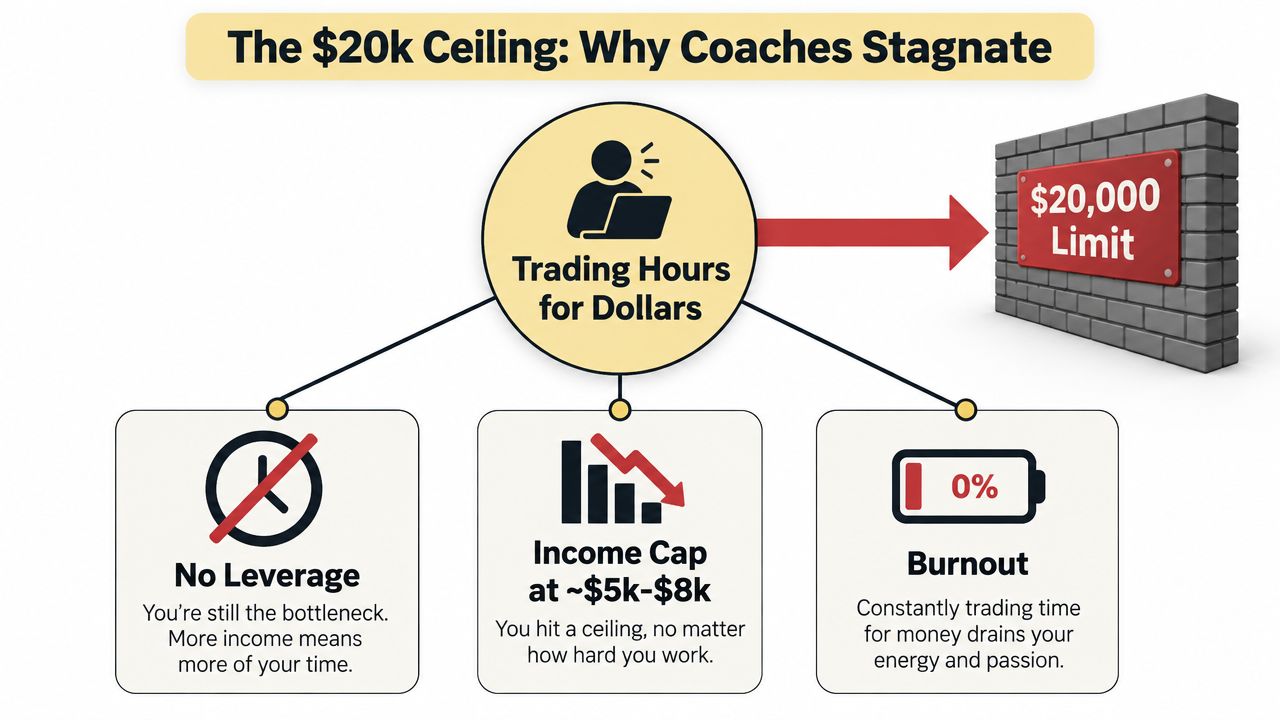
Most coaches carry a quiet fear: “If I stop taking sessions, my income stops.” That fear drives decisions that feel safe but create a permanent ceiling. You charge by the hour, fill every available slot, answer clients at all times, and call the resulting exhaustion dedication.
The problem isn't a lack of effort. It's a model built around trading time for money.
A coach with underpriced sessions can increase volume only until the calendar is full. A coach relying on one source of leads suffers whenever that channel slows down. A coach delivering everything manually turns every new client into more work. A coach who doesn't calculate renewals must replace revenue repeatedly instead of building on it.
The four traps behind the ceiling
- Underpriced delivery: A low session price forces you to sell more hours instead of improving the economics of each client.
- Single-channel lead flow: Followers, referrals, or one advertising platform can't provide dependable revenue alone.
- Manual fulfillment: If every intake, reminder, worksheet, and follow-up depends on you, growth consumes your coaching capacity.
- Missing retention math: Without renewal dates, engagement tracking, and a clear next step, clients leave before your revenue becomes predictable.
The difference between a hustle-first practice and an architecture-first practice is simple. In the first, the founder's calendar is the business. In the second, the founder owns an offer system, pricing ladder, retention process, and delivery model that can support revenue beyond individual availability.
Strategic rule: If acquiring one new client creates more delivery pressure than profit, the offer needs redesigning before the marketing needs scaling.
This is why more followers rarely solve the problem. A large audience can still produce weak revenue if the offer is vague, the price is defensive, and the sales process attracts people who can't or won't commit. Conversely, a focused niche with a clear outcome can support premium pricing and stronger retention without requiring celebrity-level reach.
The rest of the path is reverse engineering. You'll choose the price, client count, close rate, delivery hours, and retention target first. Then you'll build acquisition and operations around those numbers. $20k a month isn't a heroic marketing event. It's the result of choosing input variables that work together.
Reverse-Engineering the 20k Monthly Revenue Equation
Revenue targets become manageable when you define the operating model behind them. Start with the equation:
Clients × Price = Monthly Revenue
Then connect revenue to sales activity:
Qualified opportunities × Close rate × Price = Revenue required
At a 25% close rate, a coach selling a $4,000 package needs 5 closed clients to generate $20,000 gross revenue. That requires roughly 20 booked sales calls. The high-ticket coaching benchmarks place typical close rates in the 15% to 25% range.
Change the offer and the business architecture changes with it. A $2,500 monthly retainer requires 8 active clients. A $1,000 package requires 20 clients. A group offer priced at $1,500 per seat requires roughly 14 seats. The revenue target stays constant, while sales volume, delivery time, and retention pressure shift.
| Delivery Model | Price Per Client | Active Clients Needed | Monthly Delivery Hours | Required Close Rate |
|---|---|---|---|---|
| Premium 1:1 retainer | $2,500/month | 8 | 8 to 12 hours/month for 8 clients at biweekly sessions plus async support | 15% to 25% |
| Mid-tier package | $1,000 | 20 | 16 to 20 hours/month for 20 clients at monthly sessions | 15% to 25% |
| Group cohort | $1,500/seat | 14 | 12 to 16 hours/month for shared sessions, office hours, and support | 15% to 25% |
| Hybrid model | Two premium clients plus 8-seat cohort | Depends on the remaining offer price | 10 to 14 hours/month for two private clients plus one cohort | 15% to 25% |
The decision is operational, not motivational. Choose the combination of price, roster size, delivery hours, and renewal rate that you can sustain without turning every new sale into a scheduling problem.
Use delivery hours as a constraint
A premium retainer with one private session and structured asynchronous support can produce strong revenue with eight clients. The support boundary must be explicit. Unlimited messaging converts a retainer into hourly work, even when the contract uses a monthly fee.
Group delivery changes the capacity calculation. Fourteen clients create more relationships to manage, but shared teaching, office hours, templates, and peer accountability can reduce repeated explanations and improve delivery efficiency.
The consulting benchmark on premium retainers makes a related point for expert services. Experienced consultants often price retainers between $12,000 and $20,000 monthly, while another industry source reports that 38% of consultants earn $10,000 or more per month. Coaches can apply the same principle by packaging expertise around a defined outcome rather than selling isolated access.
Build the model in a spreadsheet with four inputs: average revenue per client, active clients, delivery hours per client, and renewal rate. Reject any version that depends on a packed calendar or unlimited access. The right model raises revenue while keeping the added operational load below the added revenue.
Pricing for Profit Instead of Pricing for Fear
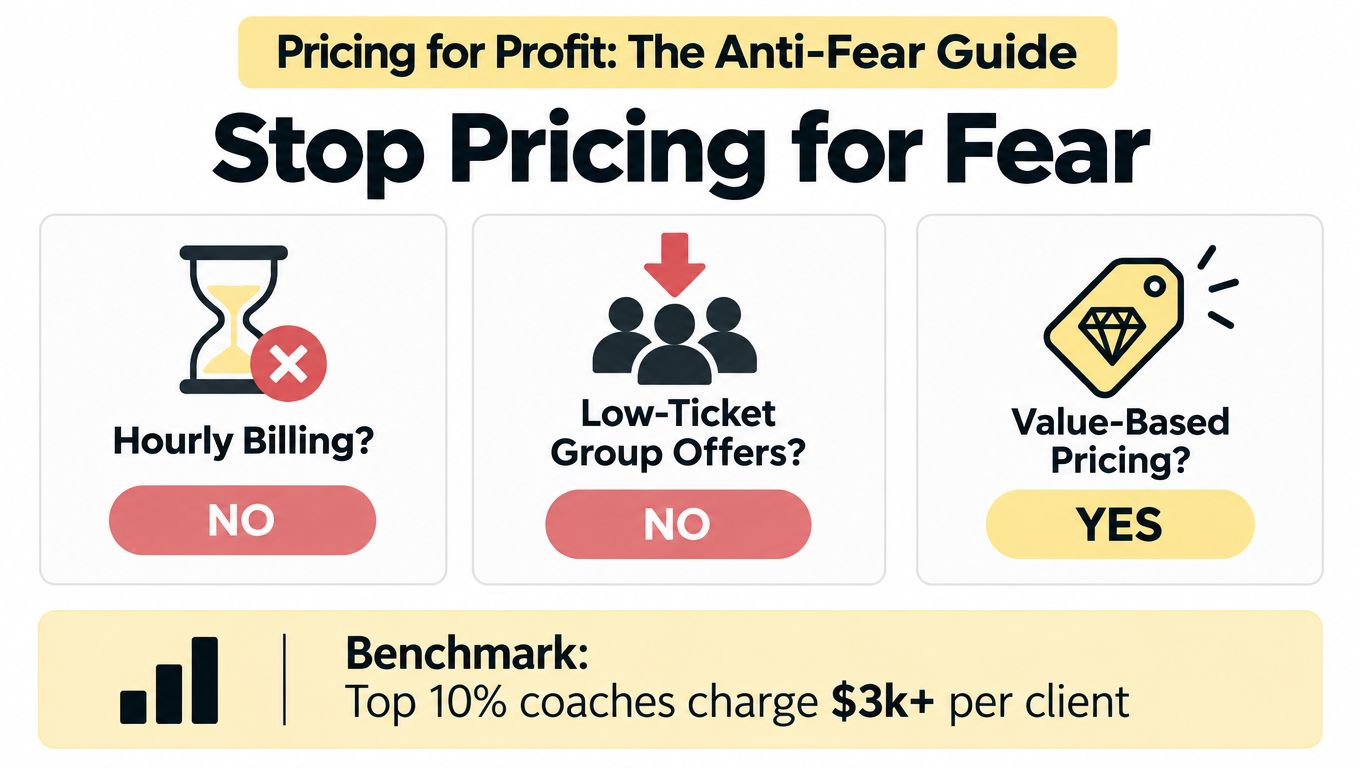
Hourly pricing feels easy to explain, but it makes your income dependent on availability. Independent coaching rate data places business and executive coaching around $272 to $293 per hour, while premium executive programs can reach $50,000 to $100,000 or more, according to independent coaching profitability benchmarks. Those price differences reflect packaging and perceived business impact, not merely the minutes spent in a call.
Fear-based pricing usually comes from three thoughts:
- “People won't pay more.” Often, the offer hasn't made the cost of the client's current problem clear.
- “My competitor charges less.” That competitor may serve a different segment, deliver less access, or have a weaker margin.
- “A lower price will create volume.” Volume only helps when your fulfillment model can handle it profitably.
Price the transformation, not the appointment. A coach helping an executive prepare for a critical leadership transition isn't selling a collection of calls. A business coach helping a founder improve decision-making isn't selling calendar time. The offer should define the outcome, process, access rules, and evidence of progress.
For a deeper treatment of this principle, review outcome based pricing explained. Then audit your own offer against the 2026 coaching program pricing guidance.
Restructure the offer before chasing new buyers
Take a practice charging $97 per session. The coach might convert part of that service into a $497 monthly retainer, then create a $2,000 high-ticket option with a more defined outcome, stronger support, and a clear completion point. The same client base can produce three to four times the revenue without acquiring new customers, provided the new packages solve a more valuable problem and the coach can deliver them consistently.
That doesn't mean every client should be pushed into the premium tier. It means your business needs a ladder:
- An accessible entry experience that demonstrates your method.
- A structured core offer that creates predictable monthly revenue.
- A premium engagement for clients who need speed, depth, or greater access.
Online coaching benchmarks list monthly retainers between $500 and $2,000, group coaching between $200 and $800 per month, and masterminds between $500 and $2,500 per month in common pricing models, as summarized by online coaching business benchmarks. Use those ranges as market context, not as a substitute for positioning.
Run a one-hour pricing audit. Write down the promise, delivery hours, client outcome, renewal path, and margin for every offer. Remove offers that attract high-support clients at low prices, and stop calling an hourly rate a business model.
Building a Client Acquisition Engine That Converts
If your content attracts attention but your calendar fills with poor-fit calls, the problem is architectural. The acquisition system is creating activity without producing qualified buying opportunities. A post can earn likes, and a lead magnet can collect email addresses, while serious prospects still lack a clear path to a paid engagement.
Build the system in layers. Warm channels include LinkedIn, podcast guesting, YouTube SEO, and referral partners. Search-led channels include long-form articles and lead magnets aimed at high-intent queries. Paid channels include Meta ads, Google lead generation, and YouTube ads. Choose one channel from each category only after you can explain which offer it supports.
Track performance by source, offer, call attendance, proposal, close, collected revenue, and renewal. Do not assign reach or cost targets before you have reliable data. The first job is attribution. Vanity traffic cannot tell you whether the business model works.
Design the sales path around qualification
A three-call sales architecture separates serious prospects from people who are curious but unready to buy:
- Qualification call: Confirm the problem, urgency, decision process, and fit.
- Story call: Examine the client's current situation, desired outcome, and consequences of inaction.
- Close call: Present the offer, address relevant objections, and agree on payment and start date.
For a $3,000 to $5,000 offer, use the documented 15% to 25% close-rate range as an initial planning assumption. Replace it with your own results once you have enough conversations. A lower close rate requires more qualified opportunities. A higher rate usually reflects sharper positioning, stronger qualification, and better preparation before the call.
| Channel | Monthly Reach | Cost Per Qualified Call | Best Offer Fit |
|---|---|---|---|
| LinkedIn and referrals | Track from owned audience and partners | Track actual spend and time | Premium 1:1 and consulting |
| Podcast guesting | Track episode-specific inquiries | Track preparation and follow-up cost | Authority-led premium offers |
| YouTube SEO | Track search-led inquiries | Track production cost | Evergreen programs |
| Long-form SEO and lead magnets | Track qualified submissions | Track content and software cost | Structured packages |
| Paid advertising | Track impressions and qualified calls | Track campaign spend | Offers with proven conversion |
Client acquisition cost varies by offer, market, and channel. Paid traffic can cost substantially more for high-ticket coaching, so do not purchase visitors for an untested offer. Validate the promise, sales path, and delivery economics first.
Use an attribution sheet with the lead source, first-touch content, booked date, attendance, offer discussed, decision, revenue, and renewal. If you need help to scale lead gen with SupportGPT, use automation for qualification and follow-up. It should support a clear offer, not compensate for a weak one.
For a practical acquisition workflow, review client-on-demand strategies. Test one warm channel, one search-led content channel, and one referral loop in the first month. Add paid traffic only after qualified conversations convert consistently. That sequence protects cash flow while showing which parts of the system deserve more investment.
Choosing the Right Delivery Model for Sustainable Scale
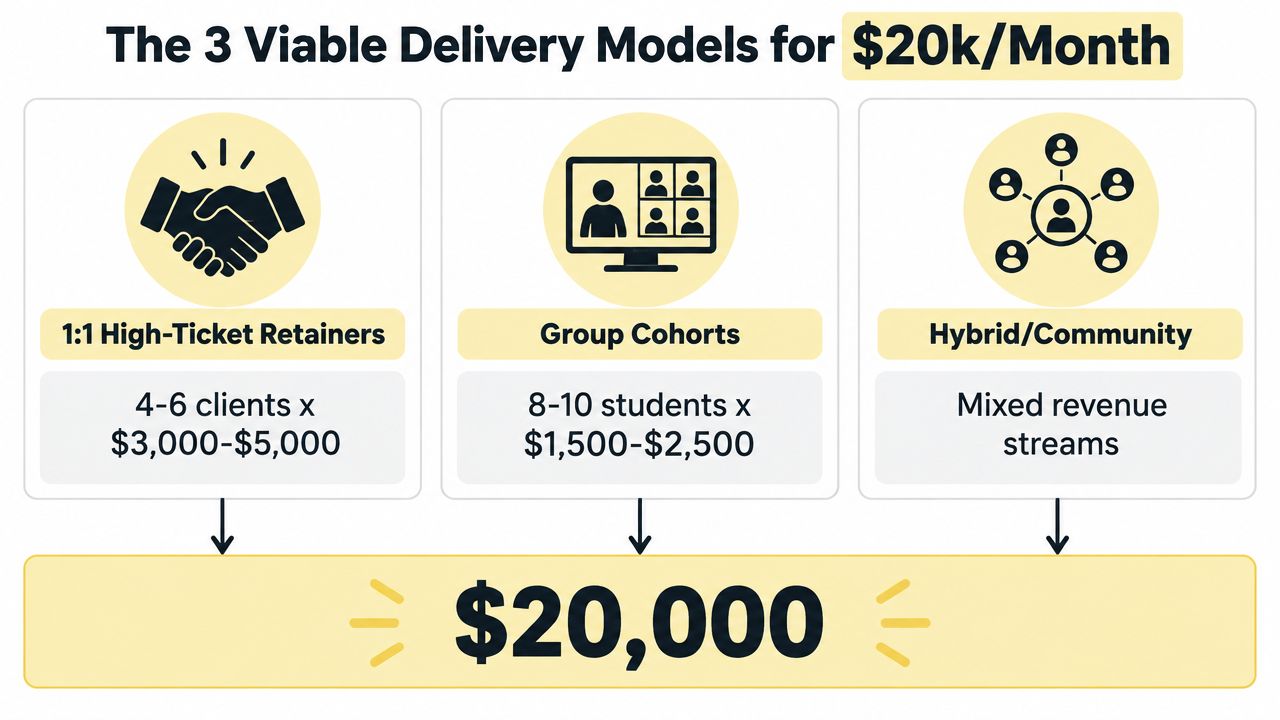
There are three delivery models that can credibly support $20k monthly revenue. None is automatically superior. The right choice depends on your niche, client expectations, current capacity, and willingness to standardize delivery.
1:1 high-ticket retainers offer control and depth. Four to six clients paying $3,000 to $5,000 per month can reach the target, but the coach must protect boundaries around access and preparation. This model works well for executive, business, and performance coaching where the client values privacy and customization.
Group cohorts build momentum. A cohort priced at $1,500 to $2,500 per seat with 10 to 15 participants, run periodically, can produce substantial revenue without repeating the full coaching process for every client. Group delivery requires curriculum design, community management, and facilitation skill. It isn't a cheaper version of 1:1 coaching.
Hybrid practices combine a small premium roster with group or community revenue. A coach might deliver private intensives, run a recurring group, and reserve a small inner-circle offer for clients who want direct access. This structure spreads revenue risk and gives clients a logical next step.
Retention beats constant replacement
A coach who renews 80% of clients on a $4,000 retainer has a stronger foundation than one who constantly replaces every client at the same price. The renewal conversation should begin before the final session. Review progress, identify unfinished outcomes, and define the next measurable phase of work.
Introduce a second offer only when the first one delivers consistently. A scattered value ladder weakens your positioning. A connected ladder strengthens it because every offer answers a different stage of the same client journey.
Use this decision matrix:
| Model | Capacity Ceiling | Margin Profile | Fulfillment Efficiency | Best Fit |
|---|---|---|---|---|
| 1:1 retainers | Limited by private access | Strong when priced well | Moderate | High-stakes transformation |
| Group cohorts | Higher participant capacity | Strong after curriculum exists | High | Repeatable shared outcomes |
| Hybrid | Flexible and diversified | Depends on offer mix | Moderate to high | Coaches ready to segment delivery |
A group or hybrid model doesn't excuse weak delivery. It demands clearer curriculum, stronger onboarding, and better engagement tracking. The goal is not to avoid clients. It's to stop rebuilding the business from zero every month.
Operational Systems That Protect Your Time and Revenue
Revenue leaks through broken client journeys. A prospect pays, waits for a welcome email, struggles to book, misses the intake process, and starts the engagement uncertain about what happens next. The coach then spends valuable time fixing avoidable confusion.
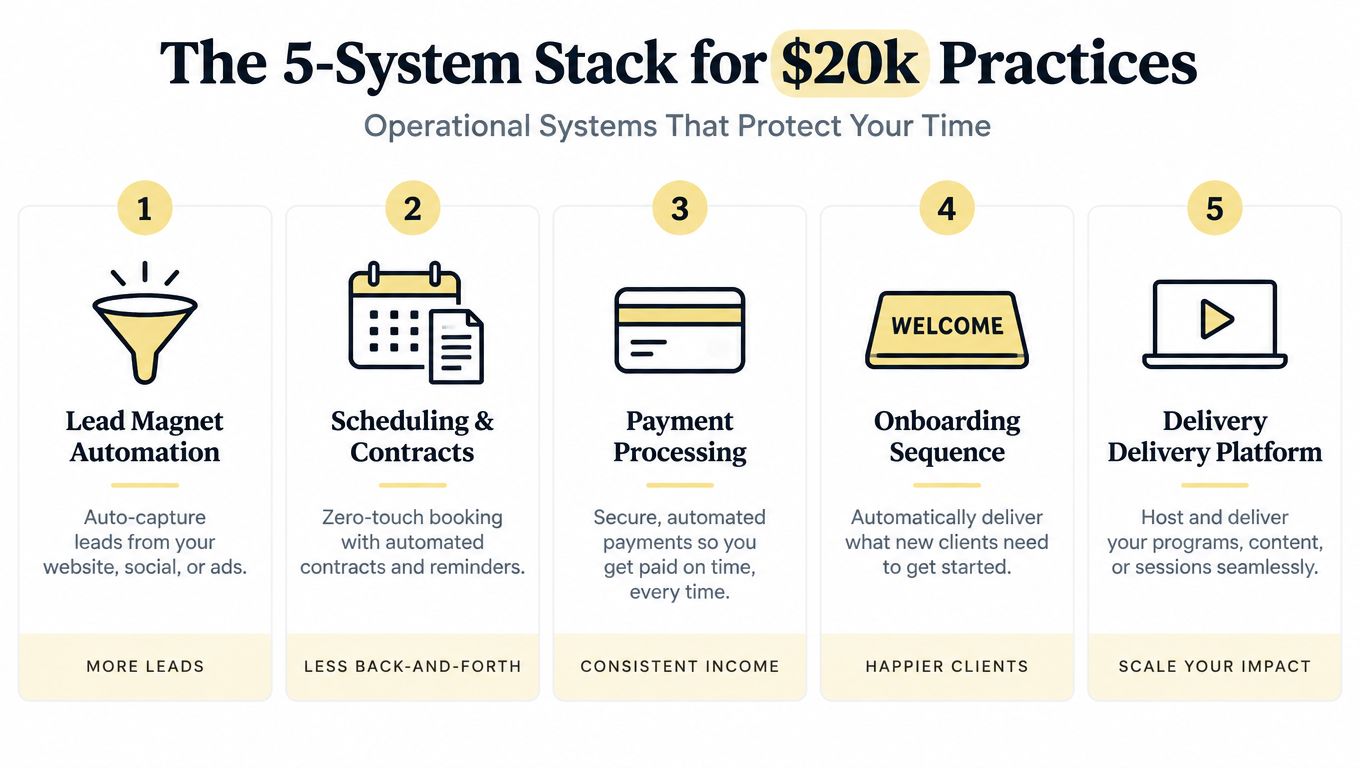
A $20k practice needs five connected systems.
- Onboarding: Send intake forms, expectations, agreements, payment confirmation, and the first scheduling instruction immediately after purchase.
- Scheduling: Use Calendly or SavvyCal with buffer rules, payment-on-booking, and a written rescheduling policy.
- Billing: Use Stripe or similar payment processing for automatic charges, failed-payment recovery, and annual prepay options.
- Client tracking: Store offer type, renewal date, engagement status, and progress notes in a lightweight CRM.
- Delivery: Standardize agendas, Loom feedback, resource sharing, and asynchronous support windows.
Document the client journey
Create one SOP for every repeated handoff. Include the trigger, owner, tool, deadline, message template, and exception process. If a sale triggers three separate manual tasks, automate the predictable parts and reserve human attention for judgment.
Delegate administration first. Scheduling, reminders, onboarding administration, and invoice follow-up rarely require the coach's expertise. A part-time operations hire may cost roughly $1,500 to $2,500 per month, so treat that expense as a capacity investment only after the process is documented and the revenue model supports it.
A platform such as Coachful can bring booking, payments, programs, courses, community, messaging, and progress tracking into one workspace. Coaches can also use automation for coaches to identify repetitive tasks worth removing from their weekly workload.
Before scaling beyond five active clients, confirm that you have:
- A payment workflow: Automatic billing and failed-payment follow-up.
- A contract process: Signed agreements before delivery begins.
- An intake form: Goals, context, constraints, and readiness captured early.
- A scheduling rule: Buffers, cancellations, and reschedules defined.
- An onboarding sequence: Welcome, expectations, resources, and first action.
- A session template: Consistent preparation and progress review.
- A renewal tracker: Next decision date visible before the final session.
- A support boundary: Clear response windows and communication channels.
Systems don't make coaching impersonal. They prevent administrative disorder from consuming the attention clients are paying for.
Your 90-Day Plan to Reach 20k a Month
Start with a model, not a motivational promise. Your first 30 days should prove that the offer can sell and that you can deliver it without creating chaos.
Days 1 to 30
Week one: Choose one audience, one urgent problem, and one outcome-specific offer. Set the price and define what's included, what isn't, and what the client should be able to do by the end.
Week two: Build one landing page with the problem, promise, process, proof you can substantiate, fit criteria, price, and call booking link. Install payment and scheduling tools before you start promoting.
Week three: Run 5 to 10 discovery calls to test the message and close rate. Ask prospects what they believe the problem costs them, what they've tried, and what would make the engagement worthwhile.
Week four: Review the evidence. If qualified prospects understand the offer but don't buy, fix positioning, price framing, qualification, or risk reversal. Don't buy more attention until the conversation works.
Days 31 to 60
Publish two SEO articles weekly around high-intent coaching problems. Each article should lead to one relevant next step, not a menu of disconnected offers. Begin one paid traffic channel with a $30 to $50 daily budget, but pause it if the cost of qualified conversations or sales is moving outside your model.
Onboard your first three paying clients with the same process. Record every repeated question. Turn those questions into onboarding messages, FAQs, worksheets, and session resources.
Days 61 to 90
Double down on the channel that produces the strongest qualified conversations, not the most clicks. Introduce a group or hybrid tier only when your core offer has a clear delivery process and clients need a logical next step.
Document onboarding, delivery, and renewal SOPs. Review the following checklist at the end of the sprint:
- Offer: Is the outcome specific and valuable?
- Price: Does revenue support delivery and operating costs?
- Channel: Can you identify where each serious prospect came from?
- Close rate: Are qualified calls converting within the modeled range?
- Retention: Does every active client have a defined renewal path?
- Capacity: Can you fulfill the promise without unlimited access?
- Operations: Can another person execute the administrative workflow?
- Decision trigger: If the model misses its targets, have you paused paid spend and fixed the funnel?
The coach who reaches $20k a month usually stops asking which tactic will save the business. They choose a profitable offer, sell it through a measurable process, deliver it with boundaries, and retain clients through a deliberate next phase.
Coachful gives coaches a workspace for booking, payments, programs, courses, community, messaging, and progress tracking, so you can build the operational layer behind a scalable coaching offer. Visit Coachful to see whether it fits the delivery model you're building.