
Build a Client on Demand System for Your Coaching Business

Coachful
Some weeks you feel like a real business owner. Calls are booked. New inquiries come in. Clients are paying on time. You finally relax a little.
Then the calendar thins out.
You check your DMs, email, Stripe, and booking page more than you want to admit. You tell yourself you need to post more, network more, maybe run a webinar, maybe rewrite your offer, maybe start over entirely. That feast or famine cycle wears coaches down because it creates two problems at once. It hurts cash flow, and it destroys focus.
What most coaches call a lead problem is often a systems problem. They can attract interest, but they can't consistently capture it, qualify it, convert it, onboard it, and turn it into a client experience strong enough to create renewals and referrals. That's where a real client on demand system matters. Not as a gimmick. As infrastructure.
Ending the Feast or Famine Cycle for Good
A coach gets three discovery calls from one LinkedIn post. Two buy. The month feels saved.
The next month, nothing happens.
So she posts harder, changes her headline, tries a free challenge, then starts doubting her niche. None of those moves solve the actual issue. She doesn't have a repeatable way to create demand, respond fast, guide the prospect into a decision, and deliver a smooth start once they say yes.
A client on demand business starts by ending randomness. You stop relying on occasional bursts of visibility and start building a system that keeps working when you're coaching, traveling, or not in the mood to manufacture urgency on social media.
That matters even more now because the market is more crowded. The International Coaching Federation's 2023 study found that the number of coaches worldwide grew by 54% from 2019 to 2023 (International Coaching Federation global coaching study). More coaches can still mean more opportunity. It also means your business needs better structure than it did a few years ago.
What feast or famine usually looks like
- Marketing only when you're scared: You disappear when client work gets busy, then panic-market when revenue dips.
- No follow-up rhythm: Interested leads don't hear from you again unless you manually remember.
- Messy handoff after the sale: A new client pays, then waits for forms, links, next steps, and clarity.
- No retention system: Every month starts from zero because referrals and renewals happen by accident.
The most expensive leak in a coaching business usually isn't visibility. It's the gap between interest and a well-managed client journey.
If that sounds familiar, you're not broken. You're under-systemized.
For many coaches, the first practical fix is simple. Build an audience asset you own, not just rented attention on social platforms. Coachful's email list building guide is useful if your pipeline currently depends too heavily on algorithm swings.
The Real Meaning of Client On Demand
A lot of coaches hear "client on demand" and immediately resist it. Fair enough. It can sound like manipulative internet marketing language, or a promise that you push a button and a buyer appears.
That's not what serious operators mean.
A real client on demand system is a low-friction demand capture and delivery system. It helps the right people find you, understand your offer, take the next step quickly, and feel taken care of from first inquiry through onboarding and delivery.
It's not a vending machine
Think of a chef with a well-run kitchen. The meal still takes skill. The ingredients still matter. But the prep is done, the stations are organized, and service doesn't collapse when five orders come in at once.
Your coaching business works the same way.
If someone finds your podcast interview, clicks to your site, fills out an inquiry form, and then waits a day or two for a reply, you've introduced friction at the worst possible moment. The core principle of a successful on-demand model is minimizing friction and response time, with systems designed to automate first responses and simplify access so people don't give up and move on (Working Solutions on successful on-demand customer care).
What coaches get wrong
Many coaches think being good at coaching should be enough. It isn't. Prospects don't experience your wisdom first. They experience your process first.
They notice things like:
- How quickly they hear back
- Whether booking is simple
- If your offer is clear
- Whether your intake feels personal or generic
- If the next step is obvious
A vague "message me if interested" approach doesn't create trust. It creates work for the lead.
Client on demand without becoming pushy
You don't need aggressive scripts, fake scarcity, or daily hard closes.
What works better is:
- Clear positioning so the right person knows you're for them.
- A simple call to action so they know what to do next.
- A fast response path so interest doesn't cool off.
- A guided sales process that qualifies instead of pressures.
- A strong handoff into delivery so the client feels relief, not uncertainty.
If your sales process feels pushy, the problem usually isn't the process itself. It's poor qualification, weak messaging, or an offer that isn't defined well enough.
Client on demand is not about hunting strangers all day. It's about building a business where demand can be captured and converted consistently because the path is clear.
Four Proven Client On Demand Models
There isn't one universal model. There are four that show up again and again in coaching businesses. The best one depends on your strengths, your stage, and how quickly you need traction.
Paid ads
This suits the coach who has budget, a proven offer, and no interest in waiting six months for organic reach.
A practical example: an executive coach runs ads to a short application page for a leadership intensive. Prospects read the page, watch a brief video, and apply for a consult. This can work well when your niche is clear and your sales conversation is strong.
Trade-offs matter here.
- What works: Fast testing, predictable volume, and clear data on which message attracts attention.
- What fails: Running ads to a weak offer, a generic homepage, or a booking link with no context.
- Best fit: Established coach, premium offer, willingness to spend to learn.
Sales funnels
Funnels suit the systems-minded coach who wants automation to do some of the lifting.
A common version is simple. A lead magnet, email nurture, case-for-change content, then a consult invite. Another version is a webinar funnel for a group program. The goal isn't complexity. It's sequencing.
For example, a health coach might offer a short training on why clients keep losing momentum after week three. The funnel educates, qualifies, and then invites the right people to a program.
What coaches often miss is that a funnel is not the business. It's one path into the business.
Organic systems
This is the best fit for the coach who can communicate clearly in public and build trust over time.
Organic doesn't mean random posting. It means a structured content engine tied to one audience, one problem set, and one next step. A relationship coach might publish short posts, a weekly email, and host a recurring Q&A. Each asset points to one action, such as an application or consultation.
Organic works when your content answers the exact questions people ask before buying. It fails when content is broad, inspirational, and disconnected from an offer.
This model rewards consistency. It punishes inconsistency.
Strategic partnerships
This model is often underrated. It works especially well when your ideal clients already trust another person or organization.
Examples:
- A career coach partners with recruiters
- A burnout coach builds referral relationships with therapists
- An executive coach partners with HR consultants or leadership trainers
The advantage is borrowed trust. The downside is slower setup and the need for clear boundaries, referral expectations, and offer fit.
A quick reality check on each model
| Model | What it looks like in practice | Best for | Main risk |
|---|---|---|---|
| Paid ads | Ads to application or booking process | Coaches with budget and a validated offer | Paying to amplify weak messaging |
| Sales funnels | Automated nurture toward a consult or program | Coaches who like systems | Overbuilding before validating |
| Organic systems | Content, email, and community-based demand | Coaches with time and communication skill | Inconsistent execution |
| Strategic partnerships | Referral channels through aligned professionals | Coaches strong at relationships | Relying on partners without a formal process |
Which On-Demand Model Fits Your Coaching Business
Most coaches don't need more options. They need fewer wrong ones.
Selecting the wrong client on demand model leads to significant internal frustration. You purchase software prematurely. You spend money on advertisements before your message is sharp. You commit to content before you have a true publishing rhythm. Then you assume the strategy failed, when the actual issue was fit.
Choosing your client on demand model
| Model | Best For | Upfront Cost | Time Investment | Speed to Results |
|---|---|---|---|---|
| Paid Ads | Coaches with a validated offer and available budget | High | Medium | Fast |
| Sales Funnels | Coaches who want automation and can create structured assets | Medium | High upfront, lower later | Medium |
| Organic Systems | Newer coaches or coaches with more time than money | Low | High and ongoing | Slower at first |
| Strategic Partnerships | Coaches with strong networks or a clear referral ecosystem | Low to Medium | Medium | Medium |
The practical way to decide
If you're newer, don't let impatience push you into complexity. Organic plus a simple email follow-up system is often the cleanest starting point.
If you've already sold your offer multiple times and know who buys, paid acquisition can make sense. Not because ads are magic. Because you now know what message and promise deserve amplification.
If you're strong on camera, in writing, or in teaching, build around that. If you're great in private rooms and referral conversations, build around partnerships. A client on demand model should fit your strengths enough that you'll maintain it when business gets busy.
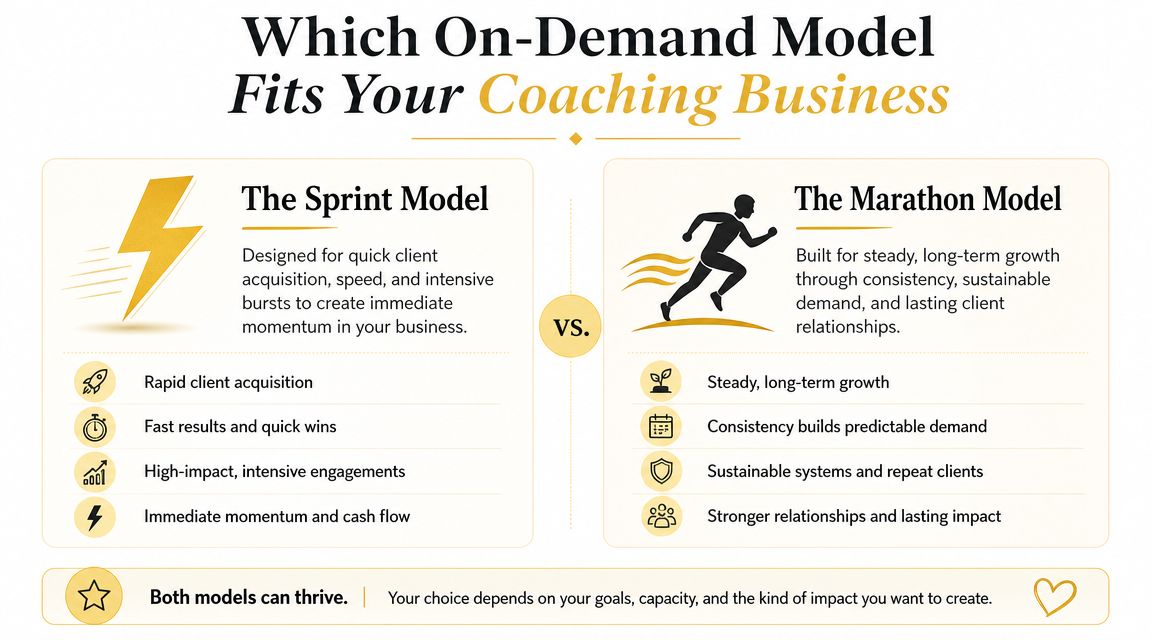
Two broad growth paths
The sprint model
This is the faster path. It often combines paid traffic, a focused offer, and a direct consultation process.
Use it when:
- you need pipeline faster
- your pricing supports acquisition costs
- you can handle consult volume
- your onboarding is already clean
The marathon model
This path relies more on audience building, reputation, and compounding trust assets.
Use it when:
- you're still refining your niche
- you want lower cash risk
- you enjoy content and community
- you're building long-term authority
Pick the model you can run consistently for the next two quarters, not the one that sounds most exciting today.
Design Your Irresistible On-Demand Offer
A client on demand system can't save a confusing offer.
Many coaches package their work around sessions because that's how they deliver, not because that's how clients buy. Clients don't wake up wanting "twelve calls and Voxer access." They want movement. Relief. Confidence. A result they can describe to themselves and justify to someone else.

A strong offer makes the rest of your system lighter. It improves messaging, shortens sales calls, and gives onboarding a clear destination.
The four-part offer structure
The promise
State the change, not the container.
Weak version: six one-to-one coaching sessions for ambitious professionals.
Stronger version: build decision-making confidence in your first season as a new manager.
The second one gives the buyer something to want.
The process
You do need a method, but don't drown people in modules and proprietary language.
Use plain structure:
- kickoff and assessment
- weekly coaching
- between-session accountability
- implementation support
- progress review
That tells the buyer what happens without making them decode your framework.
The proof
Proof can include testimonials, patterns you've seen, clear examples of client situations you solve, or visible thinking in your content. It doesn't have to be dramatic. It has to reduce uncertainty.
Many coaches undersell themselves by hiding practical evidence behind abstract language.
The offer starts the client experience
Research highlighted on Clients on Demand notes that 70% of consumers say the experience a company provides is as important as its services, and 89% are more likely to buy again after a positive customer service experience. For coaches, that means the offer itself has to prepare the client for a smooth experience, not just a sale.
If your offer promises intimacy and clarity but your intake is clunky, your trust drops before the first session.
A helpful companion to this is this scalable coaching guide by Coachful, especially if you're trying to package expertise into something that can be sold and delivered without reinventing it every time.
Keep it simple enough to say yes to
Watch this and then review your current offer with one question in mind. Is it easy to understand why someone would buy now?
A good offer usually passes three tests:
- It names a real problem: The buyer can recognize themselves quickly.
- It shows a believable path: The process feels structured, not vague.
- It feels deliverable: You can fulfill it consistently without customizing everything.
Operationalize Your System With Coachful
Most client on demand advice gets thin at this point. A lead comes in, books a call, buys, and then what?
If the answer is "I send a few emails, a Stripe link, a Zoom link, a PDF, and try to remember what happens next," you don't have an operational system. You have a personal memory test.
Speed matters before and after the sale
Flowlu's sales statistics compilation reports that leads are 9 times more likely to convert when contacted within five minutes (Flowlu sales statistics). For coaches, that doesn't mean you personally need to reply instantly at all hours. It means your system needs to acknowledge interest, route the lead, and move them toward the next step without delay.
That's the operational gap. Not more motivation. Better plumbing.
What the system actually needs to do
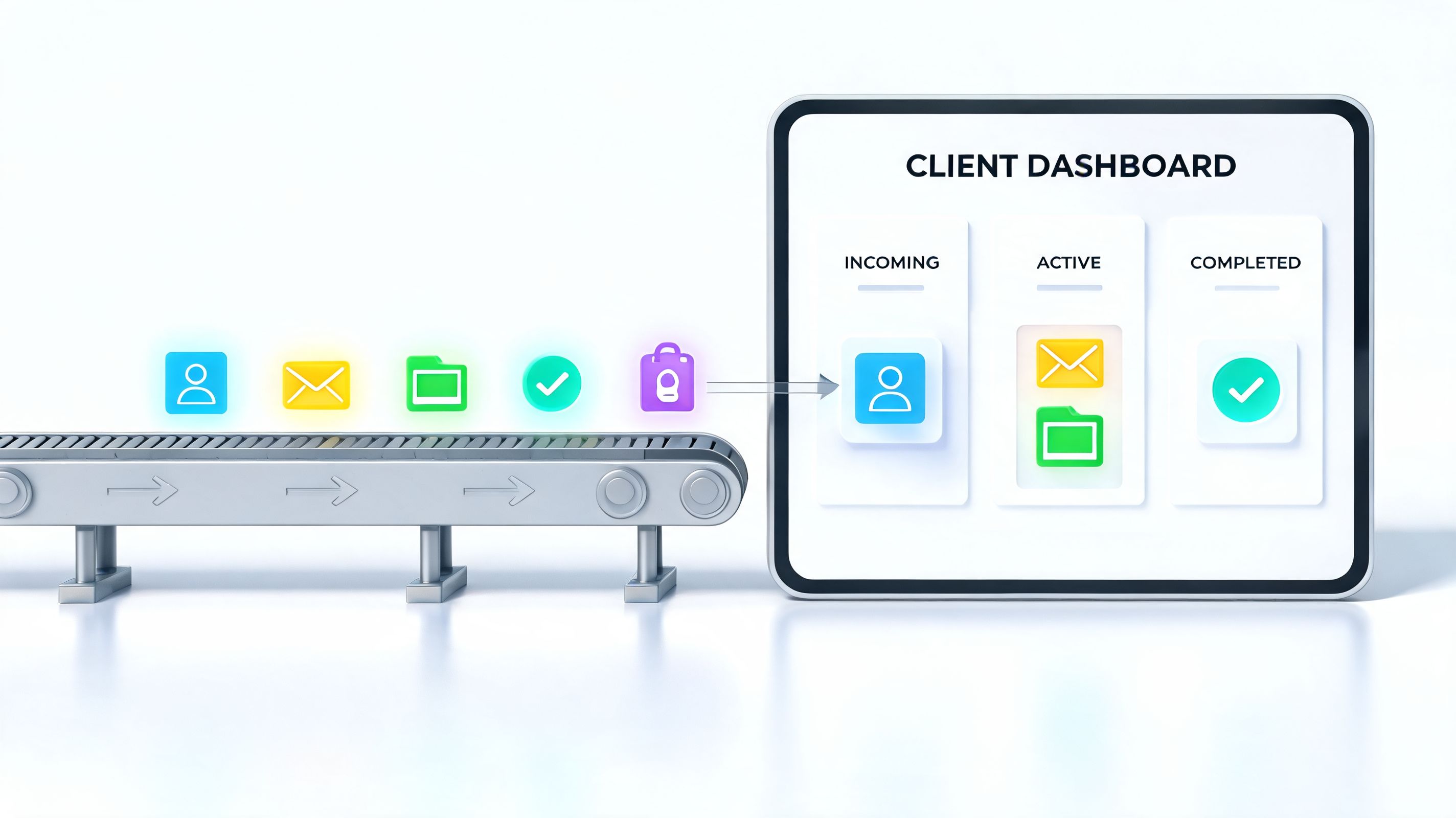
At minimum, your stack needs to handle these handoffs:
Inquiry to response
Auto-confirm the inquiry, set expectations, and present the next step.Response to booking
Give the prospect a friction-light booking path with clear call context.Sale to onboarding
Trigger payment, agreement, intake, welcome materials, and scheduling.Onboarding to delivery
Organize notes, goals, resources, and client communication in one place.Delivery to retention
Track progress, prompt renewals, and create a clean referral path.
Why platforms matter
This is the point where piecing together Calendly, Zoom, Stripe, Google Docs, email templates, and scattered notes starts to cost you real money and attention.
A platform like coachful can centralize booking, onboarding, payments, messaging, progress tracking, and program delivery so the client journey doesn't fracture across tools. That's useful when you want the sales-to-service handoff to feel calm and professional rather than improvised.
A scalable coaching business is usually less about doing more marketing and more about making sure each next step happens without manual rescue.
If you're still early, keep your system lean. If you're growing, remove tool sprawl before it becomes invisible drag.
How to Scale Your Coaching Practice Without Burning Out
A lot of coaches say they want client on demand. What they really want is enough demand to feel safe, but not so much that their life collapses.
That's a reasonable concern.
The answer isn't to cap growth forever. It's to scale in layers so each layer protects your time instead of consuming it.
Stop selling only hours
If every new client requires your full personal attention in the same format, your business has a ceiling.
The usual next steps are:
- Group coaching for clients with similar goals
- Cohort programs with fixed start dates and shared milestones
- Hybrid offers that combine live support with structured materials
- Digital resources that handle repeated teaching outside calls
A leadership coach, for example, might keep private coaching for senior clients while moving new managers into a cohort with shared trainings, office hours, and targeted one-to-one support. Same expertise. Better use of time.
Use technology for capacity, not noise
The useful role of AI in a coaching practice is not publishing bland content faster. It's helping you preserve quality while reducing repetitive work.
The verified data here is clear. 77% of organizations are using or exploring AI, and 65% of organizations using generative AI report that it's helped increase productivity (YouTube discussion referencing AI adoption and productivity). In practice, coaches can use AI to draft first-pass emails, personalize follow-up, summarize notes, repurpose content, and reduce admin load.
That said, buyers are more skeptical now. More automation isn't automatically better. Better qualification, cleaner messaging, and stronger proof matter more than flooding channels with content.
Protect your energy with design decisions
Burnout usually starts in one of these places:
- Too much customization: Every client gets a new process.
- Too many channels: Email, text, DMs, Voxer, Slack, and random voice notes.
- Too many decisions: No standard onboarding, renewal rhythm, or delivery format.
- Too little filtering: You accept clients you should have screened out.
If you want a practical outside resource on packaging and expansion, how to grow your coaching program offers useful context on scaling beyond pure one-to-one delivery.
Sustainable growth comes from tighter boundaries, cleaner offers, and better systems. Not from becoming available to everyone all the time.
A mature client on demand business feels different from a hustling one. Leads enter through defined paths. Qualified buyers move quickly. Clients know what happens next. You coach inside a structure that supports your work instead of leaning on your memory and goodwill.
That is how you grow without building a job you resent.
If you're ready to turn scattered admin, patchwork tools, and inconsistent handoffs into one usable coaching workflow, Coachful gives you a practical place to start. It brings onboarding, scheduling, payments, messaging, and progress tracking into one system so your client on demand process doesn't break between the sale and the actual coaching.