
Master Your Community Engagement Strategy for Coaches

Coachful
You've probably felt this in the gap between sessions.
A client leaves a call energized. They know their next step. They say they're committed. Then a week passes. Maybe they make progress, maybe they stall, maybe they disappear into work, family, and old patterns. If you run a course or group program, the problem gets louder. A few people participate. A few lurk. A few drift.
That's usually the moment coaches start thinking about community engagement strategy, then immediately resist it. Another platform. Another inbox. Another thing to maintain.
The right community isn't “more content” or a side project. It's the structure that helps clients stay in motion when you're not in the room. Done well, it creates accountability, normalizes setbacks, strengthens belonging, and gives clients a place to practice the behavior change they say they want. Just as important, it helps your business. Clients who feel supported between sessions are easier to retain, easier to renew, and more likely to refer people into your work.
Why Your Coaching Program Needs a Community
A client leaves your call clear, committed, and ready to act. Three days later, the actual test starts. They hit resistance, second-guess the plan, and postpone the uncomfortable step that would create results. Without a place to process that moment, many clients lose momentum before the next session even starts.
A community gives your program continuity. For coaches, that matters because transformation rarely comes from insight alone. It comes from repeated action, honest reflection, and enough support between sessions that clients keep going when motivation dips.

Community creates continuity
Many coaches hear “community” and picture a big, noisy audience. That model rarely helps a paid coaching program. What works is a smaller container with a clear purpose, where clients know why they should show up and what kind of participation supports progress.
In practice, clients need a space where they can stay connected to the work in simple, repeatable ways:
- Be witnessed: Share a win, roadblock, or commitment and know someone will respond.
- Borrow momentum: Seeing a peer follow through makes action feel more available.
- Get unstuck quickly: A short exchange can stop a week of avoidance from turning into a month.
- Integrate the work: Clients build new habits faster when they reflect, apply, and discuss what they are learning.
That changes the role of your program. Coaching stops living only inside scheduled calls. It becomes an environment that supports implementation.
If you're building that environment inside a coaching platform, keep the goal practical. Put coaching delivery, accountability, and conversation close enough together that busy clients will readily use them.
It supports transformation and business health
This matters for client results, and it matters for the business.
A well-run community reduces how often you have to carry the full emotional and motivational load alone. Clients can see that other smart, capable people also get stuck. They can ask for help before a problem hardens into disengagement. They can learn from each other's examples instead of waiting for the next call to reset.
That support also improves retention. Coaches do better financially when clients experience the program as an active container, not a sequence of isolated appointments. Renewals are easier when clients can point to real progress between sessions. Referrals are more natural when people feel held, challenged, and connected.
Here is the trade-off. Community can increase client follow-through, but only if the room feels useful and safe. A busy feed with shallow prompts often creates more pressure than support. People start performing progress instead of doing the work.
A discussion of the Vermont Community Engagement Framework highlights a similar issue. Many engagement models focus heavily on participation tactics and far less on whether the process builds partnership or reinforces exclusion. Coaches run into the same problem when they mistake activity for transformation.
What actually works
The best communities for coaching businesses are usually quiet in the right way. They are active enough to create momentum and structured enough to protect trust.
Strong community design usually includes:
- A clear reason to return
- Visible progress tied to client goals
- Easy ways to participate without writing an essay
- Boundaries that protect honesty, focus, and tone
Weak community design is easy to spot:
- An empty group with no posting rhythm or facilitation
- Prompts that feel clever but have nothing to do with outcomes
- A coach trying to generate energy every day by force
- A space where everyone can speak, but few people feel safe telling the truth
If you want more actionable community growth tips, keep one filter in mind. For coaching, engagement only counts if it helps clients implement, stay accountable, and get better results.
Community earns its place when it helps clients keep promises to themselves, and when that support leads to stronger renewals and word of mouth for your business.
Designing Your High-Impact Engagement Plan
A coach opens a new community with good intentions. There is a welcome post, a few resources, and a burst of energy in week one. By week three, the space is quiet, clients are reading without posting, and the coach is carrying the whole room alone. That usually is not a motivation problem. It is a design problem.
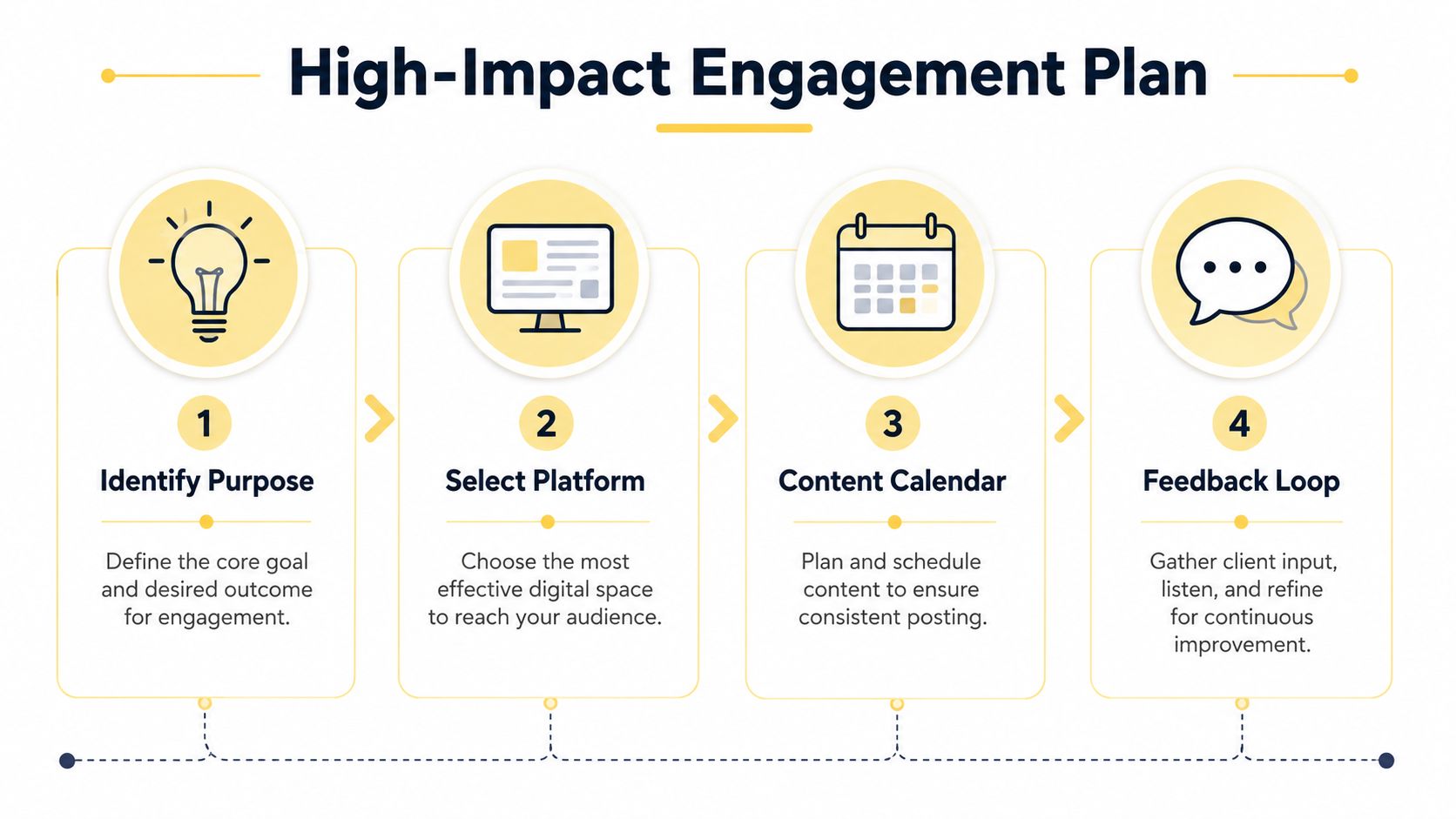
Strong engagement starts before launch. For coaching businesses, the job is not to create constant chatter. The job is to build a container where clients follow through, get support at the right moment, and stay connected long enough to produce results that lead to renewals and referrals.
Start with scope before software
Coaches often pick a platform first because it feels productive. Then they try to invent a reason for clients to use it. That order creates clutter fast.
Set the scope first.
Who is this for
Name the client clearly. New managers need a different room than burned-out founders. Mid-career executives working on visibility need different prompts than women returning to work. A broad mix can sound appealing, but it often lowers honesty because members do not feel fully understood.
What behavior should the community support
Be precise about the actions you want to see. Questions. Implementation updates. Peer accountability. Reflection after coaching calls. If the answer is only “engagement,” clients will treat the space as optional background noise.
What kind of participation counts
Some programs need short weekly check-ins. Others need deeper discussion around decisions, mindset, or leadership habits. Match the format to the transformation you sell, not to what the platform makes easy.
A useful test is simple. If a client spends ten minutes in the community this week, what business or coaching outcome should improve because they showed up?
If your community promises support but delivers confusion, clients will not diagnose the design flaw. They will quietly decide the program is not as helpful as they expected.
Build around three pillars
Most coaching communities do better with a small number of clear structures. More features rarely create better participation. They usually create more to ignore.
Onboarding that produces a first win
New members do not need a maze of tabs, trainings, and thread categories. They need a quick sense of safety and momentum.
A useful onboarding sequence looks like this:
- Welcome with context: Explain what the room is for, how clients typically use it, and what belongs somewhere else, like private coaching or support requests.
- Prompt one focused introduction: Ask a question tied to progress, such as, “What are you committed to completing this month?”
- Give one easy action: Post a commitment, reply to a check-in, or identify the goal they want help staying accountable to.
- Show the next step: Send them to one ritual, one resource, and one place to ask for help.
For a more detailed build-out, this step-by-step guide for coaches is a useful companion if you're shaping the member journey from scratch.
Rituals that create rhythm
Clients return to spaces that feel predictable. They stop checking spaces that depend on the coach improvising every day.
A good ritual schedule protects your time while keeping clients engaged between calls. It also teaches members how to participate without waiting for permission.
Examples that work well in coaching programs:
- Weekly wins thread: Reinforces progress and gives quieter members a low-effort way to contribute.
- Monday commitment post: Members name one action they will complete before the next check-in.
- Midweek obstacle thread: Creates a place to surface friction early, before people drift.
- Monthly reflection circle: Supports integration by asking what changed, what stalled, and what support is needed next.
Light facilitation matters here. If every useful interaction has to come directly from the coach, the community becomes another delivery channel you have to feed.
Content that invites contribution
Many coaching communities become content libraries by accident. The coach keeps posting lessons, frameworks, and recordings. Clients consume a little, save a lot, and participate less.
Use content that gives clients a reason to respond.
| Content type | Best use | Example |
|---|---|---|
| Member spotlight | Builds belonging | “What helped you follow through this week?” |
| Peer problem-solving | Creates practical value | “How are you handling client boundaries during busy seasons?” |
| Hot-seat thread | Encourages depth | One member shares a challenge, others offer angles |
| Reflection prompt | Supports integration | “What belief are you outgrowing right now?” |
If you want more examples of formats and prompts, Spur's collection of actionable community growth tips is helpful because it shows how to turn broad engagement goals into specific recurring interactions.
Choose intimacy before scale
The fundamental trade-off is reach versus relevance.
For most coaching businesses, a smaller, well-facilitated room produces better outcomes than a larger, busier one. Clients do not renew because a community looks active from the outside. They renew because the space helped them implement what they were learning, stay honest about where they were stuck, and keep moving when motivation dipped.
That is the standard to design for. Not more posts. Better client follow-through.
Launching and Governing Your Community Space
The biggest fear at launch is silence.
You open the space. You write the welcome post. Maybe two clients reply. Maybe no one does. Most coaches interpret that as failure when it's usually just a weak launch sequence. People need a reason to enter, a prompt to respond to, and enough visible activity to believe the room is worth their attention.
Seed the room before you invite everyone in
Don't launch into a blank space. Prepare the environment first.
A practical sequence looks like this:
- Invite a small founding group first: These can be current clients who are already engaged and comfortable contributing.
- Pre-load useful threads: Welcome, introductions, wins, questions, and one topic-specific prompt.
- Record one short orientation video: Explain how to use the space and what kind of participation matters.
- Schedule your first week of touchpoints: Don't improvise launch week.
If your wider business still needs a stronger public presence before people enter the community, a coaching website builder can help you create the pages that explain the offer, set expectations, and filter the right members into the room.
A simple first-week plan
Launch momentum comes from sequence, not intensity.
Day 1: Welcome members and ask one low-pressure question tied to their current goal.
Day 2: Reply fast and tag people into the conversation where appropriate.
Day 3: Post a practical thread such as “What are you likely to avoid this week?”
Day 4: Spotlight a member response with permission.
Day 5: Run a short live session or async recap to reinforce the value of showing up.
A little guidance helps here:
Governance protects your time and your culture
Governance sounds formal, but for a coaching community it usually means three things: boundaries, response expectations, and role clarity.
If you don't define these early, clients make assumptions. They may expect private coaching inside group threads, instant replies, or emotional labor from other members that nobody agreed to provide.
Use simple guidelines such as:
- What belongs in the community: wins, questions, reflections, requests for accountability
- What doesn't belong there: crisis support, promotional posting, unsolicited advice framed as truth
- When you reply: business hours, selected check-in windows, or specific facilitation times
- How members should disagree: respectfully, specifically, and without diagnosing each other
A healthy community doesn't eliminate tension. It gives people a safe way to handle it.
Choose your leadership stance
Many coaches get stuck because they try to be everything at once.
Pick your primary role:
| Role | What it looks like | Risk if overused |
|---|---|---|
| Facilitator | You guide conversation and draw members out | Can feel too light if clients need expertise |
| Expert | You answer and teach directly | Can make members dependent on you |
| Host | You shape tone, rhythm, and belonging | Can drift if structure is weak |
Most coaching communities need a mix, but one should dominate. If transformation is the goal, facilitator-host tends to work better than expert-only. Members need your insight, but they also need room to become resourceful with each other.
Measure What Matters for Engagement and Growth
A coaching community can look busy and still fail the people paying for it.
Members react to posts, a few clients show up live, and the feed keeps moving. But the real question is narrower. Does the community help clients take action, stay in the program, and talk about your work in a way that brings the right people back in?
That changes what you measure.
For coaches, community metrics need to do two jobs at once. They should show whether clients are using the space, and whether that participation connects to transformation, renewals, and referrals. Member count cannot answer that. Neither can a streak of comments from the same five people.
Measure in three layers
Start with activation.
This is the first meaningful action a client takes after joining. In a coaching program, that usually means finishing onboarding, posting an introduction, answering a focused prompt, or sharing a first commitment. If clients join and stay silent, the problem often sits upstream. Your onboarding may ask too much, ask too vaguely, or fail to show why the space matters to their results.
Then track ongoing engagement.
You need to know whether clients come back and participate with enough consistency for the community to become part of their coaching process. Watch return behavior, contribution patterns, and live participation together. Analysts at Watchers note that a DAU/MAU ratio above 20 percent is a strong stickiness signal in healthy communities.
Then measure retention and business impact.
Coaching communities often face overly lenient judgment. A strong community does more than create conversation. It helps clients implement faster, stay longer, finish the work, and recommend the experience to peers. If your most engaged members also renew at higher rates or refer better-fit clients, that matters more than raw activity.
Use metrics that connect participation to progress.
Key community health KPIs for coaches
| Metric | What it tells you | Healthy benchmark for coaching groups |
|---|---|---|
| Activation rate | Whether new members take an initial meaningful action | You want most new members participating early rather than joining and disappearing |
| DAU, WAU, MAU | How often unique members return | A DAU/MAU ratio above 20 percent is a useful stickiness benchmark in healthy communities |
| Engagement rate | Share of interactions relative to total members | LikeMinds cites ranges of 1 to 5 percent in large communities and 10 to 20 percent in niche professional groups |
| Average posts per user | Whether members contribute or mostly read | Track this trend month to month. In coaching groups, the pattern matters more than forcing a universal quota |
| Survey response rate | Whether members will give you usable feedback | Healthy programs usually see a meaningful share of members respond. If response drops, trust or relevance may be slipping |
| NPS | Willingness to recommend and perceived value | Use it as a directional signal alongside renewals, testimonials, and referrals rather than as a standalone verdict |
| Event attendance | Whether live sessions matter to the group | Attendance above 25 percent of active users is associated with stronger engagement in the Watchers summary cited earlier |
A table helps, but context matters more.
A small paid coaching container should not be judged like a free creator community. In a high-trust group, fewer posts can still signal strong health if the right members are showing up, applying what they learn, and getting results. I would rather see a quieter community tied to client follow-through than a noisy one that creates dependency and drains the coach.
Use the numbers to make decisions
Each metric should lead to a clear adjustment.
Low activation usually points to onboarding friction. Stable weekly actives with weak posting often means clients are reading but do not see an easy, low-risk way to join in. Strong live attendance with thin async discussion suggests your members prefer scheduled touchpoints and need tighter prompts between calls.
A simple monthly review is enough for most coaching businesses:
- What are engaged members doing repeatedly?
- Where do clients stall after joining?
- Which prompts, events, or rituals led to action outside the platform?
- Which engaged members renewed, referred, or completed milestones more consistently?
If you already review other parts of your marketing this way, apply the same discipline here. Fame's guide on how to analyze B2B podcast success is useful for this mindset because it ties activity back to business outcomes instead of surface-level reach.
The mistake that skews the whole picture
Many coaches measure what is easy to count and ignore what predicts client success.
Replies, reactions, and attendance matter. But they are only proxies. The stronger question is whether the community helps clients stay in motion between coaching touchpoints. If your space increases implementation, strengthens trust, and gives members enough momentum to renew or refer, the community is doing its job. If not, more chatter will not fix it.
Sidestep Common Pitfalls and Sustain Momentum
Most community problems aren't dramatic. They're quiet.
A thread gets fewer replies. Members start reading without posting. One strong voice dominates. You spend more time nudging than facilitating. None of that means your community is broken, but it does mean your community engagement strategy needs maintenance, not more noise.
When nobody talks
Silence usually means the ask is too broad, too exposed, or too disconnected from what members care about right now.
“Any thoughts?” rarely works. Better prompts reduce effort and increase relevance.
Use prompts like:
- Decision prompt: “What's one conversation you're avoiding this week?”
- Reflection prompt: “What felt easier this week than it used to?”
- Specific ask: “Reply with the one task you'll finish before Friday.”
- Comparison prompt: “Which is harder for you right now, focus or follow-through?”
If a conversation still falls flat, don't pile on more prompts. Close the loop. Summarize what was said, draw out one useful lesson, and start a new thread from there.
Quiet communities don't need more content. They need better invitations.
When one member becomes difficult
Every coach worries about this because conflict changes the tone of the whole room fast.
A difficult member isn't always aggressive. Sometimes they overpost, rescue others, give prescriptive advice, derail threads, or turn every discussion back to themselves. Handle it early and privately where possible.
Use a simple response pattern:
- Name the behavior, not their character
- Describe the impact on the group
- Restate the expectation
- Offer a path forward
Example: “I've noticed you're giving very directive advice in response to vulnerable posts. I want this space to support reflection before solutions. Going forward, ask a question first or share your experience without telling someone what they should do.”
When the community starts taking over your life
This happens when you build a room that depends too much on your constant presence.
You don't need to be available all day. You need predictable touchpoints and visible boundaries. Time-box your facilitation. For example, check in once in the morning, once later in the day, or on set program days. Tell members how the space works so they don't confuse accessibility with effectiveness.
Ways to reduce dependency:
- Rotate member-led threads: Let clients host a wins post or reflection prompt.
- Create recurring templates: Reuse structures instead of writing from scratch.
- Use milestone-based check-ins: Tie discussion to progress markers, not random activity.
- Encourage peer acknowledgment: Members don't need your reply to every post to feel seen.
When momentum fades after the initial excitement
Stagnation usually means the community stopped evolving with the clients inside it.
A room that worked for beginners may frustrate advanced members. A space built around encouragement may need more challenge later. A cohort that bonded around weekly wins may be ready for peer feedback, hot seats, or member-led sessions.
Refresh the energy by changing the format, not the mission:
| Sign of stagnation | Likely cause | Smart adjustment |
|---|---|---|
| Posts feel repetitive | Prompts are too generic | Make prompts tied to current program milestones |
| Members read but don't reply | Participation feels high effort | Add lighter check-ins and reaction-based responses |
| The coach carries every thread | Over-centralized leadership | Invite selected members into co-creation |
| Energy spikes only during live calls | Async layer feels optional | Post follow-up questions linked to the live topic |
The goal isn't constant novelty. It's keeping the room relevant enough that clients still experience it as part of their transformation, not extra homework.
A good community engagement strategy doesn't ask you to become a full-time moderator. It gives your clients a place to practice consistency, support each other, and stay connected to the work they're paying you to help them do.
If you want a simpler way to run that kind of client experience, Coachful brings coaching workflows, progress tracking, group programs, and community touchpoints into one place so you can support transformation without stitching together a stack of disconnected tools.