Forming a Community: The Ultimate Coach's Playbook

Coachful
You know the moment. A cohort ends, the final call lands well, people thank you in the chat, and for a few days it feels like you created something bigger than a program. Then the thread slows down. A week later, nobody posts. The accountability that felt natural inside the container disappears the second the container closes.
That's usually when coaches start thinking about forming a community. Not as a branding exercise, but as a practical fix for a real problem. You want clients to keep moving between sessions. You want peer support to carry some of the load. You want your business to stop restarting from zero every time a program ends.
The mistake is treating community like a bonus feature. It's not. If you run group coaching, cohort programs, certification pathways, or internal L&D experiences, community is part of the delivery model. The question isn't whether you need one. The question is whether you'll build it deliberately or inherit whatever random group behavior shows up on its own.
Before the First Post The Why and Who of Your Community
The most common bad start is this one. A coach says, “My clients loved each other, so I should open a community.” That instinct makes sense, but it's incomplete. Affection between members doesn't automatically create a durable space. Shared momentum inside a timed program is not the same thing as a reason to return week after week once the structure is gone.
A better starting question is simpler. What job will this community do that your coaching sessions can't do alone? If you can't answer that in one sentence, don't launch yet.
Start with the gap after the program
For most coaches, the gap looks like one of these:
- Accountability drops: Clients know what to do, but they stop doing it when no one sees the small weekly actions.
- Wins stay private: Members make progress, but nobody else benefits from hearing how they solved a problem.
- Questions pile up between calls: The same obstacles keep resurfacing because there's no place for in-the-moment support.
- The business resets every cycle: Past clients leave instead of staying connected to your ecosystem.
That's the practical why. The deeper why is human. Structured communities work because people want belonging, repetition, and a shared standard. The growth of community associations in the United States makes that visible at scale. The Foundation for Community Association Research reports 373,000 associations housing 78.1 million residents, representing 35.2% of all U.S. housing stock, up from 10,000 associations and about 2.1 million residents in 1970 in its Fact Book statistical review. People consistently choose environments built around shared space, rules, and mutual expectations.
Your digital community isn't a neighborhood association, but the underlying behavior is similar. People stay where expectations are clear and participation feels meaningful.
Define who it is for, and who it isn't for
A strong coaching community usually serves one of four groups:
- Current cohort members who need support between live sessions.
- Alumni who want continued accountability after a program ends.
- Prospects warming up before they buy a paid offer.
- Internal leaders or employees moving through a shared development journey.
Those are very different communities. If you mix them too early, the space gets muddy. A prospect wants inspiration. A paying client wants implementation help. Alumni often want peer-level discussion, not beginner questions.
Practical rule: If members are at different commitment levels, they need different expectations or different spaces.
A useful test is this. Finish the sentence: “This community exists to help [specific people] do [specific ongoing work] together.”
Example:
- Career coach: “This community exists to help first-time managers practice hard conversations, weekly planning, and peer feedback between coaching calls.”
- Executive coach in L&D: “This community exists to help cohort members apply leadership tools in real work situations and learn from one another's implementation.”
- Wellness coach: “This community exists to help clients sustain habits through weekly check-ins, shared wins, and practical troubleshooting.”
If you need help pressure-testing that purpose before launch, this guide for founders to build communities is useful because it forces you to think beyond posting frequency and into actual member value.
And don't make joining harder than it needs to be. If your audience discovers you through Instagram, LinkedIn, or podcast appearances, a simple link in bio for social media can act as the bridge between attention and community entry.
Crafting Your Community Blueprint
An idea becomes operational when you write it down. Until then, you're relying on enthusiasm, and enthusiasm is unreliable. The cleanest way to avoid a fuzzy launch is to build a Community Canvas with four decisions: purpose, people, place, and participation.
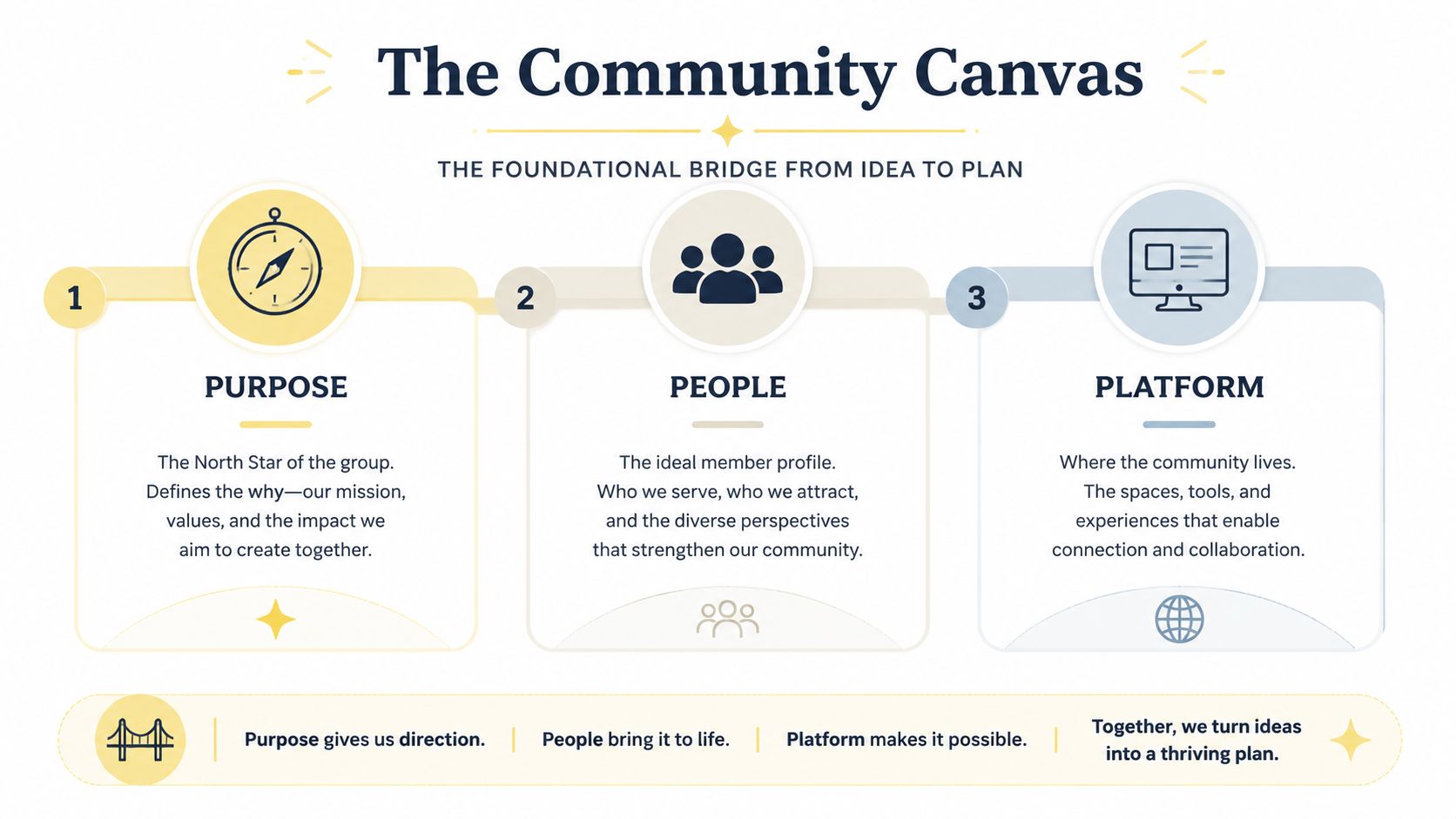
The reason this matters is simple. Communities with structure outperform communities built on hope. Prosci's work on Communities of Practice found that groups using structured frameworks and visible sponsorship achieve 40% higher awareness, adoption, and utilization rates in its article on success factors for building a community of practice. For coaches, that means your blueprint and your leadership presence shape adoption from the start.
Purpose
Your purpose is not “to connect like-minded people.” That's too vague to guide behavior.
A real purpose creates decisions. It tells members what belongs in the space and what doesn't.
Ask:
- What ongoing problem does this community solve?
- What will members be able to do here that they can't do in a newsletter or one-off workshop?
- What kind of transformation should this space support?
Examples:
- For a sales coach, purpose might be “practice, review, and refine live outreach and pipeline habits.”
- For an internal L&D cohort, purpose might be “apply workshop concepts to live managerial situations with peer reflection.”
If your purpose doesn't imply action, members won't know how to use the space.
People
A lot of communities stall because they are too inclusive at the start. Coaches worry that a narrow audience will shrink demand. The opposite usually happens. Specific communities create stronger identity and better conversation.
Document three things:
| Question | Strong answer | Weak answer |
|---|---|---|
| Who is this for | New directors managing former peers | Anyone interested in leadership |
| What stage are they in | Mid-program and alumni applying the same framework | People at all stages |
| Who is it not for | People looking for free general career advice | Nobody |
Be honest about exclusions. If the group is for paying clients only, say so. If it's for leaders inside one organization, say so. Clarity reduces awkward moderation later.
Place
Where the community lives should follow the coaching model, not your curiosity about tools. If you run structured cohorts, the space needs channels, prompts, and resources that match the curriculum. If you run a looser alumni network, discoverability and low-friction drop-ins matter more.
Choose a place based on:
- how often members need to interact
- whether discussion is tied to assignments
- how much context sits outside the community itself
- how much admin you can realistically manage
Participation
This is the part most coaches skip. They know who the group is for and where it will live, but they never define what members should do.
Write down the first three behaviors that indicate a healthy member:
- introduce themselves with context
- post one weekly win or obstacle
- respond to one other member each week
- complete discussion prompts tied to the curriculum
- bring a real case to a feedback thread
A community becomes useful when members know how to contribute on a normal Tuesday, not just at launch.
Also name the sponsor. In an independent practice, that's often you. In an L&D setting, it may be the facilitator, department head, or executive champion. Members need to see who is carrying the standard.
Choosing and Setting Up Your Digital Home
Platform anxiety wastes a lot of time. Coaches compare Slack, Circle, Facebook Groups, Mighty Networks, WhatsApp, and all-in-one coaching tools for weeks, then delay the launch because they still don't feel certain.
You don't need certainty. You need a platform that matches your delivery model and your tolerance for admin.
Match the tool to the coaching model
A short-term cohort and an alumni network are different operational creatures. One needs guided flow. The other needs easy re-entry. A mastermind needs depth and privacy. A public-facing brand community needs discoverability and lightweight conversation.
Here's the comparison I use with coaching teams.
| Platform Archetype | Best For | Key Challenge | Example |
|---|---|---|---|
| Social platform group | Broad, casual, top-of-funnel audience building | Distraction, weak boundaries, limited ownership | Facebook Group |
| Chat-first workspace | Small cohorts, fast accountability, live momentum | Threads disappear quickly, knowledge gets buried | Slack |
| Dedicated community platform | Membership communities, alumni, recurring discussion | Can feel empty if you don't design rituals | Circle |
| Integrated coaching platform | Programs where coaching, assignments, milestones, and community need to connect | Less ideal if you only want casual social conversation | Coachful |
The mistake is choosing based on feature volume. The right choice is based on the member experience you need to produce.
The real trade-offs
If you choose a social platform, people already know how to use it. That's the upside. The downside is that your community competes with everything else in their feed.
If you choose chat-first, urgency feels natural. That's useful in active cohorts. But chat creates clutter fast, and new members often can't tell where to start.
Dedicated community tools sit in the middle. They usually support cleaner structure, better evergreen discussion, and more intentional spaces. But they don't create engagement on their own. You still have to design the rhythms.
Integrated platforms make sense when the community is part of the coaching delivery itself. That includes programs with assignments, milestones, check-ins, resources, and private coaching context. For teams wanting those workflows under one roof, an option like Coachful combines cohort management with progress tracking and community touchpoints. If your public site is still fragmented, a coaching website builder can also simplify how members discover and enter your programs.
Pre-launch setup checklist
Before you invite anyone, make the room feel inhabited and clear.
- Name spaces by use, not by vibe: “Weekly Wins,” “Hot Seat Requests,” and “Resources” work better than “General.”
- Seed the first conversations: Post prompts before members arrive so they're not staring at a blank wall.
- Pin the path: Put “start here,” guidelines, and the first action in one obvious place.
- Reduce choice: Too many channels make members lurk. Start tighter than you think.
- Make the first value visible: Add one useful template, one lesson recap, or one practical thread on day one.
A clean community feels smaller and warmer than a sprawling empty one. That's what you want.
Designing a High-Impact Member Onboarding Experience
The first week determines whether a member becomes visible or vanishes. Most ghost members don't disappear because they're lazy. They disappear because the space asks them to figure out too much on their own.
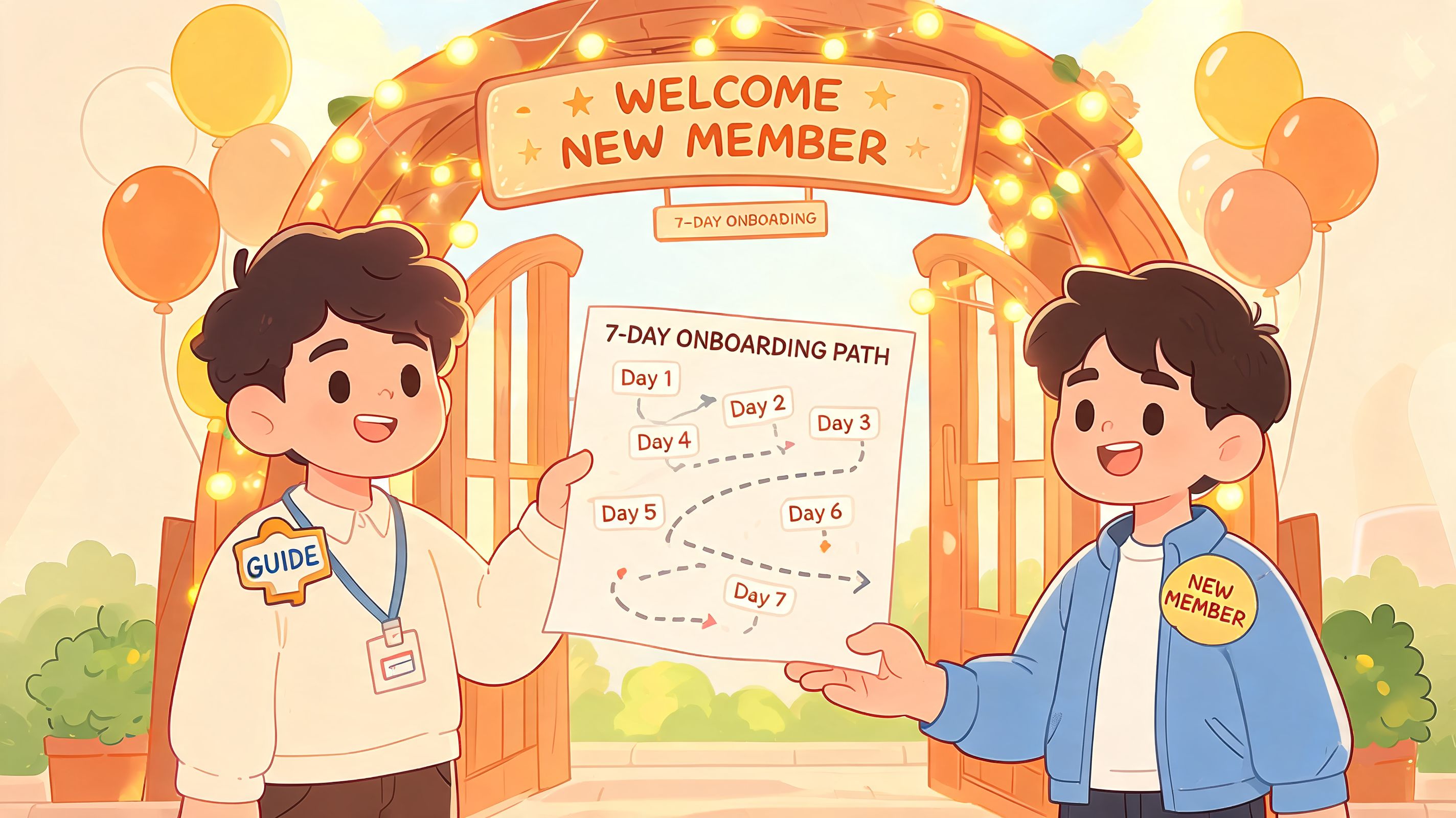
Good onboarding lowers social risk. It tells people what to do first, how personal to be, and how they'll get value without performing.
Day 1 needs one clear next step
Your welcome message should do three things:
- explain what the community is for
- tell them exactly what to do first
- reassure them that simple participation counts
Bad welcome message: “Welcome everyone. So excited to have you here. Jump in and start connecting.”
That sounds friendly, but it creates work. Jump into what? Connect how?
Better version: “Welcome. Start with the introductions thread and share three things: who you help, what you're working on right now, and one area where you'd value support this month. Then read the weekly check-in post and leave a short update.”
That gives direction without pressure.
The first ritual should be easy to complete
Your introduction prompt should not feel like an icebreaker from a retreat. Coaches often make this too personal or too abstract.
Use a structure that invites relevance:
- role or context
- current goal
- present challenge
- preferred way to participate
For example: “I'm a leadership coach working with new managers. This quarter I'm tightening my group offer. I'd like help with conversion conversations. I'm most likely to participate in weekly reflection threads.”
That kind of intro helps members locate one another quickly.
New members don't need motivation first. They need orientation.
Give them an early win by Day 3
By the middle of the week, they should complete something small enough to feel manageable but meaningful enough to prove the space is useful.
Examples:
- comment on one member's obstacle with a practical suggestion
- post a weekly commitment
- answer a simple prompt tied to the program topic
- share one tool, template, or script they use
This is a good point to show what effective participation looks like in practice:
Personal touches matter more than polished automation
Automation helps with timing. It doesn't replace warmth. In the early stage, especially with your first members, reply manually. Welcome people by name. Reference what they wrote. Point them toward one person or one thread that fits their situation.
Use simple touches like:
- “You mentioned hiring your first team member. Read the thread on delegation scripts.”
- “Your goal pairs well with Friday's implementation prompt.”
- “Two other members are working on similar launches. I tagged them below.”
That's how you turn a room into a network.
A simple first-week flow
| Day | Member experience | Your job |
|---|---|---|
| Day 1 | Join and orient | Send welcome and point to one first action |
| Day 2 | Introduce themselves | Reply and connect them to a relevant thread |
| Day 3 | Make first contribution | Prompt a low-risk action |
| Day 5 | See value from others | Surface a useful discussion or resource |
| Day 7 | Build a habit | Invite them into a recurring weekly ritual |
Most onboarding fails because coaches overfocus on setup and underfocus on behavior. Members don't need a tour. They need a path.
Fueling Ongoing Engagement and Connection
After launch, a lot of coaches slip into a reactive pattern. They post when they remember. They ask a generic question when the room feels quiet. They schedule a live call to wake people up. Then they wonder why engagement feels uneven.
Engagement gets steadier when the community runs on repeatable formats, not bursts of inspiration.
Community benchmarks help here because they reset unrealistic expectations. The Community Roundtable notes that average engagement rates range from 2% to 12%, and smaller communities under 50 to 100 members often sit at the higher end, around 8% to 12%, in its piece on benchmarks and actions for building better communities. If you have a cohort of 40 and a handful of people are visibly active each week, that doesn't automatically mean the space is failing.
Build rituals, not random prompts
The most reliable engagement formats are recurring and familiar. Members don't want to decode a new format every time they log in.
A practical weekly rhythm might look like this:
- Monday commitment thread: Members post one concrete action for the week.
- Wednesday wins thread: Members share progress, even if it's small.
- Friday reflection thread: Members name what worked, what stalled, and what they'll change.
The point isn't novelty. The point is habit. Repetition lowers participation friction.
If your members have to wonder what kind of post belongs here, you haven't built enough structure.
Mix live energy with asynchronous depth
Live calls create urgency and emotional connection. Asynchronous threads create access and permanence. You need both, but not in equal amounts for every model.
For a cohort:
- use live sessions for hot seats, role plays, and milestone reviews
- use async threads for implementation, accountability, and peer support
For alumni:
- use occasional live events to reactivate attention
- keep the main value in searchable discussion and resource exchange
I like to look at physical community examples for this. Spaces such as the Madeira Remote coliving and coworking space work because they blend scheduled touchpoints with casual ongoing connection. Digital coaching communities need the same balance. Some members need the room at a specific time. Others need a way to contribute when their workday allows.
If you want a deeper view of the mechanics, this piece on building an online community for coaching clients is useful for thinking through the difference between engagement activities and actual client support.
Encourage member-led value without losing direction
You do not want to be the only person creating energy. But “member-led” doesn't mean “host disappears.”
Invite members to lead in bounded ways:
- host a peer discussion on a topic they've solved
- share a template that helped them
- volunteer for a short case-study breakdown
- run an accountability pod for a month
That kind of leadership works because the role is clear. Open-ended requests like “Anyone want to lead something?” usually go nowhere.
A healthy community doesn't look busy all the time. It looks useful often enough that members trust it will help when they need it.
Moderation Governance and Creating a Safe Space
Most coaches wait too long to think about moderation. They assume a thoughtful audience will self-regulate. Then someone floods the group with promotions, gives reckless advice, dominates every thread, or starts a conflict that everyone else can feel but nobody wants to name.
That's why governance matters. Not because your members are difficult, but because vulnerability requires boundaries.
The demographic reality of communities makes this even more important. Communities bring together people at different life stages, economic positions, and levels of confidence. The Montana Nonprofit Association's overview of what census data can reveal about a community highlights how community formation reflects diverse demographic profiles and circumstances in its census-based community facts resource. In coaching terms, diversity is a strength only if the space is governed well enough for people to feel safe contributing.
What your guidelines need to say
Your community guidelines do not need legal language. They need operational language. Members should know what is encouraged, what is limited, and what happens when a line is crossed.
A simple template works:
Purpose of the space
This community exists to support implementation, reflection, and peer learning related to the program.Expected behavior
Speak from experience. Be respectful. Keep feedback specific and useful.Confidentiality
What members share here stays here unless they clearly say otherwise.Advice boundaries
Share suggestions, not prescriptions. Don't present personal opinion as universal truth.Promotion policy
No unsolicited pitches, DMs, or link-dropping unless invited or placed in a designated thread.Moderator role
Hosts may move, pause, or remove posts to protect clarity and safety.Escalation
Repeated violations can lead to direct warning, post removal, or removal from the community.
Post the guidelines where people can find them. Then model them yourself.
How to moderate without sounding heavy-handed
Good moderation is mostly proactive. It looks like:
- thanking people for useful vulnerability
- redirecting broad advice into questions
- pulling dominant voices back into balance
- inviting quieter members in without forcing them
Examples of moderator language:
“Useful point. Let's keep this tied to the original question so the thread stays practical.”
“I'd like us to avoid diagnosing someone else's situation from a distance. Share what worked in your case instead.”
“Please move promotional offers to the designated thread. I want this space to stay focused on support first.”
These aren't punishments. They're signals. You're showing members that the room is being held.
Watch for the subtle risks
Not every problem looks dramatic. Some communities become unsafe through accumulation. A few confident people answer everything. Newer members start reading but stop posting. The same kind of success story gets praised, while slower or messier journeys go quiet.
That's when governance becomes cultural, not just procedural.
Pay attention to:
- who speaks often
- who gets replied to
- what kind of progress gets celebrated
- whether disagreement can happen without social fallout
A safe coaching community doesn't mean conflict never appears. It means people trust that conflict will be handled fairly, quickly, and in service of the group's purpose.
Measuring What Matters and Planning for Scale
A community can feel warm and still underperform. It can also look quiet and still drive real client outcomes. That's why coaches need measurement that reflects coaching, not vanity.
Member count is the least interesting metric in the room. If you have a thousand people and almost nobody changes behavior, you built an audience container, not a coaching asset.
The sharper question is this. What evidence shows that the community is helping people move?
The retention problem is real. The verified data here is blunt: 75% of community initiatives fail due to poor retention, while coaching platforms with progress dashboards can retain 52% more members when community activity connects to personalized milestones and outcomes, according to the cited summary based on the Whatcom County source. That's why measurement needs to connect participation with progress.
Build a community health dashboard
You do not need a complex analytics stack. Start with a dashboard you can review weekly or monthly.
Track a mix of leading and lagging indicators.
| Metric type | What to track | Why it matters |
|---|---|---|
| Conversion | Did new members complete intro and first action | Shows whether onboarding is working |
| Activation | Are members participating weekly in a meaningful way | Tells you whether habits are forming |
| Peer support | Are members helping one another without host intervention | Indicates real community value |
| Outcome linkage | Are members hitting milestones tied to the program | Connects community to coaching results |
| Retention | Do members stay engaged across the full experience | Reveals whether value lasts |
If you only track posts and comments, you'll overvalue noise. A member who completes assignments, asks better questions on calls, and reports steady progress may be getting enormous value with low visible activity.
Tie metrics to your business model
Community can support different coaching economics. Keep the model clear.
Value-add to 1:1 coaching
Use community to deepen accountability between sessions. The main ROI is better client follow-through and stronger retention into renewals.
Paid standalone membership
Here the community is the product. The ROI question becomes whether members consistently receive enough structure, access, and practical value to remain enrolled.
Pipeline for premium offers
A lower-friction community can warm people toward masterminds, intensives, or leadership programs. In this model, track whether community participation predicts readiness for the next offer.
Each model changes what “healthy” looks like. A 1:1 support community may be small and focused. A paid membership needs stronger programming discipline. A pipeline community needs clear transitions without becoming one long sales funnel.
What scaling actually requires
More members do not automatically mean more value. Scale usually breaks communities in three places:
- onboarding gets thin
- moderation gets inconsistent
- the original purpose gets diluted
Before you grow, ask:
- Which rituals still work if the group doubles?
- What needs segmentation into pods or subgroups?
- Who besides you can facilitate, welcome, or moderate?
- Which outcomes should stay standard across every cohort?
Scale is not adding more people to the same room. Scale is preserving usefulness as the room changes.
If your community helps clients act, reflect, and stay accountable, it isn't just a nice layer around your offers. It becomes part of the mechanism that produces results.
Coachful helps coaches and L&D teams run programs where community, milestones, messaging, and progress tracking live in one place. If you want a cleaner operational setup for cohort-based coaching, client accountability, and ongoing member support, take a look at Coachful.