Offer a First-Module Guarantee Without Inviting Refund Abuse

You know a guarantee would help people say yes. Your program asks for real money and real time, and the buyers you most want are often the most cautious. But the worries arrive at once. Someone could race through the first module, download everything and ask for their money back. Someone could claim they were "not satisfied" weeks later. Clients might not know whether the guarantee covers the live calls or the bonus session. And part of you wonders whether offering one makes the program look less certain than it is.
Master Certified Coach Kathy McKenzie described the moment that made her offer one, in an article for the International Coaching Federation: "Early in my career, I realized that even the most interested students have hesitations. They might be intrigued by the promise of coaching but unsure if this program is the right fit or if coaching itself will be effective in their environment. That's why I started offering a simple guarantee: if they weren't satisfied after the first module, they could get their money back. No pressure, no risk."
The short answer: make the guarantee about fit, not about results. Tie it to a clearly defined first module and a fixed window. Ask for light participation, such as completing module one or attending the first call, so the guarantee rewards people who genuinely tried. Say in writing what is refunded, how to ask and when access ends. Then honour requests quickly and without interrogation. A guarantee shaped like that removes the buyer's real fear, "what if this isn't for me?", without turning your program into a free trial of everything.
Coachful details were checked on 3 October 2026.

Why a first-module guarantee works for coaching programs
The hesitation McKenzie describes is rarely about your competence. It is about fit: whether this program, with this coach, will work in the buyer's life. A first-module guarantee answers that directly. The buyer gets to experience your approach before the commitment becomes final, and you get a client who stays because they chose to, not because they felt trapped.
It also changes what you are selling. Instead of asking for trust upfront, you are offering proof early. That only works if module one is good enough to judge.
Design the first module so it can be fairly judged
- Make it a complete experience of your coaching, not an introduction to an introduction. Include at least one real exercise and, if your program has live calls, the first one.
- Give it a clear end. The buyer should know when they have finished module one and the window is about to close.
- Release the rest later. If the remaining modules open on a schedule, nobody can consume the whole program inside the guarantee window.
- Ask for a small commitment inside it, such as a worksheet or a first goal. People who do the work can judge fit honestly.

The terms every first-module guarantee needs

- The window. A fixed period linked to module one, for example "within seven days of module one opening" or "before module two unlocks." Late joiners in a cohort need their own start date for the window.
- The condition. Light and checkable: complete module one's lessons, or attend the first call. Conditions reduce abuse but make the promise feel less generous, so keep them to things an honest buyer would do anyway.
- How to ask. One email to a named address. You can invite one optional question ("what didn't fit?"), but do not require a justification.
- What is refunded. Usually the program fee paid so far. If anything is non-refundable, such as a third-party assessment you bought for the client, say so before purchase. On a payment plan, refund what was paid and cancel the remaining instalments.
- When access ends. On refund, access to the program, materials and community ends. Decide in advance whether work the client created, like their completed worksheet, stays with them.
- Who it applies to. For example, once per person and for the first enrolment only, so the same buyer cannot rejoin and repeat it.
Put the same wording in three places: the sales page, the checkout and the client agreement. Our coaching agreement template shows where a refund clause sits.
Preventing refund abuse without punishing honest buyers
Most refund problems are fit problems that started before the purchase. Prevention works better than policing:
- Screen before payment. A qualifying question or short application step lets poor-fit buyers learn the program is not for them before they pay.
- Release content over time, so the guarantee covers module one, not the whole library.
- Check the condition quietly. If the guarantee requires completing module one, look at lesson completion before replying, not to argue but to know whether the terms were met.
- Treat requests as information. If several buyers leave after module one for the same reason, the sales page is attracting the wrong people or promising something module one does not show.
- Keep records of the terms the buyer accepted and the date of the request, in case of a later dispute. See handling a client payment dispute.

Jon Penberthy walks through a case study on reducing refund requests for a course or coaching program. Source: YouTube.

Avoiding delivery confusion around the guarantee
- Say exactly what module one includes, including whether the first live call is part of it.
- Say when the window starts for each buyer, especially in cohorts where people join on different days.
- Repeat the terms in the welcome email, with the date the window closes. Clients should never discover the deadline after it has passed.
- Keep bonuses inside the same rules, or state clearly if a bonus is separate.
- Know your local consumer rules. Some buyers may have cancellation rights regardless of your guarantee; your terms should sit alongside them, not contradict them.
When a first-module guarantee is the wrong tool
Some offers carry heavy upfront work that a refund cannot undo: a custom plan written before the first session, intensive 1:1 time in week one, or a company-funded engagement agreed by purchase order. For those, a paid first session or a short fit conversation does the same job more fairly. See discovery sessions vs paid first sessions. If you are not yet sure the program works, run it as a paid beta first; a guarantee is easier to offer once you know module one delivers. And if a client is clearly not a fit later, ending well matters more than any clause; see ending an engagement that is not a fit.
Mistakes that make coaching guarantees backfire
- Guaranteeing results. "Lose the weight or your money back" invites disputes about effort. Guarantee fit instead.
- An open-ended window. "Any time you're unhappy" becomes a refund request in week ten.
- Hidden conditions. Conditions disclosed after purchase destroy the trust the guarantee was meant to build.
- Releasing everything on day one. The guarantee then covers the whole program.
- Making people fight for it. A refund handled grudgingly costs you more in reputation than the refund itself.
Setting up a first-module guarantee in Coachful
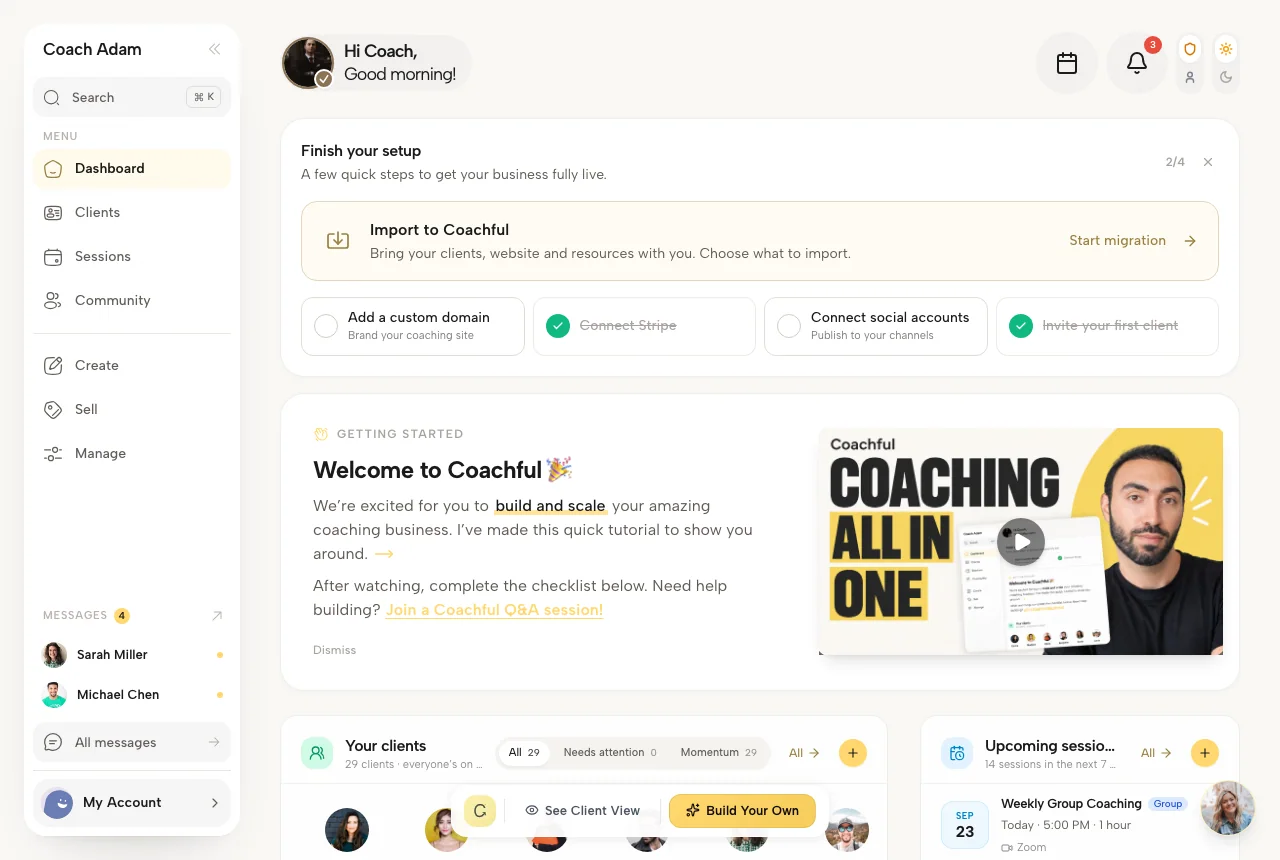
Coachful does not decide refund requests for you; the terms and the decision stay yours. What it gives you is the structure the terms depend on:
- A defined first module: courses are built from modules and lessons, with drip release so later modules open on schedule and completion tracking to see whether module one was finished.
- Screening before purchase: application and checkout funnels can include a qualifying question before the payment step.
- Payments and refunds in one place: one-time payments, subscriptions, payment plans and coupons, with refunds handled in the same system, at a 0% platform fee (Stripe or Razorpay processing still applies).
- Terms the client signs: agreements with e-signature, sent before the first call.
- The first live session: calls run on built-in video, included in the subscription, so module one's call needs no separate tool.
See the online course platform for coaches for how courses and programs fit together, and payment plans for high-ticket programs for refunds on instalments. Coachful has a 7-day free trial, card required, no charge during the trial, cancel in one click.
Frequently asked questions
Should coaches offer a money-back guarantee?
For programs where the buyer's main doubt is fit, a short first-module guarantee often helps more than it costs, because it lets people experience your coaching before fully committing. It is less suitable where you do heavy custom work upfront; a paid first session can do the same job there.
How long should a first-module guarantee last?
Long enough to complete module one properly and short enough that it ends before the bulk of the program opens. Tie it to module one, such as a set number of days after it opens or before module two unlocks, and give late joiners their own start date.
Should I require clients to complete module one before refunding?
A light, checkable condition, like completing module one's lessons or attending the first call, discourages people who enrol only to take the materials. Keep it to what an honest buyer would do anyway and state it before purchase.
How do I handle a guarantee on a payment plan?
Refund the instalments paid so far and cancel the remaining ones, then end access. Say this in the terms so a buyer on a plan knows exactly what happens.
Will a guarantee attract buyers who just want free content?
Fewer than you might fear if module one is the only content available during the window, the condition asks for real participation and you screen for fit before payment. If requests cluster around one reason, fix the sales page rather than tightening the guarantee.
Where should the guarantee terms appear?
In three places, with the same wording: the sales page, the checkout and the client agreement. Repeat the window's closing date in the welcome email so nobody misses it.