How to Run a Successful Group Coaching Session

Coachful
You're staring at eight video tiles, waiting for someone to speak. The opening prompt was clear, the participants introduced themselves, and now the conversation has stopped. Your hand moves toward the next question because the quiet feels like failure.
It usually isn't. A group coaching session becomes useful when the facilitator stops performing and starts managing the conditions in which participants can think, test ideas, challenge assumptions, and commit to action. That requires more than a polished agenda. It requires decisions about silence, group size, psychological safety, curriculum, accountability, and the operational details that determine whether participants return prepared.
The Silence Before the Breakthrough

The first silence in a group is rarely neutral. You've asked, “What's coming up for you after hearing that?” Eight faces look back. One participant glances down. Another smiles politely. You start calculating how many minutes remain and wonder whether you should explain the concept again.
Resist the reflex to rescue the room. A facilitator who fills every pause with another question, anecdote, or mini-lecture may create movement, but not necessarily progress. Participants learn to wait for the coach to supply the meaning, while the group loses the productive discomfort that makes peer coaching different from a webinar.
I once watched a new facilitator ask a group of managers to name the leadership habit they were avoiding. The first response was vague. The second participant said, “I'm not sure.” Then came nearly ten seconds of silence. The coach began to reframe the prompt, but stopped. A participant finally said, “I'm avoiding telling my strongest employee that their behavior is damaging the team.” That admission gave three others language for problems they'd been circling.
Awkward quiet and useful quiet
Awkward silence has a recognizable quality. People appear confused about the task, unsure whether disclosure is safe, or unclear about who should speak. Productive silence feels different. Participants are looking away because they're thinking, writing, or deciding how honest to be. Your job is to diagnose the difference rather than treating all quiet as a problem.
Use a low-pressure intervention:
- “Take a moment before anyone answers.”
- “You can write your response privately first.”
- “You may pass, and someone else can begin.”
- “What part of that question feels difficult to answer?”
These phrases keep agency with the participant. They also signal that the session isn't an audition for the fastest speaker.
Practical rule: Don't interrupt silence until you know whether the group needs clarity, permission, or simply time.
Structured group coaching can create outcomes that casual conversation can't reliably produce. A 2023 randomized clinical trial in JAMA Network Open involved 1,017 women physician trainees assigned to either a four-month online group-coaching intervention or a control condition. The intervention improved measures including burnout, moral injury, impostor syndrome, self-compassion, and flourishing. Emotional exhaustion changed by −3.81 points in the coaching group and increased by 0.32 points in the control group, a between-group difference of −4.13 points, with p < .001 (JAMA Network Open trial).
The lesson isn't that every quiet moment predicts a breakthrough. It's that a well-held group can turn individual hesitation into shared insight. Let participants do the work your anxiety is trying to do for them.
Defining What Group Coaching Actually Is
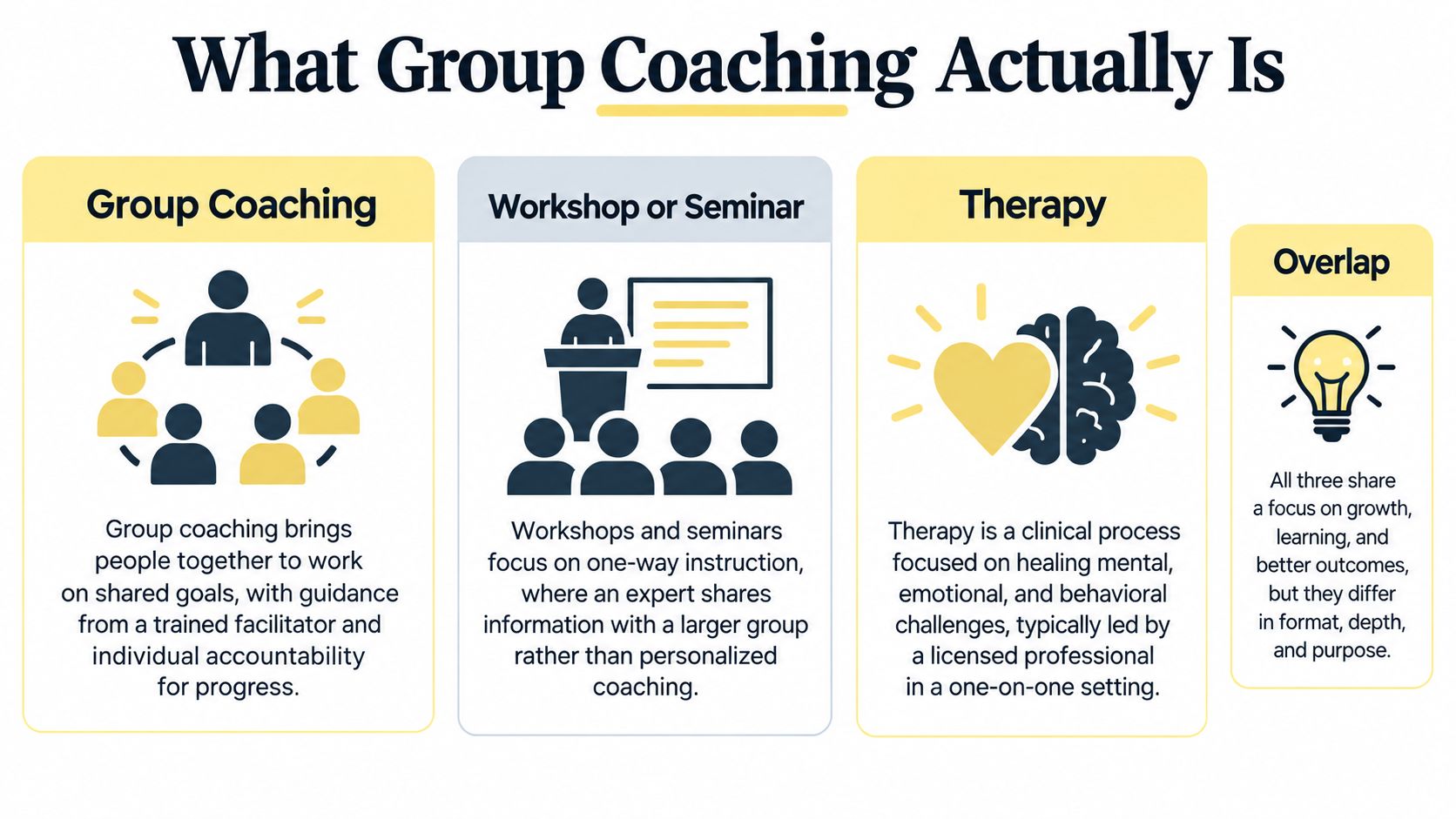
Group coaching sits between instruction and conversation, but it isn't a watered-down workshop or an informal support circle. The coach designs the container, asks questions, manages participation, and keeps the group connected to outcomes. Participants bring the cases, decisions, experiments, and commitments.
A workshop primarily transfers knowledge. You might teach a model, demonstrate a process, and give participants an exercise. In group coaching, teaching can support the work, but the central activity is applying the material to each person's situation and learning through observation and feedback.
Therapy has a clinical healing focus and may address conditions that require licensed mental-health care. Coaching focuses on forward movement, goals, behavior, decisions, and capability. That distinction matters when a participant brings trauma, acute distress, or symptoms beyond your scope. A responsible coach can acknowledge the disclosure, pause the coaching process, and recommend appropriate support without turning the cohort into an unqualified therapy group.
Peer support is valuable but often lacks a designed progression. A group coaching session needs a reason for meeting, a participation structure, and a way to translate discussion into action. “Everyone shares what's happening” may create connection, but it doesn't automatically create accountability.
The promise must match the mechanism
Your marketing and intake process should answer three questions:
- What will participants work on? A broad promise such as “become your best self” attracts incompatible expectations. “Build and test a delegation plan with peer feedback” gives the cohort a workable target.
- What will the group do together? Explain whether members will complete exercises, receive hot-seat coaching, review work, or practice conversations.
- What won't the program provide? State boundaries around clinical care, confidentiality, individual access, and guaranteed outcomes.
A feasibility study of a 12-week employee group-coaching program involving 29 employees found attendance ranging from 1 to 11 sessions, with a median of 9 sessions. Perceived physical-health scores rose from 48.1 to 52.3, while perceived mental-health scores rose from 47.4 to 54.5 during the program. At 24 weeks, physical-health scores had declined to 49.6, showing why a coach should distinguish immediate results from durable change (the feasibility study).
That finding should change how you sell and measure the program. You can promise a structured opportunity to practice, receive feedback, and build accountability. You shouldn't promise permanent transformation after the final call. Build follow-up, maintenance, or alumni support when the behavior requires reinforcement.
Choosing Your Cohort Format and Size
Cohort size changes the psychology of the room. A small group gives each participant more airtime and makes it easier to notice hesitation. A larger group creates more examples, stronger social proof, and a greater chance that someone has faced a similar problem. The right choice depends on what participants must do during the session.
Attendance data from a group-based behavioral program found an inverted-U relationship between cohort size and attendance. Attendance peaked at approximately 15 to 18 participants before declining as groups became larger (cohort-size and attendance research). That doesn't make 15 to 18 a universal prescription. It makes the range a useful upper benchmark when your design depends on energy, accountability, and enough peer interaction.
A six-person leadership cohort can work beautifully when each person needs meaningful airtime. A 15-person cohort may work better for a shared skill where participants alternate between teaching, breakout work, and short case discussions. A much larger community can function, but only if you move personalization into breakout rooms, written prompts, or smaller accountability pods.
| Format | What it gives you | What it demands |
|---|---|---|
| Small group | Deeper disclosure, easier observation, more direct coaching | Stronger screening and careful protection against overdependence |
| Mid-sized cohort | Multiple perspectives, social energy, peer pattern recognition | Firm turn-taking and time boundaries |
| Large community | Reach, variety, and efficient teaching | Breakouts, chat moderation, assistant facilitators, or limited hot seats |
| Dyad or micro-group | High accountability and focused practice | Less diversity of perspective and greater pressure on each relationship |
An applied group-coaching study used three two-hour sessions with groups of six or seven members, showing how a smaller cohort can preserve airtime while still offering multiple perspectives (applied group-coaching study). By contrast, another randomized group design used four to five participant-advisor dyads, making the working unit even smaller when each person needed feedback on tangible work.
Screen for fit, not sameness
Don't accept every applicant just because the seats are available. Match participants by shared context, stage, and practical goal. A program for new managers should probably not place a first-time supervisor beside a senior executive who controls a large organization, unless the power difference is intentional and well managed.
A published program for early-career researchers limited cohorts to no more than nine participants and grouped people at similar career stages (early-career researcher coaching program). Use an intake conversation to test goal compatibility, availability, willingness to participate, and comfort with peer feedback. Start quickly after enrollment, too. Delays between joining and the first session were associated with lower attendance, so rapid onboarding isn't administrative polish. It's a retention decision.
For a deeper comparison of capacity, intimacy, and participation design, use this group coaching size guide while shaping your own format.
Designing Curriculum That Produces Results
A curriculum should answer one practical question every time: What will participants be able to show, decide, or do by the end of this group coaching session? If the answer is “feel inspired,” the design is probably too loose.
One randomized, group-randomized NIH study offers a useful structure. Participants worked in groups of four to five participant-advisor dyads, met online every two weeks, and completed eight two-hour sessions over approximately five months. Each session focused on work in progress and feedback from both a skilled coach and peers. The study defined its success threshold in advance, with an approximately 30% success rate in an extended-dose condition compared with 15% in a regular-dose condition (NIH group-randomized study).
You don't need to copy that program. You can borrow its logic: a predictable cadence, a defined body of work, repeated feedback, and a success measure set before delivery.
Build from outcomes backward
Start with the final capability. For a delegation cohort, the outcome might be a tested delegation plan and a documented conversation with a team member. For a career cohort, it might be a completed proposal, a revised professional narrative, or a prepared negotiation.
Then sequence the program:
- Define the working outcome. Describe the behavior or deliverable, not an abstract feeling.
- Map the obstacles. Identify the beliefs, skills, decisions, and environmental constraints that could prevent progress.
- Assign one primary objective to each session. Avoid cramming several frameworks into one call.
- Attach practice to every concept. Participants should apply the idea to a live situation during the session.
- Create a return loop. Open the next meeting by reviewing what participants attempted, learned, or avoided.
A practical group coaching session might begin with a short progress check, teach one model, give participants time to apply it, coach two live cases, and end with written commitments. The exact timing can change. The sequence matters because it moves participants from understanding to experimentation.
Design test: If a participant misses the session, can another member explain what the group produced and what everyone is expected to do next?
Use a shared worksheet, a private progress field, or a cohort dashboard to capture goals and commitments. For more guidance on turning expertise into a sequence of exercises and milestones, see this resource on writing a coaching curriculum.
Facilitating Psychological Safety and Managing Dynamics
The moment that tests a group coach usually comes right after someone says something risky. A participant admits they have been avoiding a hard conversation, or presents a plan with obvious gaps, and the room goes quiet. What happens next shapes the group faster than any opening slide or ground rule. If the response protects comfort at all costs, people stay polite and hide. If the response invites honest scrutiny without humiliation, people start telling the truth.
Psychological safety works that way in practice. It gives participants enough security to ask for help, share concerns, and test ideas in public, while still leaving room for disagreement and challenge. In a strong group coaching session, people do not need to perform certainty.
That changes the coach's job. If someone presents a weak plan, empty reassurance lowers the standard for everyone listening. A better response is, “I can see why this plan appeals to you. What risk might it leave unaddressed?” The idea gets pressure-tested. The person keeps their dignity.

Research on psychologically safe facilitation points to non-coercion, freedom to participate, nonjudgmental regard, privacy, and confidentiality as conditions that support this kind of environment. You can usually see them before anyone names them. Participants volunteer early, share airtime, ask for feedback, tolerate supportive challenge, and disclose more than surface-level updates (psychological-safety research).
Protect participation without forcing disclosure
Start the cohort by defining confidentiality and its limits in plain language. State what can be shared outside the group, what stays private, how recordings are handled, and what happens if someone reports harm or a breach. Then make passing explicit.
Try: “You can contribute verbally, in the chat, through a written reflection, or not at all. I may invite you, but I won't force disclosure.”
That one sentence lowers unnecessary pressure. Quiet participants can stay engaged without being turned into a public problem. Use timed rounds, anonymous check-ins, chat responses, and voluntary hot seats. Invite people in, but do not spotlight someone as the only person who has not spoken.
Dominant voices need containment. They do not need shaming. Set time boundaries before discussion starts, interrupt respectfully when needed, and redirect to the room. “I'm going to pause you there so we can hear two other views. What are you noticing?” gives a clear limit and keeps the speaker intact.
The same principle applies when you build the cohort. In my experience, reliability improves when participants have similar working habits, but perspective improves when the group includes meaningful differences in how people interpret options. Group for follow-through, then contract for difference. Shared context helps relevance. Mixed openness can still work well if you name how challenge will be handled before friction starts.
When conflict appears, name the process before you assign motive. “We have two different views about what good leadership requires” keeps the conversation workable. “You're being defensive” usually closes it down. Ask each person to state the observation, the impact, and the request. That structure keeps disagreement specific and lets the group learn from friction without turning the session into a judgment of character.
Building Your Operational Workflow and Tech Stack
A group can do strong work in the room and still lose trust between sessions. It happens when the participant has to hunt for the Zoom link, wonder whether payment went through, or guess which worksheet matters this week. Then the first minutes of your group coaching session get spent on recovery, not reflection.
The fix is operational clarity. Every touchpoint should answer the same quiet questions participants ask themselves under stress: Where do I go next? What do you need from me? What happens if I fall behind?
Build the workflow around the participant journey, not around your admin tasks.
- Enrollment: collect goals, availability, relevant context, consent, and boundaries.
- Onboarding: send the calendar invitation, participation agreement, preparation task, and access instructions promptly.
- Delivery: keep the curriculum, assignments, session links, and messages in predictable locations.
- Accountability: record commitments, attendance, submitted work, and follow-up needs.
- Review: compare participant goals with engagement and reported outcomes, including what didn't change.
In practice, one workspace for onboarding, scheduling, payments, messaging, and progress tracking removes a lot of avoidable friction. Coachful is one option built for that. Whatever tool you choose, the test is simple. A participant should be able to find the next session, their assignment, and their commitments without asking you.
Automate administration, not judgment
Automation works best on repeated actions that do not require interpretation. Use it for reminders, renewal notices, preparation prompts, and post-session follow-ups. Keep decisions about risk, disengagement, confidentiality breaches, and scope of practice with a human, because those moments need context and judgment.
A good attendance workflow does more than mark someone absent. It flags the missed session, sends the recording or agreed alternative, asks what prevented attendance, and records whether support is needed. A good engagement workflow notices that someone has not submitted an assignment, but it does not turn that signal into a story about motivation. Silence can mean overload, confusion, accessibility needs, resistance, or a poorly framed task.
If you are comparing systems, this overview of best group coaching platforms can help you match cohort features to the way you deliver. If your program is starting to include a larger library of lessons, resources, and progress checkpoints, it can also help to scale your coaching with an LMS.
Before launch, run the whole experience yourself. Enroll as a test user, complete the payment flow, open materials on mobile, join the call, submit an assignment, miss a session, and watch what reminders appear. That is where hidden operational decisions show up.
Visit Coachful platform if you want one place to organize the operational layer behind your next group coaching session and protect your attention for the decisions, conversations, and commitments that move people forward.