
How to Build a Personal Brand for Coaches

Coachful
Half of American professionals said a strong personal brand mattered more than a strong résumé in a 2025 survey of 1,000 U.S. professionals published by Aurora University. That's a reason to make your expertise easier to evaluate, not a reason to turn your life into content.
For a coach, learning how to build a personal brand means creating a controlled professional asset: a clear promise, credible evidence, and an obvious route to a conversation. You decide what becomes public. Your clients, family, and private history don't become marketing material by default.
What Clients Check Before They Book
You may hear personal branding and think: perform until strangers approve. But the useful question isn't whether strangers like you. It's whether the right person can understand your work well enough to consider hiring or recommending you.
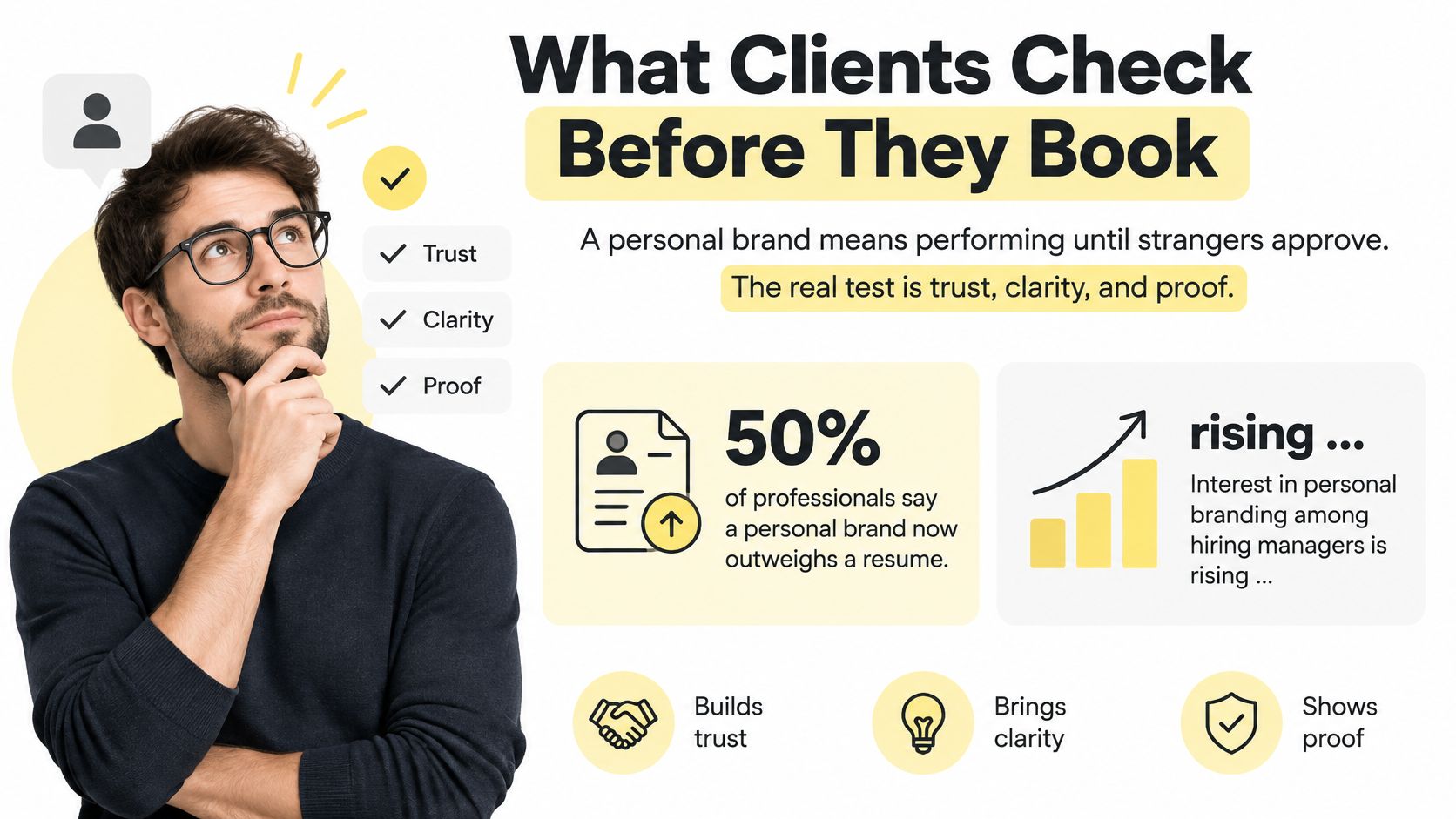
A LinkedIn post summarizing 2026 survey findings reports that 50% of professionals believe a personal brand now outweighs a résumé, rising to 61% among executives; it also states that 44% of employers have hired someone because of their personal brand, while 54% have rejected candidates because of a weak online presence. Those are hiring findings, not coaching-purchase figures, but they make the professional stakes clear: people evaluate what they can find before they start a conversation.
Profiles are surfaces, not the brand
Having a website and LinkedIn account doesn't settle the issue. A prospective client might find a leadership coach on LinkedIn, a general life coach on the website, and a productivity expert in the downloadable guide. They shouldn't have to reconcile those descriptions.
Make these lines agree everywhere:
- Who you serve: Identify a person in a recognizable situation.
- The problem: Name what's difficult in their working or personal life.
- The method: Explain how you approach that problem.
- The result: Describe progress a former client would recognize.
Compare a vague claim about helping leaders succeed with a precise promise to help first-time directors lead distributed teams without being permanently available. The latter gives a referral partner something useful to remember.
The distinction is trust, clarity, and proof, rather than performance.
You don't need to become an influencer
Your working assets are a promise, repeated proof, and a path to a conversation. None requires daily personal disclosure. For executive and health-adjacent coaches, discretion should be visible in how you explain your work.
If your headline still reads like a collection of credentials, use Linkboost's LinkedIn headline tool to generate alternatives, then remove anything you can't substantiate. For the longer introduction, follow this guide to writing a coaching bio that books calls.
Practical rule: A stranger should understand your offer without needing to understand your entire career.
Start with decisions about audience, promise, boundaries, evidence, access, and measurement. A content calendar comes after those decisions, not before.
Six Moves That Build the Brand
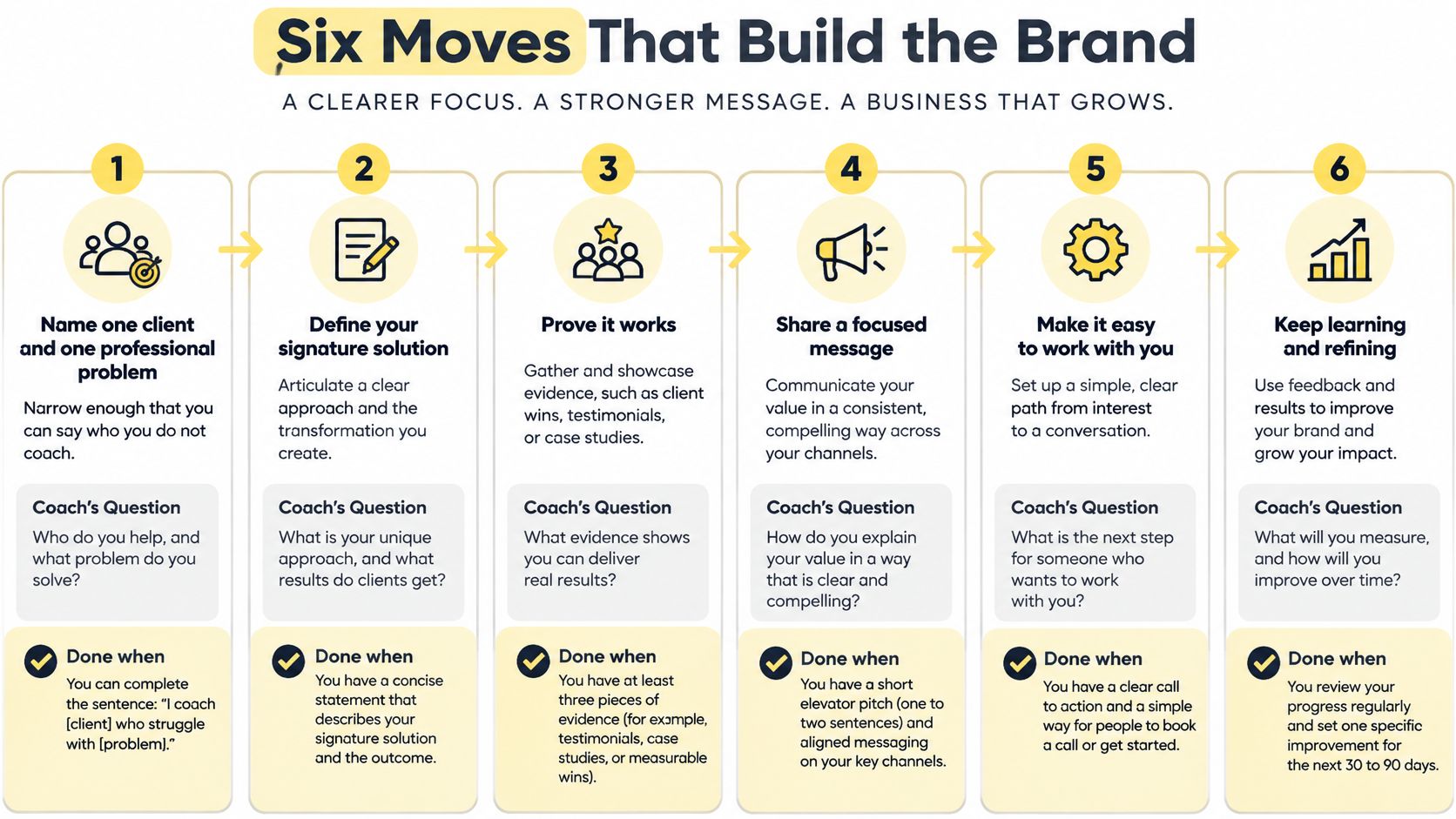
Name the client and problem. Choose an audience narrow enough that you can explain who you don't coach. A director approving every team decision presents a clearer problem than professionals seeking growth. Done when: you can identify a poor-fit inquiry without apologizing.
Write the promise. Use the client's words and connect the practical result to clarity, confidence, calm, or momentum. Done when: someone outside coaching can repeat what you help people do.
Set the privacy line. Decide what's public, bounded, confidential, and off limits before drafting stories. Done when: each proposed client example has explicit permission or stays unpublished.
Publish evidence on a primary channel. Rotate original methods, documented outcomes, and practical teaching. Set a 90-day publishing experiment, rather than treating early silence as a verdict. Done when: you've scheduled the experiment and can support every claim.
Open a conversation. Connect useful content to a framework or explanatory page, then a discovery call or application. Done when: an interested reader has an unmistakable next step.
Review demand monthly. Track qualified attention and conversations, not applause. Done when: your decisions follow inquiry quality and completed calls rather than whichever post attracted the most reactions.
Use this sequence as a build order, not a demand to produce more content.
Make expertise credible, not merely visible
A peer-reviewed personal-branding study found a strong positive relationship between personal branding and perceived employability (γ = 0.61, p < 0.001), while perceived employability strongly predicted career satisfaction (β = 0.70, p < 0.001). This isn't proof of coaching-sales results. It supports the more useful ambition: make your ability understandable and credible.
A broad niche, unsupported claims, and impressive-looking engagement can all distract from that work. For additional channel planning, SuperX's guide to grow your professional influence can help you consider distribution, but distribution shouldn't replace evidence.
Six moves for a coach's personal brand
| Move | Decision | Done when |
|---|---|---|
| Name the client | One audience and one professional problem | You can say who you do not coach |
| Write the promise | Outcome in the client's words | A stranger can repeat it in one sentence |
| Set the privacy line | Public, bounded, confidential, off limits | Every client story has permission |
| Publish proof | Method, outcomes, and teaching on one channel | A publishing experiment is scheduled and claims are supported |
| Open a conversation | Framework or page, then call or application | An inquiry has one next step |
| Review demand | Qualified visits, calls, referrals, close rate | You change the promise only with data |
For a business coach, the sequence might produce a delegation offer, a decision-rights framework, permission-based evidence, and a fit call. For a life coach serving professionals after a role change, it might produce a restart offer, a priorities worksheet, approved outcome evidence, and an application.
Both coaches can keep family stories private. Both can teach something useful without pretending every reader should become a client.
For a complementary walkthrough of personal-brand building, watch:
The Promise and the Privacy Line
Build your promise with this formula:
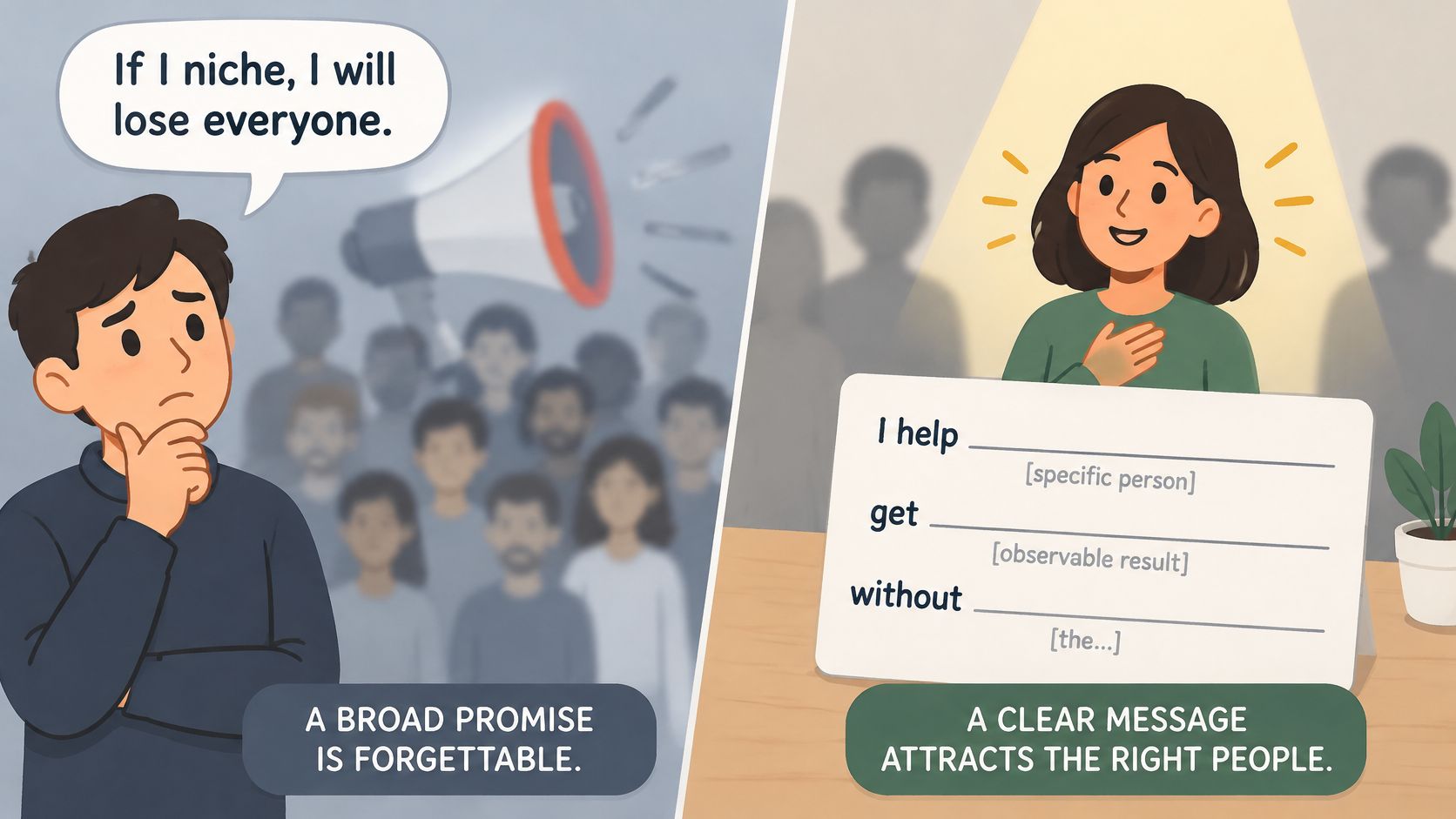
I help [specific person] get [observable result] without [the cost they fear], using [named method].
The uncomfortable thought is often that choosing a niche means losing everyone else. But a wide promise leaves a potential client doing the work of deciding whether you're relevant. Specificity helps them recognize fit.
Consider these offer drafts:
- Business coaching: I help founders stop approving routine decisions without losing oversight, using a decision-rights map.
- Executive coaching: I help newly promoted directors create visibility across hybrid teams without staying constantly available, using a leadership communication rhythm.
- Life coaching: I help professionals navigating a role change build a 30-day restart plan without forcing a premature career decision, using a priorities-and-experiments framework.
These are examples of service positioning, not guarantees. Keep only the outcome and method you're equipped to deliver.
Be relevant without commenting on everything
Should you stay neutral and teach techniques alone? Not if that strips away the circumstances that make clients need your help.
In Edelman's 2025 Trust Barometer Special Report on brands, which surveyed 15,042 people across 15 markets, 73% said they would trust a brand more if it authentically reflected today's culture, compared with 27% if it ignored culture and focused solely on products.
An executive coach can discuss hybrid-work visibility. A life coach can address uncertainty around AI-driven role changes. You don't need an opinion on every controversy; you need to understand the pressures surrounding your client's decisions.
Sound human without surrendering privacy
Use personal context when it explains a professional judgment. You can describe learning to delegate without publishing the employer, the colleague, or the conflict that prompted it.
What a coach may publish
| Bucket | Belongs here | Example | Never include |
|---|---|---|---|
| Public expertise | Method, point of view, how-to | Three-level decision rule | Client names or employers |
| Bounded personal context | Lived context that explains the method | Your first year as a director | Family, health, or home details |
| Confidential client evidence | Anonymized results with written permission | Anonymized before-and-after result approved in writing | Session notes or diagnoses |
| Off limits | Material outside marketing | Employer secrets, vulnerable history | Anything without consent |
Anonymizing a story isn't the same as getting permission. Remove identifying combinations of details, obtain approval for the final wording, and keep coaching records separate from your marketing drafts.
If you're still employed, distinguish your practice from your employer. Don't imply endorsement, reuse internal materials, or publish workplace stories because you've removed someone's name.
Keep your professional record on assets you control: your website, email list, and downloadable frameworks. Use social platforms to introduce your work, not as the only place someone can understand or access it.
Proof That Turns Into a Conversation
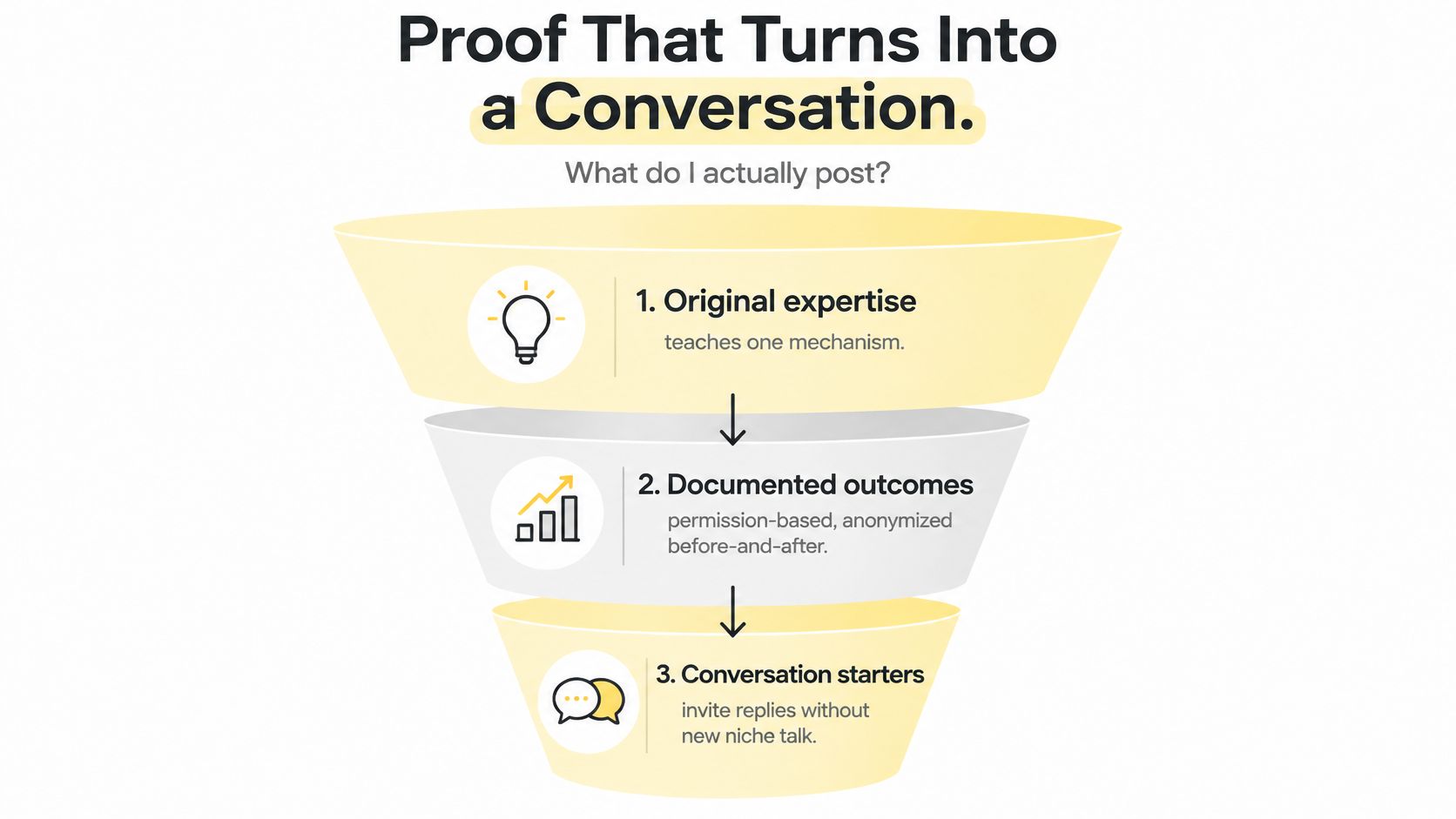
The blank-post problem usually isn't a shortage of ideas. It's uncertainty about what counts as evidence without becoming boastful. Rotate original expertise, documented outcomes, and practical teaching instead of trying to invent a new personality every week.
Give the reader a mechanism and a feeling
Original expertise explains how you think. Show why a founder's delegation problem may be unclear decision rights, rather than a lack of confidence.
Documented outcomes show what changed, using permission-based, anonymized before-and-after accounts. Describe the starting situation, the work undertaken, and the observed result. Don't turn an individual outcome into a universal promise.
Practical teaching gives the reader something to try immediately. A life coach could offer a short priorities exercise for the morning after a difficult career conversation, including when it's useful and what it won't resolve.
In Edelman's 2025 global research on the role of brands, 68% of respondents said it was very or extremely important for brands to help them feel good, meaning happy, confident, inspired, safe, or calm; 62% wanted optimism, and 59% wanted teaching and education. Apply that as an editorial test: what will this person know, and how will they feel better equipped?
Try this business-coaching post this week:
If every decision still reaches you, sort choices into client-facing, team-owned, and founder-only categories. Give each category an owner and an escalation rule, then review exceptions weekly. Start with a recurring decision you can safely stop approving.
That teaches a delegation mechanism while reducing the anxiety of handing over everything at once. End by inviting readers to identify the decision that keeps returning to their desk.
Use proof to create a relevant conversation, not merely another impression.
Connect the post to a hiring decision
Use a straightforward path: insight or diagnostic → downloadable framework → consultation or application → documented outcome.
Publish the insight on your primary channel. Keep the framework and offer explanation on your website, with your email list providing the ongoing record. Match the promise on the profile, download, and consultation page so readers don't arrive at a different offer.
Make room for relationships alongside publishing. Try a 20-minute weekly relationship loop as a starting routine:
- Share a teaching note: Extract a useful idea from existing material.
- Leave five relevant comments: Add substance to conversations your prospective clients already follow.
- Start a direct conversation: Respond to a real question without slipping into an unsolicited pitch.
- Request permitted evidence: Ask an appropriate former client for an outcome they're comfortable sharing.
In Nielsen's global trust research, 88% of respondents trusted recommendations from people they knew more than any other advertising channel. That supports prioritizing referrals and credible testimonials over making louder claims about yourself.
Use this guide to getting coaching client testimonials to ask about recognizable changes. Credentials can establish qualifications, but they don't replace outcome evidence. A case study without permission doesn't ship.
Visual Identity and Client Touchpoints
A prospective client shouldn't encounter a different version of your practice each time they click. Consistency answers the quiet fear that people won't take you seriously more effectively than endless design revisions.
Carry the same offer through each touchpoint
Start with these decisions:
- Visual identity: Choose one professional name, a consistent headshot style, two brand colors, and a type pairing. Apply them to your website, profiles, and framework.
- Homepage: Show your promise, a permitted anonymized result, a clear poor-fit statement, and a primary call to action.
- Lead magnet: Teach the mechanism you use, then end with a single next step. Don't attach unrelated offers because there's room on the page.
- Social profiles: Put the promise in the headline and opening description. Point relevant posts toward the matching page.
- Programs: Name offers in the client's language. State the duration, price, scope, and who shouldn't apply together.
- Onboarding: Send a welcome message, first-call booking instructions, and a short written plan that reflects the offer purchased.
If you're arranging the site itself, use this guide to building your coaching website as an implementation reference. Decide the message before rearranging page blocks.
Match the public promise with the private experience
Suppose an executive coach promises sustainable leadership visibility. At the first session, the coach should explain how the work will address communication expectations, stakeholder visibility, and availability boundaries. A generic welcome packet about realizing potential would create an unnecessary disconnect.
Consistency check: Read your homepage beside your welcome message. They should sound like the same professional offering the same work.
You can borrow the content-to-destination discipline from Pin Generator's guide to drive store traffic through social media, while adapting it to a consultation rather than an ecommerce purchase. The useful principle is simple: send people to the page that continues the conversation they started, not to a homepage where they must search again.
When the Brand Is Visible but Quiet
You check the likes, see no calls, and start wondering whether you're good enough. That's an understandable reaction, but it's a poor diagnosis. Popularity and demand are different signals.
An admired post may never explain what someone can hire you to do. A narrowly relevant post may attract little public engagement yet prompt a useful private conversation. Inspect the point where an interested person stops, rather than treating silence as a verdict on your coaching.
Match the fix to the signal
Brand signals and the fix
| Signal | Inner objection | Fix |
|---|---|---|
| Likes, no calls | I am bad at this | Add one next step and track qualified inquiries |
| Niche feels too small | I will lose everyone | Hold the positioning for the planned test and count fit conversations |
| Posting feels exposing | I must share my life | Move the story back to bounded context |
| Inconsistent look | They will not take me seriously | One name, one photo, one promise line |
| No proof | Asking feels salesy | Request permission and one client-worded result |
| New niche every month | This one is not working | Change the message only after a quarter of data |
When people visit but don't inquire, inspect the offer page. Does it describe a service, identify fit, and explain what happens after clicking? Adding more posts won't repair an unclear invitation.
When the niche feels painfully small, distinguish discomfort from evidence. Have you spoken with appropriate prospects, or have you grown tired of repeating the same message? Copying an influencer's format won't answer that question.
Keep a scorecard you can use
Review these five lines monthly, using consistent definitions:
- Qualified profile visits: Record identifiable visits from relevant people when available; don't pretend anonymous traffic reveals buyer fit.
- Inbound conversations: Count substantive inquiries about the problem or your service.
- Referral source: Ask how each prospect found you and record the answer.
- Discovery calls completed: Separate attended calls from bookings and cancellations.
- Close rate: Divide clients who commit by completed sales conversations, using the same reporting period.
Personal-brand equity work emphasizes appeal, differentiation, and recognition, as described in this review of personal branding and professional outcomes. Use your quarterly message review to examine which audience, problem, and promise produced the strongest qualified response, not just the widest distribution.
Treat timing as a planning decision, not a guarantee. You might secure an approved testimonial within a week if the client responds promptly. Give a recognizable promise a full quarter of focused use before judging it, unless actual conversations reveal a clear mismatch sooner.
If nothing converts, interview appropriate prospects about what they understood and what remained unclear. Change the weakest row, not the whole brand.
Ship the Promise This Week
Day 1, write the promise and exclusion. Finish the sentence describing whom you help, the result, the feared cost, and your method. Add a plain statement of who the offer isn't for.
Day 2, publish a mechanism. Address a current client pressure, such as hybrid visibility or uncertainty after a role change. Give readers something more useful than encouragement.
Day 3, finish the framework. Put the mechanism on a page someone can use without you present. Include instructions, an example, and a boundary around what it can accomplish.
Day 4, create the destination. Place the framework and consultation or application together on a clear page. Test the journey yourself from profile to confirmation.
Day 5, hold five conversations. Speak with people who already know your work. Ask which problem they associate with you and what they'd need to understand before referring someone.
Day 6, request permission. Invite a suitable former client to describe a concrete change. Explain the proposed use, offer anonymization, and let them approve the final version.
Day 7, open the scorecard. Start with a zero baseline where you have no recorded activity. Don't backfill flattering estimates to make the starting point feel better.
Choose a test you can finish
Pick your primary channel and block the 90-day experiment before judging results. Choose a sustainable publishing rhythm, reserve time for conversations, and keep a record of the questions prospects ask.
If you don't want another stack of tools, don't confuse buying software with becoming professional. Your public page and private client experience should first use the same words for the same work.
At Coachful, our website builder publishes under your own domain and connects the public page to booking, programs, payments, and a private place for client work; we can also draft the client journey from the offer, including a welcome, private chat, first-call booking, access to included items, community participation, and an end review.
The decision today isn't whether you're ready to be more public. It's whether you're willing to make your professional value more legible while keeping your boundaries intact.
At day 90, judge the experiment by more of the right conversations, not more posts. Keep what helped suitable clients understand you, and revise what left them uncertain.
Coachful connects your public promise with the booking, program, and private client experience behind it. Visit Coachful to build a clear route from discovering your expertise to starting the work, without piecing together a separate system for every step.


