Life Coach Elevator Pitch: 7 Examples You Can Adapt

Coachful
Editorial Team
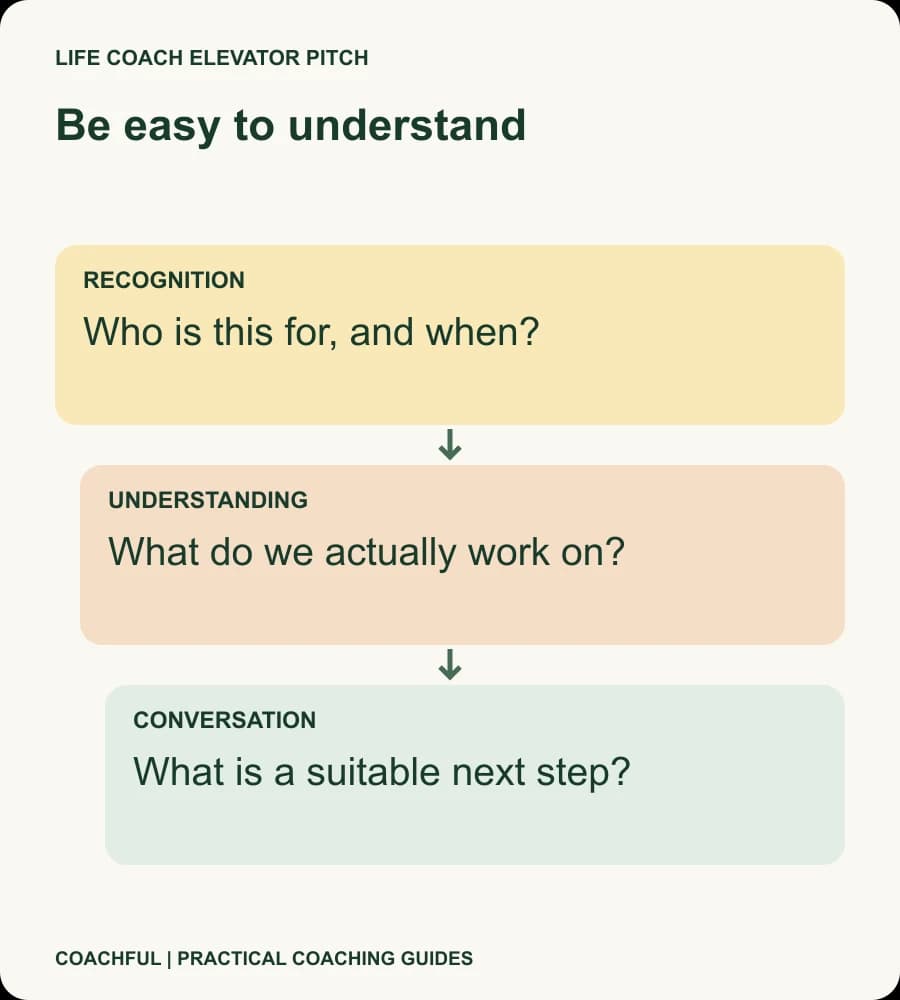
Someone asks what you do, you say “I’m a life coach,” and their face goes politely blank. Do you explain the whole profession, list your certifications, or somehow fit your offer into one sentence? A useful life coach elevator pitch names a recognisable person, the decision or difficulty they face, and the work you help them do. Then it leaves room for a conversation.
You do not need to promise a transformed life in thirty seconds. You need to make it easy for the listener to understand when your work would be relevant. “Unlock your potential” sounds pleasant, but it gives a referral partner almost nothing to remember.
Below are seven original, hypothetical examples for different situations, followed by an editable template and a practical rehearsal exercise. They describe the same fictional coach, who supports midcareer professionals considering a change in their working lives. Keeping the offer consistent shows how to adapt the conversation without inventing a new niche for every room.
What is a life coach elevator pitch?
A life coach elevator pitch is a brief, spoken introduction to your coaching work. It helps someone understand who you work with, what brings those people to coaching, and what kind of help you offer. It is an opening, not a complete sales presentation or a substitute for discussing whether coaching is appropriate.
Practitioner guides from Life Coaching Professionally and Transformation Academy both emphasise the listener, relevant benefits, and a conversational invitation. Treat those as writing principles, not evidence that a particular script will win clients.
A tagline is shorter and normally read rather than spoken. A bio gives more background. A niche statement defines the focus of your business. Your elevator pitch borrows from that positioning but adds the context a real listener needs. If your audience is still undecided, work on choosing your coaching niche before polishing an introduction.
A simple life coach elevator pitch formula
Use this structure as a starting point: I coach [specific people] who are [recognisable situation]. We work on [concrete decisions or actions], so they can [direction they want to move toward]. Add an invitation only when it fits the conversation.

For our fictional coach, that becomes: “I coach midcareer professionals who are considering a change but aren’t sure whether to change their role, their workplace, or their direction. We work through those options and plan a next step they can test.”
Notice what is missing: an income promise, a claim to cure burnout, and a guarantee that the client will find their calling. The pitch describes the work rather than pretending you control the outcome. A specific decision is often easier to understand than a sweeping promise of confidence or fulfilment.
You can cut the formula down when the setting calls for it. You can also add one sentence about your approach if someone asks. Do not cram every qualification, session format, package detail, and personal origin story into the first answer.
7 life coach elevator pitch examples for real conversations
1. The everyday “What do you do?” answer
“I’m a life coach. I work with people who’ve built a career but aren’t sure they want the next ten years to look like the last ten. We work out what they want to change and what they can try before making a big decision.”
Use it when: you are meeting someone socially and they ask about your work. The listener has not consented to a discovery call beside the snack table. Give them an answer they can understand, then pause.
The phrase about the next ten years names a familiar situation without diagnosing anyone. The final sentence explains the work in ordinary language. If the person asks, “What sort of changes?”, you can describe exploring a different role, renegotiating responsibilities, or testing a new interest.
Do not immediately add, “Does that sound like you?” A stranger might be interested in your profession without wanting to discuss their dissatisfaction in public. A normal question about their work can be the more appropriate next move.

2. The timed networking introduction
“I’m Alex, a life coach for midcareer professionals weighing a work change. My clients are often deciding whether they need a different job or a different way of working. We compare their options and design a practical experiment. I’d welcome introductions to people exploring that decision.”
Use it when: an organiser gives each person a short introduction slot. The job here is both explanation and referral recall. Someone should leave knowing the situation to listen for, not just remembering that you were enthusiastic.
The useful distinction is “different job or a different way of working.” It helps the room recognise a potential fit without demanding a major life crisis. The invitation is specific enough for someone to act on later.
Practise aloud against the event’s actual time limit. If it runs long, remove an idea rather than accelerating into auctioneer mode. Your credentials can go in a later conversation or your event profile. Respecting the slot is part of being someone people want to introduce.

3. The referral-partner introduction
“I support midcareer professionals who keep circling a work decision without choosing a next step. If someone tells you they want a change but don’t know what to explore first, that may be a useful introduction. With their permission, you can share my details so they can decide whether to contact me.”
Use it when: you are speaking with another professional who might meet suitable clients. This version teaches a recognition cue and explains a respectful handoff. It does not turn every unhappy employee into a lead.
Discuss the boundaries separately. A referral partner should understand your scope, who is not a fit, and how an introduction would work. Do not ask them to forward private client stories so you can assess a stranger from the sidelines.
The last sentence puts the prospective client in control. If you use a different introduction process, explain it plainly and get the relevant permission. An elegant pitch is not a reason to be casual about someone else’s information.

4. The potential-client answer
“I coach people who are unsure what they want to change about their working lives. We can explore the options you’re considering, what matters in the decision, and a step you could test. An introductory conversation would help us decide whether that work fits what you need.”
Use it when: someone has already expressed interest in coaching. You can be more direct about the work and offer an appropriate next step. You still do not know enough to tell them which job to take or whether they need coaching.
This version moves from a general audience to “you” because the conversation has become relevant to that person. It offers an introduction, not a claim that enrolling is the obvious answer. Explain whether that conversation is paid or free using your actual terms.
After the pitch, ask what they are hoping to work on. Listen before describing a package. If they need job placement, clinical care, regulated advice, or another service you do not provide, say so rather than stretching your definition of coaching to keep the sale.

5. The employer or HR buyer introduction
“I provide individual coaching for midcareer employees considering their next professional direction. The work can focus on choices about responsibilities, development, or a possible role change. Before an engagement, we would agree the purpose, suitability, confidentiality, and what information, if any, is shared with the organisation.”
Use it when: the listener may fund coaching for someone else. An employer has different questions from an individual buyer. They need to understand the purpose and the boundaries, not hear a personal-development promise with a corporate logo attached.
This introduction deliberately does not promise retention, promotion, or improved performance. Those outcomes may depend on decisions and conditions outside the engagement. Do not quietly promise the sponsor that coaching will persuade an employee to stay while telling the employee that all options are open.
If the conversation continues, clarify who the client is, who is paying, how goals are agreed, and what reporting is permitted. Put the actual arrangements in the engagement agreement rather than leaving the sponsor and client to infer different promises from the same introduction.

6. The “Isn’t that just giving advice?” response
“In my coaching work, I don’t choose a career direction for you. I help you examine the options, question assumptions, and decide what you want to try. For example, we might explore whether the change you want is a different role or a different working arrangement.”
Use it when: someone asks a genuine question about how coaching works. Answer the distinction they are asking about. Launching into a defence of the entire industry usually makes the explanation harder to follow.
The concrete example does more work than saying coaching is “transformational.” It gives the listener something they can picture happening in a session. Keep your description accurate to your own practice. If you also offer mentoring or consulting, distinguish those services and agree when you are changing roles.
Do not claim that coaches never share information or that every therapist, mentor, and consultant works in one uniform way. Explain your own service without reducing other professions to caricatures. If the listener is not interested, you do not owe the room a closing argument.

7. The short website or introduction-video version
“You know you want something to change at work. You’re less sure whether that means a new role, a new employer, or a different way of working. I’m Alex, a life coach who helps midcareer professionals explore those choices and plan a next step. Read how I work, then decide whether to enquire.”
Use it when: someone arrives on a relevant page or chooses to watch your introduction. Unlike a casual conversation, the visitor cannot interrupt to ask for clarification. Give them the context and a visible next step.
This version starts with the situation because the page can already identify you. The action should lead to the information you promise. “Read how I work” belongs beside a service explanation, not a surprise payment screen or an unrelated newsletter signup.
Keep the wording on the destination page consistent with the pitch. If you describe exploratory coaching and the next page suddenly promises a guaranteed career reinvention, the visitor has to reconcile two different offers. For a shorter written line beside your name, use the separate guidance on coaching taglines rather than squeezing this whole introduction into a headline.

How to write your own pitch without sounding scripted
Start with the last real explanation you gave, not an empty page titled “brand positioning.” Write down the words you actually used. Then replace any phrase that could describe almost any service business: empowering people, creating change, achieving success, reaching the next level.
- Name the person in a recognisable situation. “People considering a work change” gives someone more to picture than “ambitious humans.” Be specific enough for recognition without adding arbitrary demographics.
- Describe work you genuinely do. Compare options, prepare for a conversation, examine priorities, or plan an experiment. Do not borrow a method because it sounds impressive.
- Separate direction from guarantee. Supporting someone to explore a change is different from promising the change will happen. Remove results you cannot substantiate or control.
- Choose one next move. A follow-up question, permission to share your details, a service page, or an introductory conversation can each fit a different situation.
- Say it aloud and stop. If it needs a deep breath and a second paragraph, cut it. Leave room for the other person.
Here is the editable version: “I’m [name], a [accurate coaching description]. I work with [people] who are [situation]. We work on [specific decisions or actions]. If that is relevant, [appropriate invitation].” You do not have to include every bracket every time.
Check the draft with someone who is not immersed in coaching vocabulary. Ask, “Who do you think I work with?” and “What would you expect us to do?” If their answer is vague, revise the explanation. Compliments about how inspiring it sounds are less useful than an accurate description.
A short rehearsal exercise before you use it
Record a casual version and a networking version on your phone. Time each against the setting where you will use it. Listen for places where you speed up, stack abstract nouns, or sound unlike yourself. Replace those passages with the words you would use explaining your work to a thoughtful friend.
Then practise a follow-up. Have someone ask, “Can you give me an example?” Explain a hypothetical session focus without inventing a client success story. For our fictional coach: “We might compare staying in a role with changing responsibilities, then identify what information the person needs before choosing.”
Try one real conversation and note what the listener actually asks. If they understand the work but are not interested, that is not automatically a messaging failure. The aim is accurate understanding and appropriate interest, not making every person a prospect.
Frequently asked questions
How long should a life coach elevator pitch be?
Short enough for the situation. An everyday answer may need only two sentences; a networking introduction may have an explicit time allowance. Prepare a brief version and a slightly fuller version, then practise them aloud. There is no universal word count that makes a pitch effective.
Should I mention my coaching certification?
Yes, when it is relevant, accurate, and useful to that listener. Do not let a string of initials replace explaining the work. State the exact credential you hold, not a broader endorsement that the credentialing organisation has not given you.
What if I am a new life coach without testimonials?
Describe your actual audience, scope, approach, and invitation. You can explain what a session might focus on without claiming past results. Label hypothetical examples as hypothetical and do not present training practice as a paid-client success story.
Can I use the same pitch everywhere?
Keep the offer consistent but adapt the opening and invitation. A referral partner needs to recognise whom to introduce. A potential client needs to understand whether the service fits. An employer needs clarity about purpose and boundaries. Different emphasis does not require different promises.
Make the next step as clear as the introduction
Once someone understands your work, make the handoff easy: a page explaining the service, an accurate description of the introductory conversation, and a clear way to enquire. Use the same language they just heard. Your pitch should not create clarity that your booking page immediately takes away.
If you are evaluating how your coaching website and scheduling could support that handoff, try the Coachful interactive demo. Look at the journey from understanding an offer to finding the next step before deciding what your practice needs. The software is not the pitch; it is what the interested person encounters after it.