Life Coach Insurance: 7 Checks Before You Buy

Coachful
Editorial Team
Would your insurance respond if a client claimed your coaching caused them a financial loss? For an independent life coach, professional liability insurance is the first cover to investigate, including when every session happens online. General liability, cyber cover and other policies address different risks.
The important distinction is between insurance you are legally required to carry, insurance a client or venue requires, and insurance that actually covers your work. Those are three separate checks. A cheap policy with the wrong service description does not solve the problem.
This is a U.S.-focused buying guide, not individualized legal or insurance advice. Requirements and coverage depend on your jurisdiction, activities, contracts and policy wording. Use the checklist to have a specific conversation with a licensed insurance agent, not to decide a claim is covered yourself.
Do life coaches need insurance?
As a practical business safeguard, independent life coaches should investigate professional liability coverage before working with clients. Whether a particular policy is legally mandatory is a separate local question. Your business location, employees, additional regulated services and contractual commitments can change the answer.
Professional liability, also called errors and omissions or E&O, concerns allegations about your professional service. A hypothetical example: a client says your career-transition coaching was negligent and contributed to a financial loss. Whether an insurer would defend or pay that claim depends on the actual allegations and policy, not just the fact that you purchased “coach insurance.”
The National Association of Insurance Commissioners' small-business guide distinguishes professional liability from general liability. It also explains that a typical business owner's policy does not include liability for wrongful professional practices. Do not assume a general business bundle includes coaching E&O.
Which insurance covers which coaching risks?
“Life coach insurance” is a shopping label, not one standardized policy. Start with what could happen in your practice, then ask which coverage is intended to respond.
- Claims about your coaching service: professional liability / E&O. Discuss allegations of a mistake, omission or negligence. Your actual services must fit the insured activities and policy terms.
- A visitor's injury or damage to someone else's property: general liability. Do not treat this as a substitute for professional liability.
- A data breach or cyberattack: cyber insurance. Ask about your own response costs, third-party claims and vendor-related incidents separately.
- Loss of business equipment or premises: property or equipment coverage. A suitable business owner's policy may be an option. Home insurance and business property coverage are not interchangeable.
- An employee's work-related injury or illness: workers' compensation. Check your state's rules, thresholds and worker classifications.
Retreats, driving, physical activities, product sales and employing other coaches can introduce additional exposures. Tell the agent about them rather than assuming a solo online-coaching quote stretches to cover everything you might offer later.
7 checks before you buy life coach insurance
1. Describe the work you actually do, not just your job title
“Life coach” can mean conversations about confidence, career decisions, relationships, habits or several of these. An insurer needs a more useful description than the words on your business card.
Send a short account of who you work with, the topics you cover and how you deliver the service. Include one-to-one sessions, groups, recorded courses, workshops, subcontractors and international clients where relevant. If your offer includes physical exercise, nutritional guidance, clinical work or financial recommendations, disclose that explicitly.
Ask: “Does the policy's definition of professional services cover this exact description? Which activities are excluded or need another policy?” Request the relevant wording and written clarification before relying on the cover.
For a hypothetical example, a confidence coach adding a weekend retreat with guided hikes has changed more than the session location. The new activity belongs in an insurance review before it appears on the sales page.
2. Check professional liability and general liability separately
The two labels are easy to confuse because both contain “liability.” They address different problems. A complaint about your coaching service is not the same exposure as someone tripping in your office.
An online-only coach still has professional-service exposure. An in-person coach also needs to discuss physical premises and activities. Corporate clients or rented venues may ask for particular cover even when your own assessment of physical risk is low.
Ask: “Which part of this quote is E&O, which is general liability, and what limits and exclusions apply to each?” If a bundle lists only general liability and property, do not mentally add professional liability to it.
3. Verify the insured name, people and client locations
Check that the proposed policy identifies the correct business or person. A trading name, an LLC, a previous business name and a separate entity are not details to leave for the claims stage.
Then ask who is insured: you, employees, other coaches, contractors or the business's liability for their work. Do not assume a contractor has cover, or that their policy protects your business.
For remote practices, distinguish where you work, where clients live and where a claim can be brought. “Online” does not mean worldwide coverage. Ask about both the geographic territory and any restrictions on the courts or jurisdictions in which claims can be made.
Ask: “Does this policy cover this named business, these people and clients in these locations? What changes must I report when I hire or expand?”
4. Understand limits, deductibles and defense costs
Compare more than the headline limit. A per-claim limit concerns one claim; an aggregate is the total available across covered claims in the relevant policy period, subject to the terms. Those numbers are not interchangeable.
Find out whether defense costs reduce the available limit or are covered outside it. Ask how the deductible or retention applies, including whether you pay toward legal defense. A deductible is the portion you may have to pay under the policy's terms, not a detail to ignore because you hope never to claim.
Ask: “If I face a covered claim, what would I pay, what could reduce my remaining limit, and who controls the defense and any settlement?” Request an explanation using the actual quote, not a generic example.
There is no universal limit that is automatically right for every coach. Bring contractual minimums and a realistic description of your work to the agent rather than adopting a number from another coach's social post.
5. Check the dates, reporting rules and past-work coverage
A policy can be active today without answering every question about work you did last year. Ask whether it is claims-made, claims-made and reported, or occurrence-based, and have the agent explain the practical consequences.
For a claims-made policy, the timing of a claim, any reporting deadline and a retroactive date can matter. The retroactive date sets a boundary on which past work may qualify. An extended reporting period, sometimes called tail coverage, may allow certain later claims to be reported or treated under an expired policy; it is not permission to keep doing new work after the policy ends.
Hiscox's explanation of claims-made and reported policies illustrates why these dates matter. Its specific reporting provisions are examples from its own policies, not terms you should assume your insurer uses.
Ask: “What happens if I switch insurers, take a break or close my practice? How do we avoid a gap for past work, and what reporting deadlines apply?” Resolve that before canceling an existing policy.
6. Review home-office and client-data gaps
Working from a spare room does not turn business risks into personal household risks. The Washington insurance regulator warns that home-business owners can mistakenly assume their homeowner policy covers business operations and property. Ask whether you need an endorsement, business property cover or a separate commercial policy.
Data is a different conversation. A coach may hold contact details, intake responses, notes and sensitive client communications, even without a physical office. Ask whether a cyber quote addresses both your own incident-response costs and claims brought by affected people.
The NAIC's cyber-insurance guide specifically recommends checking first-party and third-party coverage, including attacks involving data held by vendors. Using a software provider does not by itself establish that your business's losses or liabilities are insured.
Ask: “Which home-business and cyber exposures are covered here, which require separate cover, and what security conditions must I meet?” Answer application questions accurately, including those about account security and data handling.
7. Match the policy to contracts and keep the proof
Before signing a corporate engagement or venue agreement, send its insurance requirements to the agent. A client may request limits, additional-insured status or specific documents that the quoted policy does not provide automatically.
A certificate of insurance is evidence about insurance, not a way to rewrite the underlying policy. The Texas Department of Insurance's certificate FAQ makes the distinction explicit: certificate statements cannot simply exceed the policy's actual provisions. Its detailed rules are Texas-specific, but the buying lesson is straightforward: have the agent verify the requested coverage and endorsements.
Ask: “Can this policy satisfy this contract, and which endorsements or changes are needed before I agree?” Do not promise a certificate will fix a mismatch after signing.
Keep the application, final policy, schedule or declarations, endorsements, relevant correspondence and any certificates. Set a review reminder for renewal and for meaningful changes to your work. If a complaint or incident occurs, follow the policy's notification instructions promptly rather than negotiating a settlement on your own first.
How much does life coach insurance cost?
There is no single useful price without specifying the coverage. A quote for general liability is not a quote for professional liability, and an advertised starting price is not a prediction of your premium.
Insurers can consider your services, location, revenue, claims history, limits, deductible and other risk information. Request comparable quotes using the same description of the business. The SBA's insurance guidance recommends assessing risks, working with a licensed agent and comparing terms and benefits as well as rates.
Use this comparison checklist for each quote. Leave an item blank only when the agent confirms it does not apply, not because the summary page leaves it out.
- Covered services and insured parties: record exact activities, the business name and covered people.
- Coverages and limits: list E&O, general liability and other cover separately, including per-claim and aggregate limits.
- Defense and your contribution: record whether legal costs reduce limits, the deductible or retention, and when it applies.
- Dates and territory: note the policy period, retroactive date if applicable, reporting terms and covered jurisdictions.
- Exclusions and conditions: list excluded activities, required security measures and relevant endorsements.
- Total cost: compare the annual total, fees, installment terms and any required additions.
Compare the terms first, then the premium. A lower price is only useful if the policy fits the work you are being paid to do.
A quote-request template you can adapt
This is an example enquiry, not an insurance application or a substitute for answering the insurer's own questions. Replace the brackets with accurate details.
I run [legal business name] in [state/country]. I provide [specific coaching services] to [client types and locations] through [online/in-person sessions, groups, courses or events].
My business has [employees/contractors/none], annual revenue of [amount] and [relevant qualifications]. I also offer [other activities, or none]. My proposed contracts require [coverage details, or none known].
Please quote professional liability for these activities and explain which other coverages are appropriate. Please identify covered services and people, exclusions, limits, defense costs, deductibles, territory, past-work coverage, reporting deadlines and total annual cost. I would also like to understand any conditions concerning client data or home-based work.
Disclose any existing or previous cover and any claims or known circumstances the application asks about. Do not simplify an answer to get a cheaper quote.
Make your agreement, insurance description and delivery match
The service on your website, the service in your coaching agreement and the service described to your insurer should agree. If you sell coaching but start delivering treatment, investment recommendations or undeclared physical activities, a tidy policy folder will not resolve the mismatch.
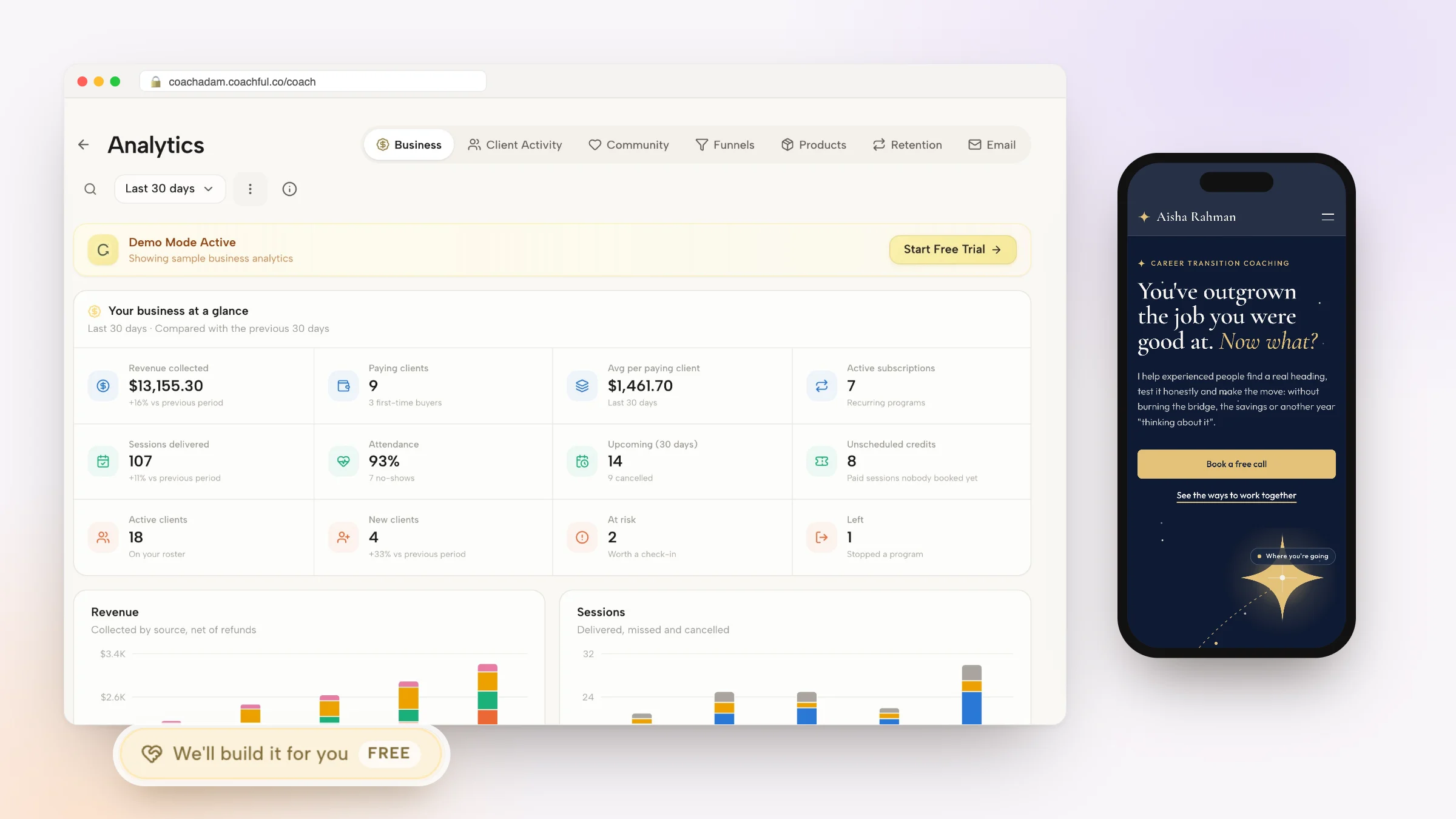
Once the insurance questions are resolved, check the client experience too: can a client tell what they have bought, book the agreed session and find the next step? If you are choosing a system for that delivery, try the interactive Coachful demo and explore the scheduling and client areas. Coachful is software, not an insurer; it does not establish coverage, replace policy review or make your practice compliant.
Life coach insurance FAQs
Do I need insurance if I only coach online?
Online delivery does not remove the possibility of a claim about your professional service. Investigate E&O for the coaching you provide, discuss client-data risks, and check any insurance requirements in your contracts. The physical-premises exposure may differ from an office-based practice, but “online” is not a blanket exemption.
Is life coach insurance the same as life insurance?
No. In this context, life coach insurance means business cover for your coaching practice. Life insurance is a different product concerning a person's life. Specify professional liability, general liability or the other business coverage you mean when requesting quotes.
Does forming an LLC replace insurance?
No. A legal business structure and an insurance contract do different jobs. An LLC is not a policy that pays covered defense costs or claims. Ask a lawyer about entity protection and a licensed agent about insurance; do not assume either removes the need to consider the other.
Will insurance cover a refund or an unhappy client?
Not automatically. Dissatisfaction, a refund request and a covered professional-liability claim are not the same thing. Coverage depends on the allegations, exclusions and conditions. Check your policy's notification requirements before deciding how to handle a complaint.
Can my therapy, fitness or consulting policy cover coaching?
Possibly, but only the actual policy and insurer can establish that. Disclose each service and ask for written clarification of what is insured. A different qualification or a related business activity does not automatically extend coverage to life coaching.
What should I do before my first paid session?
Describe your services accurately, check local and contractual requirements, obtain the appropriate insurance advice, and confirm the effective date and final policy documents. Align the coaching agreement and your delivery with that scope. Do not treat a quote alone as proof that coverage has started.
Sources and scope
This guide draws on the NAIC's small-business and cyber-insurance resources, SBA buying guidance, state-regulator explanations and Hiscox's description of its claims-made policies, linked where used. State-specific guidance and insurer examples are not nationwide rules or promises about another policy. Examples here are hypothetical; no claim outcome, universal premium or recommended coverage limit is implied.