Personal Branding Coaching: How to Build Your Offer

Coachful

53% of coaches reported annual coaching income below $30,000, according to the ICF 2023 Global Coaching Study, which counted 109,200 professional coach practitioners worldwide in 2022, a 54% increase on its 2019 estimate. Put those two facts side by side and you have the commercial case for personal branding coaching in a single sentence. More people are entering the profession than the market is rewarding with a living.
A coach with a clear position gets chosen. A coach with a good certificate and an empty profile gets compared on price. That's the gap clients pay you to close, and it's the reason the offer sells.
There are checkpoints at days 30, 60 and 90, a scoring instrument you reuse at each one, and three costs most guides leave out: the authenticity tension clients feel when you ask them to publish, the follower-count trap that makes a weak offer look healthy, and the fact that nobody can promise a conversion rate for branding.
The 90-Day Build Sequence at a Glance
A cautious coach asks one question before anything else: is there real spend in this market, or only noise? An executive coaching industry statistics roundup estimated global coaching revenue at $5.34 billion in 2025. Buyers already spend at that scale. They spend with you only when they can find you and tell you apart from the coach one search result down.
That problem has a schedule. The sequence runs 90 days and produces five outputs. Each output has a check that decides whether the phase is finished.
| Phase | Output | Check before moving on |
|---|---|---|
| Discovery interviews, days 1-14 | 5-10 interviews with target-market contacts | Notes show how prospects describe the problem in their own words |
| Association scoring, days 14-21 | Current perception scored 1-5 on expertise, relevance, distinctiveness and trust | Every gap is listed with its score |
| Positioning lock, days 21-28 | One audience, one problem, three proof themes | A stranger can repeat the positioning statement back accurately |
| Content and proof, days 28-70 | Evidence-led posts, client results and expert interviews on a fixed weekly cadence | Each week's posts are logged with the audience they reached |
| Reassessment, days 70-90 | Recognition and qualified inquiries compared with baseline | Decision recorded: keep, adjust or narrow the focus |
The check column is the part coaches skip. A phase ends when its check passes, not when the calendar moves. If interviews produced polite generalities instead of the words prospects use for their problem, keep interviewing. If a stranger paraphrases the positioning statement into mush, rewrite the statement rather than adding adjectives.
Why interviews come before assets
A brand is a perception. A systematic review of personal branding research defines personal branding as the interaction between the reputation a person intends to project and the audience's perceived identity, and concludes that the outcomes are multifaceted and nonlinear. You cannot manage a perception you have not measured, so the first two phases collect what is already in other people's heads. Content comes after that. Publishing on a weekly cadence without those notes produces volume and no direction.
I would score the offer at days 30, 60 and 90, not only at the end. Day 30 should show interview language and a scored perception, nothing polished. Day 60 should show a positioning statement a stranger can repeat, plus a log of who each post reached. Follower movement is a weak substitute for that log. Day 90 compares recognition and qualified inquiries with the baseline you wrote down.
Two costs sit inside those checkpoints. Authenticity tension shows up when you push a client to publish before the interviews have given them words that still sound like them. The follower-count trap shows up in the content phase if reach replaces the check. A branding offer also has no conversion rate you can promise in advance, so the day-90 decision is keep, adjust, or narrow, judged against your own baseline.
Put your own dates in
Take the Output column and write a calendar date beside each row, working backward from the day you want the offer live. Coaches who skip this step spend six weeks on a logo and four days on interviews. That order is why a launch can feel busy and produce no inquiries.
Reassessment is a decision, not a report. At day 90 you keep the positioning, adjust one element, or narrow the audience. Recording which one you chose, and why, turns the next 90 days into a second pass instead of a restart.
How to Define Positioning and Intake Before You Build
The first objection arrives before the first session. Won't this turn me into someone performing a personality I don't have?
The evidence says no. A study of 364 participants found that people who reported higher authenticity also showed stronger intentions to present an authentic identity to others, as reported in Employer Branding News' analysis of the personal brand paradox. Strategic self-presentation and honesty aren't opposites. What makes it work is alignment between the identity a client claims and the evidence they consistently show, not uncontrolled disclosure.
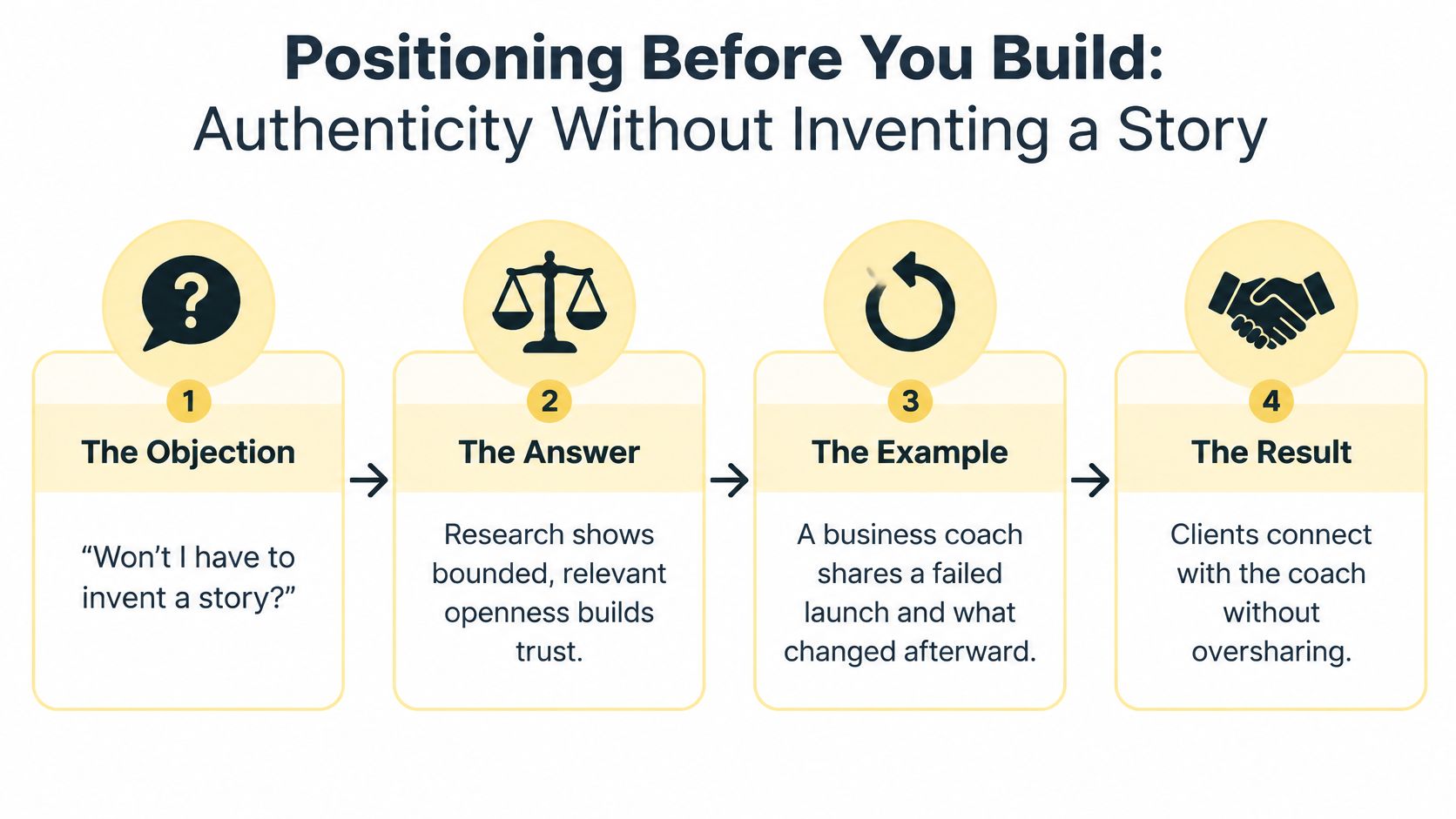
So a business coach explains a failed launch and the decision rule they took from it, and leaves out the divorce. An executive coach describes the principles behind their practice instead of manufacturing a dramatic origin story. Bounded, relevant openness reads as credible. A confessional reads as unedited.
Six steps from blank page to a positioning lock
- One audience, one problem. First-time founders who can't get press after a product launch is a positioning. Entrepreneurs who want visibility is a wish.
- Desired identity in one paragraph. How should peers describe this client in two years? Concrete nouns only. Words like "authentic" and "impactful" describe nothing.
- A ten-question intake form. Current goals, platforms in use, hours per week available for content, past public work, the biggest visibility fear, and whether an employer has to approve public posts.
- Five to ten prospect interviews, logged verbatim. The exact phrases prospects use become headlines later. Your paraphrase doesn't.
- Three proof themes. Each needs evidence behind it: a case note, a published piece, or a client result you can describe without naming the client.
- Write the statement, then test it on a stranger. If they can't repeat it back accurately, it isn't finished.
The employer question most coaches forget
Step 3 matters more than it looks. A 2025 survey of 200 companies with at least 100 employees found that 80.5% did not support employees building personal brands (Neil Patel's marketing statistics roundup). Treat that as directional rather than universal, and still plan for it. A client inside a large organisation may need approval, a confidentiality boundary, or a content matrix separating what they can say about their employer's clients from what they can't.
That changes the intake questions. Ask what the employment contract says about outside work, who owns content created on company time, and what happens to the account and the mailing list if the client changes jobs.
When the positioning is ready
Two tests. A stranger repeats the statement back accurately. The client explains each of the three proof themes without notes. When both hold, you have something you can price and publish.
If you want the evidence gathered before the first call rather than during it, build an intake quiz that qualifies coaching prospects so the answers arrive in writing.
Packages, Pricing and Session Templates
A coach with one offer and one price sells to whoever fits that shape. A coach with four structures sells to whoever shows up. Packaging decides who buys before price is ever discussed.
| Package | Structure | Best fit |
|---|---|---|
| Single session | One call of 60-90 minutes | Clients who want a positioning audit before committing |
| Fixed-length program | 6-12 weekly sessions with a workbook | Clients building a launch-ready brand in one quarter |
| Monthly retainer | Ongoing sessions plus monthly content review | Executives maintaining visibility over time |
| Group cohort | 6-8 clients over 8 weeks with shared feedback | Budget-limited clients who value peer feedback |
The differences between these structures matter less than the discipline of publishing all four and knowing which one you're selling in a given conversation. A single session priced low enough to feel safe becomes a substitute for the program and cannibalises it. Price it as the audit it is.
A 60-minute session template that survives a real client
- Check-in, 5 minutes. What happened with last week's experiment? Not how they felt about it. What happened.
- One metric, 10 minutes. Open the tracker and read a single number together: recognition score, replies from people in the target role, or qualified conversations booked.
- One exercise, 25 minutes. Rewrite the bio around the three proof themes, or re-cut the positioning statement for a narrower audience.
- One publishing task, 10 minutes. One task with a date attached. Two tasks means neither gets done.
- Client's summary, 2 minutes. The client writes it, not you. What they write down is what they remember.
Pricing logic that doesn't collapse
Work backward from delivery hours. Add the time you spend reviewing drafts, commenting on posts, and answering messages between calls, because that time is real and unbilled work is how retainers turn into a loss. Set a per-session rate from that total, then price a program as sessions multiplied by rate plus content-review hours.
Pricing rule: never price a retainer below the sum of its sessions plus the review hours. A monthly package that costs less than the same sessions bought individually means you're doing the admin for free, and that's the version of the offer that burns coaches out.
"My clients won't pay for branding"
They will pay for an outcome they can describe to a board or a spouse. "A brand" isn't one. "Three qualified conversations a month from people who already know what you do" is. Sell the second thing, and price it against the cost of the alternative: another year of referrals that arrive when they feel like arriving.
If you're building a repeatable method behind the package, how to package and sell a coaching framework walks through the structure before you put a number on it.
Onboarding and Retention Workflows That Keep Clients
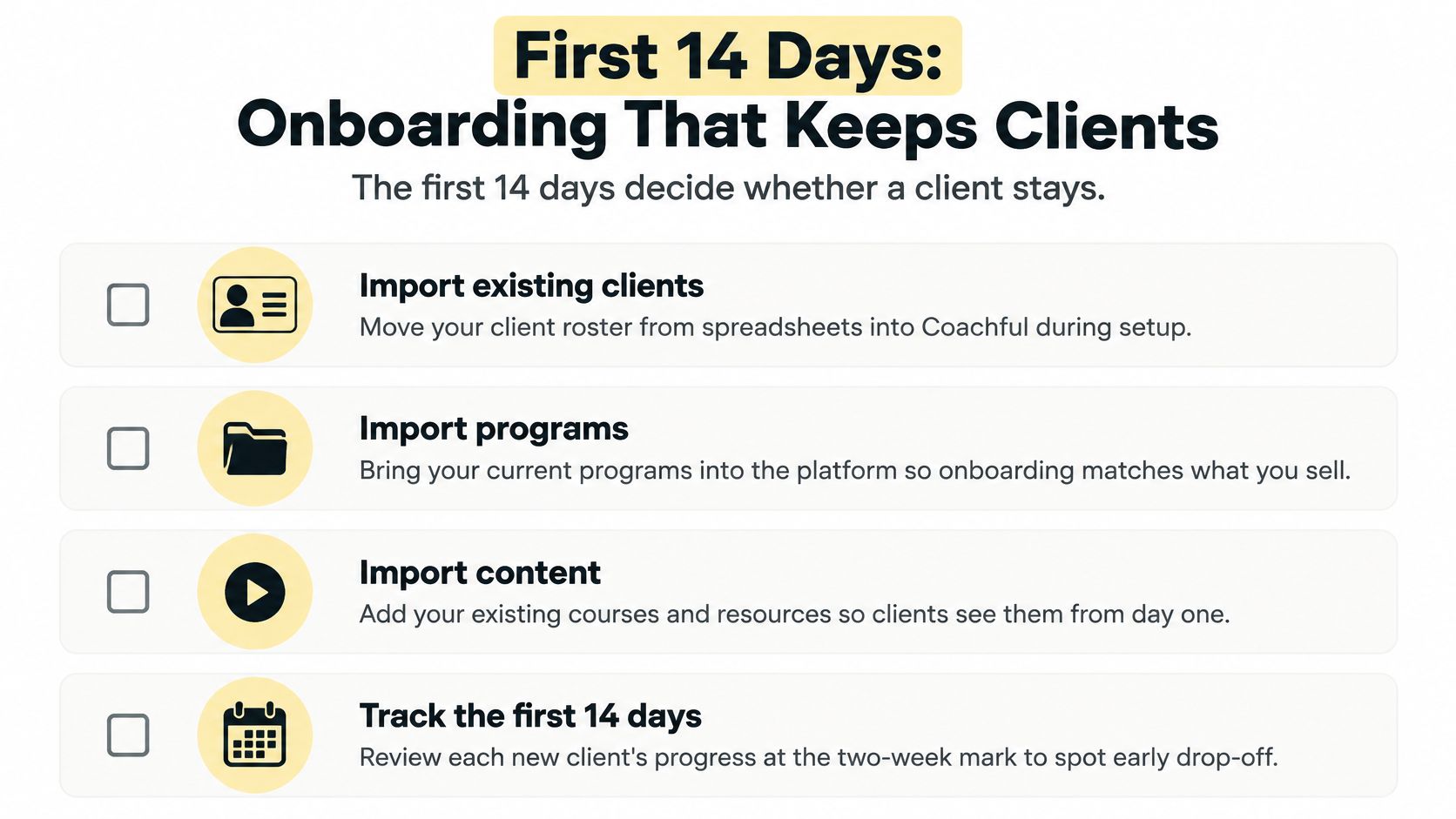
The first 14 days decide whether a client stays. Not the quality of your coaching, which they can't judge yet, but whether the first two weeks feel organised.
Seven steps in the first 14 days
- Welcome message with the intake summary. Send back what they told you, in their words. It proves someone read it.
- Private chat to confirm goals. One thread, kept in one place, not scattered across email and text.
- First call booked within five days. A gap longer than a week is where momentum dies.
- Baseline scores recorded. Same instrument you'll use at day 90, or the comparison means nothing.
- First assignment due within seven days. Small enough to finish, real enough to matter.
- Week 4 check-in. Scheduled at onboarding, not when you remember.
- End-of-program review with a written next-step plan. Even if the client isn't continuing.
If you're moving a practice off spreadsheets, Coachful imports your existing clients, programs and content during setup, so the first cohort doesn't arrive in an empty workspace. It can also draft a client journey from the offer itself, covering the welcome step, private chat, first call booking, opening each included item, joining the community and a review at the end.
The retention rule that works
If a client misses two assignments in a row, don't send a reminder about the contract. Send a short message asking what got in the way. A missed assignment is usually information about the offer, not about the client's discipline: the task was too big, too vague, or aimed at the wrong audience.
When a client goes quiet
A quiet client almost always lacks a clear next action. Give one task per week, written as a single sentence with a deadline, and the silence usually breaks. Two tasks a week produces the opposite effect: a client who feels behind and stops opening the app altogether.
Before the first session, have ready: the intake summary, the baseline instrument, the first assignment, the day 30 and day 60 review dates, and one page describing what the client will have finished by the end of the program.
Lead Generation Tactics That Attract Serious Buyers

The worry is fair. Visibility without buyers is a hobby with a content calendar attached.
The bridge between the two is documented. The 2024 Edelman-LinkedIn B2B Thought Leadership Impact Report found that 75% of decision-makers and C-suite executives said a piece of thought leadership led them to research a product or service they hadn't previously considered, as summarised in these employee advocacy statistics. Useful expertise starts an evaluation before anyone asks for a proposal.
Say a manager reads a post diagnosing why leadership development fails when training arrives without follow-up practice. Coaching wasn't on their buying list. Now they're researching it, and the coach who named the problem is the obvious first call.
Trust does the rest. A 2025 roundup of personal branding statistics reported that 74% of Americans are more likely to trust someone with an established personal brand (One Hour Digital). A stranger who has read three of your posts arrives at the discovery call having already formed a preliminary judgment about whether you know the work.
Four tactics worth the calendar space
- Three problem-specific posts a week, drawn from intake notes. The problem language is already written by your clients. Reuse it instead of inventing angles.
- One expert interview a month with a peer in the target role. Their answers become content, and the relationship becomes a referral source.
- A short diagnostic lead magnet that scores the reader's positioning on the same 1-5 scale you use with clients. It qualifies and teaches at the same time.
- Follow-up segmented by stage. Someone who downloaded the diagnostic is not the same lead as someone who asked about pricing. Coachful's Clients and Leads tools keep the client list, leads, segments and CRM workflow in one place, so the follow-up matches where each lead is.
"I don't have an audience yet"
You have twenty people. The five to ten discovery interviews plus the warm contacts around them are your first audience, and they're a better one than a thousand strangers because they can buy. Publish for them by name for the first month and watch which posts they reply to.
Promotional announcements do very little on their own. Problem-first content does the selling while you're not in the room.
Outcome Metrics to Track Each Month
Follower growth rewards broad, poorly matched attention. A coach with a large following and no qualified inquiries has a bigger number and the same empty calendar.
A meta-analysis of randomised controlled trials on executive coaching found the strongest effects on cognitive activities such as openness to new behaviour and goal strategy, as reported in this PubMed Central study. The practical translation for a branding offer: measure behaviour and perception, not applause.
The outcome hierarchy
| Stage | Metric | How to measure | When to review |
|---|---|---|---|
| Positioning clarity | Average score on the 1-5 scale | Client rates their own clarity with the same instrument | Day 0, 30, 60 and 90 |
| Target-market recall | Share of 10 contacts who name the focus | Short message asking contacts to describe the coach's work | Day 30 and day 90 |
| Relevant engagement | Replies from people in the target role | Count comments and replies on each post | Monthly |
| Qualified conversations | Calls with fit-confirmed prospects | Log each call in client or lead notes | Monthly |
| Opportunities or revenue | Packages sold or contracts signed | Track payments and signed agreements | Monthly |
Use the same instrument every time. Clarity, confidence, consistency and target-audience recognition, scored 1 to 5 at baseline and again at day 90. A score moving from 2 to 4 means something only if the questions were identical both times.
The monthly review, in four moves
- Pull the score for each stage.
- Compare it with the baseline, not with last month.
- Find the weakest stage. That's the constraint.
- Change one thing for the next 30 days.
What the numbers can't tell you
No universal conversion rate for personal branding has been established, so treat any guaranteed percentage with suspicion, including one in a proposal you're about to sign. Career outcomes are nonlinear, which means the honest report compares the client with their own starting point rather than promising a fixed return.
When the score doesn't move
Check the audience before you change the content. A flat recognition score usually means the posts are reaching people who will never buy, and better copy won't fix a mismatched room.
For a fuller set of numbers to review each month, coaching business KPIs every coach should track covers the financial side alongside these brand measures.
Launch Your First Offer This Quarter
Pick one audience and start the sequence this week. Not next quarter, when the website is finished. The website is the last thing the sequence needs and the first thing coaches build.
- Book five discovery interviews with people who match the audience you're choosing. Five is enough to hear the same problem described in different words.
- Score current associations on the 1-5 scale for expertise, relevance, distinctiveness and trust, and write down every gap with its number.
- Lock the positioning on one audience, one problem and three proof themes, then test it on a stranger.
- Publish the offer with one package from the table. One, not four. The other structures can wait until you know which client shows up.
If you're running the delivery side on Coachful, the Coaching CRM connects intake, goals, habits, check-ins, sessions, private notes, tasks and messages around one client, so the day-30 review doesn't mean assembling five tools. Packages can be built as single sessions, fixed-length programs or monthly retainers, and the free Coaching Package Pricing Calculator lets you test a rate before you publish it. None of that replaces the interviews. The tool organises what the interviews produce.
On day 30, check three things: the recognition score against baseline, the number of qualified conversations logged, and whether the first client has finished their first assignment. If all three moved, keep going. If only the follower count moved, change the audience.
The offer is ready when a stranger can repeat its positioning and a client can name the change it produced.
Coachful gives you the workspace to run this offer end to end, with intake, packages, sessions, client journeys and the metrics you review at day 30, 60 and 90 in one place instead of five. If you're ready to turn your personal branding coaching offer into a measured program rather than a content habit, visit Coachful and see how the platform supports the sequence from first interview to final review.