Should Coaches Charge for Travel Time? 5 Pricing Options

Nour
Founder, Coachful
Your corporate client wants the coaching in person, but the journey takes longer than the session. Should you charge for travel time, or absorb it to win the work?
Coaches can charge for travel time when the arrangement is disclosed and agreed before booking. The practical question is how to recover the capacity the journey consumes without surprising the buyer. Separate three things: your professional service, your reserved travel time and the money spent getting there.
There is no universal coaching travel rate. A short local visit may fit inside your fee; a journey that removes a working day needs a different commercial decision. Choose a model that your margin, schedule and client's purchasing rules can support. This guide concerns a coach travelling to deliver work, not charging clients for their own journeys.
Travel time and travel expenses are different charges
Travel time is the time you reserve for reaching and returning from the engagement. Travel expenses are outlays such as an agreed train ticket, mileage allowance, parking or accommodation. Reimbursing a ticket does not compensate you for the hours spent travelling.
Conversely, a time fee does not necessarily include the ticket. A buyer who hears “travel included” may reasonably assume both are covered. Replace that phrase with a specific statement about time, distance, transport costs and limits.
Do not treat a tax deduction or an employee mileage policy as automatic permission to bill a client. What a buyer agrees to pay, how your business records it and what is deductible are separate questions. Check current local tax requirements with a qualified adviser.
Calculate the whole engagement before choosing a model
Start with the door-to-door commitment rather than the time printed on the workshop agenda. Include preparation, delivery, follow-up, travel, required early arrival and any overnight interruption. Distinguish active work from reserved availability so you can explain the quote honestly.
Hypothetical example: a coach quotes $600 for two hours of preparation, a two-hour workshop and one hour of follow-up. That is five professional hours. A four-hour return journey expands the commitment to nine hours. If the fee stays $600, the fee divided by those nine hours is $66.67 per hour, before overhead, tax and other costs.

Suppose the coach uses $120 per hour as an internal planning value, not a market rate. Five professional hours account for $600, four travel hours add $480, and pre-approved transport costs total $180. The illustrative quote becomes $1,260: $600 service, $480 travel time and $180 expenses.
The $180 reimbursement is not extra compensation for your labour. Whether it is recorded as income and expense, or treated differently, depends on your circumstances and accounting rules. For the commercial decision, keep cash outlay separate from the fee available to pay for your work.
Also examine the calendar. A four-hour journey can make an otherwise usable afternoon unavailable, even if the scheduled coaching lasts only an hour. Do not automatically add every displaced appointment to a full time-based calculation: that can count the same capacity twice. Use opportunity cost to test the price, not to produce a second unexplained surcharge.

5 ways coaches can charge for travel time
These are pricing choices, not industry standards. Select the simplest one that describes what you actually promise. State expense treatment separately under every model.
1. Include a defined amount of local travel
Build a modest local journey into your on-site price when it is predictable and commercially sustainable. Define the included area by a practical boundary, distance or return journey allowance. Avoid “nearby” when the buyer's definition could be very different from yours.
For example: “The quoted fee includes return travel time within [defined area]. Parking and other agreed outlays are [included / reimbursed under the expense schedule].” These brackets need real decisions before the wording reaches a buyer.
This model reduces administration for repeated local visits. Its weakness is boundary creep: a second location, peak-hour journey or changed venue can turn a small inclusion into a substantial commitment. Explain when a new quote is required.

2. Charge an agreed hourly travel rate
Use a separate time rate where journey length varies and the client accepts time-based billing. Specify whether the rate applies to the return trip, what counts as travel, any minimum increment and the approval ceiling.
You may choose a rate different from your delivery rate. That is a commercial choice, not an admission that travel has no value. Explain the reason in terms of reserved availability rather than claiming that every minute in transit is coaching.
The weakness is uncertainty. A buyer may not want an uncapped bill after a delayed train. Quote the planned hours, state the maximum without further approval and agree how disruptions are handled. If you deliver paid work for another client during the journey, avoid overlapping charges for the same work or reserved time.
3. Quote a fixed return travel fee
A fixed fee suits a familiar route with a reasonably predictable commitment. The buyer knows the amount in advance and you avoid debating small variations in journey duration.
Write what it covers: one coach, one return journey, the named venue and the agreed date. Clarify whether the amount covers time only or also named outlays. A fixed time fee plus actual expenses is different from an all-inclusive travel fee.
You carry more risk if the journey takes longer than expected. Price that risk deliberately, and define material changes that require a revised quote. A changed city is not a minor adjustment to the same trip.
4. Reserve a travel half-day or day
A half-day or day fee can suit a trip that makes a block of your schedule unavailable. Define the block rather than using “day” to mean whatever the invoice later needs it to mean. Agree whether arrival the previous evening is necessary and compensated.
This approach can be clearer for distant corporate engagements, but check procurement first. Some buyers permit receipted expenses while refusing a separate travel-time line. You can negotiate an overall engagement price or decline; do not relabel compensation as an expense to bypass their rules.
A block fee is not automatically fairer than hourly billing. Compare it with the actual reserved time, work required and practical alternatives. Offer remote delivery or a different date when those options preserve the coaching purpose.
5. Build travel into an all-inclusive on-site price
Give the buyer one complete fee for a defined engagement, location and travel arrangement. This can work when budget certainty matters more than itemised reimbursement. Calculate the components internally even if the client sees one price.
Make the boundaries explicit: number of visits, location, transport assumptions, overnight stay, rescheduling and additional attendees or facilitators. “All inclusive” without a scope becomes an invitation to absorb changes you never priced.
The main trade-off is risk transfer. If travel prices rise, you may carry the difference unless the agreement provides otherwise. For repeated visits, decide whether the package fixes all dates and routes or requires approval for each trip.

Agree the expense rules before buying tickets
Ask the corporate sponsor for the supplier travel policy and the person who can approve your quote. The enthusiastic coaching contact may not control expense reimbursement. A later disagreement is harder to resolve once you have bought a non-refundable ticket.
Published consultant policies show why assumptions are risky. Pacific Life's published consultant policy requires travel approval and sets reimbursement conditions. It is an example of buyer-specific rules, not a rule for every coaching client or a source of rates to copy.
- Booking responsibility: Will the client book directly, or will you pay and request reimbursement?
- Permitted costs: Which transport class, accommodation, meals, mileage and incidental charges are eligible?
- Approval limit: What total can be committed, who approves increases and how is approval recorded?
- Evidence: Are itemised receipts, proof of payment, a journey log or a particular claim form required?
- Payment: Is an advance possible, when must claims be submitted and when are they payable?
If the client books transport, agree a workable itinerary before accepting it. A cheaper fare can require an extra night or make timely arrival unrealistic. Client booking also does not settle whether your reserved travel time is paid.
Keep expense sharing honest. If you combine a personal trip with the engagement or visit several clients, agree an allocation rather than billing each person for the entire journey. Handle refunds, credits, loyalty benefits and unused allowances according to the arrangement and applicable rules.

Confirm the venue details that change your quote
Ask for the actual address, access time, contact person, expected finish time, accessibility requirements and equipment arrangements. “Our London office” is not enough to plan transport or judge the return journey. Confirm whether security registration or an escort is needed.
Keep logistics questions proportionate. You do not need confidential employee histories to estimate a journey. A simple form or email can gather the venue and timing information, with sensitive coaching material handled through a separate appropriate process.

Check whether the venue can support confidential work. Travel is wasted if you arrive for individual coaching and discover a noisy open-plan desk. Confirm a suitable private space and the boundaries of confidentiality with the sponsor before the visit.
For multiple coaches, identify who must attend and whose travel is included. Adding a co-facilitator changes both delivery and travel costs. Do not assume the client's approval for your journey extends to everyone you later bring.
Write a short travel schedule beside the offer
The buyer should be able to see the price rule before committing, not discover it in an invoice note. Put a plain-language summary beside the on-site offer and include the complete agreed schedule in the proposal or contract.

The following is a commercial drafting scaffold, not legal advice or a ready-to-use contract:
For [engagement] at [venue] on [date], the professional service fee is [amount and scope]. Travel time is [included within a stated limit / charged using the agreed method]. Transport and accommodation are [fixed inclusions / reimbursed at actual approved cost / booked directly by the client].
Before booking, [approver] must confirm the itinerary and a maximum expense commitment of [amount]. Costs above that limit need written approval. Claims require [evidence] and follow [submission and payment terms]. Changes, cancellations and unused credits are handled under [the agreed schedule]. Applicable taxes are addressed separately.
Remove alternatives and fill every placeholder. A template containing three unresolved slash options is not an agreement. Have appropriate professional advisers check enforceability, consumer protections, tax treatment and any cross-border complications.
Set cancellation and disruption rules before the journey
Address two different losses: time you reserved and travel costs already committed. An engagement cancellation fee does not automatically settle the treatment of a rail ticket or hotel. Conversely, reimbursing a non-refundable ticket does not pay for the reserved coaching day.
Agree what happens if the client changes the venue or date, you cannot travel, transport is disrupted or the event moves online. Identify what can be cancelled, transferred or refunded. Do not present every booking as irrecoverable without checking its terms.
Discuss a practical backup: remote delivery, a replacement date or another agreed arrangement. Safety and suitability come before forcing a journey to protect a fee. Do not promise that insurance will cover a cancellation unless you have checked the relevant policy and circumstances.
Keep the client's decision and approval in writing. If a delayed train creates an extra hotel night, send the cost and options to the named approver where practical. The absence of an immediate reply is not necessarily authority to incur an unlimited expense.
Invoice what was agreed, then review whether the model worked
Show professional fees, travel-time charges and reimbursable outlays clearly where your chosen arrangement calls for separate items. Use the agreed reference, purchase order and evidence requirements. Do not describe a fixed travel fee as an actual-cost reimbursement.

Reconcile any advance against the final approved claim. Explain unused amounts, refunds and extra costs rather than quietly retaining a difference that the agreement requires you to return. Ask your accountant how to record the transaction and applicable taxes; a tidy invoice is not proof of correct tax treatment.
After the engagement, compare planned with actual door-to-door time, approved outlay and collected payment. Note whether the trip disrupted delivery for other clients. Use that evidence to adjust your next quote, not to retrospectively add a charge the buyer never accepted.
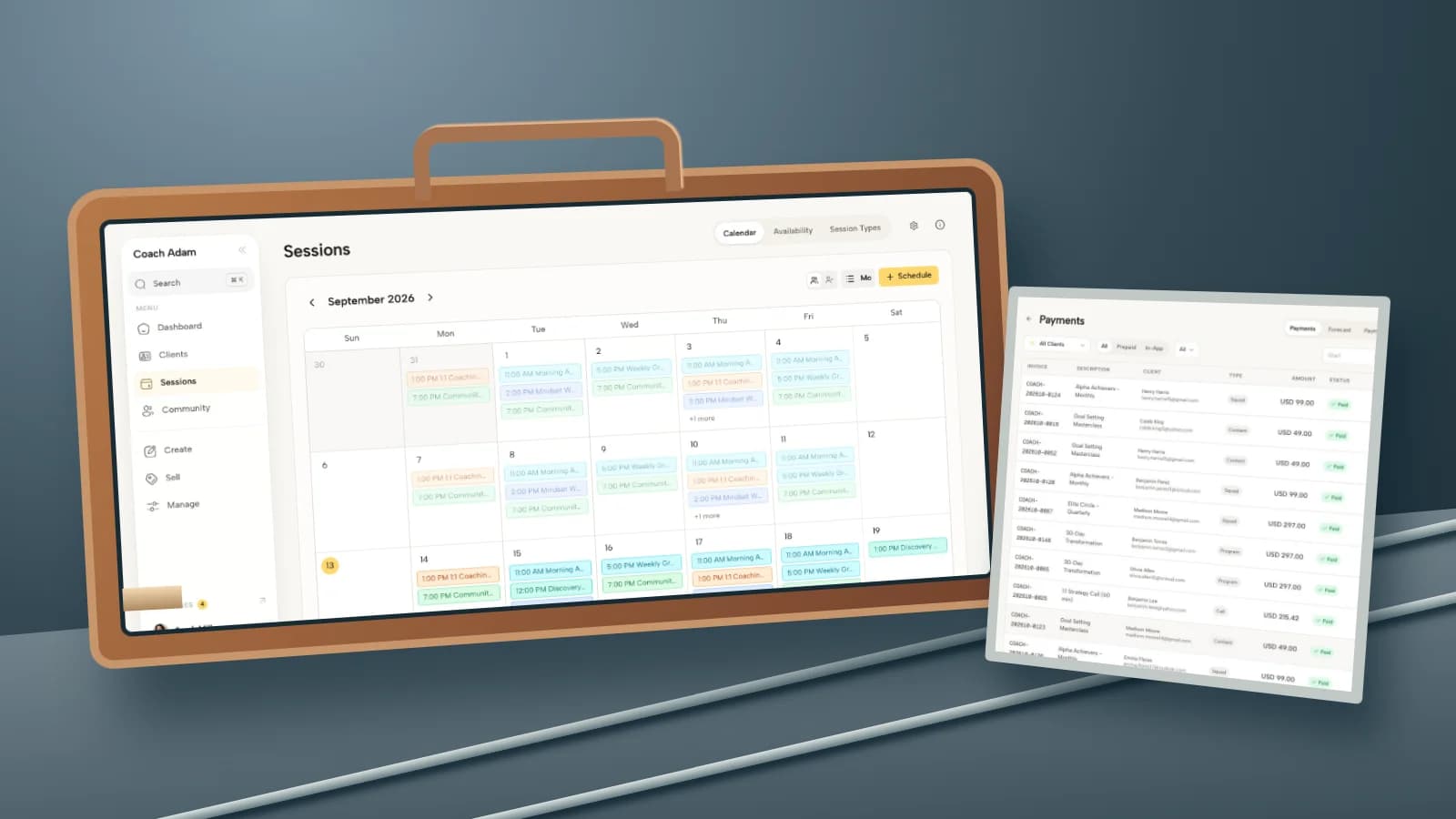
Before selling another on-site package, make the scope, location, availability and payment record agree. Try the interactive Coachful demo to inspect the offers, calendar, forms and invoice surfaces shown here. They can support the practice-management side of your process; they do not set a travel rate, calculate mileage or determine your tax obligations.
Frequently asked questions
Should a coach charge the full coaching rate for travel?
Not automatically. You can use a separate rate, a fixed travel fee, a reserved block or an all-inclusive engagement price. Test whether the arrangement covers the capacity you commit, then obtain the buyer's agreement. Your delivery rate is one planning input, not a universal entitlement.
Can I charge travel time and mileage?
You can propose both because time and vehicle costs are different components. Make that distinction explicit and check the client's policy. Do not duplicate fuel or other costs already covered by the agreed mileage basis. The appropriate rate and tax treatment depend on the actual arrangement and jurisdiction.
What if the client refuses travel-time charges?
Ask whether they can approve a complete on-site engagement price, book a longer useful block or choose remote delivery. Evaluate the whole commercial outcome. If the work is not sustainable under their rules, declining can be more sensible than hiding the charge elsewhere.
Should travel be paid before I book?
Consider requesting direct client booking or an agreed advance when the outlay is material. Confirm approval and payment terms first. Do not assume an advance is non-refundable or may be retained regardless of what happens; state the reconciliation and cancellation treatment.
The decision: do not argue about a travel percentage before calculating the commitment. Price the service, the reserved journey and the outlay deliberately, then give the buyer a clear choice before either side spends money.