Walk and Talk Coaching: 7 Steps for Safe Outdoor Sessions

Nour
Founder, Coachful
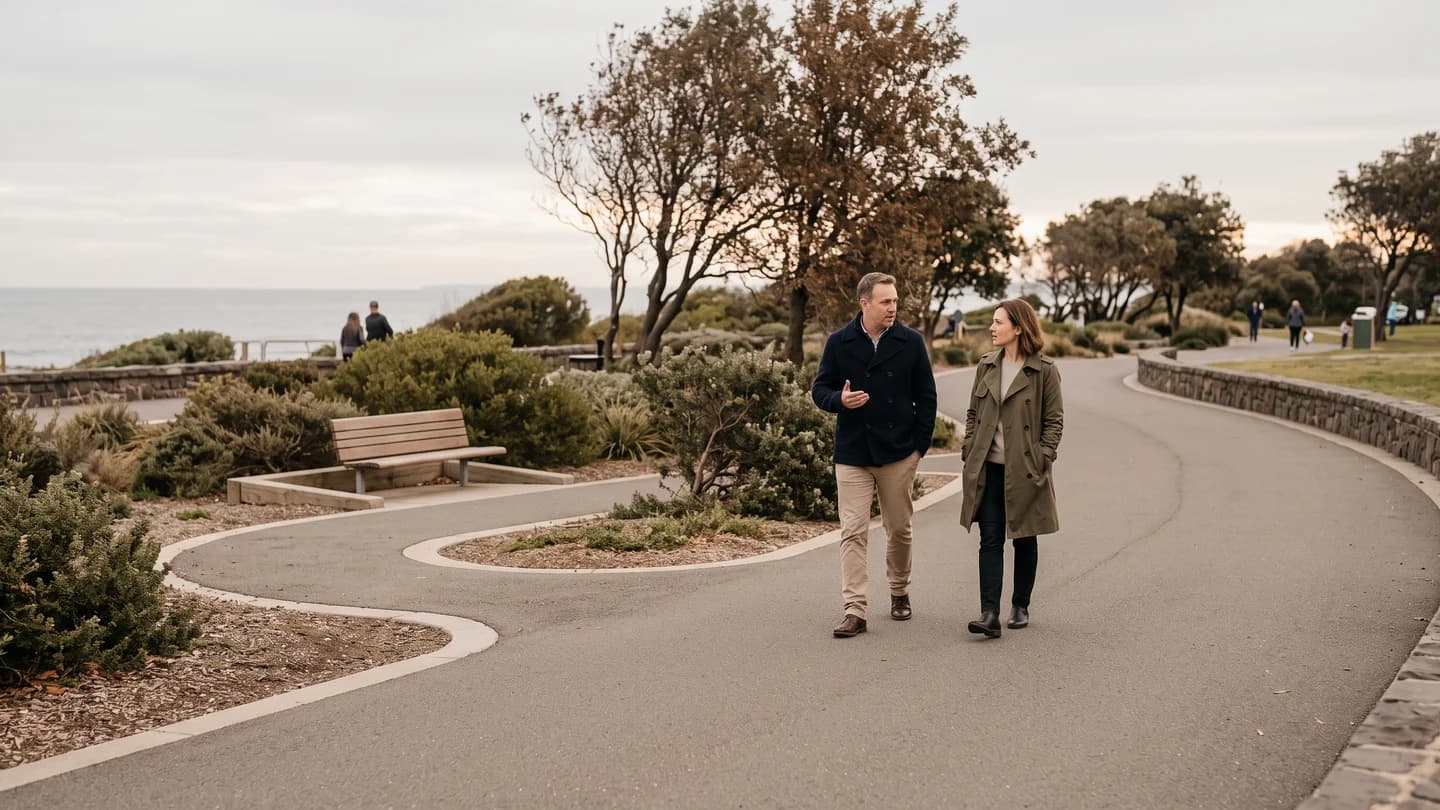
You can offer walk and talk coaching, but treat it as a different delivery format, not an ordinary appointment moved into a park. Agree the route, practical access needs, limits of public-space privacy, weather decisions and an equivalent alternative before the first session. If the setting makes the conversation harder or less private, change the setting.
The uncomfortable question is not whether walking looks good on your website. It is whether you can stay properly present as a coach while checking a junction, wondering who can hear and calculating whether you will get back on time. A beautiful location does not solve those problems for you.
This guide is for coaches planning adult, in-person outdoor conversations on straightforward local routes. It is not a guide to wilderness leadership, exercise prescription, therapy or emergency treatment. More demanding terrain, specialist populations and remote locations need expertise and preparation beyond this article.
What is walk and talk coaching?
Walk and talk coaching is a coaching conversation held while coach and client walk together, usually with the option to pause or sit. The client still brings a goal, question or decision. The coach still contracts for the work, listens, challenges appropriately and helps the client choose their next action.
It is not automatically nature coaching. You can use a suitable outdoor setting without asking the client to interpret trees as metaphors. Nor is it automatically a fitness service: increasing distance, pace or exertion should not become a hidden requirement for receiving the coaching.
The International Coaching Federation's practical article on walking coaching highlights location, accessibility, terrain, other users, a backup plan and health and safety preparation. Use those as operational questions, not as a promise that outdoor sessions will produce better results for every client.
1. Choose the format with the client, not for the client
Offer a genuine choice between walking, sitting outdoors and your usual indoor or online format. Ask what would help the client think and participate. Someone may prefer moving beside you; someone else may need a quiet room, reliable seating, clear sight of your face or somewhere to use written material.
Describe the actual experience before asking for consent. “Outdoor coaching” could mean a paved ten-minute loop with benches or a muddy hour on a hillside. Those are not interchangeable offers.
- Purpose: what coaching question will you work on?
- Format: how much walking, pausing or sitting is possible?
- Participation: what practical arrangements would make it workable?
- Choice: can the client change their mind without having to defend the decision?
A useful invitation is: “We can meet on a level park route, sit outside or use our usual online format. Which would make it easiest to focus on your question? We can change the plan if the setting is not working.”
Do not sell the session through claims that walking will treat anxiety, resolve trauma or guarantee creativity. A client choosing an outdoor conversation is not consenting to treatment or to an exercise program. Keep your description inside your actual coaching competence.
2. Inspect a route you can shorten and leave
Walk the proposed route yourself before offering it. Look at the actual surface, crossings, gradients, seating, toilets, shelter, other users and mobile coverage where relevant. “Flat” on a map does not tell you about loose gravel, a locked gate or a busy cycle lane.

Prefer a route with straightforward return options over a destination that you must reach. A reversible loop lets you turn back when the conversation needs stillness, the weather changes or the client wants to stop. Avoid making the end of the appointment depend on keeping up a particular pace.

Check who manages the land and whether commercial coaching activity needs permission. Public access does not establish permission for every business use. Review any relevant local requirements and ask your insurer whether the proposed activity and location fit your cover; do not assume an indoor coaching policy answers that question.
Ask about practical access without asking the client to provide a medical history. For example: “The route includes compacted gravel and a short slope, with benches at two points. Would a paved route or a seated conversation work better?” If you cannot confidently accommodate the need, offer another format rather than improvising reassurance.
Write a short route note for yourself: meeting landmark, route choices, places to pause, return options, emergency access and known limitations. Keep it factual. It is a working preparation document, not a claim that you have eliminated risk.
3. Agree what happens when someone can hear
A public path is not a confidential consulting room. You can choose a quieter time and route, but you cannot promise that nobody will overhear or recognize either of you. Explain this before booking, particularly when the client expects to discuss a sensitive work or relationship issue.
Agree a simple encounter protocol. Should you pause the conversation when people approach? How will you respond if somebody greets the client? Is the client comfortable being seen with you? Do not introduce them as your coaching client without their permission.

Try this wording: “If someone comes within earshot, I will pause the sensitive part of our conversation. If either of us recognizes someone, we will use the greeting we agreed and will not explain our coaching relationship. If the location is too exposed, we can stop, move or change format.”
This is not a waiver that transfers your responsibilities to the client. Consent to meet outside does not make avoidable disclosure acceptable. The ICF's discussion of privacy and confidentiality in coaching emphasizes agreeing boundaries and maintaining them in practice.
Do not record the walking conversation by default. Recording outdoors can capture other people and creates separate consent, storage and practical problems. If recording is genuinely necessary, resolve the specific permissions and applicable requirements first. For an ordinary walking session, a brief agreed written recap may be the simpler choice.
4. Set a weather and stop rule before the appointment
Make the decision process boringly clear. Who checks the conditions? When will the decision be communicated? Will you switch online, move indoors or reschedule? Which cancellation terms apply? A client should not discover the answer while standing in the rain.
Review the actual forecast, official local warnings and route conditions. A previous pleasant walk is not evidence that today's conditions are suitable. Heat, ice, lightning, poor air quality, strong wind, flooding or a damaged route can change the decision.
Do not adopt a universal numerical cutoff from a blog. Appropriate decisions depend on the people, route, activity, local guidance and your competence. If you cannot assess the conditions confidently, use the alternative.
- Before leaving: confirm whether the outdoor plan still stands.
- At the meeting point: check that both people are comfortable with today's conditions.
- During the session: either person can ask to pause, sit, return or stop.
- After a change: confirm what happens to the remaining time and any follow-up.
Carry what the setting reasonably requires, and have an emergency plan appropriate to your role and location. Review relevant first-aid competence and insurance with qualified providers. If a real emergency occurs, prioritize appropriate local help rather than trying to preserve the coaching agenda.
5. Keep the coaching stronger than the walk
Start by agreeing the session focus while stationary if that helps. You want to know what the client hopes to leave with before the route starts competing for your attention. Then choose a pace that supports comfortable conversation, not one that proves either person's fitness.
Notice when navigation is taking you out of the conversation. Stop at a safe place to clarify a difficult question instead of half-listening while choosing a crossing. Leave enough return time that the closing reflection is not delivered while rushing toward the car park.

You can invite the environment into the coaching, but ask first. “Would it help to use what you notice around us as a prompt, or would you rather stay with the question directly?” A client is allowed to want a practical discussion without a nature exercise.
A hypothetical career-coaching example: the client is choosing whether to apply for an internal role. You explore what matters, test the assumptions behind each option and agree one information-gathering step. The walk is the setting; the useful outcome is the client's clearer decision process, not the number of steps taken.
When someone becomes upset, do not assume movement will help. Ask what they need, offer a pause and check whether the public setting is still appropriate. Work within your competence and use established referral or emergency procedures where needed. Do not turn an outdoor coaching offer into an informal therapy service.
6. Use an agenda that leaves room to return
An outdoor appointment needs the same boundaries as any other session, plus enough logistical room to finish well. The following 60-minute agenda is an example, not a standard or a claim about an ideal dose of coaching.

- First 5 minutes: check conditions, comfort and today's route choice.
- Next 10 minutes: agree the focus and what a useful session would change.
- Next 30 minutes: explore the question, with pauses or a shorter loop as needed.
- Next 10 minutes: identify the client's next action and test whether it is realistic.
- Final 5 minutes: recap, confirm follow-up and finish at the agreed endpoint.
Choose your turn-back point before time becomes tight. A shorter conversation with a proper close is preferable to adding another loop and then ending abruptly at a road crossing. If route management repeatedly interrupts the work, simplify the route or switch to a seated session.
Leave a buffer between appointments for returning, writing notes and any change of clothes or location. Do not sell consecutive outdoor slots as though both begin and end at your desk. The fee and session description should reflect the delivery arrangement you can reliably provide, without promising that walking is intrinsically more valuable.
7. Brief, document and review the session
Send one practical briefing rather than scattering the details across several messages. Include the exact meeting landmark, the format, the route limitations, the privacy agreement, weather decisions, the alternative and how to contact each other if someone cannot find the meeting point.

A walking-coaching briefing you can adapt
The following is a fictional example, not a legal agreement or an outdoor-risk assessment. Replace each bracket with a verified detail and have relevant contractual wording reviewed for your location.
We will meet at [exact landmark] at [time and time zone] for [session duration]. Our planned route is [plain-language surface, slopes and approximate route description], with [seating and shorter-return options].
We can pause, sit or return at any time. Please tell me what practical arrangements would make the session work for you; you do not need to justify choosing our [indoor or online] alternative.
This is a public location, so we cannot guarantee that nobody will hear or recognize us. Our agreed approach to passers-by is [encounter protocol].
I will confirm the plan by [decision time] using [contact method]. If conditions are unsuitable, we will [verified fallback], under the cancellation and rescheduling terms we agreed.
If you cannot find me, use [contact method]. Bring [route-appropriate practical items]. We will focus on [agreed coaching question], not on covering a particular distance.
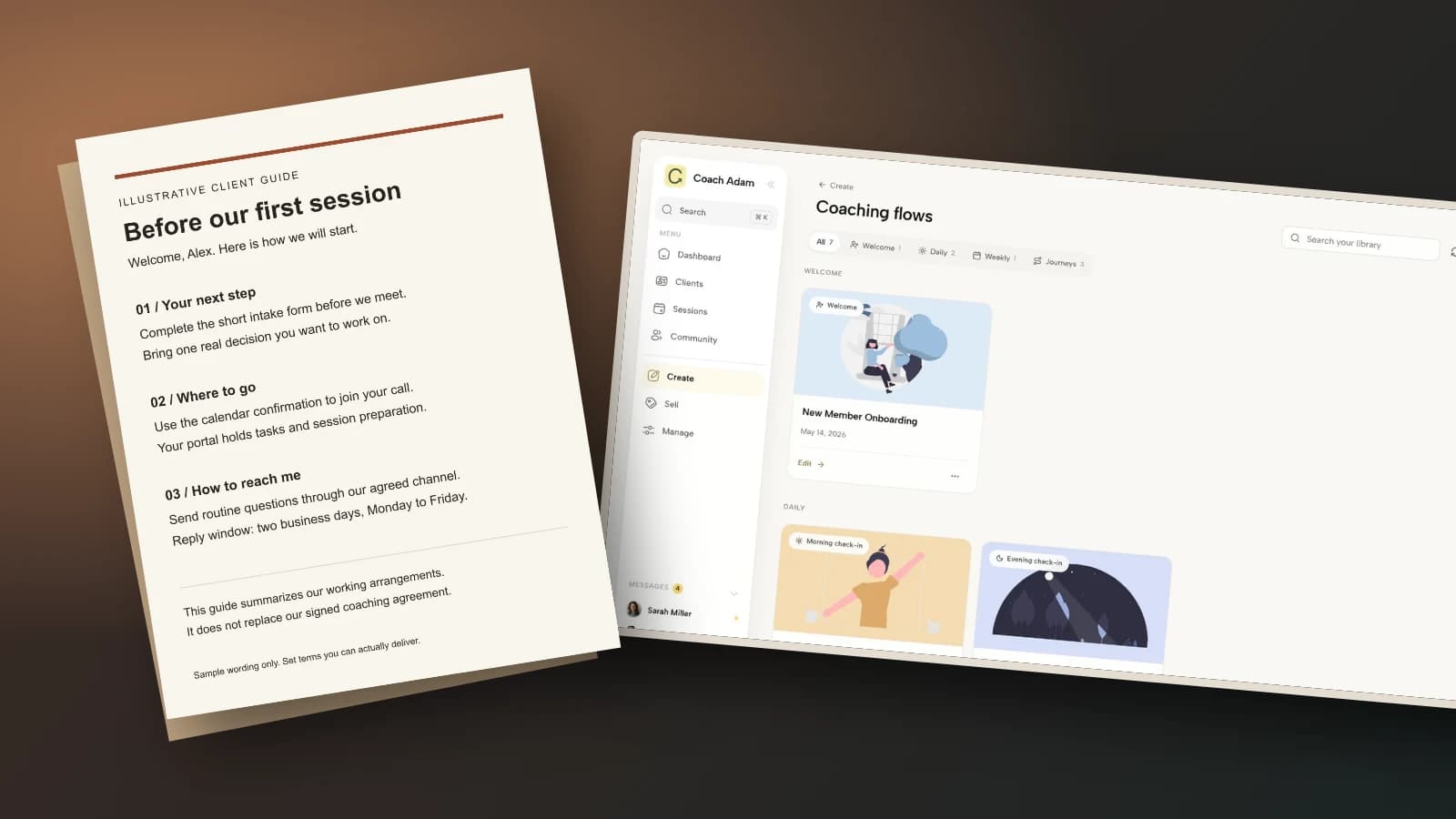
Record the client's agreed format and any practical arrangements needed for delivery. Avoid collecting sensitive information merely because a form has space for it. If a client shares something you do not need to retain, do not turn it into a permanent note out of habit.

Coachful's real demo intake workspace illustrates the administrative starting point: establish the information needed for the appointment before you meet. It is not proof of a prebuilt outdoor-coaching consent process. You remain responsible for the questions, agreement and suitability of your own setup.
After the session, ask one format question alongside your normal coaching review: “Did walking help you work on the question, or did any part of the setting get in the way?” Note the client's preference and change the next appointment accordingly. Do not interpret politeness as evidence that the format worked.
Make the booking match the actual experience
The practical handoff is where a good outdoor plan often becomes vague: the calendar entry says “coaching session,” the meeting point lives in an old message and the client cannot find the fallback. Rehearse that handoff as though you were the client.

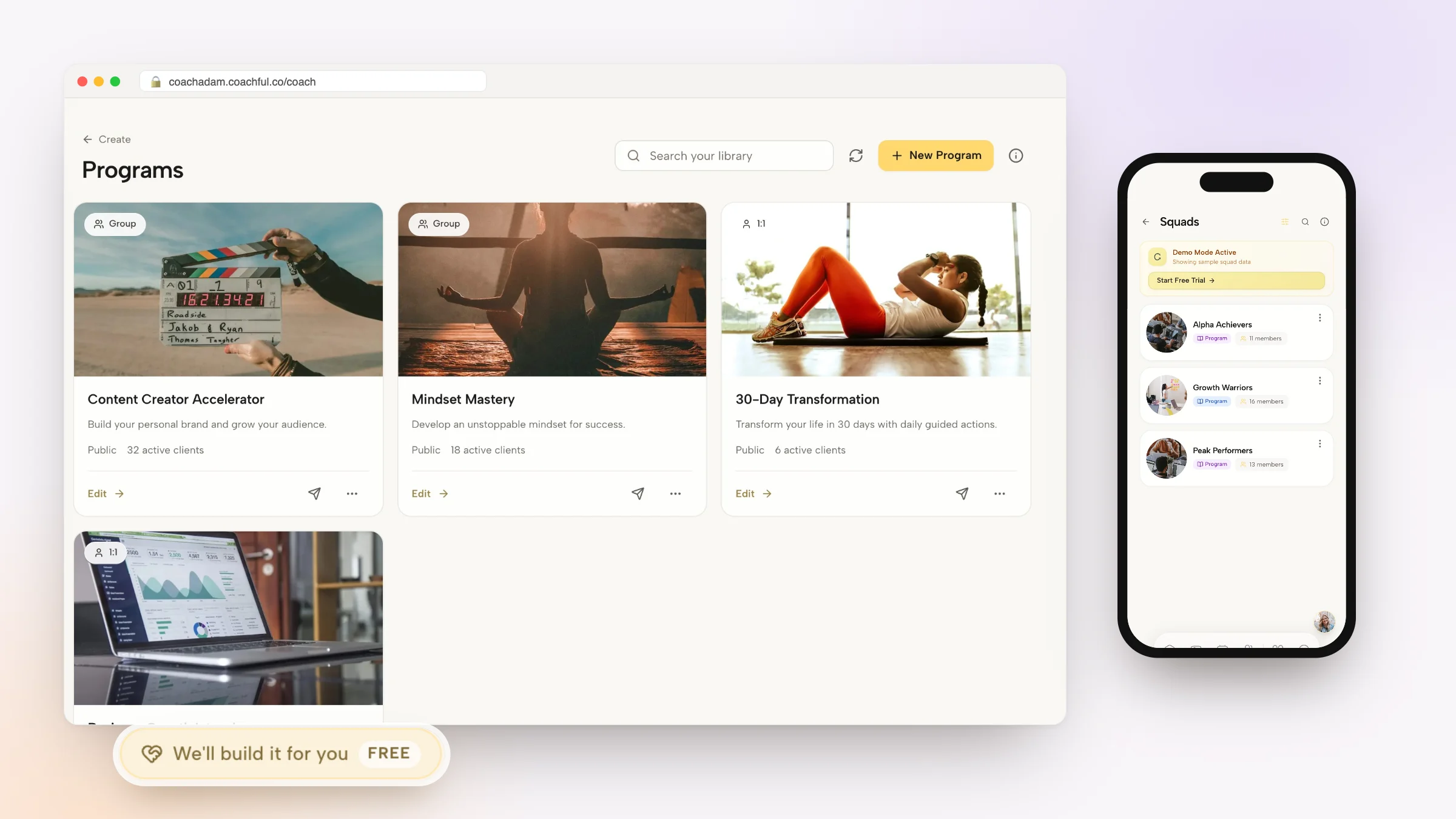
Check the appointment time, the instructions the client receives, the exact landmark and the message explaining how a format change will be confirmed. Coachful's scheduling workspace can help you organize the appointment, but a calendar screen cannot inspect a route or judge the weather for you.
If you are reviewing how your booking and intake administration support outdoor sessions, Try the interactive demo. Explore the scheduling and intake surfaces with one test question: could a client identify where to meet, what to expect and how the alternative will be communicated? Keep the outdoor judgment with the coach.
Frequently asked questions
Do I need a qualification to offer walk and talk coaching?
There is no single answer that applies to every country, location and activity. Check local requirements, land permissions, insurer expectations and your competence for the actual route. A coaching credential does not automatically qualify you to lead remote or technically demanding outdoor activities.
Is walk and talk coaching confidential?
Your confidentiality obligations continue, but public space introduces exposure you cannot fully control. Explain the limits, agree an encounter protocol and offer a more private format. For a topic that requires privacy you cannot provide outdoors, choose another setting.
What if the client cannot or does not want to walk?
Offer an equivalent seated, indoor or online option and ask about practical access needs without demanding a justification. The purpose is access to useful coaching, not compliance with your preferred delivery style.
Can the client walk elsewhere while I coach them by phone?
That is a different, remote delivery arrangement. You cannot inspect their surroundings or know whether their location is private or safe. Agree location, connectivity, attention, privacy and what happens if contact drops before offering it; do not automatically reuse your in-person outdoor plan.
Should I charge more for an outdoor session?
Price the offer around its actual scope, preparation and delivery costs. Explain any travel, location or cancellation arrangements before booking. Do not justify a premium through unsupported claims that being outside produces better coaching results.
The standard is not “we got outside.” It is “the client could participate, think and make a useful next decision without the setting undermining the work.” If the route, conditions or public exposure work against that standard, changing the format is good coaching.