What Is a Survey Course and Why Coaches Use Them

Coachful
A survey course is a broad, introductory class that touches the chief topics of a field briefly rather than exhausts any one of them, and it gives learners a general view before they specialize. If you've ever built a welcome sequence, a foundation module set, or a first-week onboarding path that helps people orient without overwhelming them, you've already been thinking like someone who designs a survey course.
That's why this format matters for coaches, program designers, and L&D teams. You're trying to give people enough structure to feel grounded, enough language to follow the conversation, and enough context to decide whether they want to go deeper, not dump every detail on day one. A survey course solves that exact problem, and in coaching it often shows up first as a clean onboarding experience that feels calm instead of crowded.
The Coach Who Accidentally Built a Survey Course
She called it onboarding, not a course. A few welcome videos, a values worksheet, a session-prep guide, and a short resource library had slowly turned into a learner's first real map of the field.
That's the moment many coaches recognize. You want clients to feel oriented, but you don't want to bury them under frameworks before they've even had a first call. If that sounds familiar, you've probably already built the bones of a survey course without naming it that. A useful companion at this stage is a no-code coaching app for coaches, especially if you want intake, scheduling, and program access to feel connected instead of stitched together.
Why the name matters
The label changes how you design. Once you call it a survey course, you stop asking, “How do I teach everything?” and start asking, “What do learners need to see first so the rest makes sense?”
That shift is huge for coaches. A client doesn't need your whole operating system in week one. They need the basic language, the major categories, and a sense of where the work is headed. In a coaching school, that might mean orienting new students to ethics, coaching presence, goal-setting, and the role of practice sessions before any advanced specialization.
Practical rule: if your first module is trying to make learners fluent in the whole field, you're probably overbuilding. If it's giving them a clear map, you're on the right track.
Survey courses work because they reduce uncertainty. They let people sample the terrain before they commit to a path, which is exactly what good onboarding should do. The coach in your head who says, “I want a real foundation, but I don't want to overwhelm them,” is already asking the survey course question.
Defining a Survey Course Without the Textbook Jargon
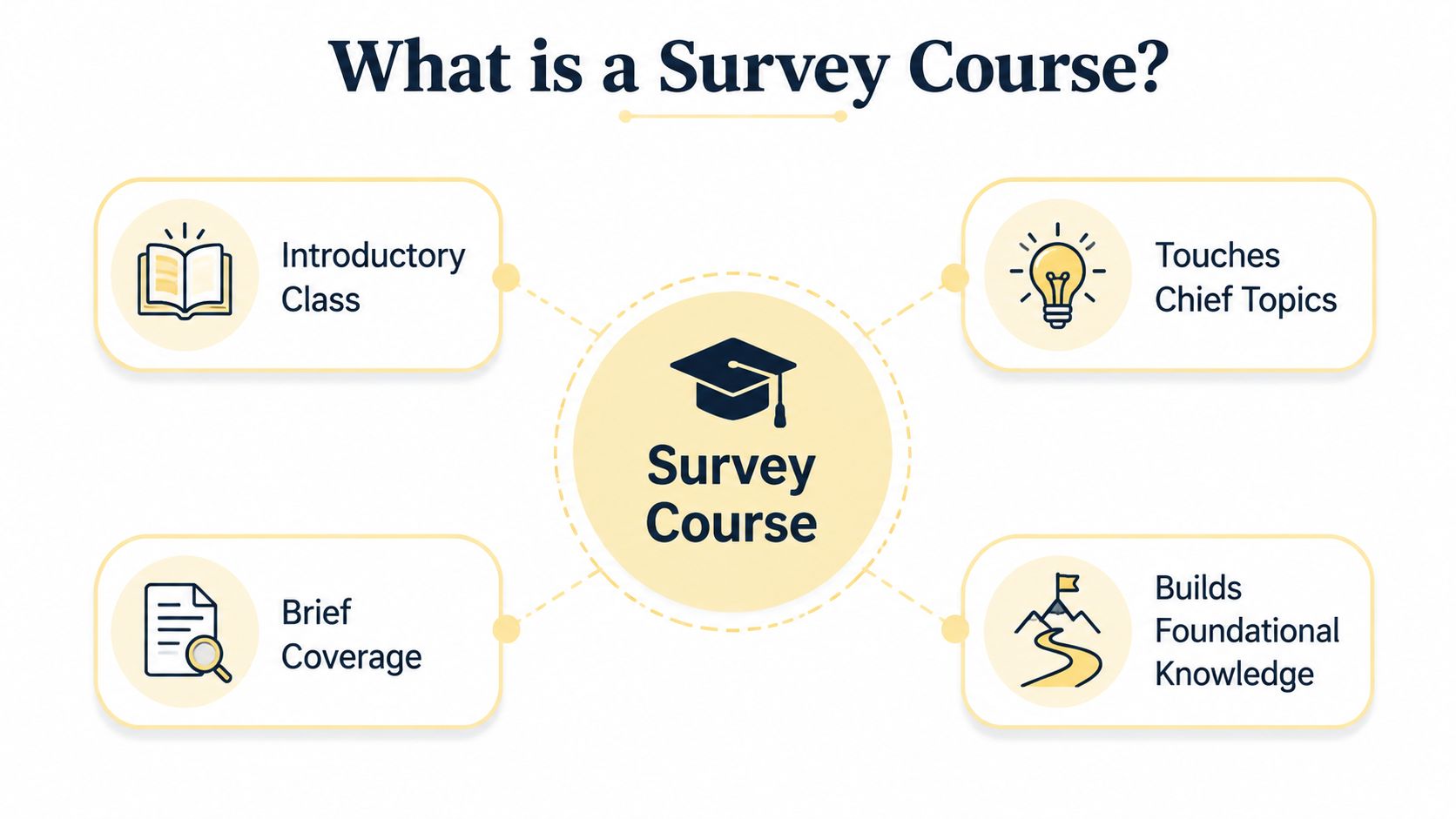
A survey course is an introductory class that gives students a broad overview of a subject rather than deep specialization. Major dictionaries describe it as a course that treats the chief topics of a field or gives general information for beginners, which is why it's so often used at the beginning of a program. The idea is simple, it introduces the terrain before asking anyone to climb a mountain.
A survey course is a tasting menu. You're not ordering one giant dish and hoping it covers every flavor in the kitchen. You're sampling the core plates so you can understand the restaurant, decide what you like, and know what to order next.
What makes it different from other formats
A survey course is not the same as a narrow intro course, and it's not the same as a standalone mastery course. A narrow intro course usually teaches one framework, one tool, or one repeatable skill. A standalone course is built to finish a job in one sitting, with no expectation that learners need follow-on study.
A survey course does something else. It gives breadth first, then leaves room for depth later. For coaches, that often means the learner gets the logic of the field, the vocabulary, and the major branches of study before they're asked to choose a specialization.
A simple way to test your design is to ask three questions:
- Is the goal orientation or mastery? Survey courses orient. They don't try to finish the job.
- Does the content cover several major topics? If yes, you're in survey territory.
- Would a learner still need more study after finishing? If yes, that's usually the point.
The other clue is pacing. Survey courses move across a field, not down into a single topic. That's why they feel broad, structured, and intentionally selective. They're not thin because the designer was lazy. They're broad because the learner needs a map before detail.
How a Survey Course Is Actually Structured
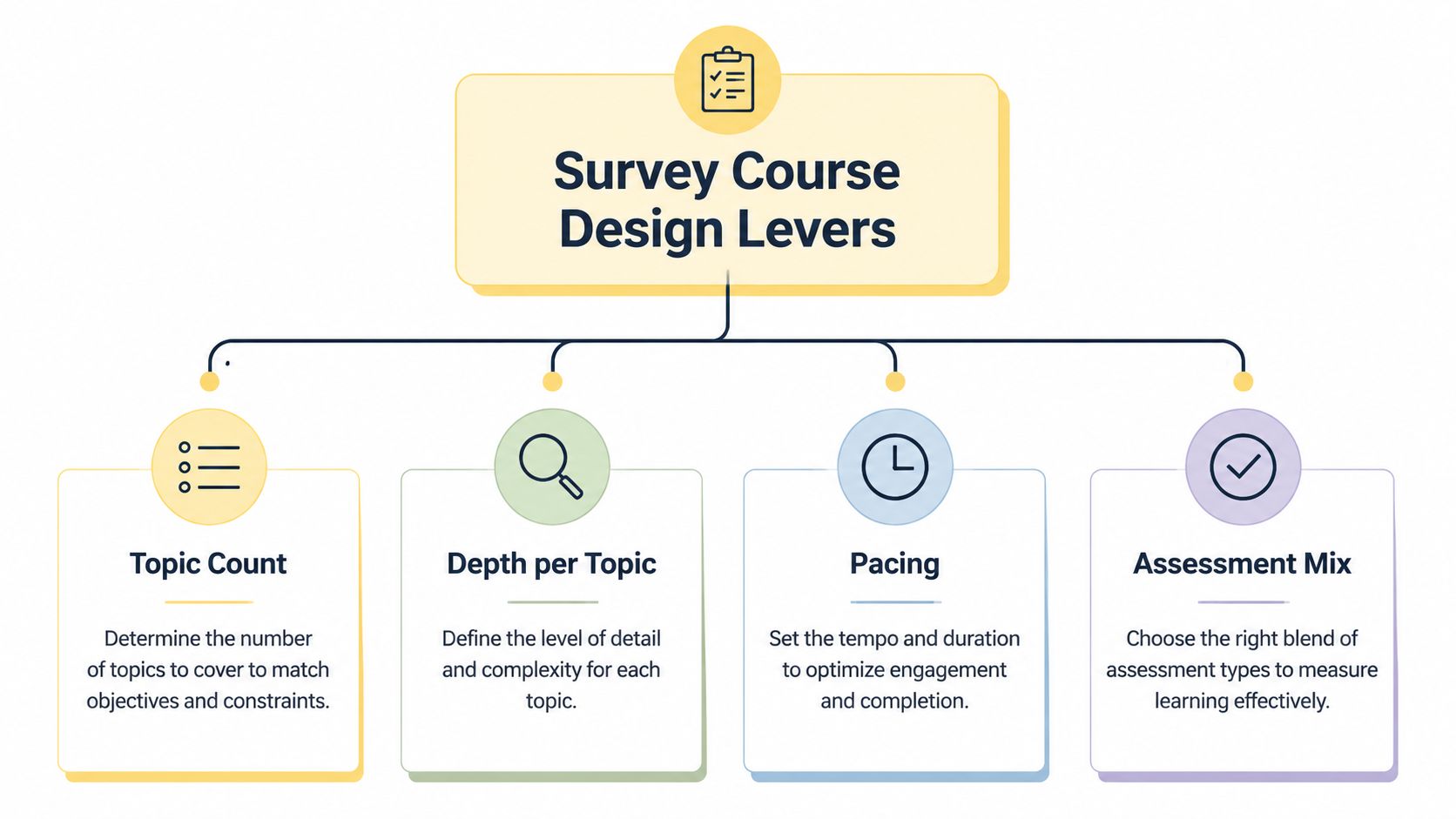
A survey course usually works because the designer makes a series of deliberate tradeoffs. It touches multiple topics briefly rather than exhausting any one topic, and it can even bring in material from related disciplines when those pieces share a common goal. That structure is what makes the course feel broad without feeling random.
The four levers coaches already use
First, there's topic count. A survey course covers several major themes, but each one is selected because it helps explain the field as a whole. Second, there's depth per topic. The course stays moving, which means each module should answer, “What does the learner need to know here, just enough to follow the bigger picture?”
Third, there's sequencing. Some survey courses move chronologically, some move thematically, and some move by competency. A history survey might go era by era. A coaching survey might move from identity to conversation skills to goal design. A leadership survey might shift from self-management to team dynamics to strategic thinking.
Fourth, there's audience posture. Survey courses are often for people who are deciding whether to go deeper, or for learners who need broad literacy rather than specialization. That's why the format works so well for onboarding, cohort kickoffs, and academy-style programs.
If a learner can summarize the field but still can't practice every part of it yet, the structure is probably doing its job.
That also explains the assessment style. Survey courses usually work better with reflection, synthesis, and decision-making than with mastery tests on narrow skills. Each module should end with a clear takeaway, something the learner can carry into the next conversation or the next stage of study.
The architecture is not decorative. It's the course version of a clean intake form, a well-paced discovery call, or a careful onboarding path. The structure says, “Start here, understand this much, and then choose your next step.”
Survey Course vs Intro Course vs Standalone Course
The confusion usually starts because all three formats can appear early in a learner's journey. The difference is what the designer wants the learner to be ready for at the end.
A survey course is built for learners who are thinking about studying a subject further. Oxford Learner's Dictionaries describes it as a college course that gives an introduction to a subject for people who are thinking about studying it further, and that's the key distinction. It's a broad view, not mastery of a single topic.
| Criterion | Survey Course | Intro Course | Standalone Course |
|---|---|---|---|
| Scope | Broad view of a field | Narrow focus on one skill or framework | Self-contained transformation around one outcome |
| Depth | Brief coverage across several topics | Deeper practice in one area | Enough depth to complete a defined result |
| Audience | Learners deciding whether to specialize | Learners who need one foundation | Learners who want an end-to-end solution |
| Assessment style | Reflection, synthesis, orientation | Skill checks, guided practice | Completion, application, implementation |
| Best use case | Map the discipline | Teach one repeatable capability | Deliver a packaged result |
The decision rule coaches can use
If your learner needs a map of the field, choose a survey course. If they need one repeatable skill, build an intro course. If they need a packaged transformation with no follow-on, build standalone.
That rule matters because the wrong format creates friction later. A survey course that promises mastery feels disappointing. An intro course that tries to cover the whole field feels rushed. A standalone course that needs too much prior knowledge leaves people stranded.
For coaching schools and L&D teams, the key question is not “Which format sounds smart?” It's “What job is this course supposed to do for the learner right now?” Once you answer that, the format usually becomes obvious.
Two Sample Syllabi Coaches Can Borrow
A survey course becomes much easier to picture once you see the shape of the syllabus. Survey courses are often the first point of contact with a field and are designed to establish foundational vocabulary, core frameworks, and the scope of the discipline rather than produce mastery on day one.
Foundations of Life Coaching
In a life coaching survey, the goal isn't to turn a new learner into a polished practitioner in one pass. The goal is to help them understand what coaching is made of.
A useful eight-module sequence might cover self-awareness, values, communication, emotional regulation, goal architecture, habit loops, relationships, and integration. Each module can have one learning outcome, one short activity, and one reflection prompt. For example, the communication module might ask learners to rewrite a rushed client question into a cleaner coaching question, while the values module might ask them to sort priorities before trying any techniques.
Executive onboarding survey
An executive onboarding survey can work the same way, just for a different audience. Six modules could cover stakeholder mapping, feedback loops, decision frames, energy management, strategic narrative, and first-100-days planning.
That format works because it helps the learner see the terrain of a new role before they try to own it. It's less about memorizing every tactic and more about understanding the major decisions they'll face and the conversations they'll need to manage. A single course outline can carry that logic cleanly, and a program outline builder can help you map those modules without losing the flow between them.
Coach's lens: if a learner can tell you how the field is organized after the course, the syllabus is doing real work.
A good survey syllabus also shows restraint. It doesn't chase every possible subtopic. It chooses the pieces that help the learner orient, compare, and decide what comes next.
When the Coverage-First Model Falls Short
The old model has a weakness. The American Historical Association notes growing recognition that the conventional history survey course, organized around chronological coverage and lecture, is failing to meet larger learning goals, and faculty are testing new models because of it. That warning matters outside history too.
A survey course can become a list of topics with no pulse. Learners leave informed, but not changed. Coaches usually create that problem in one of three ways.
- Topic dumping without integration: the course covers many ideas, but never shows how they fit together.
- Memorization-heavy assessment: learners are tested on recall instead of reflection or application.
- No decision point at the end: the course ends without helping learners decide what to do next.
How to keep the course alive
The fix is to anchor the course in one driving question. That question should run through every module, so the learner always knows why this topic belongs here. For a coaching survey, the question might be, “What does a new learner need to understand before they can choose a path?”
The second move is to connect each module back to that question. A module on ethics shouldn't sit in isolation. It should help the learner understand what coaching expects and what it protects. A module on goal-setting shouldn't just explain tools. It should show how goals fit into the larger coaching relationship.
A survey course without a unifying question is just a long orientation packet.
The final move is synthesis. End with an activity that helps the learner decide what they're ready for next. That could be a self-assessment, a roadmap discussion, or a short plan for specialization. The point is to leave learners with a decision, not just a stack of notes.
Designing and Delivering Your Own Survey Course
The build process is simpler when you treat the course like a guided pathway instead of a content warehouse. Start with the driving question, then list the handful of topics learners must encounter, then decide what each one should help them notice, name, or choose.
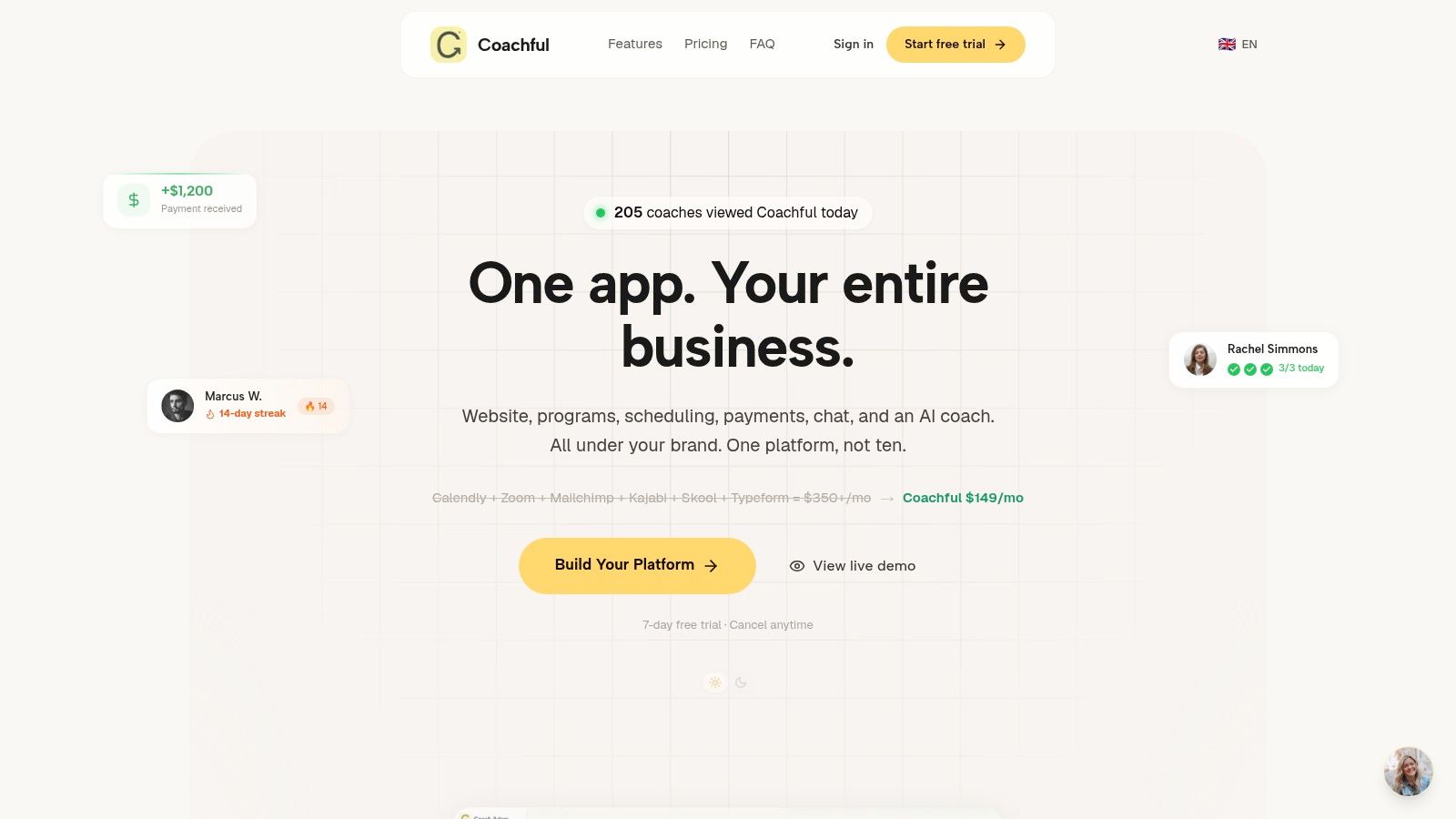
A platform like Coachful can support that workflow by organizing modules, lessons, reminders, notes, and progress tracking in one place. That matters when you're delivering a multi-week program and don't want learners bouncing between a spreadsheet, a calendar app, and a separate resource folder.
A practical build flow
- Write the course question. Make it specific enough to guide decisions.
- List the core topics. Keep the set broad, but not sprawling.
- Assign one outcome per topic. Each module should produce one clear takeaway.
- Add a synthesis assignment. Ask learners to compare, reflect, or decide.
- Set the pace. Decide how much material fits in each session without crowding the learner.
The delivery side matters just as much as the outline. Reminders keep people moving, session notes preserve context, and a dashboard helps you spot when someone drops off or stops engaging. That's especially useful in cohort programs, where one quiet learner can disappear unless the coach notices early.
For a deeper look at how to move from idea to paid offer, the framework in Learn, Plan, Profit is a useful companion. It fits naturally with survey-course design because both rely on sequencing, clarity, and a clear learner path.
After that, your build choices get easier. One module becomes a short overview. The next becomes a comparison. The last becomes a decision point. That's the rhythm that makes a survey course feel intentional instead of crowded.
Choosing the Right Format for Your Coaching Program
The easiest test is the learner's end state. If they should be ready to decide whether to commit to deeper work, a survey course is the right on-ramp. If they need one specific skill, build an intro course. If they need a complete packaged transformation, build standalone.
That same filter works for content breadth. Broad field, survey. Narrow capability, intro. Finished outcome, standalone. If you can answer the question, “What decision should learners be ready to make by the end?”, the format usually picks itself.
If you're building a digital offer around coaching education or skills training, beginner video editing guides can help when your course needs simple recorded lessons rather than a full production team. That's often enough for a survey course, where clarity matters more than cinematic polish.
For a related look at how programs get packaged and sold, the ideas in best platforms to sell digital products can help you think about delivery without losing the educational structure.
If you're designing a survey course for clients, cohorts, or internal learning programs, Coachful gives you a place to organize modules, sequence content, track engagement, and keep the whole experience coherent. Visit Coachful to see how a structured coaching platform can help you turn a broad learning path into a clean, usable program.