5 Coaching Bonus Ideas That Don’t Add More Live Calls

Coachful
Coachful Editorial
What can you add to a coaching package that makes it more useful without quietly selling another week of your time? Start with one optional resource that removes a specific implementation obstacle: a template kit, a short demonstration library, a self-directed practice sprint, a decision workbook or a curated replay collection. Keep the core coaching complete without it, and state exactly what access and support the extra includes.
The trap is calling an extra session, unlimited messaging or a personal audit a “free bonus.” It may be free to the buyer, but it is still work you have promised to deliver. A resource can also create support work, so the sensible distinction is not digital versus live. It is bounded delivery versus an open-ended obligation.
These five coaching bonus ideas are selected for relevance, reuse and a manageable support boundary. They are not ranked by conversion rate, and none guarantees more sales. All package examples below are hypothetical. Choose the smallest useful extra for your clients rather than attaching all five.
First, separate a genuine bonus from the core service
Ask whether a client could use the coaching you have promised without the proposed extra. If the answer is no, put it in the core package. Required session worksheets, instructions for joining calls, accessibility information and the agreed action plan are not persuasive bonuses. They are part of delivering the service properly.
A useful bonus answers a secondary question. Your main career-coaching package might help someone make a career decision; an optional interview-example library could help them prepare for a later conversation. If interview preparation is already the main promise, however, the essential preparation material belongs in the package itself.

Then write three boundaries: what the client receives, how long they can access it and whether you review their work. “A self-directed worksheet with one completed example, available during the engagement, with no individual review included” is less dramatic than “an exclusive implementation accelerator.” It is also much clearer.
Do not use an invented standalone price to make a stack of extras look valuable. If you have never sold a worksheet separately, describing it as a “$497 value” needs a defensible basis. Explain the task it helps with instead. A bonus should make the buying decision easier to understand, not harder to verify.
1. A ready-to-adapt template kit
Best for: clients who understand the principle but stall when they have to create the first draft. A career coach might provide networking-message starters. A leadership coach might provide an agenda for a development conversation. A business coach might provide a weekly review document.
Keep the kit narrow. Three relevant templates with usage notes are often a more sensible editorial choice than a large folder the client must organize. Include a blank version, one completed fictional example and a short note explaining when the template is unsuitable. Those three elements help distinguish useful implementation support from a pile of downloadable files.
- Example bonus: three networking-message starters for reconnecting, requesting information and thanking a contact.
- Client task: adapt one message to a real relationship before sending it.
- Boundary: no promise that you will rewrite messages or respond outside agreed coaching arrangements.
- Trade-off: templates can encourage copy-and-paste behavior unless the adaptation instructions are explicit.
Suggested offer copy: “You also receive a networking-message kit with three adaptable examples and a short guide to personalizing them. Use it independently between sessions; message editing is not included.”

The client-facing instructions matter as much as the file. Put the purpose, recommended first action and support boundary beside the resource. A person should not have to infer whether uploading their completed worksheet means you will review it. If review is part of your normal package, describe that in the core agreement rather than quietly expanding it here.
2. A short worked-example library
Best for: clients who need to see a process before trying it. Instead of recording a large additional course, demonstrate one small task: preparing a networking conversation, turning an observation into a feedback request or comparing two business priorities.
Use a fictional scenario, your own material or something you have permission to share. Do not turn confidential client conversations into bonus lessons. Removing a name does not necessarily remove identifying details, especially in a small industry or a sponsored coaching engagement.

A useful format is a brief explanation, a worked demonstration and a pause point where the client tries the task. Choose the length to fit the task rather than promising a large number of videos. If a demonstration requires substantial background teaching to make sense, it may belong in the core curriculum instead.
- Example bonus: two narrated demonstrations of preparing a difficult workplace conversation.
- Client task: use the same preparation process for a situation they choose.
- Boundary: no individual recording review or live rehearsal unless separately agreed.
- Trade-off: demonstrations need updating when the underlying process, terminology or software changes.
Suggested offer copy: “An optional demonstration library shows the preparation process using two fictional workplace examples. Watch when relevant; it does not add assignments or extend your coaching support.”

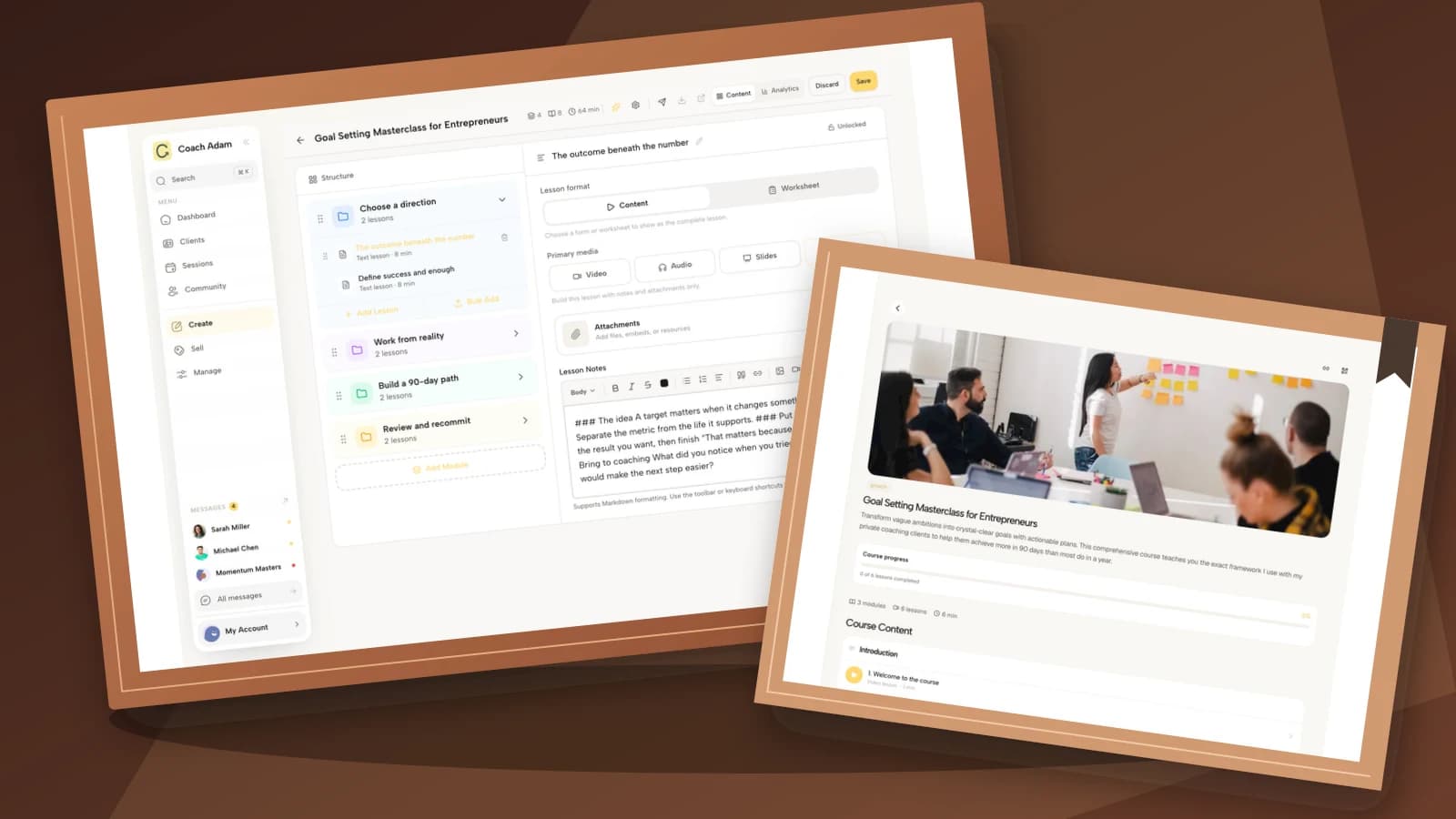
Test the participant experience before describing it on a sales page. Can a client find the right lesson, understand the context and access the supporting material? A polished coach-side editor is not proof that the handoff works. The screenshots here show real Coachful demo surfaces, not a prebuilt bonus package or an automatic entitlement rule.
3. A self-directed practice sprint
Best for: clients who want a small, repeatable experiment between sessions. The extra is a structured practice plan, not additional coaching availability. For example, a leadership coach might offer an optional five-working-day observation log for noticing interruptions in meetings.
Make the experiment light enough to use. Ask the client to choose a behavior, record whether they tried it and note one observation. Let them adapt the practice to their circumstances. The point is usable information for their own reflection, not a streak they feel obliged to preserve for the coach.

Write the response boundary particularly carefully. A daily prompt can sound like a daily personal check-in. If you do not intend to review entries or send daily responses, say so before enrollment and next to the log. Do not present an unattended tracker as monitored support.
- Example bonus: an optional five-day meeting-observation log with one reflection prompt per day.
- Client task: notice a pattern and choose one experiment for the following week.
- Boundary: entries are not monitored continuously and do not create a new response commitment.
- Trade-off: some clients already have enough tracking. Offer a simpler alternative or make the extra genuinely optional.
Suggested offer copy: “If useful, use the five-day observation log to notice patterns between sessions. It is self-directed, not a daily coaching check-in. We can discuss relevant observations within your existing session time.”
Keep the practice within your competence. An observation exercise should not turn into diagnosis, treatment or a prescriptive health intervention because it is packaged as a bonus. Refer clients to appropriate qualified support when their needs fall outside your coaching scope.
4. A decision workbook with a completed example
Best for: clients who repeatedly face a defined choice and need a reusable way to think it through. Unlike a template kit, which helps them produce something, this workbook helps them compare options. A career coach might use it for evaluating opportunities; a business coach might use it for choosing which service to test next.
Build around a real decision rather than a broad promise of clarity. A simple workbook might ask: What decision is due? Which options are available? What constraints matter? What evidence is missing? What small test would reduce uncertainty? What would make the person revisit the choice?
Include a completed fictional example showing uncertainty, not a magically obvious answer. If every worksheet points neatly toward the coach's preferred option, it is not much of a decision aid. Leave room for the client to choose differently and explain their reasoning.
- Example bonus: an opportunity-comparison workbook with one fictional job-offer example.
- Client task: identify a trade-off and a question to investigate before deciding.
- Boundary: no promise of an additional written assessment, recommendation or review call.
- Trade-off: a structured worksheet can oversimplify a choice. Invite revision when important context does not fit.
Suggested offer copy: “Keep the optional decision workbook for future choices. It includes a completed fictional example and prompts you can reuse independently. It is not legal, financial or employment advice.”
Do not call a mandatory onboarding questionnaire a decision-workbook bonus. If you need the answers to coach responsibly, it is part of the core process. The optional workbook should remain useful even when the client does not submit it to you.
5. A curated replay or resource collection
Best for: a coach who already has relevant material and can select a small collection around one client problem. A library becomes a useful extra when the selection saves the client from searching. It becomes clutter when the offer is simply “access to everything I have ever recorded.”

Give every item a reason to be there. Add a short “start here” note, explain which question each resource answers and indicate what can be skipped. For an interview-coaching package, a supplementary collection might cover researching an employer, planning questions and organizing post-interview reflections. It should not withhold essential interview preparation from the core service.
- Example bonus: three selected resources with a one-page guide to when each is useful.
- Client task: choose the item relevant to their next step, not complete the entire collection.
- Boundary: state access duration and whether new resources will be added.
- Trade-off: licensing, outdated advice and recorded participant contributions can make reuse inappropriate.
Suggested offer copy: “You receive an optional three-resource collection, organized by the question each item answers. Access lasts for the period stated in your agreement. Future additions and individual resource reviews are not included.”
Only include material you own or can lawfully share. If a replay includes participants, check the permissions covering this specific reuse. Consent to attend or record a live session does not automatically settle every later marketing, training or distribution use.
Calculate the workload before calling a bonus scalable
Separate preparation from per-client delivery. A resource can be reused, but accessibility fixes, support questions, updates, licensing and access administration may remain. Estimate those before announcing the bonus. A reusable file is not the same thing as a zero-cost commitment.
Here is a deliberately simplified hypothetical calculation. Suppose eight clients each create fifteen minutes of bonus-related support and the first version takes three hours to prepare. Support uses 120 minutes; preparation uses 180 minutes. The total is 300 minutes, or five hours. At a chosen planning allowance of $60 per hour, that is $300, or $37.50 per client.

This is a time-planning example, not a recommended rate, an accounting expense calculation or a profitability forecast. It excludes fees, tax, refunds and other costs. Preparation might fall for a later cohort, but the assumption that support disappears should be tested rather than wished into the spreadsheet.
Use the calculation to compare options. A template kit that triggers repeated rewriting requests may cost more to deliver than a well-explained demonstration. Change the instructions, the resource or the support boundary before adding more content. Never quietly withdraw a benefit that an existing client has already purchased.
Write and test the bonus promise before promoting it
Use this compact description: “Optional extra: [resource] for [specific task]. Includes [exact contents]. Available [access period]. Support includes [boundary]. It is not required to receive the core coaching service.” Replace every bracket before publishing and make the same promise in your sales page, agreement and welcome instructions.
If you attach an enrollment deadline, use a real one and explain it plainly. Do not invent scarcity for a digital resource with no actual limit. Coachful's guidance on ethical scarcity and urgency distinguishes a genuine capacity constraint from a claim you cannot support. Our early-bird pricing guide covers deadline decisions; this article is about choosing and delivering the resource itself.
Before launch, test access with the appropriate test workflow rather than charging a real client. Read the offer as a buyer, locate the resource as a participant and check the instructions without relying on an image. Confirm that captions, transcripts or accessible documents are available where needed. Verify any access limits in your actual configuration; do not assume the screenshot demonstrates them.

After delivery, ask whether clients used the resource for its intended task and what confused them. Course completion and engagement can help you locate friction, but they do not prove coaching effectiveness or a sales lift. Review unsolicited support work as well as usage. An unused bonus that looks impressive on a sales page is still a candidate for removal from future offers.
Frequently asked questions
How many bonuses should a coaching package include?
Start with one useful extra and a clear reason for including it. There is no universal evidence-based optimum. Add another only when it solves a different relevant problem and the client can understand when to use it. More items can increase delivery complexity without making the package better.
Should I offer extra coaching sessions as a bonus?
You can, but price the time and define the booking window, duration and scope. It is not a low-delivery-cost option simply because you label it free. If your aim is to protect live capacity, choose a self-directed resource instead of another appointment.
Can I use the same bonus for every client?
Yes, if it remains relevant, accurate and appropriate to share. Explain when to skip it. Do not imply personalization that you have not provided, and check permissions before reusing client examples or group recordings.
Is a bonus better than a discount?
Not automatically. Compare the actual cost, client relevance and clarity of the offer. A bonus with substantial personal support may be more expensive than a modest price reduction. Neither tactic fixes an offer whose core promise or fit is unclear.
Make the extra useful before making it bigger
Choose one obstacle your clients encounter after a session, create the smallest optional resource that helps, and test both access and support expectations. The strongest bonus is not the longest list. It is an extra a client knows how to use without discovering a new obligation for either of you.
If you want to inspect how a lesson, course and client-facing resource experience could support that handoff, try the interactive Coachful demo. Look at both the coach and participant surfaces before promising a delivery experience. The right next step is to verify one small resource, not build an entire bonus library.