Coaching Subcontractor Agreement Template: 9 Key Clauses

Coachful Editorial Team
Coachful Editorial
Can you adapt your client coaching contract when another coach delivers sessions for your practice? Not by changing the names. A coaching subcontractor agreement governs the working relationship between two businesses or professionals: what you commission, what the coach can decide, how they get paid, what happens to confidential information and how the work ends. Your client agreement has a different job.
Agree the work and the exit before granting access to a client record. A friendly conversation about a session fee will not settle whether preparation is included, who carries a late cancellation, or what a client hears if the associate leaves.
Use the nine clauses and copyable work-order template below to prepare a brief for qualified local legal advice. This is an operational drafting guide, not a jurisdiction-ready contract. Employment status, tax, privacy, restrictions and liability need review for the countries and circumstances involved. Calling someone a subcontractor does not make them one.
First, separate the three agreements
The practice-to-coach agreement covers the commissioned service and commercial relationship. The client coaching agreement explains the service the client purchases, the delivering coach, confidentiality, payment and cancellation terms. Where an employer or other sponsor pays, the sponsor arrangement also needs to explain what reporting is permitted.
Those documents must agree with one another. If the client was promised sessions specifically with you, your subcontractor agreement cannot quietly authorize replacing you. If the sponsor receives only agreed progress information, your instructions to the associate should not demand private session notes for the sponsor.
This guide assumes you have already decided to commission coaching and are preparing its written terms. For the earlier commercial choice, see our guide to structuring an associate coach delivery model. Here, the task is to turn that choice into a precise drafting brief and a usable work order.

1. Name the parties, relationship and limits of authority
Record the correct legal names, business addresses, contact people and applicable registration details. Distinguish a trading name from the person or entity signing. Identify who can authorize a new assignment, approve an expense or amend the agreement.
Define what the associate may represent publicly. Can they describe themselves as an associate of your practice? Can they quote your prices, promise a refund, change the client’s programme or sign something on your behalf? A logo on their slides should not become an accidental grant of commercial authority.
Discuss classification before choosing the document. The US IRS classification guidance, for example, considers behavioral control, financial control and the type of relationship. That is US federal tax guidance, not a universal employment test. Other jurisdictions and legal purposes can use different tests. Ask an appropriately qualified adviser to assess how the work actually operates.
Drafting instruction: identify the intended relationship, then have the adviser test it against the actual control, independence and working arrangements. Do not use a contractor label to paper over an employee-like role.
2. Define the commissioned work in a separate schedule
A master agreement can set the enduring rules, with a work order defining each assignment. This makes changing a client cohort or delivery period easier without burying the whole arrangement in email.
Specify the client population, coaching scope, session number and duration, delivery format and assignment period. Then describe preparation, administration, between-session support and reporting. “Coaching services as required” is not a sufficient boundary when one person expects session delivery and the other expects an always-available programme manager.
A hypothetical career-coaching assignment might include six 50-minute sessions, an agreed preparation allowance, brief completion records and one defined weekly check-in. Recruitment consulting, CV rewriting, unlimited messaging and sponsor presentations would be excluded unless separately commissioned. These are example boundaries, not recommended defaults for every practice.
Drafting instruction: list what is included, what is excluded and how additional work is requested and priced. Name who can approve a change before the associate performs it.

3. Make scheduling and cancellation terms work in both directions
Set the booking process, agreed delivery windows, time-zone reference and responsibility for communicating changes. Distinguish a client cancelling, the practice cancelling and the associate being unavailable. They create different questions about held time, client continuity and payment.
The client’s cancellation policy does not automatically determine the associate’s compensation. A client might receive a discretionary refund while the associate is still owed an agreed fee for time reserved. Equally, an associate should not assume every client no-show creates an entitlement that was never agreed.
Write separate rules for timely cancellations, late cancellations, no-shows, technical failure and illness. Decide whether rescheduling is included, what notice is expected and who finds replacement availability. Define an emergency contact route without promising continuous availability.
Drafting instruction: take one real booking scenario and trace it through the client terms and associate terms. Both parties should be able to explain the same result before the first session.

4. Specify fees, invoices and the payment trigger
State whether compensation is a fixed session fee, a project fee, a time-based fee or a defined share of revenue. If you use a revenue share, define the base: billed amounts or collected amounts, treatment of taxes, discounts, processing charges, refunds and chargebacks. A percentage without a denominator is a future disagreement.
Identify the currency, invoice requirements, invoice recipient, payment deadline and approved expense process. Clarify whether preparation, supervision, meetings and onboarding are included or separately paid. Do not expect a coach to discover unpaid administrative obligations after accepting the assignment.
Be explicit about whether the practice pays independently of collecting from the client. If payment depends on collection, discuss the resulting risk and obtain advice on whether the arrangement is lawful and suitable. Do not silently change the trigger when a client pays late.
Drafting instruction: describe a normal invoice, a late client payment and a refunded session. Record how each affects what the associate invoices and when payment is due. Keep client receipts separate from proof of contractor settlement.

5. Set confidentiality, record access and reporting boundaries
Name the information each party needs and why. A coach delivering to one client does not automatically need your entire prospect list, every other client’s history or access to business finance. Start with the minimum access required for the assignment.
Decide what records are created, where they are stored, who may read them and what retention or deletion obligations apply. Distinguish administrative completion information from sensitive coaching content. The practice’s desire to check delivery does not mean every reflective note should become a management report.
Check the professional ethical standards that apply to each coach as well as the law. Neither a confidentiality promise nor a professional code replaces a tailored assessment of the data arrangement. Have the actual data roles, security responsibilities, breach process and cross-border issues assessed by an appropriately qualified adviser where relevant.
Drafting instruction: name approved tools, access levels, reporting recipients and escalation contacts. Treat recordings, transcription services and other third-party processing as explicit decisions, not implied permission hidden inside “use our systems.”

6. Agree professional standards without scripting every session
Set the competence, qualification and insurance requirements appropriate to the assignment. Verify the evidence instead of merely collecting a contractual promise. Describe how changes affecting suitability must be disclosed, such as a relevant credential lapse or a conflict involving a client.
Define the practice standards that genuinely matter: onboarding, scope, attendance records, complaint handling and escalation. Leave room for the coach’s professional judgment within the agreed service. There is a difference between documenting safety boundaries and requiring someone to imitate your personality.
Agree how quality review works. Supervision, feedback and an occasional delivery review should have a defined purpose and confidentiality boundary. Do not assume the right to record, observe or inspect private session content because you commissioned the work. Obtain appropriate agreements and permissions, and provide a less intrusive review method when suitable.
Drafting instruction: attach the relevant delivery standard, identify the review process and explain what happens when a concern arises. Do not promise clinical, legal or other regulated services through a coaching assignment unless the provider is appropriately qualified and the arrangement supports them.

7. Distinguish existing materials from commissioned materials
A practice may supply a programme, worksheets and brand assets. An associate may bring pre-existing methods, exercises and presentation material. New material may be developed specifically for the assignment. Treat these as different categories rather than claiming ownership of “everything created during the relationship.”
Ask who may use each category, for which clients, in what formats and after termination. Can the associate reuse a generic worksheet elsewhere? Can your practice continue using a commissioned resource after the assignment? Are you receiving ownership, a license or only permission for a particular cohort? Have the agreement express the intended answer.
Include third-party material and publicity. A coach cannot grant rights they do not hold. Client testimonials, case studies, recordings and screenshots require their own permissions and confidentiality review. Association with your practice should not imply permission to use client names or sponsor logos.
Drafting instruction: inventory existing materials before work starts, then describe the rights required for new deliverables. Avoid a sweeping clause that neither side understands nor intends.
8. Plan complaints, conflicts and serious concerns
Name the first contact for a client complaint, a boundary concern or an issue with the assignment itself. Describe response expectations and temporary arrangements while a concern is assessed. A contract needs a route for a difficult conversation, not just a statement that everyone will behave professionally.
Consider conflicts of interest, work outside competence and requests from a sponsor that contradict the client’s understanding. The associate needs a way to pause and seek guidance rather than choose between breaching confidentiality and upsetting the business owner.
Seek local advice on liability, insurance, dispute resolution, governing law and any proposed restrictions on future work. Do not copy a broad non-compete from another industry or assume a narrowly worded restriction is enforceable. Client choice, professional duties and local law still matter.
Drafting instruction: rehearse one complaint and one sponsor information request. Identify who decides the response, what can be shared and when outside professional advice is needed. Operational chat is not a suitable place to casually circulate sensitive session details.

9. Write the exit before you need it
State the term, renewal process, ordinary notice and circumstances that may require an immediate pause or termination. Obtain advice on the appropriate rights and process rather than inventing a universal notice period.
Then separate termination of the business relationship from care for clients. Who informs them? What happens to booked sessions? What options are available if the client does not want a replacement coach? Which fees remain due, and who handles refunds under the client terms?
Define the handover record, account-access removal, equipment return and lawful handling of records. Do not require deletion of material someone must legally retain, or permit indefinite copies of client data merely because it once helped delivery. Agree the basis with appropriate advice.
Drafting instruction: write an exit checklist with named owners and dates. Reconcile completed work and payment, arrange client communication, transfer only permitted information and close access at the correct point. “We will work it out” is not an exit plan.

A copyable coaching subcontractor work-order template
Use this operational schedule to brief your adviser and associate. It is not the master agreement or legal boilerplate. Replace each bracketed field and resolve disagreements before treating the assignment as accepted.
Assignment: [name, version and date].
Parties: [practice legal name] and [coach legal name].
Authority: [named people who may approve work and changes].
Service: [client population, coaching scope and delivery format].
Delivery: [session number, length, period and scheduling process].
Included work: [preparation, support, records and meetings].
Excluded work: [services requiring a separate agreement].
Fees: [basis, currency, invoice process and payment trigger].
Changes and cancellations: [agreed treatment for each scenario].
Confidentiality and access: [approved systems, minimum access and permitted reports].
Standards and escalation: [relevant attachment, contact and concern process].
Materials: [existing materials, new deliverables and agreed rights].
Client continuity: [communication, handover and exit owners].
Master terms: [reviewed agreement governing this schedule].
Acceptance: [authorized parties and agreed acceptance process].
Test the agreement against a difficult week
Imagine a client cancels late, the associate becomes ill, a sponsor requests session notes and an invoice falls due. Read the draft as if neither party remembers the friendly conversation that started it. Can you identify the next action and responsible person without improvising?
If not, fix the ambiguity before adding another clause. A long agreement that never names the payment trigger or information-sharing boundary is less useful than a clear brief reviewed for your circumstances.
Frequently asked questions
Is a subcontractor agreement the same as a coaching agreement?
No. The subcontractor agreement concerns the practice and the delivering coach. A client agreement concerns the coaching service the client receives. The documents should align, but one does not replace the other.
Can I write my own associate coach agreement?
You can prepare the commercial brief and work order yourself. Have the legal terms and classification assessed by qualified advisers for the relevant jurisdictions. A downloaded template cannot establish that your actual arrangement is lawful or correctly classified.
Should the associate have access to all client notes?
Not by default. Define the minimum information required for the assigned work, the agreed confidentiality boundaries and applicable legal obligations. Test the actual permissions instead of assuming the written agreement configures them.
Does coaching software handle the contract for me?
Software can support delivery records and coordination. It does not determine employment status, supply local legal advice or settle how your commercial terms should work. Verify each claimed capability and retain the reviewed agreement separately where necessary.
Turn the written terms into a delivery rehearsal
Once the drafting questions are resolved, test one assignment from team access through scheduling, client records and invoice reconciliation. That is where a missing owner or an over-broad permission becomes visible before a client encounters it.
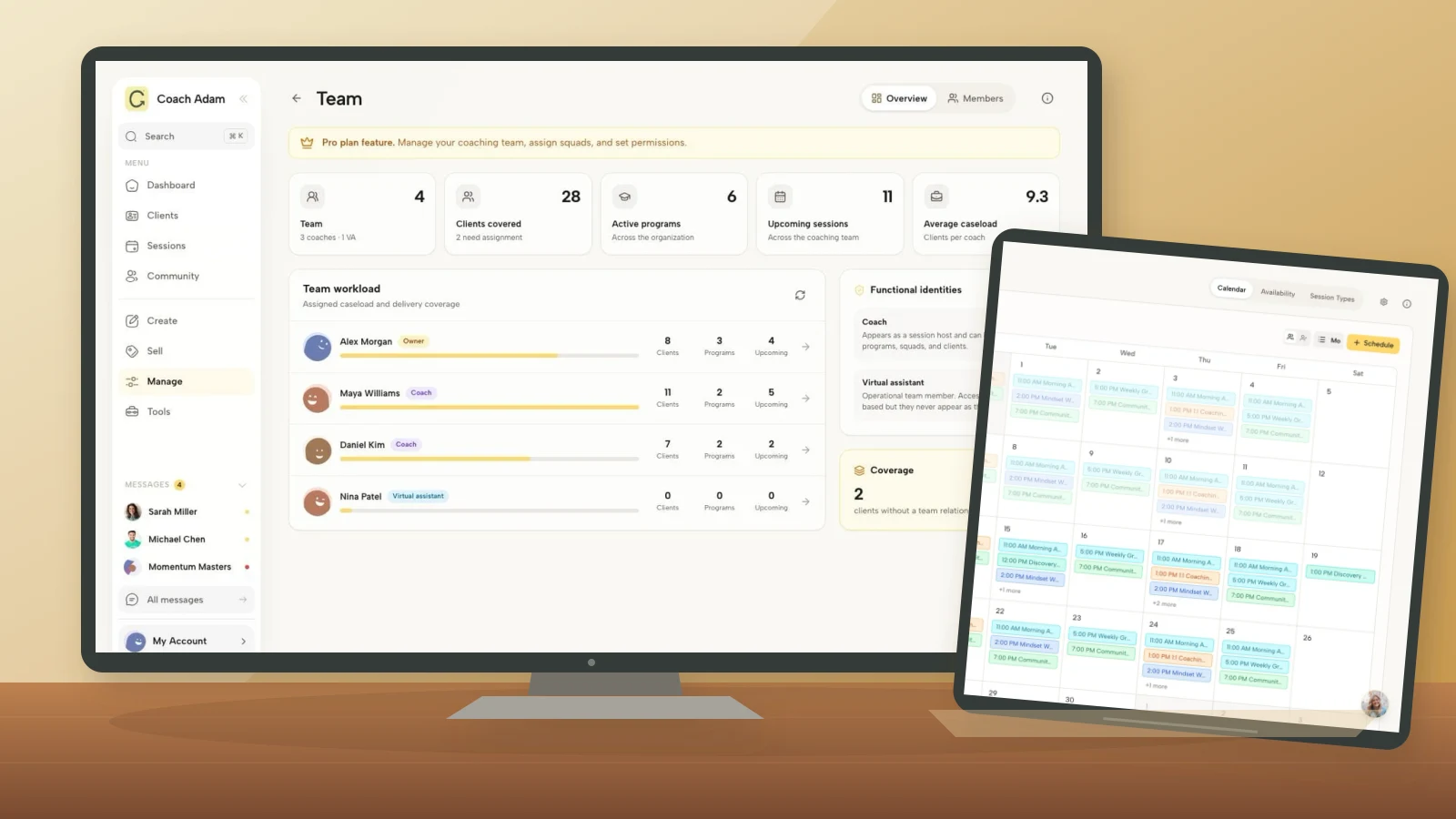
Coachful’s real demo surfaces shown above provide a practical way to inspect that operational layer. Try the interactive demo with one question in mind: could the people named in your work order carry out their responsibilities without sharing more information than they need? Keep legal drafting and contractor settlement decisions distinct from what the interface actually demonstrates.