How to Become a Content Creator That Actually Grows

Coachful

Most advice about becoming a content creator starts with cameras, posting hacks, and the promise of going viral. That's backwards for a coach. Content is not a personality contest or a public diary. It's a business asset that should attract the right people, build trust, and lead them toward a coaching offer. The creator economy now includes more than 207 million creators worldwide, yet only about 4 million reach 100,000 or more followers, according to this 2026 creator economy summary. You don't need celebrity reach, but you do need a clear commercial reason to publish.
The Real Decision Behind Becoming a Content Creator
Becoming a content creator is a business decision before it's a creative one. If you're a coach, the useful question isn't, “Can I make interesting videos?” It's, “What should consistent content do for my practice?”
The market is crowded. About 67% of creators are nano creators with 1,000 to 10,000 followers, representing roughly 139 million people globally, while only a small share reaches large audiences, as reported in the same industry summary. That should change your expectations. You don't need to compete with celebrity creators. You do need to become unmistakably useful to a specific buyer.
Decide what the content is for
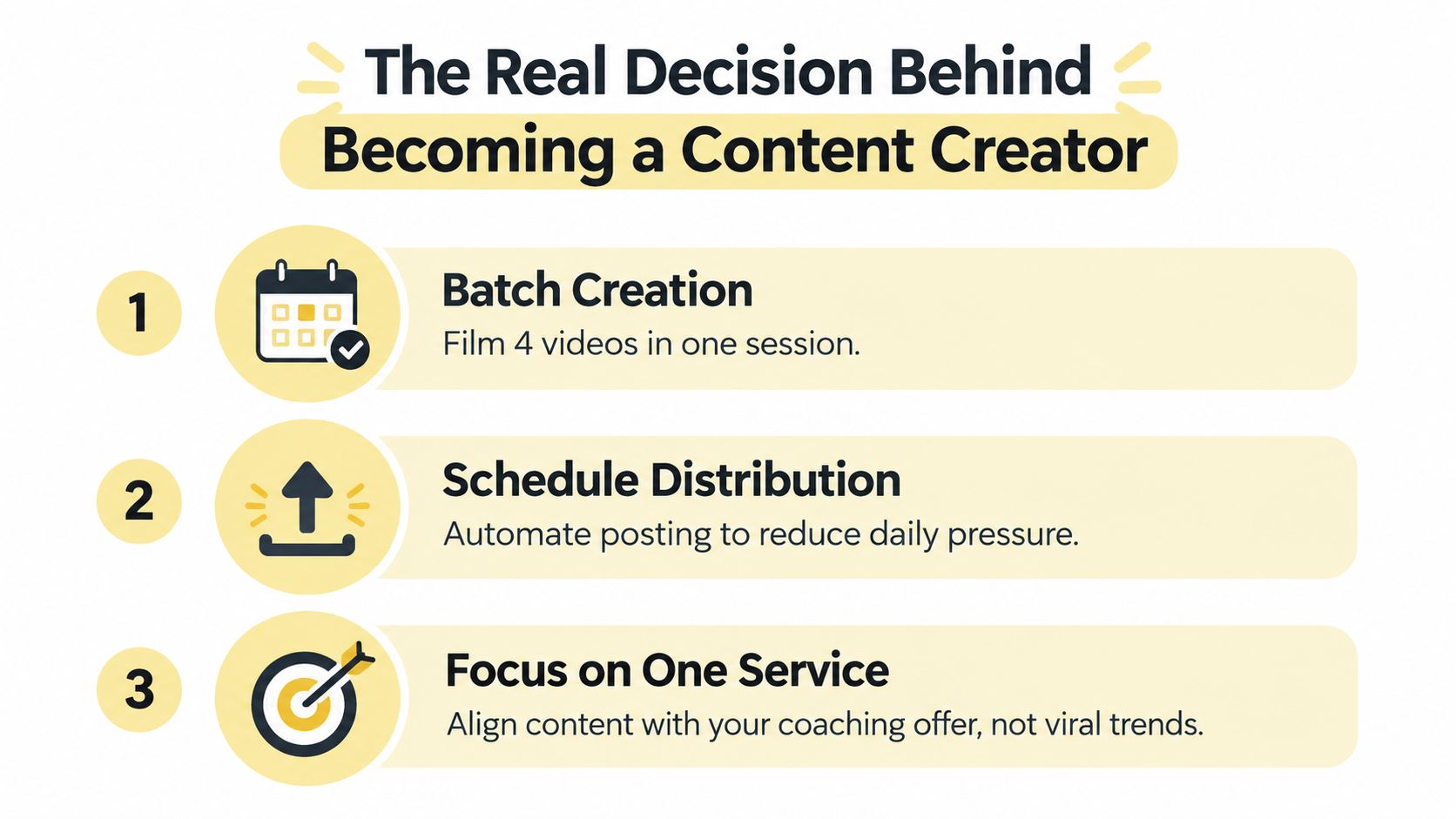
Choose one primary commercial job for your content:
- Lead generation: Bring qualified prospects into a call, workshop, or email list.
- Authority building: Make buyers trust your judgment before they ever speak with you.
- Product sales: Create demand for a group program, course, retreat, or digital resource.
You can support all three eventually, but one should lead. A leadership coach who publishes clever workplace observations without connecting them to a service may earn attention and still struggle to create revenue. A coach who consistently teaches new managers how to handle difficult conversations has a clearer path from post to offer.
Accept the revenue ramp
Don't assume a few good posts will produce paying clients in the second week. One independent guide reports an average of about five months to earn the first dollar, thirteen months to become full-time, and eighteen months to become fully self-supporting. The same guide reports that roughly 96% of creators earn under $100,000 annually, which makes the early period a test of consistency, positioning, and commercial judgment, not instant popularity. Read the creator launch timeline and income benchmarks before you build your financial plan around optimistic projections.
A coach who quits after a quiet launch treated content as a lottery ticket. Another coach might treat the first year as paid research, using every conversation, reply, and sales call to sharpen the offer. The second coach has a better chance because they're learning while building.
You'll trade time for reach, privacy for familiarity, and income stability for a longer runway. If you're not willing to publish on a fixed cadence, review weak ideas without taking them personally, and protect your finances while demand develops, don't start with the fantasy of a creator career. Start with a smaller commitment and prove that your operating system can support it.
Picking a Niche and an Audience You Can Actually Serve
Your niche should begin with the coaching offer you can deliver, not the audience size you wish you had. A broad topic may attract attention, but a narrow problem creates recognition. Buyers rarely think, “I need leadership content.” They think, “I'm a new manager and my one-to-ones keep turning into exhausting status meetings.”
Narrow the topic until the buyer recognizes themselves
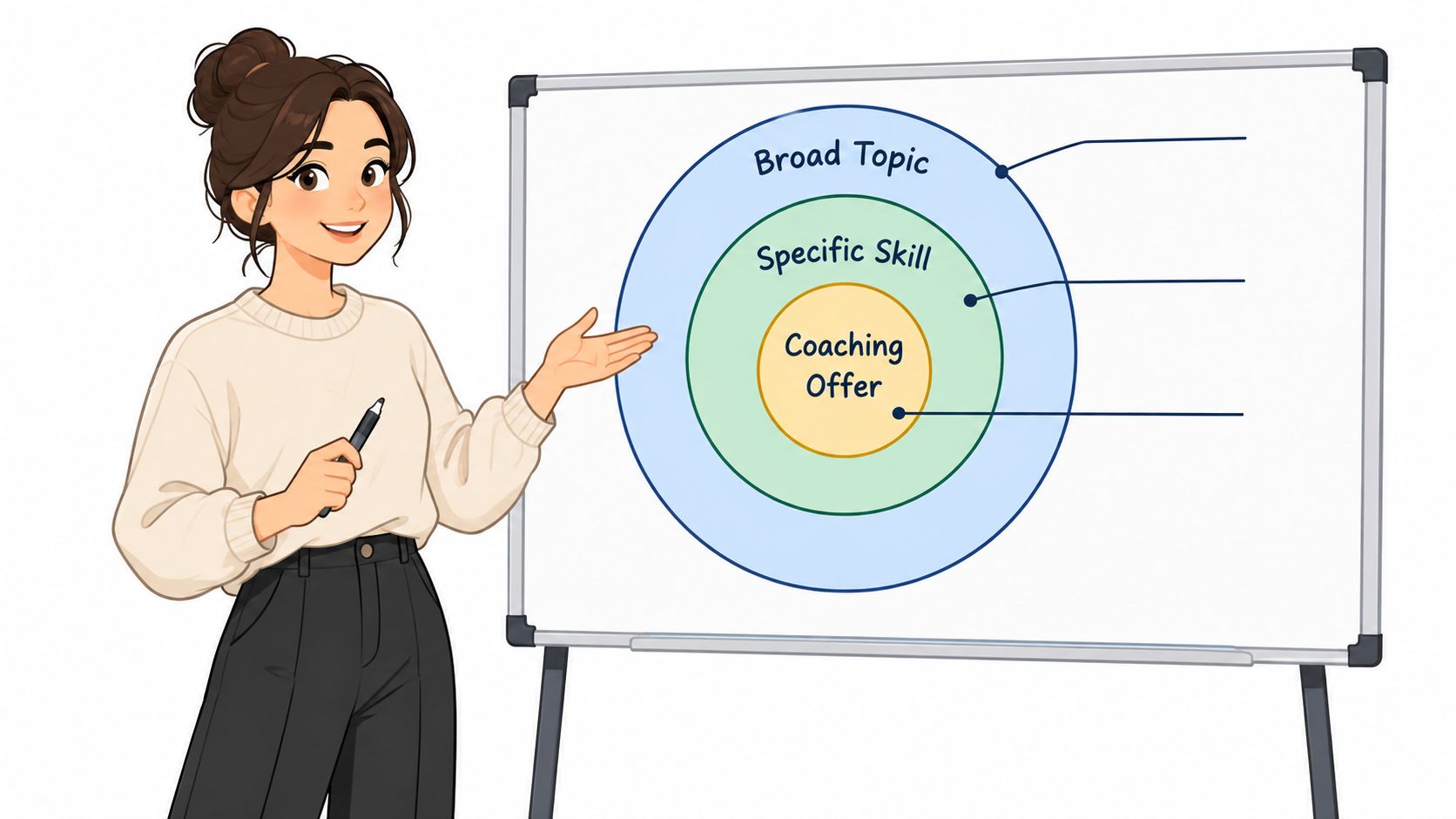
Use three layers:
- Broad field: Leadership.
- Specific audience: First-time managers in SaaS companies with small teams.
- Useful promise: Help new managers run focused one-to-ones and stop drowning in follow-up work.
The final version gives you content subjects, a buyer profile, and a possible program outcome. It also creates boundaries. You won't need to comment on every leadership trend because your content can focus on delegation, feedback, meeting design, and manager confidence.
A useful promise doesn't need to guarantee a result you can't control. “Help new managers prepare for difficult feedback conversations” is stronger and more credible than “Turn every manager into an inspirational leader.” Specificity builds trust because it shows you understand the problem at working level.
Research the language buyers already use
Don't invent your audience's pain from a blank document. Mine it from places where people describe the problem in their own words:
- Comments: Look for repeated questions, emotional phrases, and objections under relevant videos and posts.
- Communities: Scan subreddits, professional groups, and discussion boards for recurring situations rather than isolated opinions.
- Sales-call transcripts: Highlight the phrases prospects use when explaining why they haven't solved the problem yet.
- Client conversations: Ask which part of the process feels confusing, embarrassing, expensive, or difficult to sustain.
Your content should sound like it came from the buyer's head. “I keep postponing feedback because I don't want to damage the relationship” gives you a stronger opening than “Communication is important for leaders.”
Create a simple audience one-pager with four fields:
| Field | Question to answer |
|---|---|
| Pain | What situation keeps frustrating or worrying this person? |
| Desired outcome | What would feel meaningfully better after coaching? |
| Objections | Why might they delay, distrust, or avoid buying help? |
| Content habits | Where do they already learn, compare, and ask questions? |
If you can't fill this page using real conversations, your niche isn't ready. Keep researching before you spend months publishing to an imaginary audience.
Building a Production Workflow That Fits Coaching Life
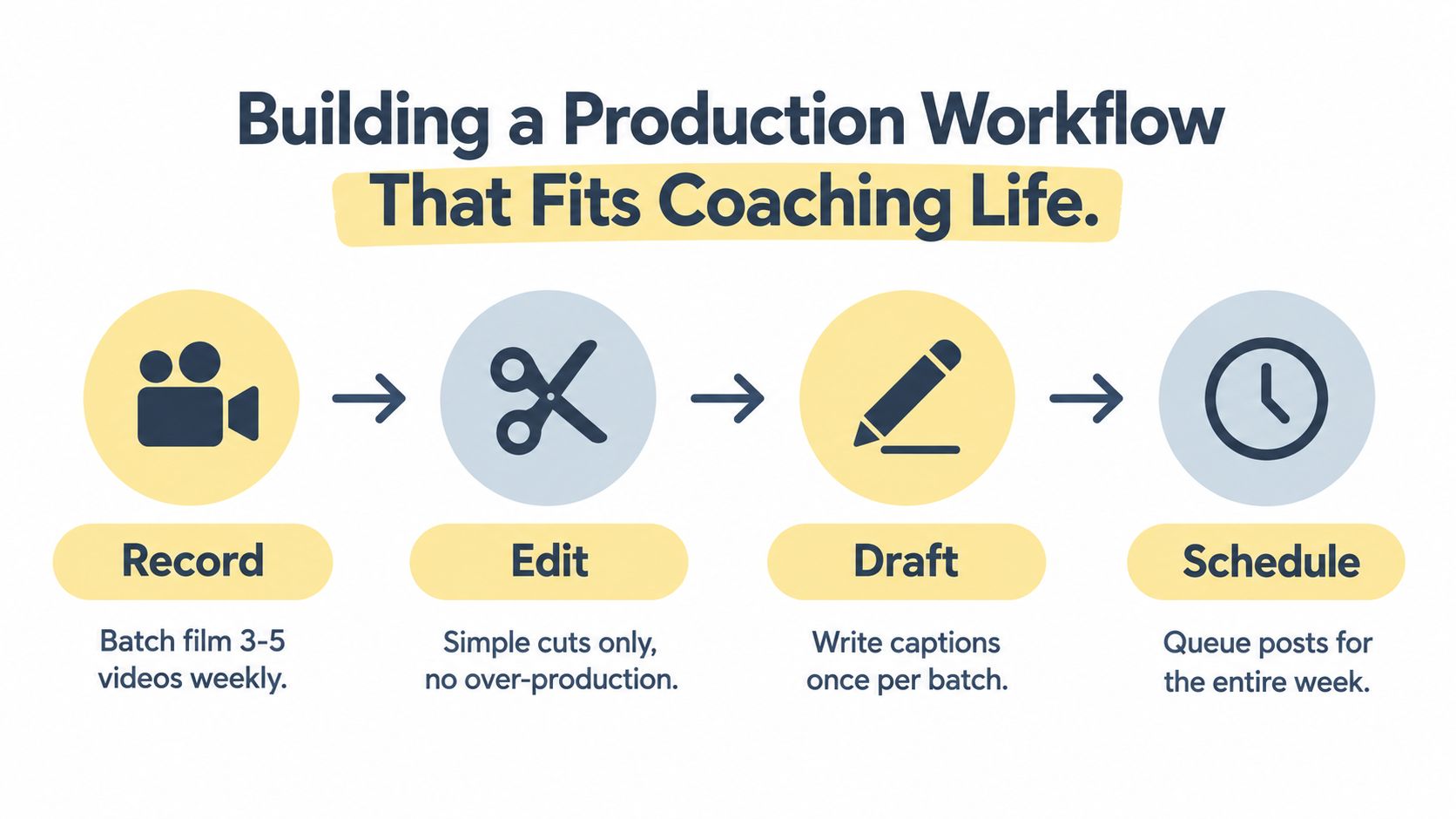
A working coach shouldn't create content from scratch between client sessions. That pattern turns every quiet moment into a production emergency. Build one concentrated creation block, then distribute the material throughout the week.
Consider a coach who delivers sessions on most weekdays. They use one block for idea capture and scripting, another for recording, a short editing session, and a final scheduling block. Client delivery remains protected because content has a home on the calendar rather than competing with every appointment.
Use a batch, then distribute system
A practical workflow looks like this:
- Capture ideas: Use Apple Notes, Notion, or a voice recorder to save client-safe questions, observations, and objections as they appear.
- Script lightly: Turn each idea into a hook, one teaching point, an example, and a call to action. A teleprompter can reduce retakes, but don't write a speech that sounds unlike you.
- Record in batches: Film several related videos in one session while the setup is already ready. Change the opening, not your entire production environment.
- Edit for clarity: Use CapCut, Descript, Riverside, or similar tools for cuts, captions, and audio cleanup. Don't spend an hour adding effects to a lesson that needs only a clean explanation.
- Schedule and review: Queue posts with a scheduling tool, then use native analytics to identify replies, saves, watch time, and clicks.
A coach teaching imposter syndrome might record one long explanation, several short responses to common objections, and a written post that summarizes the framework. The source material stays consistent while the formats serve different viewing habits. For help shaping persuasive video content, this direct response YouTube ad playbook offers useful guidance on hooks, structure, and calls to action.
Practical rule: Protect your coaching hours first. Content should fit the business you're building, not quietly replace the work that pays your bills today.
The common failure is winging it. Without a content calendar, a coach opens a camera, forgets the last useful idea, and publishes whatever feels easiest. A simple calendar should include the topic, audience problem, format, call to action, and repurposing destination. A content automation platform can help you keep those pieces visible without managing them in scattered documents, and this guide to content automation for coaches provides relevant context.
If you miss a week, don't punish yourself with a frantic catch-up session. Resume with the next useful topic, recycle an evergreen lesson, and remove unnecessary production steps. Consistency means shipping through most of the year, not maintaining a perfect streak.
Choosing Where to Publish and How Each Platform Pays
There isn't one universally correct platform for coaches. Choose based on your teaching strength, the buying behavior of your audience, and how long you want each piece of content to work.
YouTube suits coaches who can explain complex ideas in depth and tolerate a slower production cycle. LinkedIn fits business, executive, and career coaches who can turn workplace problems into sharp written analysis. Instagram Reels and TikTok offer discovery through short-form video, but they demand strong openings and can make it difficult to demonstrate the depth of a coaching method on their own.
A newsletter deserves more respect than it usually gets. Social platforms control distribution, while an email list gives you a direct way to continue a conversation, invite people to a workshop, and explain an offer without depending entirely on an algorithm. Short-form content can attract attention, but a deeper platform or owned audience gives that attention somewhere to go.
| Platform | Discovery | Content Lifespan | Monetization Threshold | Best For Coaches |
|---|---|---|---|---|
| YouTube | Search, recommendations, suggested videos | Often long-lasting when topics stay relevant | Ad revenue typically requires 1,000 subscribers plus either 4,000 public watch hours in the last 12 months or 10 million Shorts views in the last 90 days | Detailed teaching, demonstrations, and searchable problems |
| Professional network, search, sharing | Moderate, especially for strong opinions and practical posts | No single universal threshold for coaching revenue | Executive, business, leadership, and career coaching | |
| Instagram Reels | Recommendations, shares, profile discovery | Fast-moving, with some evergreen potential | Varies by feature, eligibility, and region | Personal connection, visual teaching, and direct messages |
| TikTok | Interest-based recommendations and search | Fast discovery, uneven longevity | Varies by program and eligibility | Concise lessons, experiments, and audience testing |
| Newsletter | Referrals, search, social promotion, existing audience | Available in your archive and inbox | Depends on your offer, list quality, and conversion path | Nurture, launches, workshops, and relationship building |
YouTube also offers lower entry points for fan-funding features, such as 500 subscribers plus 3,000 public watch hours or 3 million Shorts views over 90 days, while ad revenue uses the higher thresholds above, according to this overview of how major platforms pay creators. For a broader comparison of platform economics, this analysis of how YouTube pays creators best in 2026 can help you evaluate trade-offs without treating platform payouts as your entire business model.
Pick one primary platform and one repurposing channel. A coach who teaches through long-form lessons might choose YouTube and a newsletter. A coach who thinks quickly in short insights might choose LinkedIn and short-form video. Keep a presence elsewhere by reposting key ideas and maintaining a way to contact your audience. Platform risk is real. Algorithm changes, demonetization, and account restrictions can disrupt reach, so diversification matters from the beginning.
For more channel ideas and publishing options, review this practical guide to content creation sites for coaches.
Monetization Paths That Work Before You Hit 100K
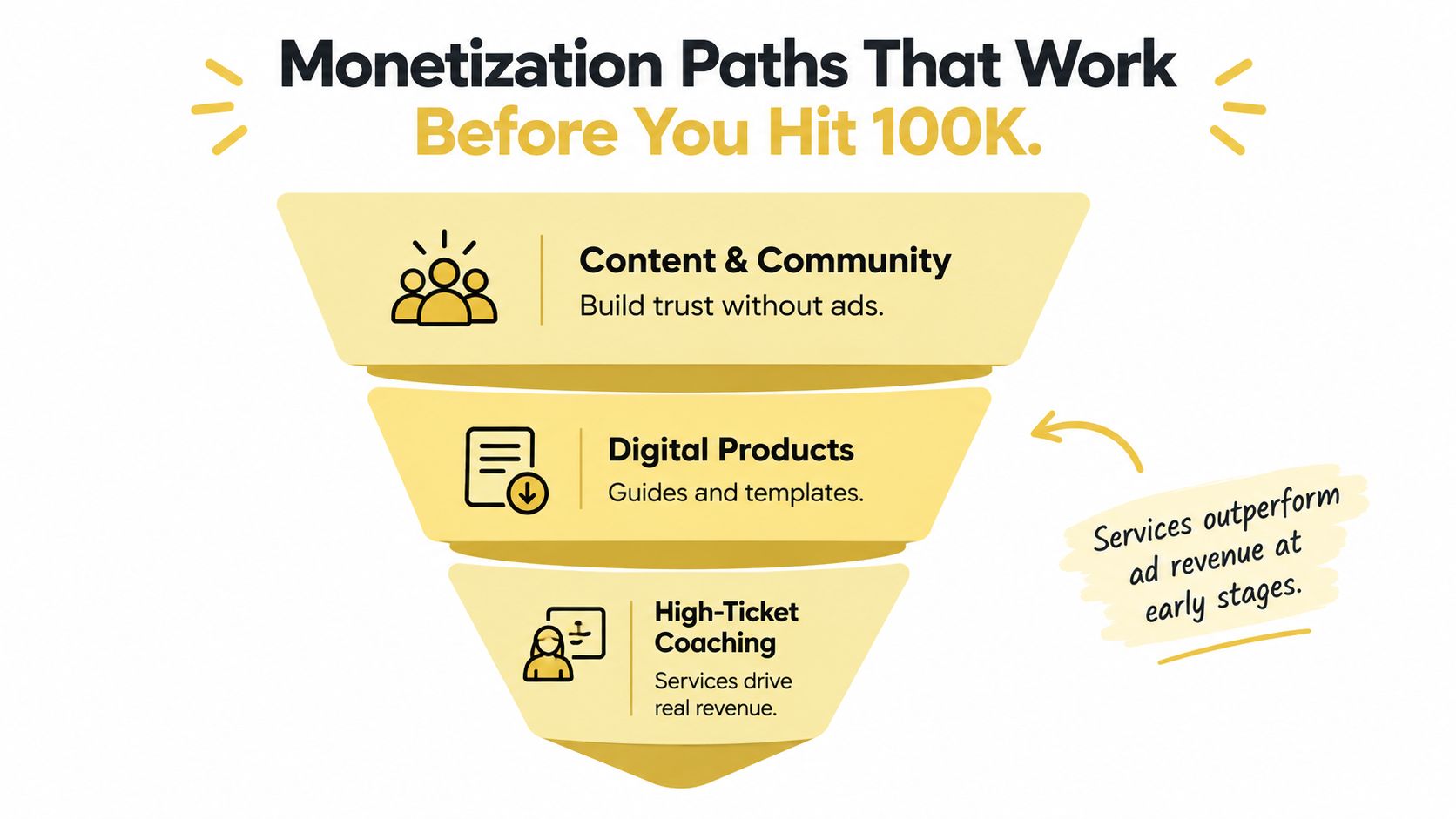
Small audiences can support real businesses, but not if you wait for advertising to rescue you. The more sensible early stack is service revenue first, product revenue second, and platform revenue where it happens to fit.
Creator income is concentrated. CreatorIQ reports that 67% of creators earned less than $10,000 annually, and 62% don't rely on content creation as their primary income source, according to its State of Creators report. Those figures support a side-hustle-first strategy. Keep coaching, consulting, or employment income while you build an audience and learn which offer people will pay for.
Start with the offer closest to the problem
One-to-one coaching is often the fastest way to turn attention into revenue because the buyer receives a direct path to help. Group coaching improves your capacity by serving people with a shared problem. A hybrid offer can combine group teaching with individual feedback for buyers who want structure and accountability.
Digital products work well when you repeatedly explain the same process. A manager coach could sell a difficult-conversation workbook, a meeting preparation template, or a short course on feedback. Keep the product narrow. A resource that solves one recognizable problem is easier to explain than a giant library that promises total transformation.
A paid community can become the middle layer between free content and intensive coaching. It gives members regular prompts, office hours, peer discussion, and accountability. The community must have a clear reason to exist. Access to a chat channel isn't a result.
The advertising market is growing, but that doesn't mean ad revenue is the right first target. The IAB projects U.S. creator ad spend to reach $44 billion in 2026, and nearly half of ad buyers now view creators as a must-buy channel, according to the IAB creator economy ad spend report. At the same time, just under 5% of creators clear $100,000, and 5.7% of U.S. creators report earning $100,000 or more, according to the verified industry data cited above. Advertising is valuable to brands, but it remains selective and uneven for individual creators.
Affiliate income can supplement a relevant recommendation. Sponsorships can work when the brand fits your audience and standards. Neither should determine your business plan before you have a dependable offer.
Don't underprice coaching to appear approachable. Low pricing can attract buyers who need more support than the offer includes, while making delivery impossible to sustain. Package the transformation, define the boundaries, and charge for the access, structure, judgment, and accountability you provide.
Turning Content Into Coaching Clients and Programs
Content should function as a pipeline, not a portfolio. A portfolio proves that you can create. A pipeline gives a stranger a logical next step toward becoming a lead, a call, and eventually a client.
Every useful piece should connect to a simple path:
- Content to resource: A lesson points to a checklist, workshop, assessment, or email guide.
- Resource to conversation: The follow-up sequence explains the problem and invites a relevant call or reply.
- Conversation to offer: The call confirms fit, clarifies the desired outcome, and presents the program that solves it.
A YouTube lesson about imposter syndrome can invite viewers to a free workshop on speaking with confidence. A LinkedIn post about executive communication can end with a discovery-call invitation. An Instagram Reel can ask viewers to send a specific word by direct message, then use a short qualifier to identify whether they need a resource or a conversation.
The call to action should match the depth of the content. Don't send every casual viewer straight to a high-ticket sales call. Use a low-friction resource for people who are still diagnosing the problem, then offer a conversation once they understand the cost of leaving it unresolved.
This approach also pre-qualifies prospects. Someone who watches a detailed lesson, downloads the related resource, and replies with a specific obstacle has already shown context and intent. The sales call becomes a confirmation conversation rather than a cold performance.
Your flagship offer should give your content somewhere to lead. That might be a group coaching cohort, a signature course with live support, or a focused retreat. A well-positioned long-form lesson can create demand for a $2,000 program, but you shouldn't promise that outcome from any single piece. Build a body of content that repeatedly explains who the program is for, what changes, how the process works, and why your method is credible. This content marketing playbook for coaches offers further guidance on connecting publishing with business growth.
Your First 90 Days and the Metrics That Matter
Your first quarter should answer business questions, not satisfy your ego.
During the first month, clarify the niche, offer, audience language, and publishing rhythm. Publish two or three useful pieces per week, using a repeatable format rather than chasing every trend. Your job is to discover which problems you can explain clearly and which topics make the right people respond.
During the second month, examine the strongest signals. Double down on topics that generate thoughtful saves, replies, qualified questions, or conversations. Don't automatically choose the post with the most views. A broad motivational clip may attract attention, while a specific post about a buyer's problem may attract the person who can ultimately hire you.
During the third month, add a lead-capture path, a free resource, and one outbound direct-message workflow connected to your content. The message shouldn't be a pitch to strangers. It should respond to people who engaged, asked a relevant question, or requested the resource.
Track four commercial metrics:
- Qualified replies and DMs: Are the right people describing a real problem?
- Booked calls: Does content create enough intent for prospects to take the next step?
- Show rate: Do booked prospects attend and arrive with a clear need?
- New clients signed: Does the offer convert qualified demand into revenue?
Review the week by recording the topic, format, strongest response, lead actions, calls booked, and client outcomes. Keep a topic when it creates qualified movement. Change the hook or format when the idea is useful but ignored. Stop publishing a topic when repeated tests produce attention without buyer relevance. Double down on evidence, not vanity.
The creator economy may exceed $250 billion globally in 2026 and could reach $500 billion by 2030, according to projections in this global creator economy report. The opportunity is substantial, but opportunity doesn't remove the trade-offs. Build slowly enough to protect your coaching quality, and deliberately enough that every published idea strengthens the business behind your name.
Coachful helps coaches organize programs, schedule sessions, manage payments, message clients, track progress, and support group cohorts from one workspace. If you're building a content-led coaching practice, visit Coachful to see how it can reduce delivery admin while you turn audience attention into structured client work.