Client Profitability Analysis for Coaches: 5 Cost Checks

Coachful
Editorial Team
Which coaching clients actually leave enough money to pay you properly? Run a client profitability analysis on completed engagements: match each client’s earned fee to the direct costs, the time you actually spent and the cost of winning the work. Then compare what remains before shared overhead and tax, rather than ranking clients by invoice size.
The awkward surprise is usually not a large expense. It is the extra preparation, rescheduling and between-session support that never made it into your price. A client can pay promptly, enjoy the work and still belong to an offer whose economics do not work.
This guide gives you five checks, a copyable worksheet and a two-client worked example. Every amount is hypothetical. This is an internal management exercise, not tax advice, a statutory accounting method or a judgment about a client’s worth as a person.
What client profitability analysis tells a coach
A practice-level profit and loss statement asks whether the whole business made money during a period. A client profitability analysis asks which engagements contributed enough to support that business, after the work required to serve and acquire them.
The distinction matters when two apparently similar packages take very different amounts of time. If one routinely includes extensive document reviews and another does not, comparing their sales totals hides the operational difference. The analysis should change the offer, delivery process or future agreement, not encourage you to withdraw promised care.
Use this management formula consistently:
Engagement contribution = earned revenue excluding sales taxes − direct cash costs − owner-time allowance − allocated acquisition cash costs.
Here, the owner-time allowance means your recorded hours multiplied by an internal hourly compensation target. It makes your own labor visible even when your accounting records treat owner drawings differently. The result is contribution before shared overhead and income tax, not your final accounting profit.
For the wider monthly picture, use the coaching business profit and loss template. Keep that report separate from this engagement-by-engagement worksheet.
1. Define the client relationship you are measuring
Start with a small set of completed engagements under the same offer. A six-session package is a workable unit. A corporate contract with several participants may need a contract-level analysis first, with participant-level detail only where the costs can be assigned sensibly.
Write down the engagement’s start, finish, offer version and reporting currency. Include the sales work that led to that engagement, even if it happened before the first session. Include the final handover and administration after the last call.

Do not compare the first month of a new client with a finished year-long relationship and call the difference profitability. One has delivery costs still to come. Mark active engagements as provisional, separating actual results to date from the estimated remaining work.
For repeat clients, decide whether each renewal is a separate engagement or whether you are examining the entire relationship. Both views can be useful. Switching between them midway through the calculation is not.
Use anonymous client codes in the working sheet. You need a reliable link back to the financial records, not session disclosures, health information or private accounts of why the client sought coaching.
2. Reconcile the fee before subtracting anything
Use the revenue attributable to the work being measured. A signed proposal is not proof of payment, and a bank deposit may combine multiple clients, processing deductions and refunds. Check the underlying records rather than copying the largest number on a dashboard.
For a completed engagement, list the agreed fee, discounts, refunds, unpaid amounts and taxes collected on behalf of authorities. Show what was earned and what was collected separately if they differ. Ask your accountant how to align this management view with your accounting basis.

Prepayments deserve particular care. A payment for twelve sessions does not establish the profit on the first two while the remaining ten vanish from your cost estimate. Either analyze the completed package or show the remaining obligation explicitly.
Do not subtract a refund twice. If your revenue line already excludes it, do not add it again as an expense. Likewise, use either a gross receipt with the processing fee listed below, or a reconciled net receipt with no second deduction for that same fee.
For multiple currencies, choose a documented conversion method and a reporting currency. Exchange-rate movement should not silently turn an otherwise identical offer into a supposedly better coaching service.
3. Count the delivery work your package really includes
Your session calendar is only part of the cost. Review the actual offer and agreement, then record the work required to fulfill them. Separate the service you promised from optional extras you added without noticing.

Capture these categories without overlapping the same minutes:
- Live delivery: coaching sessions, agreed stakeholder conversations and group facilitation.
- Preparation and review: reading documents, reviewing exercises, planning and writing agreed summaries.
- Between-session support: messages, feedback, voice notes and additional check-ins.
- Administration: onboarding, scheduling, payment chasing, access questions and offboarding.
- Sales: fit calls, proposals and follow-up associated with acquiring the work.
Track the next few comparable engagements if you lack reliable records. For historical work, reconstruct from your calendar and task history, label the estimate and use a plausible range. Precision to the minute is misleading if you are guessing about entire afternoons.

A reusable welcome flow can reduce repetitive work, but creating, checking and maintaining it still consumes time. Assign shared setup work across the engagements expected to benefit, using a written rule. Do not charge its entire creation time to one client and then declare every later client effortless.
Choose an internal owner-hour allowance that represents sustainable compensation for your labor. It is not your advertised session rate. Use the same allowance when comparing similar work, then test whether the conclusion changes at a higher or lower amount.
For an associate coach, record the actual delivery fee you pay as a direct cash cost. Do not also value the associate’s same hours as your owner labor. Your supervision and coordination time are separate hours if you actually performed them.

4. Add direct costs and acquisition without double counting
Direct cash costs are expenses attributable to the engagement: payment fees, a separately purchased assessment, a client-specific room booking, contracted delivery or travel you absorbed. Keep invoices and use actual costs where available.
Shared software, general insurance and a practice-wide website subscription normally belong to shared overhead in this worksheet. If you allocate them to clients later, show that as a separate, consistently applied step. Otherwise the apparent difference between clients can come entirely from an arbitrary allocation.
Acquisition deserves its own line. A paid referral fee, a directly attributable campaign or a specific proposal expense can belong there. For pooled marketing spend, allocate the relevant cost across the paying engagements acquired by that activity under a stated window and method.

Do not divide all marketing expenses by the number of names in your lead list. A lead is not a paying client. Also allow for the sales lag: spending in one month may produce contracts later. If attribution is uncertain, show a range or an unallocated pool instead of assigning a false exact cost.
In this article’s method, sales hours are included in total owner hours. The separate acquisition line therefore contains cash costs only. If your own acquisition figure already includes valued sales time, remove those hours from the owner-time line before subtracting it.
The paid advertising CAC guide explains the acquisition-budget decision in more detail. This worksheet answers the different question of what an individual engagement leaves after its actual work and costs.
5. Compare contribution, then choose a proportionate change
Consider two completed hypothetical engagements in the same currency. Both are fully earned and collected, with no sales taxes, outstanding balances or refunds in these examples. The internal allowance is $60 per owner hour, not an industry rate or recommended coaching price.
Client A: the smaller fee
- Earned revenue: $1,800.
- Direct cash costs: $90 processing-related costs plus a $110 assessment, totaling $200.
- Owner time: six session hours, three preparation hours, three support hours, two administration hours and two sales hours, totaling 16 hours.
- Owner-time allowance: 16 × $60 = $960.
- Acquisition cash costs: $120.
- Contribution: $1,800 − $200 − $960 − $120 = $520, before shared overhead and tax.

Client B: the larger fee
- Earned revenue: $2,400.
- Direct cash costs: $120 processing-related costs plus $180 contracted support, totaling $300.
- Owner time: eight session hours, seven preparation hours, ten support hours, seven administration hours and three sales hours, totaling 35 hours.
- Owner-time allowance: 35 × $60 = $2,100.
- Acquisition cash costs: $180.
- Contribution: $2,400 − $300 − $2,100 − $180 = negative $180, before shared overhead and tax.
The second engagement generated more revenue but did not cover the chosen owner-time allowance after its direct and acquisition cash costs. That does not mean $180 disappeared from the bank. The negative figure includes an internal allowance for the owner’s labor.

Another useful view is cash remaining per owner hour before that allowance and shared overhead. Client A yields ($1,800 − $200 − $120) ÷ 16 = $92.50 an hour. Client B yields ($2,400 − $300 − $180) ÷ 35 = about $54.86 an hour. Neither amount is final take-home pay.
Investigate the reason before changing the price. Did you under-estimate document review? Did a promised support channel create ten hours of messages? Did your own unclear onboarding create repeated scheduling questions? Fixing a coach-created process problem is different from charging a client more for the same unresolved friction.
Copy this client profitability worksheet
Use one record per engagement and keep a link to the supporting financial and time records. The template works in a spreadsheet or a simple internal document; it does not require dedicated profitability software.
Engagement identification
Client code: [ ]
Offer and version: [ ]
Start and completion dates: [ ]
Status: [completed / active and provisional]
Currency and conversion method: [ ]Revenue and cash
Earned revenue excluding sales taxes: [ ]
Cash collected for this engagement: [ ]
Outstanding amount and remaining delivery obligation: [ ]
Refund treatment and source records: [ ]Costs and time
Direct cash costs, itemized: [ ]
Session hours: [ ]
Preparation and review hours: [ ]
Between-session support hours: [ ]
Administration hours: [ ]
Sales hours: [ ]
Total non-overlapping owner hours: [ ]
Owner-hour allowance and basis: [ ]
Acquisition cash costs and allocation method: [ ]Result and decision
Contribution before shared overhead and tax: [ ]
Cash remaining per owner hour before the allowance: [ ]
Estimate uncertainties: [ ]
One change to test: [ ]
Contractual or accessibility considerations: [ ]
Review date and comparable engagements: [ ]
Record missing data as unknown, not zero. An empty time cell is not evidence that support took no work. Add a low and high estimate when reconstruction is necessary, and check whether your decision holds across that range.
What to do when an engagement contributes too little
Choose a response that matches the cause. You do not need to remove a client, raise every price or turn human support into a stopwatch.
- Clarify the next offer. Specify review limits, response windows and included support before the next purchase.
- Repair avoidable administration. Improve instructions or scheduling where your process creates repeated questions.
- Price a distinct scope. A document-intensive or sponsor-heavy engagement may need a different package rather than a hidden surcharge.
- Review shared costs. If most engagements contribute adequately but the practice does not, investigate overhead and unused capacity.
- Make exceptions deliberately. A scholarship or strategic investment can be valid when it has an explicit budget, purpose and review date.
Honor existing agreements. Discuss changes openly at an appropriate review or renewal point and obtain any required agreement. Do not quietly reduce contracted support because a private spreadsheet looks uncomfortable.
Accessibility adjustments and reasonable accommodation obligations also require care. A higher time requirement is not permission to discriminate. Get qualified local advice where legal duties apply, and design sustainable access into the service rather than treating it as a client defect.
How Coachful fits into the review
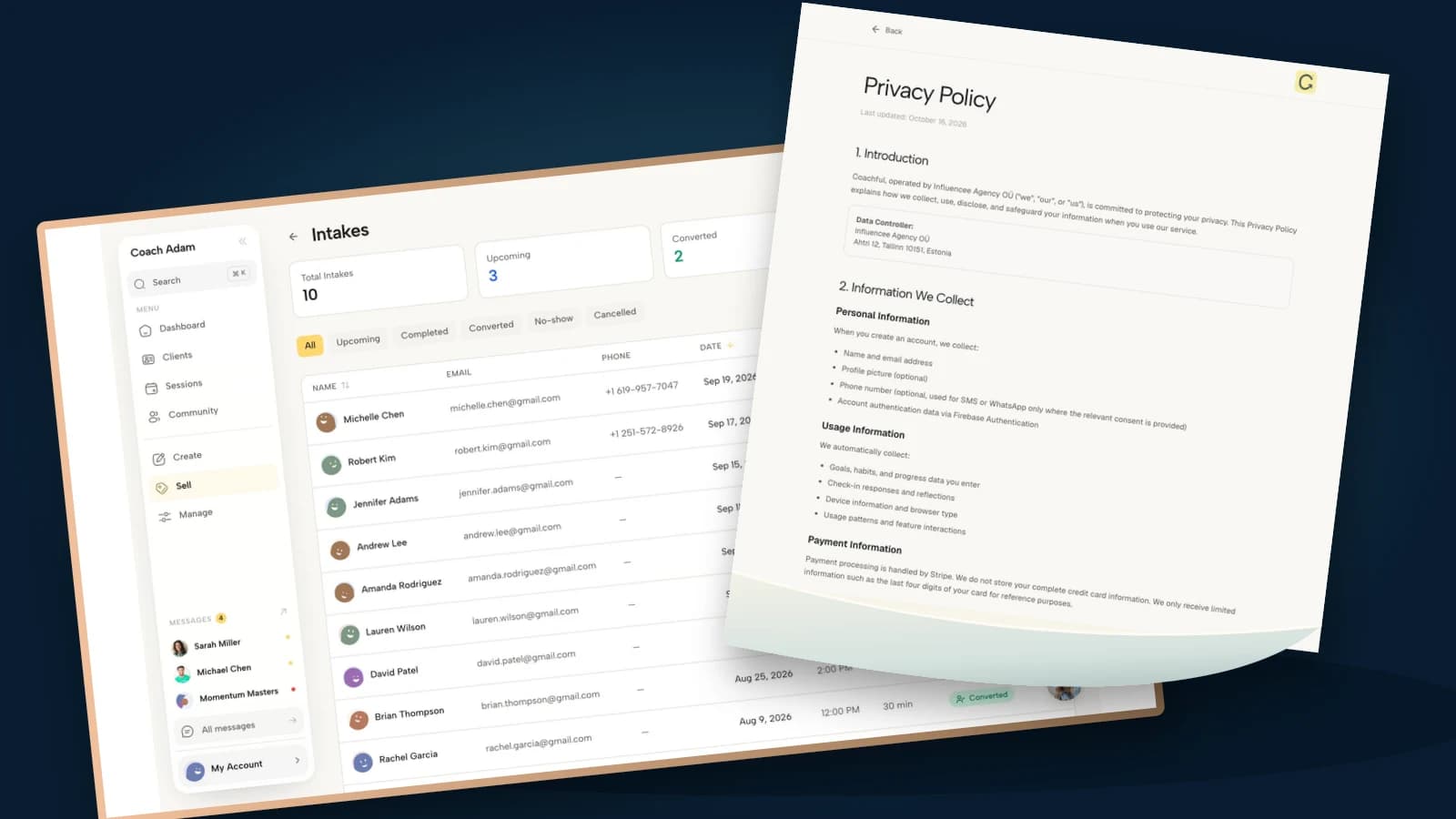
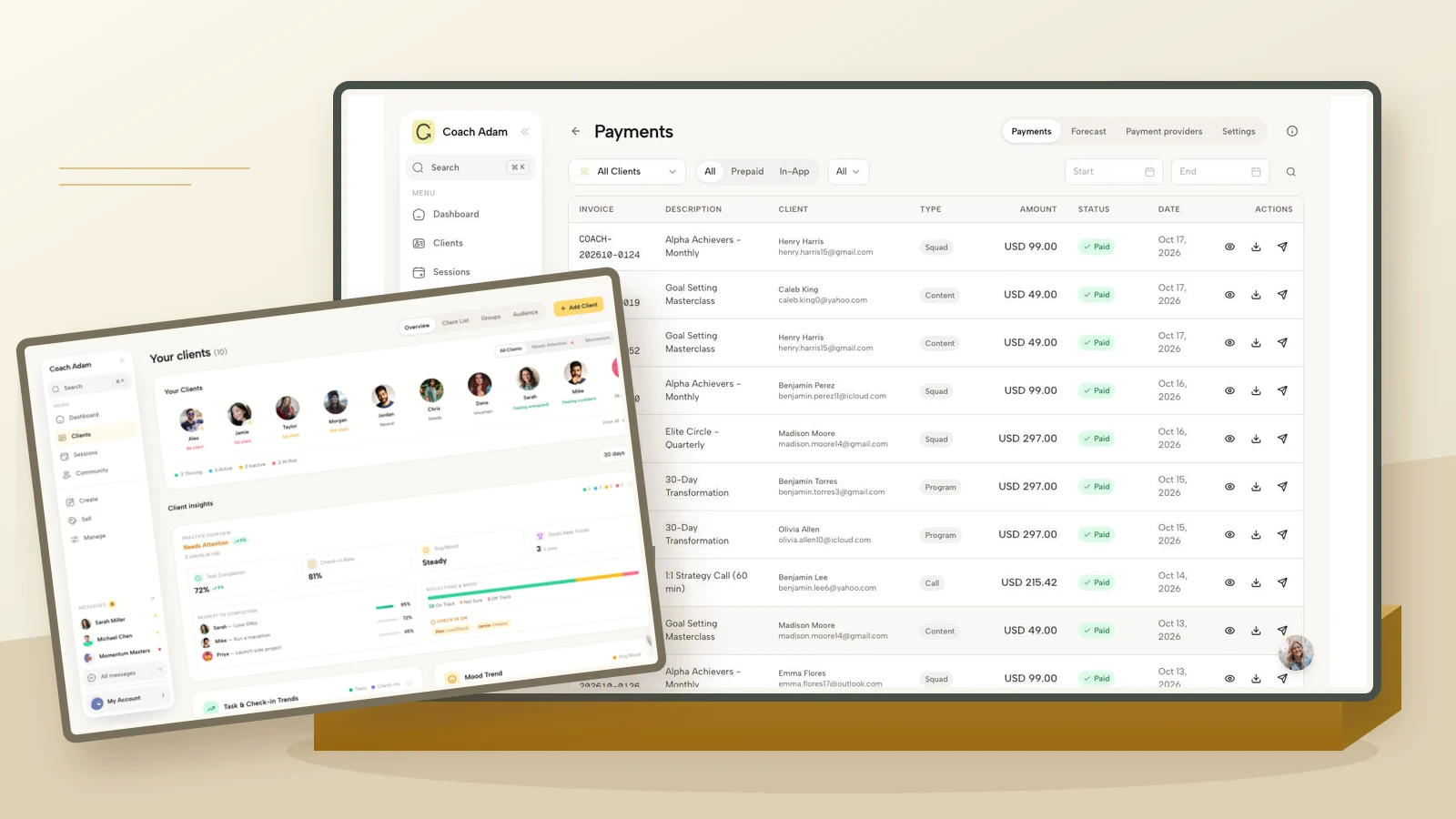
Use client records to identify the engagement, payment records to investigate receipts, bundle inclusions to check promised scope, and lead follow-ups to reconstruct sales activity. The demo screens in this guide show those surfaces, not an automatic client profitability calculation or time-tracking report.
Keep the calculation in your worksheet and reconcile it with your accounting and actual time records. If those inputs are currently scattered, the useful next step is to inspect how you would locate the client, payment and offer records before adding more tracking complexity.
Try the interactive Coachful demo and follow one example relationship through those records. Evaluate whether the workflow makes your review easier; do not assume a visible invoice proves profitability.
Frequently asked questions
How often should coaches review client profitability?
Review a small batch of comparable completed engagements after a package has enough delivery history to examine. Repeat when scope, pricing, acquisition costs or support demands materially change. A monthly review of active work can flag surprises, but label unfinished engagements as provisional.
Should I include my salary and owner drawings?
Distinguish cash payments, accounting expenses and an internal labor allowance. In this method, your hours receive an allowance so unpaid owner labor is not invisible. Do not also subtract the same labor as salary. Owner drawings are not automatically another engagement expense; ask your accountant how your entity treats compensation.
Is client profitability the same as client lifetime value?
No. Lifetime value estimates or measures value across a whole relationship, often including renewals. This review examines a defined engagement’s actual cost-to-serve. Do not rescue an unprofitable current package with renewals or referrals that have not happened.
What is a good client profit margin for a coach?
There is no universal percentage established by this worksheet. The required contribution depends on overhead, capacity, compensation needs and risk. Define what your practice needs and keep the method consistent. A positive contribution still does not prove the whole business is profitable.
Can I compare one-to-one and group coaching?
Yes, but allocate shared group delivery and preparation consistently across the cohort. Do not multiply the same facilitator hours by every participant. Show cohort contribution first, then individual costs where those differ. A full group and a half-empty group can have very different economics despite identical ticket prices.
The useful outcome is a better service decision, not a ranking of people. Review one completed offer, count the invisible work honestly and change the part of the business that created the gap.