Coaching Business Profit and Loss Template: A Worked Example

Coachful
Editorial Team
How much did your coaching business actually make this month, rather than simply collect? Start with a monthly profit and loss statement: record revenue on one consistent accounting basis, subtract refunds and business expenses, and show the operating result before income tax and owner drawings. Keep a separate cash view for what you can safely transfer to yourself.
A full calendar and a healthy-looking bank deposit do not answer that question. The deposit may include money for future coaching, exclude payment fees, or combine several clients and a refund. Meanwhile, the quiet expenses keep arriving whether you have checked your books or not.
This coaching business profit and loss template gives you a copyable structure, a completed hypothetical example and a short monthly review. It is a management starting point, not a tax return, a statutory financial statement or individualized accounting advice. Ask a qualified local accountant to adapt it to your entity, reporting requirements and accounting basis.
What a coaching profit and loss statement should tell you
A profit and loss statement, also called an income statement or P&L, summarizes revenue and expenses over a defined period. For a coaching practice, its useful job is to show whether the work you sell supports the costs of running and delivering the practice.
Use it to answer specific questions: Did revenue fall, or did contractor costs rise? Is a workshop contributing enough after venue costs? Are software and marketing commitments growing faster than the practice can support? Those questions lead to better decisions than celebrating the largest number on a payments screen.
Do not confuse three different reports. A P&L explains performance over a period. A balance sheet records assets, liabilities and equity at a point in time. A cash-flow report explains movements in cash. A profitable business can still face a cash shortage, particularly when corporate invoices are paid later than the related work.
1. Define the month before entering the money
Put these fields at the top of your spreadsheet or accounting report. They are part of the template, not administrative decoration.
- Practice and reporting period: [Business name], [start date] to [end date].
- Reporting currency: [Currency]. Do not add different currencies without a consistent conversion policy.
- Accounting basis: [Cash or accrual, as agreed with your accountant].
- Sales-tax treatment: [How VAT, GST or other sales taxes are handled].
- Report status: [Actual results or forecast]. Keep assumptions separate from completed transactions.

Cash and accrual accounting can put the same transaction in different months. Broadly, a cash basis records income when received and expenses when paid; an accrual basis recognizes income and expenses according to the applicable accounting rules rather than simply their payment dates. The US Small Business Administration’s finance guidance explains the basic distinction.
Prepaid coaching packages deserve particular attention. A client paying for several months does not mean every accounting basis treats the entire amount as this month’s earned revenue. Do not invent a recognition rule from the number of installments or sessions. Ask how your contracts and obligations should be treated, then apply that policy consistently.
Sales taxes collected for a tax authority generally need separate treatment from your own revenue. Recoverable and nonrecoverable taxes can also affect expense recording. Do not switch between tax-inclusive and tax-exclusive amounts halfway down the sheet. The example below assumes no sales tax and one reporting currency to keep the arithmetic visible.
2. Gather the records, not just the bank balance
Collect client invoices, payment records, refunds, processor fees, business-bank transactions, supplier bills and supporting receipts. On an accrual basis, include the relevant unpaid invoices, outstanding bills and adjustments. A cash-basis report still needs a clear trail explaining each receipt and payment.

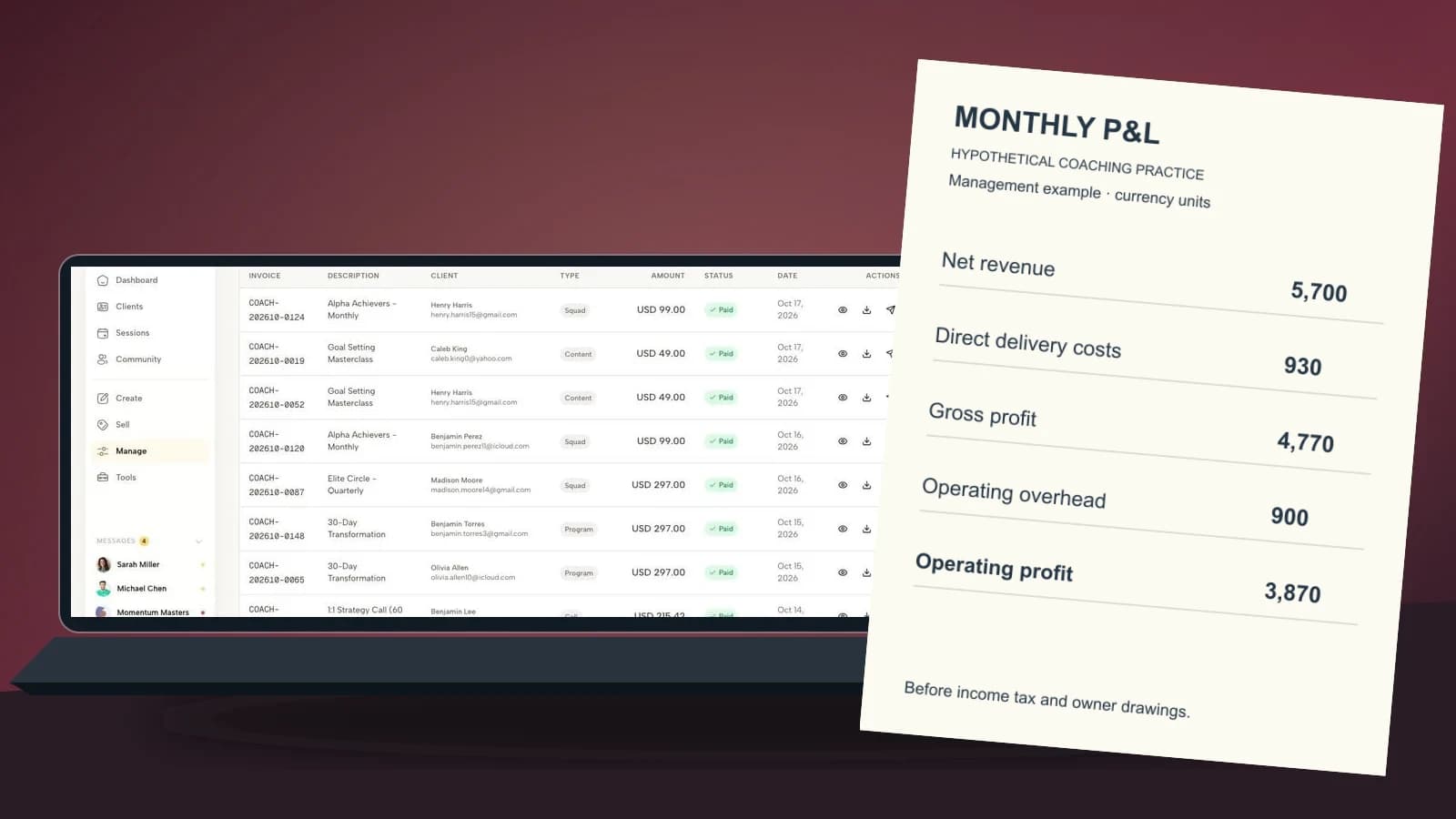
The real Coachful demo invoice ledger illustrates an upstream record: who was billed, the amount and the payment state. It does not show your full business expenses or prove the practice’s profit. Keep the accounting report in your bookkeeping system or an accountant-reviewed spreadsheet.
Give each transaction a reference you can trace back to its source. A simple transaction register can contain date, reference, client or supplier, description, category, amount and a link to the supporting document. Use client identifiers where practical and restrict access. Your bookkeeper does not need private session notes to categorize an invoice.
Include revenue paid outside your main checkout. A corporate client paying by bank transfer is still part of the business. Equally, a transfer from your personal savings into the business is not a coaching sale. Classify it appropriately rather than letting a bank-feed suggestion decide.
3. Copy this coaching business P&L template
Create a column for the current month, one for the previous comparable period and an optional notes column. Add year-to-date totals when useful. The structure below is deliberately short enough to maintain without building a new category for every purchase.
Revenue
- One-to-one coaching: [amount]
- Group coaching and workshops: [amount]
- Courses and digital resources: [amount]
- Other operating revenue, described separately: [amount]
- Gross operating revenue: [sum of revenue lines]
- Less refunds and sales adjustments: [amount]
- Net operating revenue: [gross revenue minus refunds and adjustments]
Direct delivery costs
- Associate-coach or delivery-contractor costs: [amount]
- Workshop venue and delivery materials: [amount]
- Payment-processing fees: [amount]
- Other directly attributable delivery costs: [amount]
- Total direct costs: [sum of direct-cost lines]
- Gross profit: [net revenue minus direct costs]
Operating overhead
- Software and business subscriptions: [amount]
- Marketing and advertising: [amount]
- Business insurance: [amount]
- Bookkeeping and professional fees: [amount]
- Training, supervision and professional development: [amount]
- Other operating expenses, described separately: [amount]
- Total overhead: [sum of overhead lines]
- Operating profit or loss: [gross profit minus overhead]
This is a management presentation, not a universal chart of accounts. For example, some businesses present processing fees within overhead rather than direct costs. Choose a defensible convention with your accountant and keep it stable. Moving the same fee between sections changes gross profit, but it should not change the final operating result.

Use revenue categories that support a decision. The Coachful demo offers show why the distinction can matter: a recurring coaching service, a standalone session and a program have different delivery commitments. Those displayed offer prices are not this month’s sales. Record the transactions that belong in the reporting period, not the catalog value of everything available to buy.
4. A completed monthly example
All figures in this section are hypothetical currency units, not Coachful prices, typical coach earnings or recommended spending. Assume a sole-trader practice, a consistently applied reporting basis, no sales tax, no depreciation, no interest and no other adjustments. Its recorded revenue and expenses for the month are:
Revenue in the example
- One-to-one coaching: 4,200
- Group coaching and workshops: 1,500
- Digital resources: 300
- Gross revenue: 6,000
- Less refunds: 300
- Net revenue: 5,700
Direct costs in the example
- Delivery contractor: 600
- Workshop venue: 150
- Payment-processing fees: 180
- Total direct costs: 930
- Gross profit: 4,770
Overhead in the example
- Software: 150
- Marketing: 300
- Insurance: 80
- Bookkeeping: 170
- Training and supervision: 200
- Total overhead: 900
Operating profit = 5,700 − 930 − 900 = 3,870. Total operating expenses are 1,830. This is the result before income tax and owner drawings under the stated assumptions, not an amount the coach can automatically spend personally.

The operating margin is approximately 67.9%: operating profit of 3,870 divided by net revenue of 5,700, multiplied by 100. That percentage is an illustration, not a benchmark. A solo coach whose own work is not expensed as a salary can show a high operating margin while earning little for the hours invested.
To understand the business economically, review the owner’s delivery, preparation, administration and marketing time alongside the statement. Keep an imputed value for that time in a separate pricing or capacity analysis. Do not insert an invented owner wage into the bookkeeping report without an accounting basis for doing so.

Read changes at category level. A higher contractor bill could reflect additional group delivery rather than waste. A training payment may be an occasional investment rather than a permanent monthly run rate. Put a short explanation beside material changes before deciding to cut costs or raise prices.
5. Avoid counting the same sale twice
Packages and bundles make the revenue line easy to inflate accidentally. If a client buys one bundle, do not count the bundle sale and then add the listed values of its included course and coaching sessions as extra sales. Any allocation between components must still reconcile to the actual transaction and your accounting policy.

The Coachful demo bundle library illustrates packaged services, not a second source of revenue on top of the same buyer’s payment. Keep a consistent transaction reference through your records. If you analyze component revenue, the parts must reconcile to the whole after appropriate adjustments.
Processor payouts create another trap. In a simplified example, a client pays 1,000, the processor retains a fee of 30, and the bank receives 970. Record the gross sale and the fee according to your accounting policy. Do not record the 1,000 sale and then treat the 970 deposit as a different sale.

Real payouts may combine multiple sales, refunds, disputes, reserves and other adjustments. Reconcile the processor statement to its underlying transactions and then to the bank. Never force an unexplained difference into “other income” just to make the totals agree.
If two systems import the same transaction, match or exclude the duplicate using the bookkeeping tool’s correct process. Deleting a source record or changing a completed payment to improve a report is not reconciliation. Preserve the audit trail and ask your bookkeeper about corrections.
6. Separate operating profit from what you pay yourself
For the sole-trader example, a transfer to the owner is a drawing, not an operating expense. The practice’s operating profit remains 3,870 even if the owner transfers 1,200 to a personal account. A company paying a director or employee can have different payroll and tax treatment, so do not generalize that rule to every entity.
A transfer into a tax-reserve account is also not, by itself, an operating expense. It earmarks cash. It does not establish the tax bill or reduce operating profit just because the money is no longer in the main account.
Suppose, only for this simplified cash illustration, that all reported revenue and expenses were received or paid during the month, with no other cash movements or timing differences. Starting from the 3,870 operating surplus, subtract an owner drawing of 1,200 and a transfer of 800 to a separate business tax-reserve account. The operating-bank remainder from those movements is 1,870.

The reserve transfer changes which business bank account holds the money, not the total cash held across those accounts. The 800 is an invented allocation, not tax advice or a suggested reserve percentage. Opening balances, unpaid bills, loans, equipment purchases and future delivery obligations can all change what is actually available.
Keep a separate cash plan showing upcoming bills, expected collections and commitments. A package paid upfront can fund this month’s bank balance while requiring several months of work. The P&L is one part of the decision about drawings, not permission to empty the account.
A monthly review you can repeat
Close the month before interpreting it. Confirm that all relevant records are included, reconcile bank and processor accounts, resolve uncategorized items and review any accountant-required adjustments. Mark an incomplete report as provisional instead of comparing it with a completed month as though both are final.
- Check revenue quality. Compare the same accounting basis and period. Separate actual sales from unpaid enquiries, pipeline estimates and catalog prices.
- Inspect refunds and direct costs. Look for a delivery problem, a timing difference or an unusually expensive event before assuming a trend.
- Review recurring overhead. Identify commitments that continue even during a quiet month. Avoid canceling a useful service solely because its annual payment landed this month.
- Compare profit with cash. Note outstanding invoices, future delivery, taxes, debt and owner transfers separately.
- Choose one action. Reconcile an unexplained payout, review an offer’s delivery cost or cancel a genuinely unused subscription. Record who will do it and when.
Compare several periods before drawing conclusions about seasonality. A single successful launch can hide a weak recurring base, while one annual insurance payment can make an otherwise ordinary month look unusually expensive. Keep a note of the event rather than smoothing away the actual transaction.
Where Coachful belongs in this workflow
Coachful’s relevant role is upstream: the reviewed demo shows offers, bundles and invoice records. These help a coach understand the client-facing sale and retrieve the record behind it. They do not replace a general ledger or generate the P&L used in this article.
If matching a sale back to its coaching offer is currently the difficult part, try the interactive Coachful demo and inspect those records before changing your workflow. Then decide with your bookkeeper how the verified transactions should enter your accounting system. Do not assume an automatic accounting integration or export format from a screenshot.
If the real problem is choosing accounting software, use the separate bookkeeping tools comparison. This template answers a different question: what the monthly statement should contain and how to read it without mistaking cash collection for profit.
Frequently asked questions
Can a coach use a spreadsheet for a profit and loss statement?
Yes, a spreadsheet can organize a simple management report if its inputs are complete and reconciled. It is not automatically a complete bookkeeping system. Have an accountant review the structure, formulas and required adjustments, particularly for prepayments, payroll, multiple currencies or sales taxes.
Should I include unpaid coaching invoices?
That depends on the accounting basis and recognition rules you use. Do not include an invoice just because it exists, or exclude it just because it is unpaid, without checking the policy. Maintain an accounts-receivable list separately so unpaid clients do not disappear from view.
Is operating profit the same as my personal income?
No. Entity structure, payroll, drawings, taxes, cash timing and business obligations all matter. The example deliberately stops before income tax and owner drawings. It does not calculate taxable income or an appropriate personal transfer.
Do professional-development costs belong in the report?
Record relevant business costs under a consistent policy, supported by receipts and explanations. Their treatment in financial reporting and their tax deductibility are separate questions. A coaching qualification or course is not automatically deductible everywhere simply because it helps your practice.
The useful result is a number you can explain. Copy the structure, reconcile one completed month and write down the reason for its largest change. A smaller, defensible profit figure is more useful than an impressive revenue total that counts the same payment twice.
Sources and limits: The Australian government’s profit and loss statement guide supports the basic revenue, expense and profit structure and provides a general template. The SBA finance guidance supports the distinction between accounting methods and the need for reconciliation and professional help. All coaching examples, amounts and visuals here are original illustrations. Local accounting and tax requirements take precedence.