Coaching Invoice Template: A Filled Example and 7 Checks

Coachful
Editorial Team
What should you put on a coaching invoice so the client can pay it without another round of emails? Identify the seller and payer, name the agreed service, show the amount and currency, and give an unmistakable payment deadline and method. Keep session notes off the document. An invoice should explain the charge, not retell the coaching conversation.
Below is a copyable coaching invoice template, a filled example and service descriptions for different billing arrangements. Start with the commercial facts you already agreed. A polished document cannot repair an unclear package, invent a cancellation fee or turn an unapproved expense into something the client owes.
The examples are hypothetical, not Coachful customer records, recommended coaching rates or jurisdiction-specific accounting advice. Invoice and tax requirements vary by location, business structure and transaction. Use this as a drafting framework, then confirm the required fields and treatment with a qualified local adviser.
Copy this coaching invoice template
Use the following structure in your invoicing software or document editor. Replace every bracketed field. Delete inapplicable optional fields rather than leaving empty labels that make a client wonder whether something is missing.
INVOICE
From: [Legal business name and any trading name]
Business address: [Required business address]
Contact: [Business email or other contact]
Business or tax registration details: [Where required]Bill to: [Person or legal entity responsible for payment]
Billing address: [Required payer address]
Billing contact: [Approved contact, if different]
Purchase order or engagement reference: [If applicable]Invoice number: [Unique identifier]
Invoice date: [Issue date]
Service date or period: [Actual date, period or agreed advance-billing description]
Payment due: [Unambiguous calendar date]
Currency: [Currency code]Description: [Agreed coaching service and relevant scope]
Quantity: [Units being billed]
Unit amount: [Price per unit]
Line total: [Quantity multiplied by unit amount]Subtotal: [Sum of line totals]
Agreed discount: [If applicable]
Applicable tax: [Required treatment and breakdown]
Invoice total: [Total charge]
Payments or credits applied: [If applicable]
Amount due: [Remaining amount payable]How to pay: [Verified payment route or approved instructions]
Payment reference: [Reference to use]
Questions about this invoice: [Business contact]
Relevant agreed terms: [Short reference to the existing agreement]
Put the amount due and due date where they can be found immediately. A payer should not need to calculate the balance from a paragraph at the bottom. If your software labels these fields differently, preserve the meaning rather than forcing this exact layout.

A filled coaching invoice example
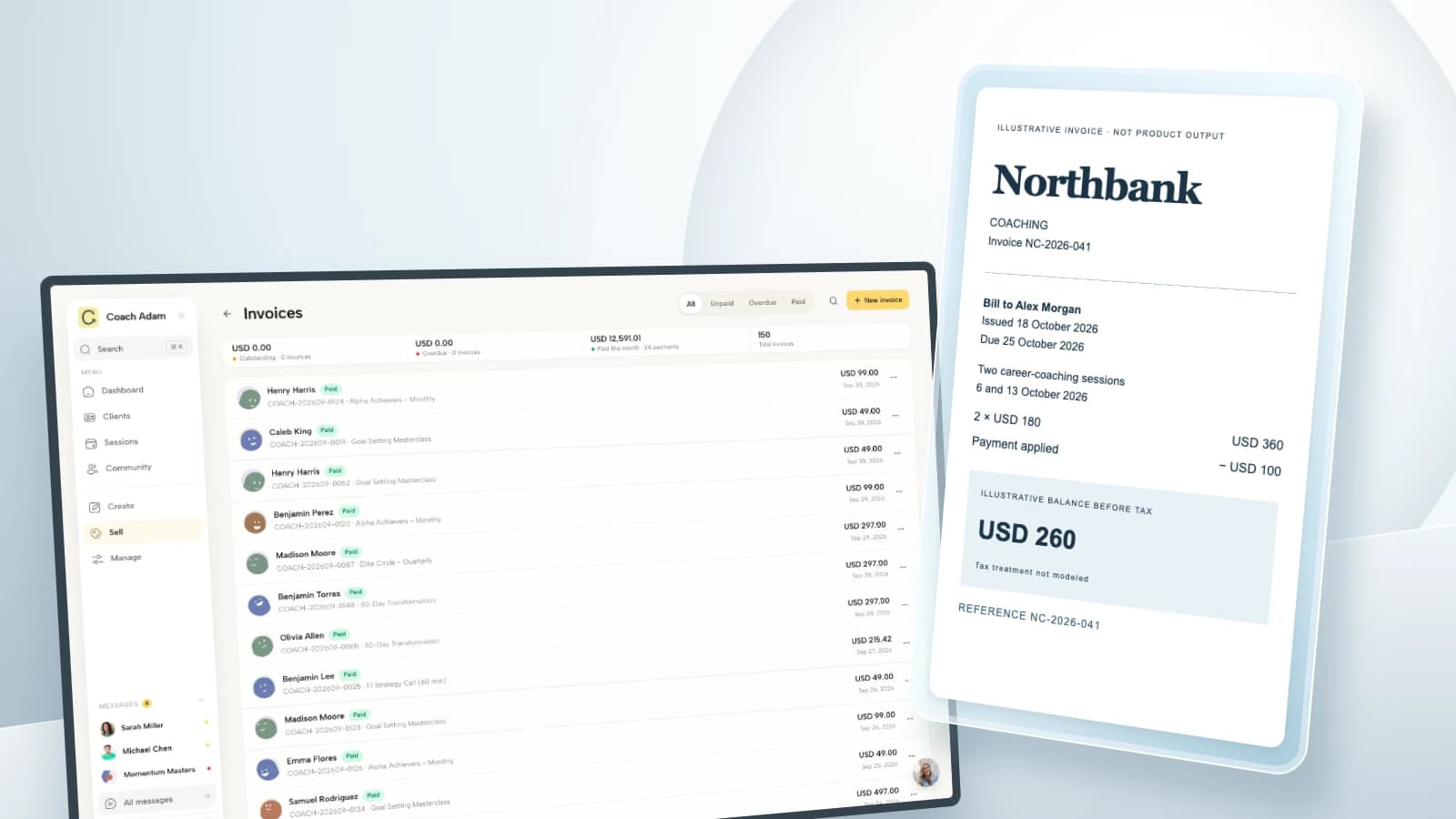
Imagine a career coach invoices for two sessions already delivered under an agreed per-session arrangement. The fictional business is Northbank Coaching, the payer is Alex Morgan, and the service description is deliberately neutral. The example omits addresses and tax identifiers because they must be supplied accurately for the real business.
- Invoice number: NC-2026-041.
- Issued: 18 October 2026.
- Service: Two individual career-coaching sessions, delivered 6 and 13 October 2026.
- Quantity and unit amount: 2 sessions at USD 180 per session.
- Subtotal: USD 360.
- Tax: Not modeled in this arithmetic example; determine the applicable treatment before issuing a real invoice.
- Payment already applied: USD 100 against this invoice.
- Illustrative balance before any applicable tax: USD 260.
- Due: 25 October 2026, under the hypothetical agreed terms.
The calculation is two times 180, giving 360, less the 100 already applied, leaving 260 before any tax that the example does not model. This is a teaching example, not a send-ready tax invoice. A real document needs the correct tax treatment and final amount, not a note asking the payer to work it out.
Notice what is absent: the client's worries about their manager, career ambitions and session outcomes. Those details do not help someone match the charge to the engagement. Even when the client pays personally, keep billing descriptions proportionate to their purpose.

7 details to get right before sending
1. Use your actual seller identity
A brand name is not always the legal entity issuing the invoice. Check the business name, address, contact information and any required registration details. If you trade under a different name, make the connection clear in the way your local rules require.
Do not copy another coach's invoice footer and substitute a logo. For example, the UK government's invoice requirements specify identity, service, dates and amounts, with additional distinctions for sole traders, limited companies and VAT invoices. Those are UK rules, not a universal checklist for every coach.
2. Name the payer, not just the participant
The person you coach and the person or organization responsible for payment may differ. Confirm who accepted the commercial terms and which legal entity should be billed. Ask for the billing contact and any required reference before the invoice is due, not after it is rejected.
If an employer pays, do not automatically include the participant's name in every field. Use the identification needed and permitted under the engagement. A program reference may be sufficient. An accounts-payable inbox does not need access to personal coaching content just because it processes the bill.

3. Give the document a unique identity and clear dates
Use an invoice identifier that lets you retrieve the exact document later. A system such as NC-2026-041 can work as an organizational convention, but check any numbering rules that apply where you operate. Do not reuse the same identifier for unrelated charges.
Distinguish the issue date from the service date and the payment due date. They answer different questions. Write an explicit date rather than relying only on “due next Friday” or an ambiguous numeric format. If you bill before delivery, describe the advance arrangement honestly instead of implying the sessions have already happened.

4. Describe what was actually purchased
“Coaching” may be too vague; a paragraph about personal development is too much. A useful line identifies the agreed service, relevant quantity and billing basis. Use the same package name as the accepted offer so the payer can recognize it without decoding your internal labels.
Do not turn a fixed-fee package into an hourly engagement simply because your template has an hours column. Quantity one can represent a whole package. If you include an informative session count, make clear that it describes the package rather than creating a second charge.

5. Separate the package commitment from this payment
A six-session package, a monthly membership and the second installment of a fixed-fee engagement are not interchangeable. State what the invoice covers. If a package is paid in installments, distinguish the whole commitment, this installment and amounts already settled where appropriate.
Be especially careful with deposits. If you already invoiced a deposit, the later document must account for it correctly rather than charging the full package again. Depending on the system and local rules, you may need a balance invoice, an applied payment, a credit or another treatment. Do not improvise the accounting by deleting the original record.

6. Make the money readable
Show the currency code, line amounts, discounts, applicable tax, total and balance due consistently. A dollar sign alone can be unclear in international work. Avoid making one amount tax-inclusive and another tax-exclusive without an explicit explanation.
Use the tax treatment that actually applies to the transaction. Coaching is not automatically tax-free because it is educational or personal-development work. Equally, a template's VAT field does not mean every coach must charge VAT. Registration, location, customer status and the nature of the service can matter. Confirm your obligations rather than copying an example rate.
7. Match the payment instructions to the agreement
Give the payer one verified route to pay, the reference to use and a contact for a genuine question. Check that a hosted payment link belongs to your business and opens the correct amount and currency. Avoid collecting card details by ordinary email.
Do not quietly add new late fees, shorter deadlines or a surcharge in the invoice footer. An invoice records a charge under an existing arrangement; it is not a reliable way to introduce terms after the client committed. If commercial terms need changing, address that explicitly and obtain appropriate advice.
5 coaching invoice line-item examples
Choose the example matching your billing basis, then replace its particulars with the agreement. These are descriptions, not price recommendations. Keep the same distinction between sessions delivered, access periods and installments throughout the document.
- One completed session: “Individual leadership-coaching session, 60 minutes, delivered 13 October 2026.” Use the actual agreed duration and date, without naming confidential session topics.
- A prepaid package: “Career-direction coaching package: six individual 50-minute sessions, fixed fee, billed in advance under engagement NC-17.” Do not imply the package has been delivered merely because payment is due.
- A monthly arrangement: “Monthly coaching retainer, 1–31 October 2026, covering the services described in engagement NC-22.” Specify the genuine inclusion boundary elsewhere in the agreed scope.
- An installment: “Installment 2 of 3 for the career-direction coaching package, engagement NC-17.” Show the amount due for this installment without suggesting the client is buying the package again.
- A group place or workshop: “One participant place in the November leadership-coaching cohort” or “Team coaching workshop, agreed date and scope, reference NC-30.” Choose the correct unit: seat, workshop or engagement.
If reimbursable expenses were agreed, identify them separately with the supporting records required by the arrangement. Do not bury travel in a higher session quantity. Likewise, only bill a cancellation charge when the applicable agreement and legal position support it, and describe it accurately rather than pretending a cancelled appointment was delivered.

Invoice, receipt, quote or statement: use the right document
A quote proposes a price before the buyer accepts. An invoice sets out a charge and any amount payable. A receipt acknowledges payment. A statement summarizes account activity or outstanding items. A document can sometimes combine functions, but its status must remain clear.
This distinction matters when clients buy through an online checkout. If the payment system already created the transaction document, manually generating another demand for the same amount can create duplicate billing. Check the actual record before sending anything new. A paid invoice should not look like a fresh request to pay again.
Coachful's current invoice generation help describes Stripe-connected payment records and explains where invoice branding and resending are handled. The exact document can depend on the transaction and configuration. Inspect your own account's output instead of assuming every payment produces an identical file.
If your problem is choosing a billing system, use the separate invoicing software guide. This article is about the content of the document. It is not a software ranking or a promise that a particular screen supplies every legal field your practice needs.
Check the invoice against the payment record

Before sending, match the invoice to the accepted offer, any previous invoice, payments already applied and approved credits. Look for repeated package charges and installments that have been marked paid in one record but remain due in another. Fix the underlying record, not merely the wording of the email.
After payment, reconcile the amount received to the right invoice. A payment processor's net bank payout can differ from the gross customer payment because of processing fees or other adjustments. Do not reduce the client's invoice balance by only the net payout and then chase them for the fee difference without a valid basis.
Keep the invoice, payment evidence and any correction linked in your records. If a final invoice needs correcting, follow your system's and jurisdiction's correction process. Quietly overwriting a paid document can make later bookkeeping and client queries much harder.
A short email to send with your invoice
Subject: Invoice [number] for [agreed service]
Hi [name],
Attached is invoice [number] for [service or period]. The amount due is [currency and amount], payable by [date] under our agreed terms.
Please use [verified payment route] and quote [reference]. If the billing details need correcting, contact me at [business contact] before making payment.
Thank you,
[Your name]
Check the recipient and attachment before sending. An employer's billing contact may need the invoice but not the coaching participant's other correspondence. If payment has already cleared, change the message to acknowledge payment and share the appropriate record, rather than asking for money again.
Test the document before a client has to
Open the final invoice on a phone and as a downloaded document. Can you find the seller, payer, service, currency, amount due and due date without zooming around? Does the payment link work, and does its amount match? Are the business details current? Can someone raise a billing question without sending confidential coaching information?
Then compare the document with the actual offer and payment record. That is the useful software test: not whether the dashboard looks tidy, but whether the commercial promise and the financial evidence agree. To explore those surfaces with fictional data before changing your own billing process, try the interactive Coachful demo.
Frequently asked questions
Can I create a coaching invoice in Word or Google Docs?
You can draft a document in a general editor, provided the final invoice meets the requirements that apply to you. You still need reliable numbering, correct amounts, secure storage and payment tracking. A template becomes risky when each copied file creates another manually maintained version of the truth.
Should I list every session in a coaching package?
Not necessarily. Describe the package as sold and include the detail needed to identify the charge. Listing session dates may suit completed per-session work; it may misrepresent a package billed in advance. Keep delivery tracking separate when it would make the invoice confusing or expose unnecessary personal information.
Can an invoice include coaching session notes?
It generally should not include private session content merely to justify the bill. Use a neutral service description and an agreed engagement reference. Employer-funded coaching makes this especially important because the billing recipient and the coaching participant may be different people.
What should I do if the client says the invoice is wrong?
Compare it with the accepted scope, payment schedule and transaction records before defending the amount. Identify whether the issue is the payer identity, service description, arithmetic, duplicate charge or a disputed commercial term. Correct genuine errors through the appropriate documented process, then confirm the result in writing.
Does a coaching invoice need a logo?
A logo can make the document recognizable, but it does not replace the required identity, dates, description or amounts. Prioritize a readable, accurate invoice over elaborate branding. The best-looking document still fails if the client cannot tell what they owe.