What to Do When a Coaching Client Wants a Refund Halfway Through

The message lands on a Tuesday night, six weeks into a twelve-week program. “I have been thinking about it and I do not think this is working for me. Can I get a refund?” You read it three times. The fee is already in your account and part of it is already spent. You start typing a reply that lists everything you have done for this person, then delete it, because a worse question has shown up underneath: did I fail them?
Do not refund on the spot, and do not refuse on the spot. Reply within a day to acknowledge the request, get the client on a short call, find out what changed, read what your agreement says, and then offer the option that fits the cause. Sometimes that is a reset or a pause. Sometimes it is money back for the sessions you have not delivered. Occasionally it is the whole fee. Whichever it is, confirm it in writing and close things cleanly.
The reason to slow down comes from coaches who have been through it. In a public r/lifecoaching thread titled “Client refund,” one practitioner replied: “The refund conversation is almost never actually about money.” According to the same reply, someone asking for their money back halfway through a program “is usually telling you something went wrong at the relationship level”, in that coach's words. That is one coach's view from a forum, and nobody has measured it. It is still a useful place to start, because it changes what you do first.
What to do when a coaching client wants a refund halfway through
Here is the whole sequence. The rest of this guide takes the steps one at a time.
- Reply within 24 hours. Acknowledge the request and say you take it seriously. Do not agree, refuse or explain yet.
- Ask for a 20-minute call. A refund settled by text ends the relationship, and you never learn why.
- Find out what changed. Stalled results, a poor fit, a life event and a money squeeze all read the same in a two-line message.
- Read your agreement. It tells you the least you owe, which is a different thing from what is wise.
- Offer the option that fits the cause. A reset, a pause, a change of format, a credit, a partial refund or a full one.
- Confirm the decision in writing. The amount, the date, and what happens to the remaining sessions and to access.
- Close or continue cleanly. Then fix whatever let it get this far without you noticing.
Each wrong move has a price. Say yes within ten minutes because the message stung, and you hand back money for work you did, the client leaves without the result they paid for, and you never find out what went wrong. Say a flat no and point at the contract, and you may keep the fee while gaining a client who sits through six more sessions resenting you, or who takes it to their card issuer. Send three paragraphs defending your coaching, and a request has become an argument.
An invented example shows the stakes. A client paid $2,400 up front for twelve sessions and you have delivered six. A full refund costs you $2,400 and six sessions of your time. A flat refusal protects the $1,200 of work you have not yet delivered, at the risk of a dispute over the whole amount. A fair outcome usually sits between those two, and the order of the steps is how you find it.
Your first reply to a coaching refund request: acknowledge, do not decide
The first reply has one job, which is to lower the temperature and get you to a conversation. A few lines will do:
“Thank you for telling me directly. I can hear this is not where you hoped to be by now, and I want to understand it properly before we decide anything. Could we talk for 20 minutes this week? I will come ready to discuss every option, including a refund.”
Why that wording holds up:
- It says the word refund. A client who thinks you are dodging the question has no reason to get on a call.
- It promises nothing. You have not read your agreement yet, and you do not know the cause.
- It defends nothing. No list of what you delivered and no reminder of the terms.
- It sets a clock. “This week” tells the client you are not stalling.
If the urge to justify yourself is strong, you are in good company. Frank Macri of Thriving Coach Academy, a coach-training school, describes it in the notes to his Life Coaching Secrets episode on refunds: “You might feel ashamed and devastated if a client asks for their money back. You may feel the need to defend yourself.” Going by the episode description, he covers how to make a refund request less likely, how to handle cancellation requests gracefully and how to learn from client feedback.
“When Clients Want A Refund | Life Coaching Secrets Ep. 142,” Frank Macri, Thriving Coach Academy, published November 30, 2023. Source: watch the original video. The episode is from 2023 and its description promotes the school's coach certification. We link it for how to hold the conversation and make no claim about its contract advice.
Then have the conversation by voice or video. Tone carries most of what matters here, and tone does not survive a text thread.

Find out what changed before you talk about refund money
On the call, ask before you offer. Open with “Walk me through what has changed since we started,” and then stay quiet. Follow with questions like these:
- “What did you expect to be different by now?”
- “Was there a session or a week where this stopped feeling useful?”
- “Is anything outside our work making it harder to continue?”
- “If this program were working, what would you be seeing?”
We sort the answers into five causes. They call for different responses, so it is worth knowing which one you are dealing with.
- Results have stalled. The client is doing the work and seeing no movement, or has stopped doing the work and feels guilty about it.
- The fit is off. Your style, pace or method does not suit them, and they did not know how to say so.
- Expectations did not match. They thought they were buying something else: more contact, a different focus, faster change.
- Life happened. Illness, a lost job, a family crisis. The program is fine and their capacity is gone.
- Money got tight. The program is fine, they still want it, and the payment now hurts.
Before the call, look at your own record so you are not guessing: sessions held and missed, the goal you agreed at the start, the last time the client finished something between sessions, and what your notes say. If the lapse was on your side, a cancelled session or a fortnight of slow replies, say so first. “I dropped the ball in week four” is far easier to say yourself than to concede later.

Match the offer to the cause: a refund ladder for coaches
Once you know the cause, the right offer is rarely hard to see. Start with the option that solves the client's actual problem, and move to a refund if they still want out.

| What you heard | Offer first | If they still want out |
|---|---|---|
| Results have stalled | A reset: one session to rewrite the goal and the plan for the remaining weeks | Refund the sessions not delivered |
| The fit is off | No rescue attempt. Offer a referral to a coach who suits them better | Refund the sessions not delivered, promptly |
| Expectations did not match | Name the gap honestly, and change the format if you can deliver what they expected | Refund the sessions not delivered, and more if your own sales page or call created the expectation |
| Life happened | A pause with a restart date, or a credit to use later | Refund the sessions not delivered without a debate |
| Money got tight | A pause, a longer payment schedule or a smaller format | Stop future installments and refund prepaid sessions not delivered |
Two rules keep the ladder honest. First, offer an alternative once and treat a second “no” as final. A client who accepts a pause only to end an awkward call has not changed their mind, and you will be having this conversation again in a month. Second, when fit is the problem, skip the rescue. Our guide to ending a coaching engagement when the fit is wrong covers the version where you are the one who ends it.
If you do offer a pause, put a restart date on it. An open-ended pause turns into unpaid limbo for both of you. The same rules as a fair pause policy for coaching memberships apply.
What your coaching agreement decides about a refund, and what it cannot
Read the agreement before the call, not during it. You are looking for four things: the refund terms, any guarantee you offered, what happens to unused sessions, and how either side can end early.
The agreement sets the floor. If it says sessions not yet delivered are refundable on request, that is the least you do. If you sold the program with a guarantee and the client meets its conditions, honour it without negotiating. That is the deal you made, whether it was a first-module guarantee or something broader.
Some things the agreement cannot settle for you:
- Whether holding the line is worth it. A no-refunds clause may let you keep the fee. It will not make the next six sessions with that client worth having.
- What the law requires where your client lives. Consumer protection rules differ by country and state, and some give buyers rights a contract cannot remove. We are not lawyers and this is not legal advice. If the sum is large or the client mentions legal action, pay for an hour with a local lawyer.
- What you owe when you did not deliver. If you cancelled sessions, went quiet or changed the program, a no-refunds clause is a poor thing to hide behind.
If you have no agreement, or one that is silent on refunds, default to the simplest fair rule: keep the fee for what you delivered and return the rest. Then add a refund clause before the next client signs. Our coaching agreement template includes wording for refunds, guarantees and early exit, and the guide to unused coaching sessions covers rollover and expiry.
How to work out a fair partial refund for coaching sessions
A pro rata refund returns the share of the fee that matches the work not yet delivered. With the invented example from earlier:
- Fee paid: $2,400 for twelve sessions, which is $200 a session.
- Sessions delivered: six, worth $1,200.
- Pro rata refund: the six sessions not delivered, $1,200.
Real programs are messier, so settle these points before you quote a number:
- Front-loaded work. An assessment, a custom plan or a long first session costs you more than an ordinary week. Keep a set-up amount only if your agreement names one. A fee invented after the request reads as a penalty.
- Missed sessions. A session the client skipped without notice counts as delivered if your cancellation terms say so. A session you cancelled does not.
- Access between sessions. Messaging support, a course library or a community has value, but it is hard to price after the fact. If you did not price it separately at the start, leave it out of the sum.
- Payment plans. If the client pays monthly, the cleanest exit is often to stop the remaining installments and refund nothing, as long as what they have paid matches what they have received. The trade-offs are in our guide to payment plans for high-ticket coaching.
- Processing fees. Check whether your payment processor returns its fee when you refund. If it does not, absorb that cost yourself.
Then round in the client's favour. Arguing over the last $50 costs you more than $50.
Put the coaching refund decision in writing
Whatever you agreed on the call, send it by email the same day. Keep it short and factual:
- What the client asked for, and the date they asked.
- What you agreed: the refund amount, method and send date, or the pause and its restart date, or the new plan.
- What happens to the remaining sessions.
- When access to materials, messaging and any group ends, and what the client keeps.
- One line confirming that this settles the matter, if it does.
File that email with the signed agreement, the list of sessions delivered, the payment record and the messages around the request. With luck you never open the file again. If the client later disputes the charge with their card issuer anyway, it is the first thing you will reach for, and our guide on how to handle a coaching client payment dispute picks up from there.
Close access and end the coaching program well
A slow exit undoes a fair decision. Do the practical things within a day or two of the email:
- Send the refund on the date you promised, and tell the client it is on its way.
- Cancel the remaining sessions so no reminders go out.
- Stop any future installments or subscription payments.
- End access to the program, community and messaging on the date you stated and no earlier.
- Send anything that belongs to them: their worksheets, their goals, any notes you promised to share.
- Ask one question: “What is one thing that would have made this work better for you?”
Then stop. Send no follow-up pitch and no discount to come back. The way you handled the exit is the last thing this client will remember about working with you.
When a coach should refund in full, and when to hold the line
Refund everything, without a debate, in these situations:
- You did not deliver what was sold: cancelled sessions, long silences or a changed program.
- A guarantee you offered applies.
- The law where your client lives requires it.
- The client is in real hardship and the amount will not sink you.
- The relationship has broken down so far that fighting would cost more than the fee, in hours and in sleep.
Hold to a partial refund when you delivered the work as agreed, the client used it and the agreement is clear. Being fair to a client does not require working for free, and a coach who refunds everything at the first wobble will not be in business long enough to help anyone.
The common worry is that one refund invites more. A private refund to one client is not a public policy. If requests keep coming, look upstream at a vague promise during the sale or an agreement with no refund clause. Both are yours to fix. If you are tempted to go the other way and advertise a guarantee, read when a coaching money-back guarantee is worth the risk first.
Make the next coaching refund request rarer
If the coach in that thread is right that the request is about the relationship, the trouble started before the message did. These habits give you a chance to hear about it sooner.
- Say what the program does not include. Before anyone pays, spell out contact between sessions, response times and what progress in the first month looks like.
- Put the refund terms in the agreement, and say them out loud. A clause the client first reads during a dispute helps nobody.
- Ask the uncomfortable question early. At the end of session three or four: “Is this what you hoped it would be? What would you change?” Asking a third of the way in leaves time to change something.
- Keep progress visible. A client who can see the goal, what they have done toward it and what recent sessions covered has something to weigh a bad week against.
- Watch the quiet signs. Rescheduled sessions, unanswered check-ins and homework that stops all deserve a question. Our guide on how to spot at-risk coaching clients before they cancel goes through the warning signs.

Where Coachful fits when a coaching client asks for a refund, and where it does not
Coachful publishes this guide, so weigh this section with that in mind.
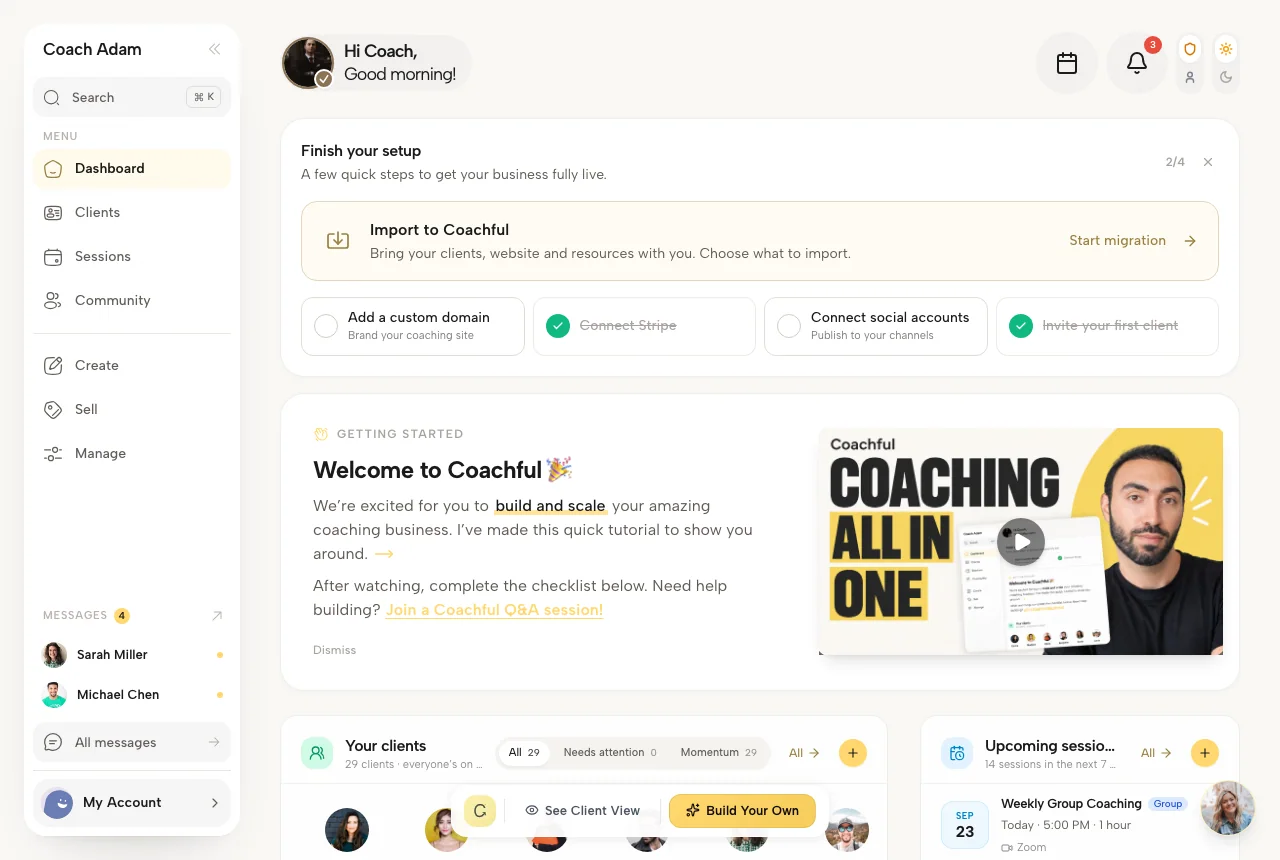
A sound refund decision needs three records side by side: what was agreed, what was delivered and what was paid. In Coachful they sit in one account. Agreements go out for e-signature before the first call. Sessions, notes, goals and weekly check-ins are kept on the client's record, and clients see their own sessions and a summary drawn from your session notes, as the first screenshot in this guide shows. Payments run through Stripe Connect or Razorpay with an invoice for each transaction, and refunds are part of that. Sessions run on built-in video that is included in the subscription, so a Coachful user has no separate video-call bill, though Zoom, Google Meet or Teams links can be created instead.
For the prevention side, Coachful's coaching flows cover a welcome flow, daily and weekly check-ins, and journeys. The demo account in the second screenshot has a journey named First 14 days and a draft win-back for quiet clients.
The limits are worth stating. Coachful does not make the decision, and we are not claiming it calculates a partial refund or closes a client's access automatically when you issue one. You still choose the amount, send the email and end access yourself. And if you coach a handful of clients with a signed PDF, a calendar and a spreadsheet of payments, you already hold all three records. One refund request is not a reason to change software.
If your records are spread across several tools and you lose an evening every time you need to piece a client's history together, the coaching contracts and coaching CRM pages show how agreements and client records work in Coachful.
Frequently asked questions about coaching refund requests
Do I have to give a refund if a coaching client asks halfway through the program?
It depends on your agreement, any guarantee you offered and the consumer law where your client lives, so there is no single answer, and this is not legal advice. When the agreement is silent, a sound default is to keep the fee for the sessions delivered and return the rest. If you did not deliver what you sold, refund in full.
How do I calculate a pro rata refund for a coaching package?
Divide the fee by the number of sessions to get a per-session amount, then refund the sessions not yet delivered. In an invented example, $2,400 for twelve sessions is $200 each, so six sessions not delivered come to $1,200. Keep a set-up amount only if your agreement names one, and count a missed session as delivered only if your cancellation terms say so.
What should I say when a coaching client asks for a refund?
Keep the first reply to a few lines. Thank them for telling you, say you want to understand what changed, offer a 20-minute call within the week and say a refund is one of the options you will discuss. Leave out any agreement, refusal, contract quotes or list of what you have delivered. Those belong on the call.
Should I offer a pause or a credit instead of a refund?
Offer one once, when it fits the cause. A pause with a restart date suits a client whose life got in the way. A credit suits someone who likes your work and needs a different format. If the client says no, take that as final and move to the refund. Pushing an alternative a second time turns a request into a negotiation.
What if my coaching agreement says no refunds?
Then the agreement is on your side, although consumer law where your client lives can still give them rights a contract cannot remove. The harder question is whether to enforce it. Returning the fee for sessions not delivered can cost you less than six resentful sessions or a card dispute. Decide case by case, and note your reasons in the client's file.
Can a client dispute the charge if I refuse a refund?
A client who paid by card can raise a dispute with their card issuer. Your signed agreement, the record of sessions delivered and your written refund decision are the evidence you would rely on, which is one more reason to keep all three. Our guide to coaching payment disputes, linked above, covers what to submit and when to pause access.
Does a refund request mean I failed as a coach?
No. It means one engagement did not go as either of you hoped, for a reason you can usually find by asking. Sometimes the reason has nothing to do with you: a lost job, an illness, a budget that changed. Sometimes it points at something to fix, such as how you describe the program before people buy. Treat it as information about one engagement.
Sources and Coachful capabilities reviewed October 4, 2026. The Reddit reply is quoted from our research record of September 29, 2026. Reddit blocked automated access on the review date, so the thread was not reopened, and the quotation stops where that record does. The $2,400 example is invented to show the arithmetic. The 24-hour reply, the 20-minute call, the five causes and the refund ladder are editorial judgment, not sourced statistics. Refund rights vary by country and state. This is general business information, not legal or financial advice.