Co-Facilitation Plan Template: 5 Decisions for Coaching Workshops

Nour
Founder, Coachful
How do you co-lead a coaching workshop without talking over each other or leaving participant support to chance? Agree one lead and one support role for every segment, rehearse the handoffs, and decide who acts when the session goes off plan. Put those decisions in a short co-facilitation plan before you invite people into the room.
“We both know the material” is not a delivery plan. Two competent coaches can still give contradictory instructions, miss the same question, or each assume the other is helping the person who cannot access the exercise. The fix is not more polished slides. It is making the invisible jobs explicit.
This guide gives coaches five decisions to make, a worked 90-minute run sheet and a copyable planning template. It applies to a paid workshop, a practice lab inside a group program or a jointly led client event. The examples are hypothetical, not Coachful customer results.
What is a co-facilitation plan?
A co-facilitation plan is the operational agreement between people who jointly lead a session. It identifies the intended participant outcome, the lead and support tasks, handoff language, communication signals, support routes and recovery arrangements. It should tell each coach what to do while the other is speaking, not merely whose name appears on the slides.
It is different from a commercial agreement. Fees, cancellation obligations, intellectual property and recording rights need their own appropriate terms. If one coach is a guest presenter, use a speaker-agreement discussion as a separate starting point. If you are building an ongoing delivery team, the associate-coach model raises different business decisions.
SessionLab's co-facilitation guide emphasizes defining lead and supporting responsibilities for individual agenda sections. The coach-facing plan below turns that principle into decisions you can rehearse, with preparation, delivery and debrief treated as connected jobs.
1. Agree the participant outcome and each coach's authority
Start with what participants will do, not what each coach wants to teach. “Understand difficult conversations” is broad. “Practice opening a workplace conversation using a fictional scenario, then identify one adaptation for their role” gives both coaches a basis for choosing activities and cutting material.
Name the format honestly. A skills workshop can include reflection and practice without promising individual coaching for everyone. If you offer individual coaching moments, define their scope, participant choice and confidentiality arrangements. Neither the presence of two coaches nor a small audience automatically makes every activity private or appropriate.
Then divide decision authority. Who can shorten an exercise? Who decides to pause? Who communicates a change to participants? You can share responsibility for quality without requiring a live negotiation over every small choice. Agree that either coach can flag an urgent safety or access concern, with an explicit way to stop and regroup.

In a hypothetical first-time-manager workshop, Alex might own the opening, practice instructions and closing resources. Sam might own demonstrations, debrief questions and the access check. They are equal collaborators, but each segment still has a named lead. That is role clarity, not a hierarchy of expertise.
Write down boundaries before sharing access to your workspace. A co-facilitator may need the agenda and participant materials without needing private client records or payment information. Check the actual permissions of each tool and account. Do not share your own login to avoid making that decision.
2. Give every agenda segment a lead and a useful support job
The support role is not “wait until it is my turn.” It is a defined task that makes the participant experience work: monitoring questions, tracking time, checking access, preparing materials or noticing confusion. Avoid assigning all of those at once if they compete for attention.
For each segment, record five inputs: elapsed time, participant activity, lead coach, support coach's task and the condition for moving on. A time allocation alone is insufficient. You also need to know whether the group has heard the instruction, received the resource or completed the intended practice.

Use elapsed minutes in the run sheet and keep the actual event date, start time and time zone in the event brief. That avoids rebuilding the whole agenda when a workshop starts at a different hour. Both coaches should confirm which version is current before delivery.
A hypothetical 90-minute run sheet

- Minutes 0 to 10, welcome and boundaries: Alex leads; Sam checks access and collects practical questions. Move on when participants know the purpose, how to participate and how to ask for help.
- Minutes 10 to 25, demonstration: Sam leads; Alex watches time and questions. Use a fictional example rather than a recognizable client story.
- Minutes 25 to 50, paired practice: Alex explains the task; Sam handles support and the alternative for anyone who does not wish to join paired work.
- Minutes 50 to 70, debrief: Sam leads; Alex captures general themes without participant names or sensitive details.
- Minutes 70 to 85, next-step practice: Alex leads; Sam monitors time and clarifies the task through the agreed route.
- Minutes 85 to 90, close: Sam leads; Alex checks that the promised resource destination is correct.
This is a planning example, not a prescription for group size, participant outcomes or the right duration for your specialty. Change the activities to suit the audience, scope and access needs. If the support coach must leave the main room to help someone, decide which monitoring task is paused or reassigned.
3. Rehearse the handoffs and the signals
Participants should not have to infer who is leading from which coach speaks more loudly. Use a brief spoken handoff that names the next person and their job. The receiving coach acknowledges the transfer, and the previous lead switches to the agreed support task.
For example: “Sam will guide the debrief. I will collect questions so we can come back to them.” Sam can respond: “Thanks, Alex. Start with what you noticed in the fictional example.” This gives the room a coherent transition without a long introduction every time.

Agree a small set of private signals: two minutes remaining, practical clarification needed, pause required and technical problem. Define what each means and what response you expect. A vague message such as “time” might mean finish immediately or begin wrapping up; decide before the session which one it means.
Test the channel during rehearsal. Can the speaking coach actually see the message while presenting? Is the signal visible to participants? What happens if the coach misses it? Choose a spoken fallback such as “Can we pause for a practical check?” rather than repeatedly sending messages nobody notices.
Separate disagreement from interruption. A different preferred question can usually wait for the debrief. An instruction that breaches the agreed scope, exposes confidential information or creates an immediate access problem may need a respectful pause. Agree language for that distinction so neither coach has to improvise a public correction.
4. Assign participant support without compromising privacy
Before delivery, ask who watches practical questions, who responds privately and who continues leading the room. If a participant cannot open a resource, two coaches troubleshooting together leaves everyone else waiting. If a participant shares something sensitive, leaving the lead alone to manage both the group and the disclosure creates a different problem.

Set a support route appropriate to the event, and tell participants what it is. Do not assume a community discussion is private, or that an event collaborator should join every existing client channel. Share the minimum information needed for the assigned task and check your confidentiality and data-handling arrangements.
Prepare a participation alternative. Someone may prefer to observe a demonstration, work individually or use a fictional scenario instead of disclosing personal material. State what they can choose and what the support coach will do. Participation should not depend on explaining a private reason in front of the group.

For emotionally difficult material, stay within your competence and the event's scope. A coaching workshop is not an emergency or clinical service. Have an appropriate escalation process for your setting and jurisdiction, and make clear which support you do and do not provide. Do not promise that one coach will privately resolve any issue that arises.
Recording needs its own decision. A shared facilitation plan does not authorize recording, transcription, screenshots or reuse of participant contributions. Decide what is captured, how participants are informed, which permissions or other requirements apply, who can access the result and who removes anything that should not be retained.
5. Practice the failure points and own the follow-up
A rehearsal should test transitions, access and recovery, not just whether both coaches can read their slides. Walk through the opening, one activity instruction, the first handoff and the close. Have each person briefly use the participant-facing resource destination rather than assuming an administrator's view proves that it works.

Then test likely disruptions. If the lead loses connection, the support coach might summarize the task and continue the current reflection while contacting the lead through a separate route. If the resource fails, use the pre-agreed spoken or text alternative. If there is no safe or workable continuation, pause and communicate the next step instead of improvising a new promise.
Choose what to cut before you run late. Protect the participant's opportunity to finish or safely close an exercise. A second example may be optional; a rushed ending to sensitive reflection is not a sensible default. Agree who makes the time decision and how the other coach will support it.
Finally, assign follow-up. Who checks the resource links, answers outstanding practical questions, sends the promised summary and handles feedback? Give each task one owner and a deadline you can meet. “We will send it” is how both coaches assume the other has already done so.

Debrief the coordination with observable evidence. “Three participants asked for the worksheet link” is actionable. “They were disengaged” is an interpretation. Discuss what each coach noticed, select one change and identify who will test it before the next delivery. Keep private participant stories out of the shared learning record.
Copyable co-facilitation plan template
Copy this into the document you will actually use during preparation. Replace every bracketed field and keep the live run sheet easy to find. This is an operational brief, not a contract or a substitute for professional advice on legal, privacy or clinical obligations.
Event and version: [Workshop name, date, start time and time zone, format, location or joining route, plan version and last agreed date].
Audience and outcome: [Who is attending]. By the end, participants will [observable practice or output]. We are not providing [excluded services or promises].
People and authority: [Coach A] owns [segments and decisions]. [Coach B] owns [segments and decisions]. Either coach can request a pause for [agreed concerns]. The final decision on [timing or changes] belongs to [person].
Run sheet: For every segment, enter [elapsed minutes], [participant activity], [lead], [support task], [materials] and [transition condition]. If time is short, remove [optional content] before [protected closing activity].
Handoffs and signals: Our spoken transfer is [phrase]. Our private signals mean [definitions]. The acknowledgement is [response]. If the signal fails, use [spoken fallback].
Support and access: [Person] monitors [route]. [Person] responds to [practical or sensitive issue]. The participation alternative is [option]. Information shared with the collaborator is limited to [scope].
Rehearsal and recovery: We rehearse on [date]. We test [links, instructions, handoff and participant access]. If the lead disconnects, [action]. If materials fail, [alternative]. If continuation is not appropriate, [pause and communication process].
Follow-up and review: [Owner] sends [promised item] by [deadline]. [Owner] answers [outstanding questions]. We debrief on [date], record [general observations] and assign [one improvement and test].
Separate arrangements: Commercial terms, permissions, recording, confidentiality, ownership and any other required agreements are documented in [appropriate reviewed documents]. This plan does not replace them.
Frequently asked questions
Should co-facilitators split the speaking time equally?
Not necessarily. Divide the work according to the participant outcome and each coach's strengths. One coach may lead more discussion while the other handles demanding support work. Agree the contribution and commercial terms separately rather than using equal microphone time as a proxy for fairness.
Can one coach be the lead for the whole workshop?
Yes. A consistent lead with a defined supporting coach can work well. State the support responsibilities, the points where the second coach contributes and the circumstances that allow them to pause or redirect. Avoid presenting someone as a co-coach while leaving them with no meaningful role.
Do we need a new plan if we have worked together before?
You can reuse the structure, but check the audience, outcome, activities, access needs and failure points for the actual event. Familiarity is not proof that both coaches remember the same arrangement. Confirm the current version, especially when materials or participant expectations have changed.
Can coaching software replace the planning conversation?
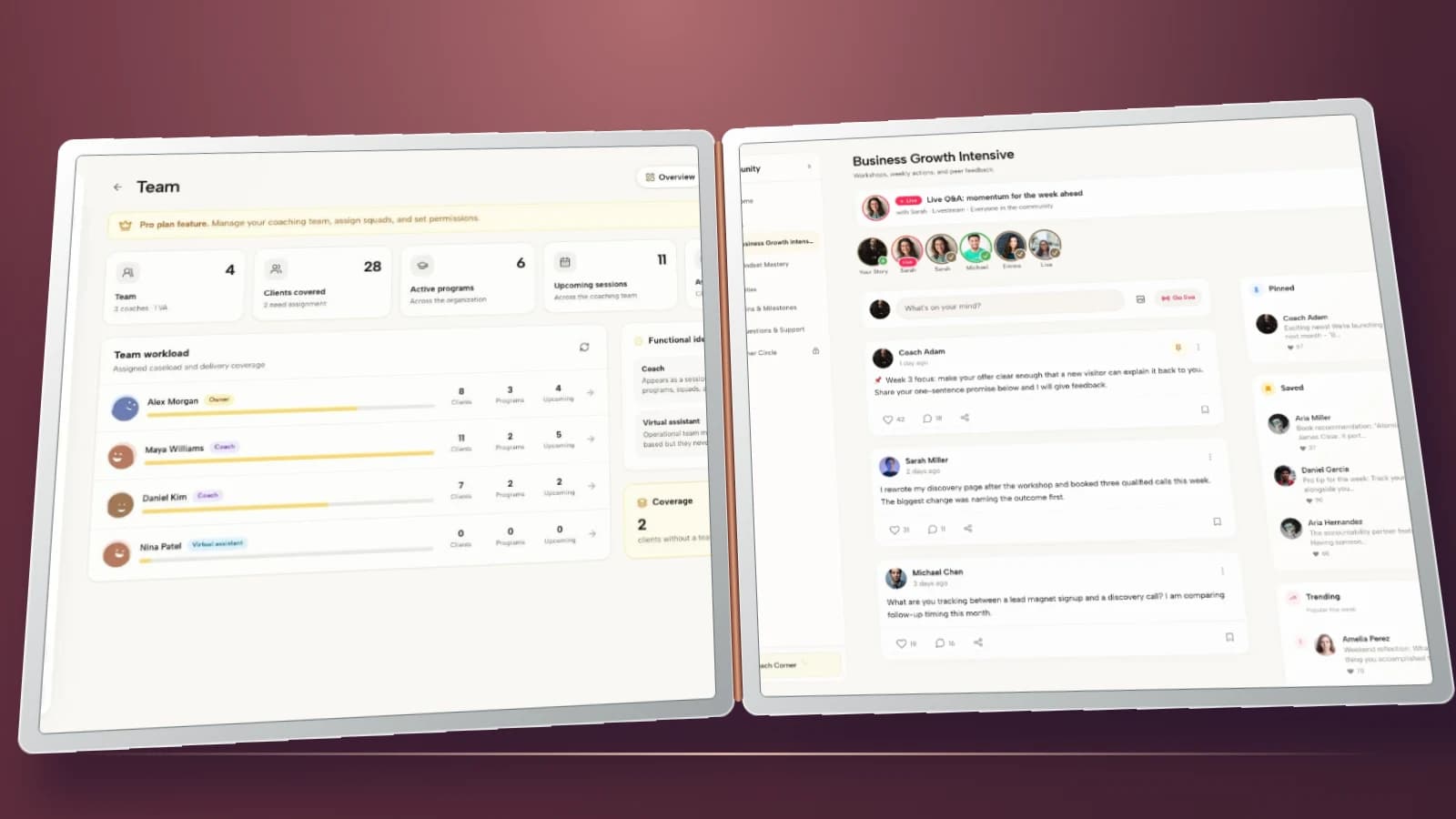
No. An event record, team roster and participant workspace can support delivery, but they cannot decide your authority, boundaries or handoff language. Make those decisions first, then test whether the software and accounts you use support the actual plan.
Your next step: rehearse one transfer
Before adding more workshop content, fill in the template and rehearse the first handoff with your co-facilitator. If you cannot say who leads next and what the other coach does, the participant experience is not ready.
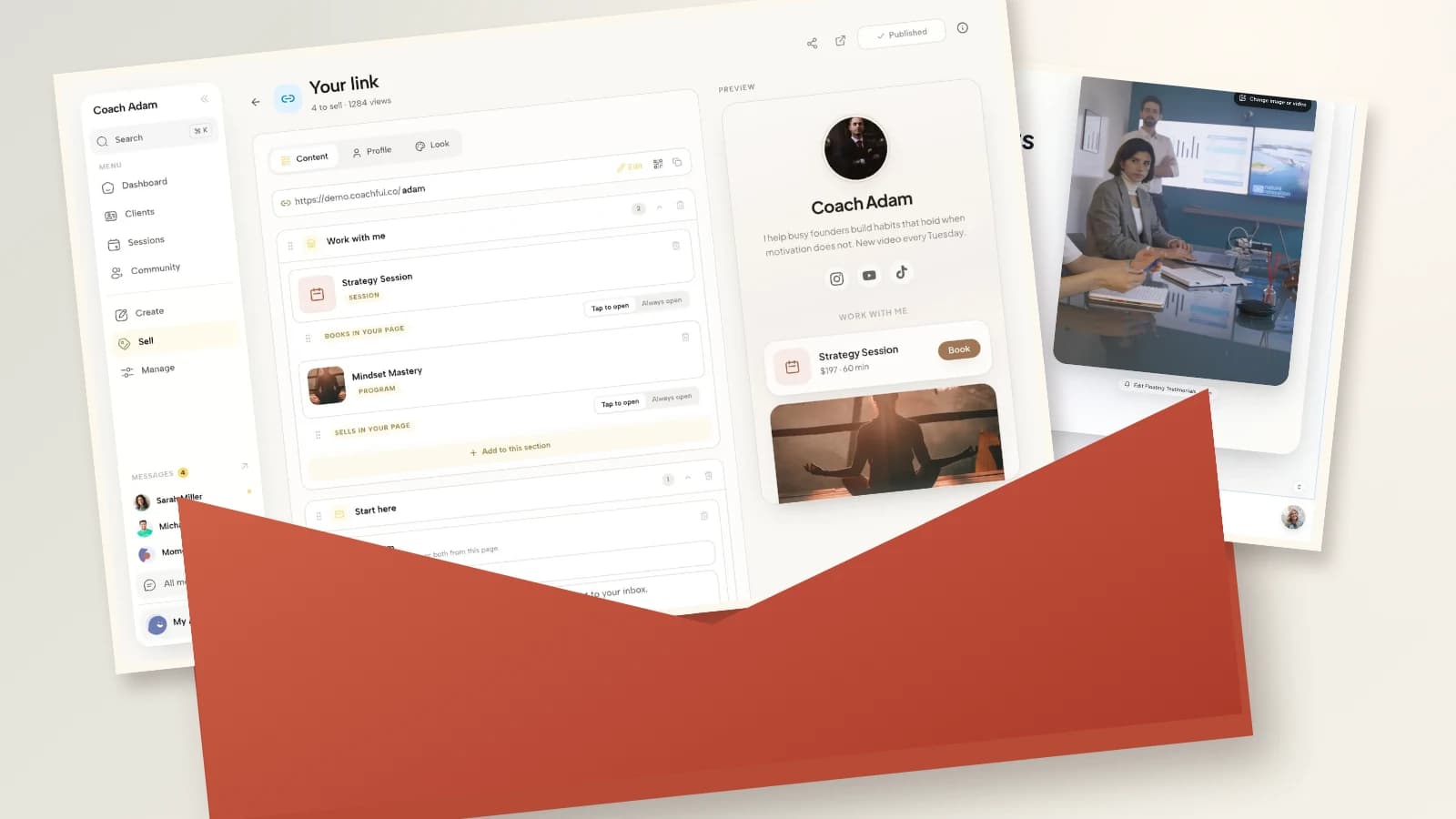
Then check the practical surfaces around that transfer: the event details, collaborator access, participant materials and question route. Try the interactive Coachful demo to inspect the team, webinar, program and community views shown here. Use your completed plan as the test brief, and verify the actual permissions and participant journey separately before using any workspace for a live event.