Coach Business Plan for Real Profit

Coachful
Most coaches are told to find a niche, post consistently, and keep filling the calendar. That advice sounds smart until you look at the numbers and realize a full schedule can still leave you exhausted, underpaid, and wondering whether you've built a business or a very demanding hobby. A serious coach business plan starts with profitability, not applause.
The coaching profession is large enough to support real businesses, but the structure of the market matters. The International Coaching Federation's 2023 Global Coaching Study estimated 109,200 active coach practitioners worldwide in 2022, a 55% increase from 2019, with about $4.564 billion in annual coaching revenue and average annual revenue of $52,800 per coach. At the same time, 53% of coaches reported annual coaching revenue below $30,000 (ICF Global Coaching Study executive summary). That's the uncomfortable truth: the market is big, but many practices still don't pay their owner well.
Why Most Coaching Practices Fail to Profit
The problem isn't a lack of demand. It's that too many coaches mistake activity for economics. They celebrate a packed calendar, a steady stream of discovery calls, and a growing following, then look up at tax time and realize they've built a practice that depends on their constant personal effort just to stay afloat.
That inner voice is usually the same one in every coach's head. Maybe I just need more clients. Maybe I should post more. Maybe the next package will fix it. The hard truth is that more bookings don't help if your margins are leaking through unpaid admin, no-show gaps, and too much one-to-one delivery.
Practical rule: If your business only works when you're in sessions all day, it isn't a scalable practice, it's a time trap.
A better starting point is to treat your coach business plan like an operating model, not a vision board. The coaching field has been moving toward structure for decades, from early management thinking in the 1950s to formal training programs, professional associations, and established delivery systems. That history matters because it shows coaching isn't just inspiration anymore. It's a service business with repeatable workflows, records, onboarding, and client journeys that can be standardized.
If you're still thinking, “But I'm good at coaching, why isn't that enough?” the answer is simple. Skill creates value, but business design determines whether that value reaches your bank account. If you want a cleaner starting point for the financial side, review this coaching business financial setup guide before you lock in pricing or packages.
Calculating Your True Coaching Capacity
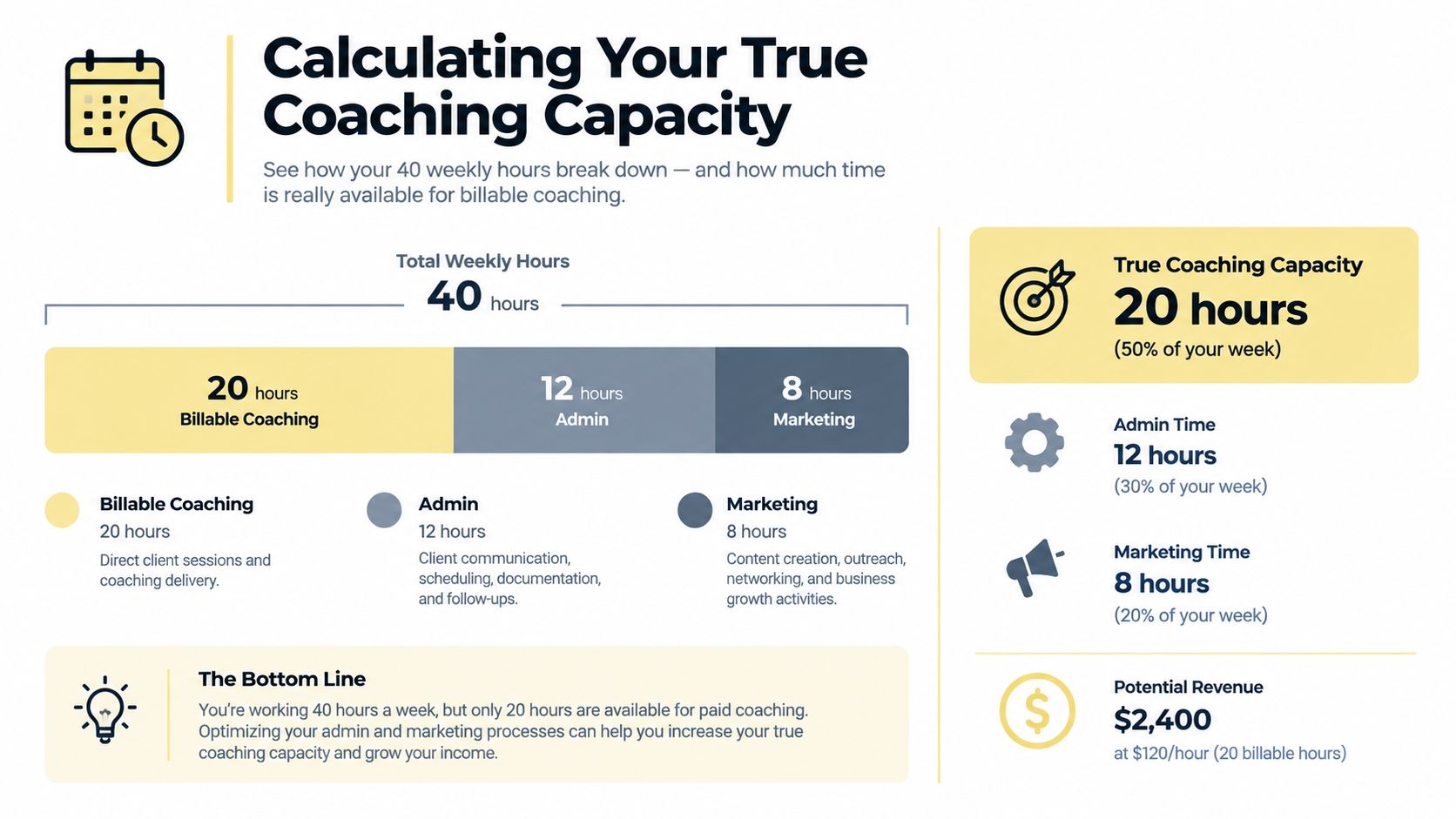
Your calendar is not your capacity. That's the mistake most coaches make. A forty-hour week does not mean forty billable hours, and if you don't account for admin, marketing, cancellations, supervision, and follow-up, you'll overpromise yourself into burnout.
Start with working time, not wishful time
The right question is not, “How many clients would I like?” It's, “How many hours can I sell without wrecking delivery quality?” Once you answer that, your pricing and package design become honest instead of optimistic.
A good coaching capacity model should separate:
- Billable sessions, the hours a client pays for.
- Admin time, the work around scheduling, notes, follow-up, and billing.
- Marketing time, the time you spend generating leads and closing deals.
- Non-negotiable professional time, including supervision, continuing education, and compliance.
If you skip those blocks, your hourly math will lie to you. A package that looks profitable on paper can turn thin once you factor in cancellations, reschedules, and the invisible hours after a session ends when you're writing notes, sending resources, and checking in.
Don't price from the outside in. Price from your real week backward.
A coach who wants a viable owner income has to think in terms of profit per working hour, not revenue per session. That means a one-hour session isn't just one hour. It's the session, the setup, the admin, the gap between calls, and the unpaid work that makes the next call possible. If your model can't survive those realities, it's not a model yet.
For a sharper view of client load and scheduling pressure, the discussion in how many clients a full coaching roster should support is worth reading before you commit to a target number.
Designing High-Leverage Service Packages
The fastest way to make coaching more profitable is to stop selling only your time in neat little slices. One-to-one work can be powerful, but it's also the least efficient format because your income rises only when your hours rise. That's a direct path to fatigue if you don't build better packaging.
Build offers that change the economics
Start by asking which format creates the best result with the least strain on your week. For some clients, a focused one-to-one engagement still makes sense. For others, a cohort, a retainer, or structured asynchronous support will deliver more consistency and require less direct time from you.
One practical comparison is the kind of pricing visibility you'd get from a market reference like what Bragly costs. Even when you're not copying another business's numbers, seeing how pricing is presented forces you to think more clearly about scope, cadence, and client expectations.
Use this logic:
- One-to-one coaching works when the problem is personal, sensitive, or high stakes.
- Group coaching works when clients need accountability, peer energy, and a shared curriculum.
- Corporate retainers work when the buyer wants continuity, reporting, and a stable service relationship.
The psychological hurdle is real. Many coaches undercharge because they think raising prices means becoming less caring. It doesn't. It means aligning price with transformation, delivery burden, and buyer value. If a client gets clarity, momentum, and behavior change over time, your price should reflect the full outcome, not just the hour on the calendar.
A clean service menu should guide the right buyer toward the right format. If you need a reference point for structuring tiers, this package-tiers guide can help you think through scope without defaulting to random bundles. And if you want a more detailed look at the pattern itself, the old coaching mantra of “just get more clients” should be replaced with “design the offer that makes more clients optional.”
Structuring Defensible Corporate Coaching Offers
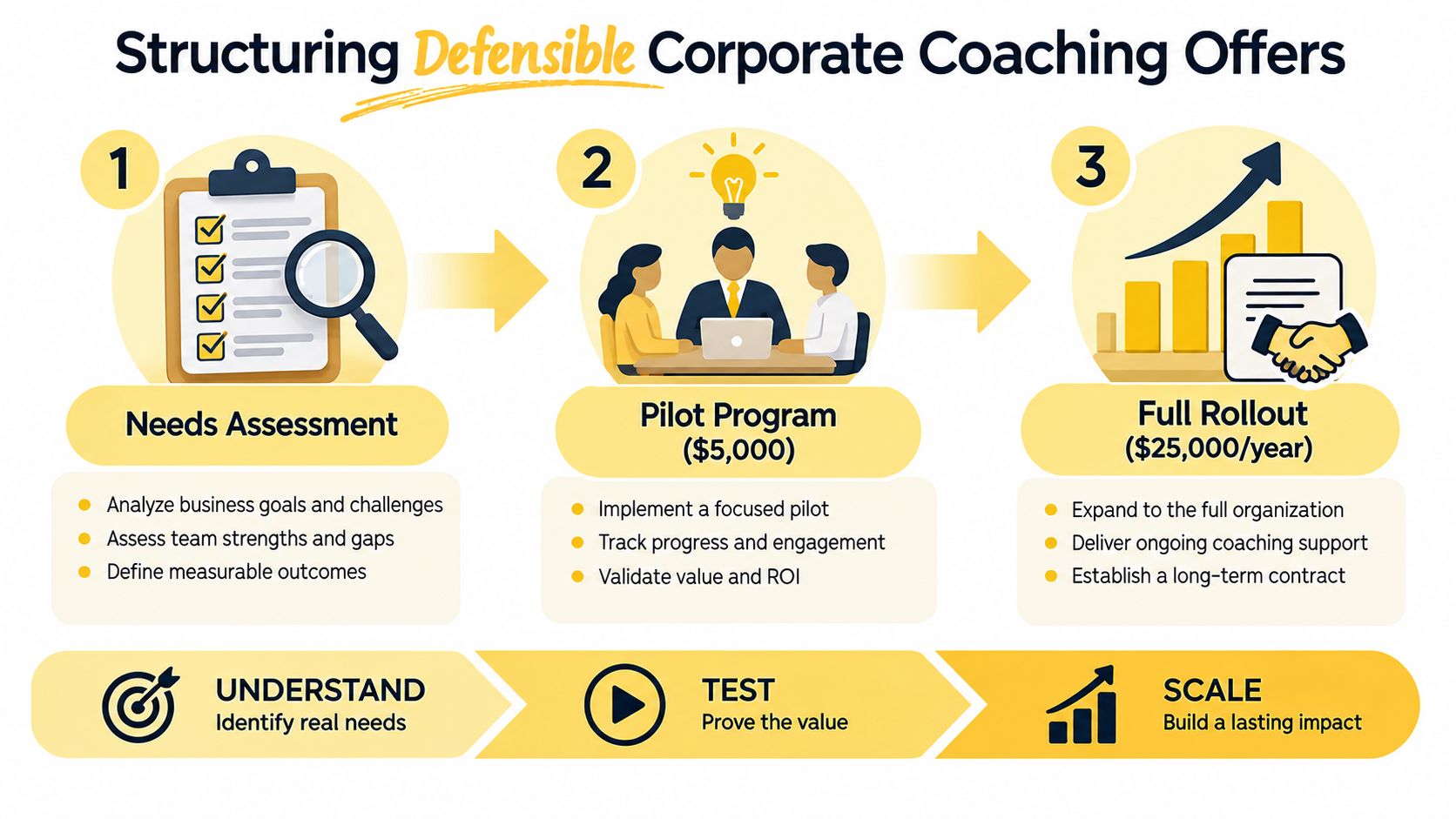
Corporate coaching fails when the coach sells sessions to a company that's really buying risk reduction, capability building, and internal credibility. The buyer is rarely one person. It's a chain of people, participant, manager, HR or L&D sponsor, procurement, and sometimes legal or data-protection stakeholders, each with a different question in mind.
Sell evidence, not vague inspiration
A defensible offer starts with a business problem. Not “leadership potential.” Not “executive growth.” A real problem, like low manager consistency, poor follow-through, or a team that needs better accountability around a specific change. From there, define the behaviors that would look different if coaching works.
Then build the measurement chain:
- Business problem the organization already feels.
- Target behaviors the participant can actually change.
- Milestones that show movement.
- Participant-reported change and manager observations.
- Operational indicators the sponsor can review without exposing confidential notes.
That last point matters. Sponsor-facing reporting should be aggregate and limited to what supports the business case. Private coaching notes stay private. If you blur those lines, you create distrust before the engagement has a chance to work.
One useful way to think about this is as a governance system, not a set of sessions. Companies don't renew because they liked a conversation. They renew because they can see a coherent program with boundaries, reporting, and enough evidence to justify another cycle. That's why a corporate coaching proposal needs more than a calendar and a rate card.
For the legal side, the guide to service agreement clauses is a practical place to review how scope, confidentiality, and renewal terms should be framed before you sell into a business environment.
A corporate buyer wants a coach who can explain what gets measured, who sees it, and why it can be trusted.
Automating Operations to Protect Your Margins
Even a smart package gets crushed if your operations are messy. Coaches lose money in the cracks between tools, when scheduling lives in one app, payments in another, notes in a third, and reminders in someone's inbox. That friction doesn't just waste time. It makes the client experience feel improvised.

Reduce the admin that nobody pays for
The fix is to centralize the work that repeats. An all-in-one platform like Coachful handles client onboarding, session scheduling, secure payments, messaging, progress tracking, goals, milestones, notes, and renewals in one workspace. That matters because every manual handoff is a chance to lose momentum, forget a follow-up, or create extra work for yourself later.
The operational goal is simple. Cut the amount of work you do that clients never directly see. That means fewer manual reminders, fewer payment chases, and fewer “just checking in” messages that should've been automated. It also means better continuity when a client pauses, renews, or moves into a new program.
For a broader comparison of tools, compare invoicing apps for freelancers if you want to see how much time basic billing can consume when it isn't tied into the rest of your workflow. That's the wrong place to lose margin in a coaching practice, because billing should support the client journey, not sit outside it.
A coach often thinks, “I don't need software, I just need more clients.” That's backwards. More clients amplify bad systems. Automation doesn't replace coaching, it protects the time and energy that make good coaching possible.
If you build templates for onboarding, reminders, renewal prompts, and progress updates, your business starts to feel more like a practice and less like a scramble. That's the difference between staying available for clients and being trapped by your own admin.
Building a Realistic First-Year Financial Model
A credible first-year model starts small, then gets specific. Suppose you launch with a narrow offer, a modest lead pipeline, and a realistic conversion process. Your job is not to prove everything works at once. Your job is to see whether the customer math, the retention math, and the cash timing can coexist without stress.
Model the business month by month
Begin with a few core assumptions: how many leads come in, how many demos or trials happen, how many prospects activate, how many become paid clients, and how many leave. Then translate that into recurring revenue, support load, and cash balance. The U.S. Small Business Administration recommends projecting income, balance sheet, cash flow, and capital expenditures for up to five years, with monthly or quarterly detail in year one, and that's the right discipline for a coaching practice too (SBA business planning guidance).
Build three versions of the same model:
- Base case, where your conversion and retention are normal.
- Downside case, where acquisition is slower and churn is higher.
- Upside case, where a segment responds better than expected.
The point isn't to guess the future. It's to stop lying to yourself about what the business needs in order to survive. A coach who only models annual revenue can miss a cash crunch long before the income statement looks alarming.
The most important discipline is reconciliation. Your customer count and your recurring revenue must match. If you have more clients on paper than in active use, you've got a forecasting problem. If support hours keep climbing faster than revenue, you've got a delivery problem. If renewals depend on your memory instead of a process, you've got an operations problem.
A strong coach business plan doesn't just say you'll grow. It shows how the business behaves when growth shows up, and whether that growth can pay the owner without draining the practice.
If you want your coaching practice to run like a real business, build it around capacity, packaging, and repeatable operations instead of hope. Coachful gives you a single place to handle onboarding, scheduling, payments, goals, notes, and renewals, so your plan doesn't fall apart in the admin pile. Visit Coachful and start turning your coaching work into a business that can hold its margins.