Coach Directory Profile Examples: 5 Before-and-After Rewrites

Nour
Founder, Coachful
Your coach directory profile is complete, but a stranger still cannot tell whether you work with someone like them. Rewrite it around three decisions: Is this for me, what will we actually do, and what happens if I contact you? A polished biography that leaves those questions unanswered is still hard to choose.
The five coach directory profile examples below show how to replace vague positioning with useful specifics. Each has a weak opening, a stronger short listing and a fuller version you can adapt. These are fictional copywriting examples, not real coaches, client testimonials or promises of results.
The aim is not to sound more impressive than the next coach. It is to make the right prospective client understand your work without translating phrases like “transformational empowerment journey.” Nobody should need a coaching qualification to understand your coaching profile.
What belongs in a coach directory profile?
Start with the directory’s actual fields and rules. You may have a headline, a short search-card description, a longer profile, specialty filters, credentials, location, languages and a contact button. Do not paste the same biography into every field.
Life-Coaches.ca’s listing guide makes a useful distinction: the short bio earns the click, while the full profile explains the approach and experience. It also warns that long short-bio text gets cut off. Those are that directory’s conventions, not universal field limits.

Use this order when the platform allows it:
- Headline: your genuine specialty and intended client.
- Short description: a recognisable situation and the work you help with.
- Full profile: approach, relevant evidence, scope, format and practical fit.
- Next step: what the visitor can request, and what happens afterwards.
Some directories limit external links or reserve them for particular plans. Some have compulsory credential fields or specific eligibility requirements. Check before drafting. A strong profile that breaks the listing rules is not ready to publish.

1. Career coach profile: replace “find your passion” with a decision
Weak opening: “I help ambitious professionals unlock their potential and discover their true purpose.”
The problem is not warmth. It is ambiguity. Someone deciding whether to change careers cannot tell whether you help with decision-making, interview preparation, job-search tactics or all three.
Stronger search-card version: “Career coaching for mid-career professionals deciding whether to change roles or change direction. We compare options and plan practical experiments before a major move.”
Full profile example:
“You have built a career that looks sensible on paper, but you are not sure you want the next version of it. I work with mid-career professionals weighing a new role, a different sector or a more substantial change.
We clarify what matters in your working life, compare realistic options and choose small tests, such as an informational conversation or a short project. You leave with decisions and actions to explore, rather than a personality label you are expected to build your life around.
Sessions are online and one-to-one. Before we agree to work together, we discuss what you want help with and whether my approach fits. Coaching does not guarantee a job offer.”
Why the rewrite works: it names the decision and describes a method. It also makes a boundary explicit. If you provide résumé writing or interview training, say whether those services are included or separate; do not let readers infer them from the word “career.”
Personalise it: replace the career stage, decision and session format with your real practice. Add only relevant experience you can substantiate. Do not borrow a seniority claim just because it makes the example sound convincing.
2. Leadership coach profile: show the work, not just the outcome
Weak opening: “An experienced leadership expert helping leaders become the best version of themselves.”
“Leadership” covers a great deal. A first-time manager preparing for a difficult conversation has a different buying question from a chief executive navigating board relationships.
Stronger search-card version: “I coach first-time managers preparing for difficult team conversations. We practise the conversation and choose one step to test at work.”

Full profile example:
“Your first management role can bring conversations you were never taught to have: giving feedback, setting expectations and addressing a missed commitment without avoiding it or becoming unnecessarily harsh.
I work with first-time managers on those practical leadership moments. We examine a current situation, separate assumptions from observations and rehearse language you can use in a real conversation.
If your employer is funding the work, we agree the coaching goals and reporting boundaries before starting. Individual session content is not something I casually pass to a manager or HR contact.”
Why the rewrite works: readers can imagine a session. The sponsor sentence addresses a real concern without inventing an absolute confidentiality promise. Your actual agreement must explain confidentiality, its limits and any agreed reporting.
Personalise it: identify the leadership level you are equipped to serve. Add accurate training, credential or work-history details in the directory’s evidence fields. A former job title may establish relevant context; it does not by itself establish coaching competence.

Keep training completion, membership and a professional credential distinct. Name the issuer and current designation accurately. Do not present a directory badge as an independent qualification unless that is genuinely what it certifies.
3. Life coach profile: narrow the situation without inventing a diagnosis
Weak opening: “I help everyone overcome limiting beliefs, heal the past and create the life of their dreams.”
This version is both broad and risky. It is unclear who it is for, and “heal the past” can imply treatment that the coach may not be qualified or authorised to provide.
Stronger search-card version: “Life coaching for adults rebuilding everyday routines after a major life change. We choose realistic priorities and turn them into actions you can review between sessions.”
Full profile example:
“A move, a relationship change or a new caring responsibility can leave your old routines looking rather irrelevant. I coach adults who want to decide what matters now and build a workable week around it.
We use conversation, practical planning and reflection on what you tried between sessions. You choose the priorities; my role is to help you examine them, notice obstacles and decide your next action.
This is coaching, not mental health treatment or crisis support. If your needs sit outside my competence, we discuss more appropriate support rather than treating another coaching package as the answer.”
Why the rewrite works: it describes a life situation without diagnosing the reader. It is specific enough to recognise, but it does not assume every difficult transition is a clinical problem.
Personalise it: choose a life transition you genuinely understand and can support. Replace broad promises with the decisions and behaviours you help clients explore. If you hold another professional licence, clarify which service you are offering and which agreement governs it.
Life-Coaches.ca explicitly advises against therapeutic and guaranteed-outcome claims. That is a useful editorial check even when another directory’s form would technically let you type them.
4. Health coach profile: make your scope visible before the inquiry
Weak opening: “I fix your hormones, cure your fatigue and make healthy living effortless.”
A prospective client may have a genuine health concern. Your listing should not persuade them to treat coaching as diagnosis or medical care.
Stronger search-card version: “Health coaching for busy adults who want more consistent everyday habits. We work on client-chosen routines and practical follow-through, within the coach’s training and scope.”
Full profile example:
“You may already have plenty of health information and still find it difficult to build routines that fit your life. I work with adults who want structured support putting their own wellbeing priorities into practice.
We explore what gets in the way, choose a manageable experiment and review what happened without treating a difficult week as a character flaw. The work is collaborative, not a promise that I will prescribe the perfect routine.
I do not diagnose conditions, prescribe treatment or replace your healthcare team. Where relevant, we discuss how coaching can support goals you have agreed with an appropriately qualified professional.”
Why the rewrite works: it explains a useful service while respecting its boundary. The precise scope of health, nutrition and exercise services depends on qualifications, jurisdiction and the work being offered. Check the rules that apply to you rather than copying a disclaimer and assuming it settles the matter.
Personalise it: name your actual training and the behaviours you are competent to support. Remove any sentence that implies a guaranteed health outcome. If the profile cannot explain the offer honestly without medical claims, the offer needs attention before the copy does.
5. Business coach profile: distinguish coaching from done-for-you delivery
Weak opening: “I scale entrepreneurs to six figures with my proven system.”
The reader cannot tell what you do, what they will need to do or whether the income claim is representative. A business owner may also assume you build the marketing assets you merely discuss.
Stronger search-card version: “Business coaching for independent service providers choosing an offer and a manageable client-development plan. We test decisions against your capacity, customer conversations and actual numbers.”
Full profile example:
“You have several ideas for growing your service business and not enough time to pursue them all. I coach independent service providers who want to choose a focused offer and a client-development plan they can actually execute.
We examine your current sales process, constraints and evidence from prospective customers. Together we decide what to test, what to measure and what you will stop doing for now.
Coaching does not include writing your website, running your ads or providing legal, tax or investment advice. If we agree separate consulting or delivery work, its scope and price are documented separately. No revenue result is guaranteed.”
Why the rewrite works: it makes responsibility visible. It tells the reader what kind of business problem belongs in the conversation and removes an easily misunderstood promise.
Personalise it: replace “independent service providers” with a client group you can credibly serve. If you combine coaching and consulting, say when you change roles. Do not quietly sell advice under a coaching-only description.
Turn the example into a profile that matches the next page
The directory is often only the first impression. If your short listing says “career decisions for mid-career professionals” and the destination says “wellness, relationships, business and spiritual transformation,” the visitor has to work out which promise is real.

Carry the same core audience, service and next step onto your website or booking page. You can provide more detail there; you should not introduce an entirely different business.

Make the invitation descriptive. “Request a 20-minute fit conversation about your career decision” tells a reader more than “Begin your journey.” If there is a fee, say so before they commit. If the next step is an inquiry rather than a confirmed appointment, do not describe it as an instant booking.
State practical fit where the directory allows: online or in person, languages, location, relevant time zones and whether you currently accept inquiries. Check that your calendar and capacity support what you publish.

A copyable coach directory profile template
Use this as a drafting structure, not a script you must force into every directory:
Headline: [Coaching specialty] for [specific client group].
Short listing: I work with [client group] facing [recognisable situation]. We [concrete description of the coaching work].
Full profile: You may be [brief description of the decision or challenge]. I help [audience] explore [scope of the work]. In our sessions, we [method or process], and you [client’s role between sessions]. My relevant background includes [accurate, supportable evidence]. We meet [format and practical details]. This service does not include [important boundary].
Next step: [Request or book] [specific action] to [purpose]. [Duration, cost and what happens after the request, where appropriate].
Write the full version first. Then edit the short listing as a separate piece of copy. Keep the audience and situation at the beginning so truncation does not remove the useful part.
How to test the rewrite without pretending one inquiry proves it worked
Ask someone unfamiliar with your practice to read the search-card version and answer three questions: Who is it for? What would the person work on? What would they do next? If their answers differ from your intentions, fix the wording before adding more adjectives.
Then preview the actual public listing on a phone. Look for truncated text, missing credentials, the wrong category and a button that points somewhere unexpected. Directory rules vary: Life Coach Hub’s listing guidance, for example, discusses several visibility factors. A copy change is not the only influence on how many people see a profile.

Keep a simple record of the date, listing version, inquiries and whether each inquiry fits your service. Where available, record profile views too. Few inquiries from very few views tell you little about the quality of the writing. Many inquiries for the wrong service suggest a positioning or category problem.
Choose a review period that matches the directory’s actual activity rather than declaring success after a quiet weekend. Avoid changing every field and your offer simultaneously if you want to learn which change mattered. No universal conversion rate or guaranteed inquiry count applies here.
Where Coachful fits
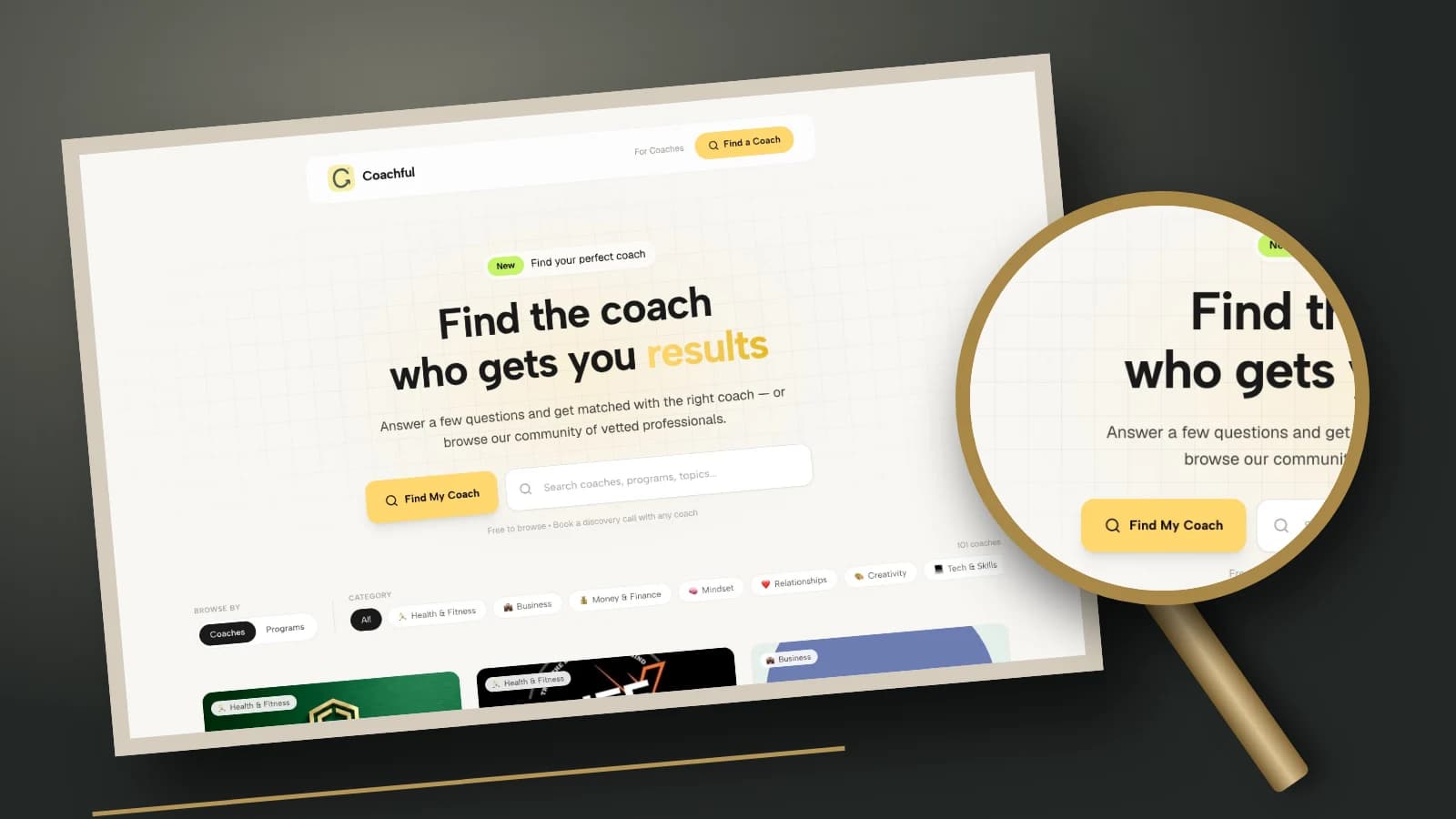
The screenshots in this article show real Coachful demo surfaces, not the editors of the external directories discussed. Coachful cannot rewrite another platform’s rules or make a listing produce demand on command.
Once your profile makes a credible promise, the practical question is whether the next page, booking experience and follow-up keep it. To inspect those parts before changing your setup, try the interactive Coachful demo. Follow the path as a prospective client and check whether the experience supports the words you plan to publish.
Frequently asked questions
How long should a coach directory bio be?
Follow the platform’s actual field limits. Use the search-card field for a short, specific introduction and the full profile for method, evidence, practical fit and boundaries. There is no single correct word count across all directories.
Should I use first person or third person?
First person is a useful default for an independent coach because it sounds like the person the client will meet. Follow the directory’s editorial rules if they require third person. Clarity and accurate claims matter more than the pronoun.
Can a new coach write a credible profile without testimonials?
Yes. Explain who you serve, how you work, your relevant completed training and what a first conversation involves. Do not invent client results or turn unrelated experience into coaching hours. An honest, concrete profile is stronger than borrowed authority.
Should I copy the same profile into every directory?
Keep the underlying facts consistent, but adapt to the directory’s fields, audience, categories and link permissions. The search-card text may need a different edit from the long description. Review every public version rather than assuming pasted text renders correctly.
Will a better directory profile bring me coaching clients?
It can make your offer easier to understand; it cannot guarantee traffic, inquiries or sales. Visibility, buyer fit, directory activity, pricing and the experience after someone contacts you all matter. Treat the rewrite as a practical improvement to test, not a substitute for a broader client-development plan.