Instagram Captions for Coaches: 5 Examples Without Client Stories

Nour
Founder, Coachful

What should you write under an Instagram post when you want coaching enquiries, but do not want to turn private client conversations into content? Start with a recognisable situation, give one useful observation and invite an action you can actually fulfil. You can demonstrate judgement without a client anecdote, an invented transformation or a dramatic promise.
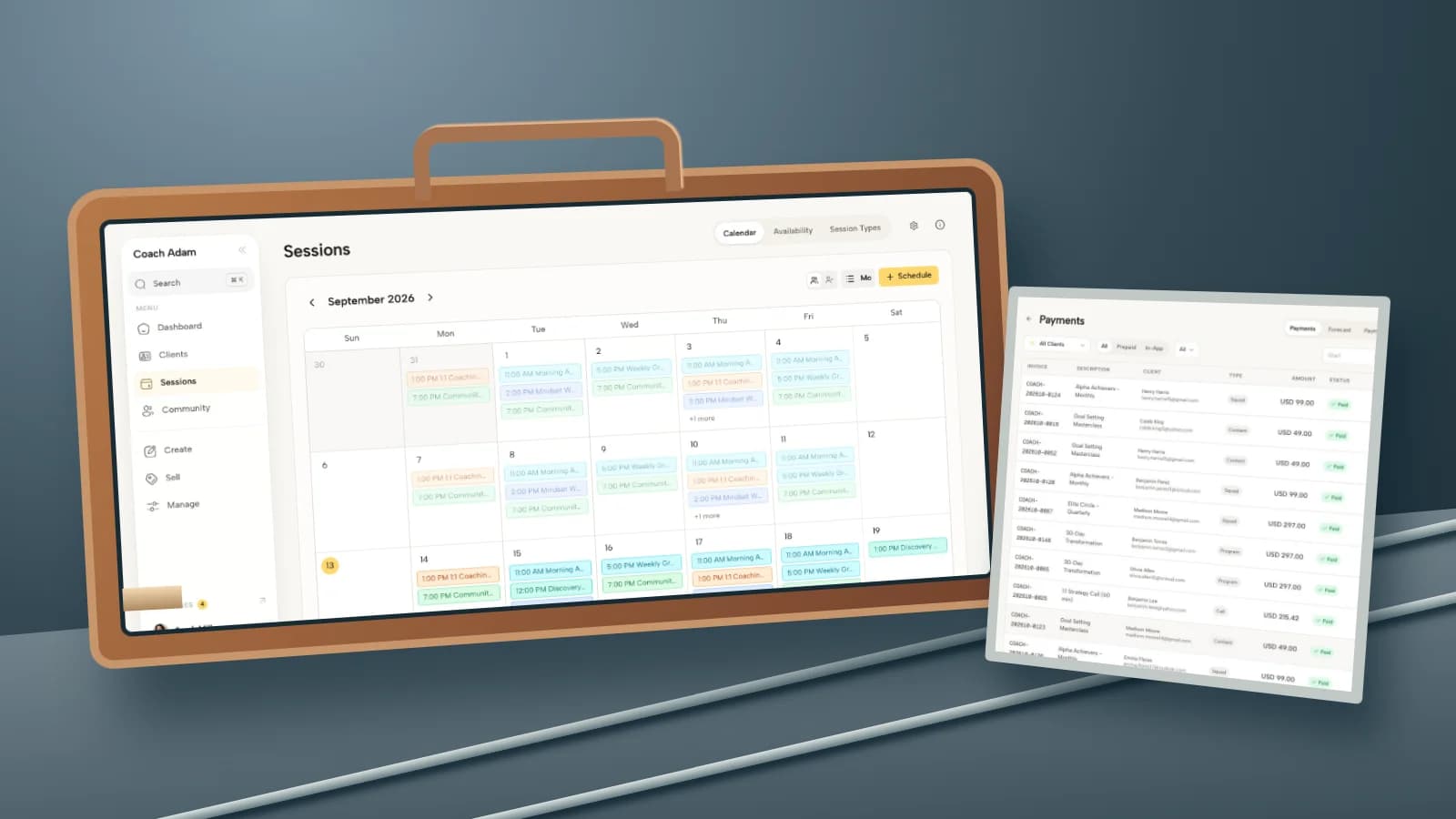
Cover: an original caption-to-destination composition using real Coachful demo link and website screens, not Instagram UI.
The five Instagram captions for coaches below are complete original examples, not quotes from clients or claims about a real practice. They cover a practical exercise, a service boundary, a process explanation, an availability announcement and a workshop invitation. Adapt the language, remove any service detail that is not true for you and check the destination before publishing.
The annoying part of caption writing is often not the first sentence. It is reaching the end and realising you have written “learn more” without deciding what the person will learn or where they will find it. Write the useful answer and the next step together. A caption is not finished until its invitation makes sense.
Choose the caption by the decision your reader faces
Do not choose between these examples by which sounds most impressive. Choose by the question you need to answer. Someone exploring a problem needs something different from a person checking whether your package is available.
- “Can I try something useful?” Use the small-exercise caption.
- “Is this the kind of help I need?” Use the service-boundary caption.
- “What would we actually do?” Use the process-explanation caption.
- “Can I work with you now?” Use the availability caption.
- “Is this event worth my time?” Use the workshop-invitation caption.
These are editorial choices, not an algorithm formula. You do not need to rotate through them on a fixed schedule. If people repeatedly ask what your coaching includes, answer that question before writing another inspirational post.

1. The small-exercise caption: give a useful starting point
Use when: you want to demonstrate a bounded piece of your thinking without diagnosing a stranger. This example suits a career coach who helps people investigate work decisions. It offers a private observation, not a public confession.
You can dislike your working week without wanting a completely different career.
Before you start searching for a new job title, write down three moments from the last week: one you wanted more of, one you wanted less of and one that left you unsure.
For each moment, name the work and the conditions around it. Was it the task itself, the deadline, the working relationship or something else?
You are collecting clues, not making a resignation decision. The same task can feel different with a clearer brief, more time or a different level of responsibility.
Keep the notes private. If this is useful, save the post for your next weekly review.
Why it earns its length: the opening names a tension without claiming to know the reader's cause. The middle gives a concrete output: three observations and a distinction to investigate. The ending asks for a proportionate action rather than treating every person who recognises a problem as ready to buy.
Before adapting: check whether the exercise stays within your competence and leaves room for other explanations. Do not replace the opening with “The real reason you hate your job.” You cannot establish that from a feed post.
If you offer a companion worksheet, create it first. Change the final invitation to name the actual resource, explain any access requirements and test delivery. Do not promise a free worksheet when the link leads only to a sales call.

2. The service-boundary caption: help the wrong person opt out
Use when: prospects confuse your coaching with a different service. A clear boundary can save an unsuitable enquiry without making the reader feel foolish. Here the distinction is career coaching versus recruitment.
I can help you prepare a job-search decision. I cannot promise to find you a job.
Career coaching and recruitment do different work.
In my coaching, we would explore what you are looking for, examine the options you want to investigate and practise how you explain your experience.
I would not act as your recruiter, submit applications on your behalf or guarantee an interview.
If you need someone to place you in a role, look for an appropriate recruitment service. If you want support making and acting on your own career decisions, the career-coaching overview in my profile explains the scope and enquiry process.
Why it works as decision support: it states both what is included and what is excluded. The alternative service is not presented as inferior. The reader can choose an appropriate route instead of booking a call to discover the mismatch later.
Before adapting: replace every description with your real scope. Some practitioners offer coaching alongside recruitment or consulting. If that is you, explain which service is being discussed, rather than claiming a boundary you do not maintain.
The linked page should use the same language. A careful caption cannot repair a website that promises guaranteed job placement. Review headlines, testimonials and booking descriptions together for contradictions.

3. The process-explanation caption: make the invisible work understandable
Use when: people understand the topic but cannot picture a session. This example is for a leadership coach discussing preparation for a work conversation. It describes possible work, not a standard result every client will achieve.
“Practise a difficult conversation” does not mean memorising a script I give you.
We might start by choosing one conversation you want to prepare for and deciding what you want the other person to understand.
Then we could examine the facts, the assumptions you are making and the request you want to make. You would try wording that sounds like you, not like a management textbook.
We would also consider the limits of rehearsal. Clearer words cannot control another person's response or fix an unsafe workplace.
If that is the kind of preparation you are looking for, read the leadership-coaching details through the link in my profile. They explain the format, boundaries and next step.
Why the wording matters: “might” and “could” are accurate when you are giving an illustration. They do not make the offer weak. They stop an example becoming an accidental promise that every engagement follows the same sequence.
Before adapting: check that you actually offer this kind of rehearsal. Do not imply legal, therapeutic or employment advice if you are not qualified and engaged to provide it. Avoid turning ordinary discomfort into a diagnosis to make the service sound more necessary.
A process explanation also needs a matching service description. If your actual offer is a defined package, show its current contents and terms. The caption should not quietly add unlimited messaging, document reviews or between-session access.

4. The availability caption: make a direct invitation without invented scarcity
Use when: you have real capacity and a defined offer. This is intentionally a fill-in template because dates, price and availability cannot responsibly be invented for your practice. Replace every bracket before posting.
I am accepting enquiries for [actual offer name], with starts available from [verified date or period].
This is for [specific audience] who want support with [bounded coaching focus].
The format is [actual session arrangement and duration]. It includes [checked inclusions], and it does not include [important exclusion].
The price is [current price, currency and applicable tax wording]. [State the actual payment arrangement if relevant.]
Read the package details using the “[exact link label]” link in my profile. That page explains suitability, scheduling and the enquiry process before you decide whether to contact me.
Why this is more useful than “big things coming”: an interested person can decide whether the topic, timing and arrangement fit. You are making a commercial invitation, so let it be one. There is no need to wrap it in a motivational lesson.
Before adapting: verify every claim about capacity. “Two places left” is appropriate only when two places really remain in the offer being promoted. An application process should not imply selection or exclusivity unless there is a genuine suitability decision.
If the date changes or the offer closes, update or retire the caption and review the linked page. A closed offer with an active “book now” invitation creates work for the prospect and for you.

5. The workshop-invitation caption: sell the learning experience honestly
Use when: you are inviting people to a real workshop with a defined output. This template separates what attendees will work on from outcomes you cannot promise. It also makes the practical details visible before registration.
Leave with a first draft of your [specific working output], not another list of things you should be doing.
In [workshop name], we will work through [bounded activity] and give you time to draft [output]. This is for [audience and relevant starting point].
We meet on [date], at [time and time zone], for [duration], [online or actual location]. The fee is [current fee and currency, or genuinely free].
[State relevant participation requirements and whether a recording or materials are included.] You can ask about access arrangements before deciding to register.
The “[exact workshop link label]” link in my profile has the agenda, terms and registration details. Please read those before booking so you can check the workshop is a useful fit.
Why the output is modest: a first draft is something the workshop can be designed to support. “Finally transform your leadership” is not an adequately defined workshop deliverable. Even a first-draft promise needs suitable activities, time and participation conditions.
Before adapting: confirm the event exists, registration works and the page states the same details. Do not advertise a recording unless you have decided how it will be produced, what it will contain and how participant privacy will be handled.
The Coachful screenshot below illustrates a real webinar-management surface with event listings. It is not proof that a particular external event is running, that a recording is included or that an Instagram post has been published.

Edit the first line without overstating the problem
The opening should help the right person recognise the subject. It does not need to accuse them, invent a secret cause or exaggerate the cost of doing nothing. Specificity is a better editing tool than intensity.
- Vague: “A reminder to believe in yourself.” More specific: “You can prepare for a meeting without scripting every sentence.”
- Overconfident: “This is why you never follow through.” More accurate: “Before you call it a discipline problem, check what the task actually requires.”
- Unsupported: “My method will double your confidence.” More useful: “Here is how we could practise making one clear request.”

Keep the qualification close to the claim. Do not put an absolute statement in the first line and hide the exception several paragraphs later. A person may only read the opening, or encounter it in a screenshot without the rest of the caption.
Check the claim before you check the polish
Read every “I,” “my clients” and “you will” sentence separately. Is it a fact you can substantiate, a hypothetical example clearly labelled as such or an offer term you can honour? If it is none of those, rewrite it.
You do not need a client story to sound credible. Explain a decision, show a sample question, describe an actual process or state a boundary. If you do use client material, appropriate permission, accuracy and confidentiality still matter. Removing a name alone may not prevent identification.

Do not invent a testimonial because the template has a space for one. Do not imply that one person's experience predicts another person's result. The examples in this article deliberately work without borrowed evidence.
Make the caption and destination agree
Before you post, follow the invitation on your phone as a prospective client would. Read the caption, open the profile, find the named link and complete the intended action in an appropriate test environment. Check that the resource, offer or event matches the words you used.
- If you offer a worksheet, the person should find the actual worksheet or a clearly explained access process.
- If you explain a service, the destination should confirm audience, scope, terms and enquiry steps.
- If you announce availability, the page should show a current route to enquire rather than an expired offer.
- If you invite workshop registration, the date, time zone, fee and participation information should agree.
Do not ask people to leave sensitive personal details in public comments. If you invite messages, decide who will respond and what information is appropriate to discuss there. A request for a resource is not blanket permission for unrelated marketing.
The real Coachful screens above show possible business-side destinations: a form, a website, packages, a link page and webinars. They do not demonstrate Instagram publishing or automatic message handling. If that destination is the missing piece in your practice, try the interactive Coachful demo and inspect the relevant surface before building the caption around it.
Frequently asked questions
How long should an Instagram caption be for a coach?
Use enough space to deliver the promised point and a proportionate invitation. An availability update may be brief; a process explanation may need more detail. These examples are working drafts, not a claim that a particular length produces better reach or more clients.
Should every caption ask people to book a discovery call?
No. A useful exercise can invite private practice or saving. A service explanation can point to checked details. Ask for a call when it is a sensible next step for the actual offer, not because every post needs the same ending.
Can I copy these captions exactly?
Use the original wording as a starting point, but verify that every service description is true for you. Fill all brackets, change any language outside your competence and check the linked destination. Do not publish the fictional examples as accounts of work you have done.
What should I measure after posting?
Record the question answered, the invitation and any observable response relevant to that job. Saves, enquiries and registrations are different signals. A single caption is not enough to establish that a format causes sales, and a quiet post is not proof that nobody found it useful.
For a wider Instagram strategy, see our guide to Instagram for a coaching practice. If you need a visual teaching sequence rather than words below a post, use the slide-by-slide carousel briefs. Start here with one truthful caption, one useful point and one next step that is ready to receive the reader.