Blogger on Instagram: A Coach's Guide to Attracting Clients

Coachful
You've posted a few times. A quote graphic here, a talking-head Reel there, maybe a client win you almost didn't share because it felt too self-promotional. The result is frustratingly familiar. A few likes, the occasional heart from peers, and almost no serious client conversations.
That's where most coaches get stuck with Instagram. Not because they aren't good at coaching, but because they're treating the platform like a scrapbook instead of a sales environment. If you want to become a blogger on Instagram as a coach, your content has to do a job. It has to build trust, show method, filter out poor-fit leads, and make the next step obvious.
That matters because Instagram still gives coaches access to a huge audience. The platform has over 2.35 billion monthly active users globally, and 50% of U.S. adults now use Instagram, according to these Instagram usage statistics. For coaches who serve younger and working-age buyers, it's not a side channel anymore. It's often the first place prospects decide whether you're credible.
If you're thinking, “I'm not a writer,” good. You don't need to become one. You need a repeatable way to turn what you already say in sessions, sales calls, voice notes, and workshops into content that attracts high-ticket clients.
Your Instagram Profile Is Your New Homepage
A prospect reads one strong Reel, taps your profile, scans for five seconds, and asks a quiet question. Can this coach help me with my specific problem, or not?
That decision happens before the DM, before the call, and long before a contract. Coaches who treat Instagram like a real client acquisition channel build profiles that answer the basics fast. Who you help. What result you help them get. What to do next.
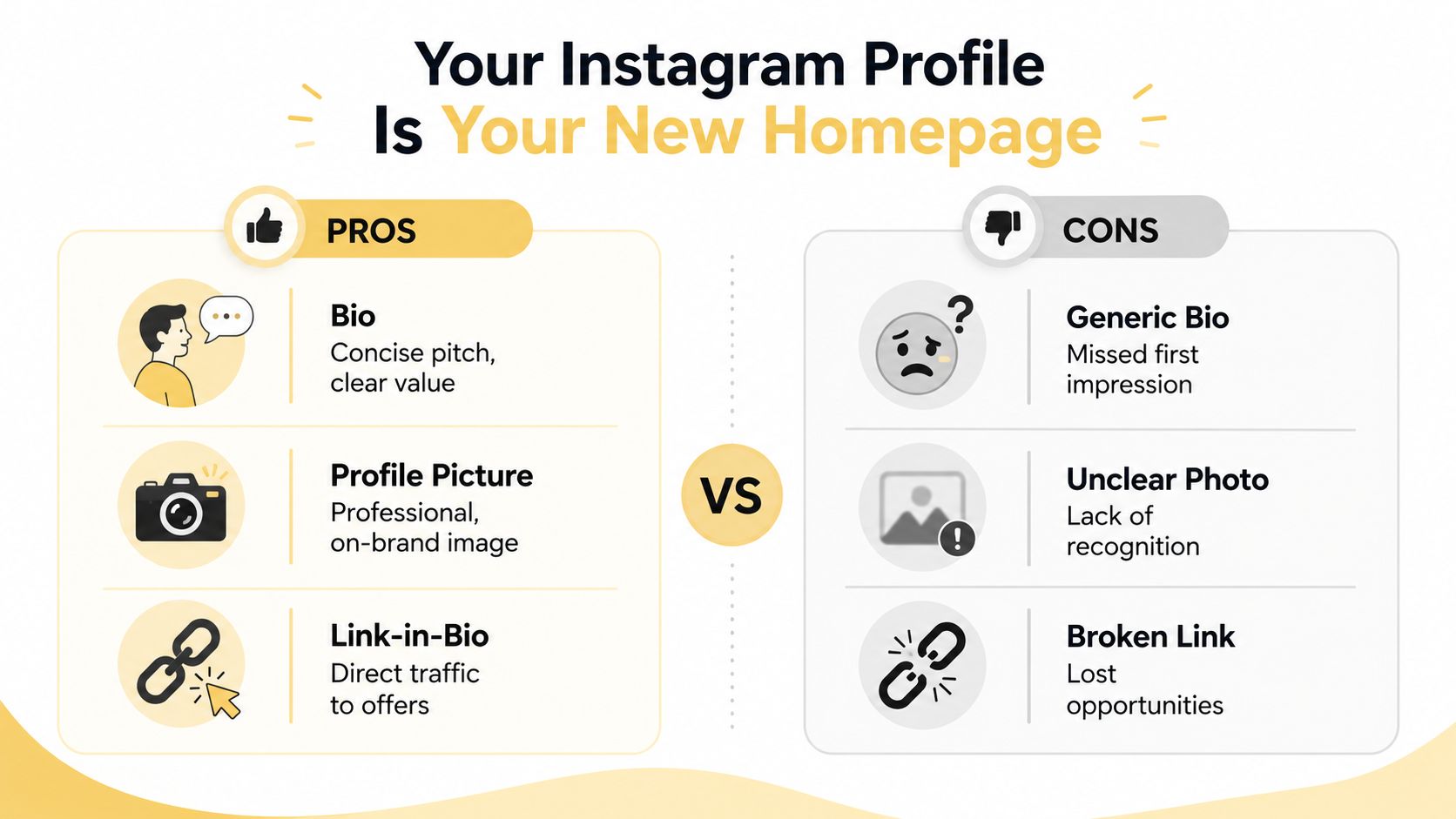
Fix the four profile elements that actually matter
Many coaches spend hours writing posts and almost none tightening the profile those posts send people to. Start here first.
| Element | Weak version | Strong version |
|---|---|---|
| Name field | “Sarah | Coach” | “Sarah | Executive Leadership Coach” |
| Photo | Cropped vacation shot | Clear, professional, on-brand headshot |
| Bio | “Helping you live your best life” | “I help senior leaders communicate with confidence and lead without burnout” |
| Link | Website homepage | One clear next step, such as book a consult or apply |
The name field affects both clarity and search. If your ideal client is looking for a leadership coach, sales coach, or career coach, your profile should say that in plain language.
The photo should look current, calm, and credible. You do not need a luxury brand shoot. You need a clean headshot that would not feel out of place on a sales page for a premium service.
The bio should describe a real problem and a real buyer. “Helping women thrive” sounds nice, but it does not help a serious prospect self-identify. “I help consultants package expertise into a premium offer” gives them something concrete to say yes to.
One quick test works well. If a stranger lands on your profile with no context, they should understand who you help, what you help them do, and the next step within a few seconds.
Stop sending people into a maze
For coaches, the link in bio often decides whether Instagram turns attention into leads. Sending people to a generic homepage usually drops momentum. Sending them to a focused next step gets more booked calls.
Keep the path simple:
- Primary action: Book a discovery call
- Secondary action: Join your email list or download a lead magnet
- Optional trust builder: Client results, testimonials, or a short start-here page
If you want help structuring that page, own.page's guide for creators gives a useful overview. For a practical example built around coaching offers, study this coach link in bio tool.
This matters even more for high-ticket coaching. A buyer who is considering a serious investment does not want to hunt through ten buttons, three old freebies, and a podcast link from 2022. They want a clear next step and enough proof to feel safe taking it.
Write a profile that pre-qualifies
A strong profile gets better leads because it filters. That is the goal.
Before
- Life Coach
- Helping you step into your power
- Website link
After
- Confidence Coach for women returning to work
- I help you stop second-guessing, speak up in meetings, and rebuild career momentum
- Book a clarity call
The second version will attract fewer random followers. Good. Coaches do not get paid by profile visits or vague interest. They get paid when the right person lands on the profile and thinks, “This is for me.” If you have ever thought, “I'm not a writer,” keep this in mind. Your bio is not a poem. It is a short sales message. Clear beats clever every time.
Developing Your Core Content Pillars
The thought that kills consistency is simple. “What am I even supposed to post today?”
Without content pillars, every post starts from zero. That's exhausting. With pillars, you stop improvising and start publishing from a system.
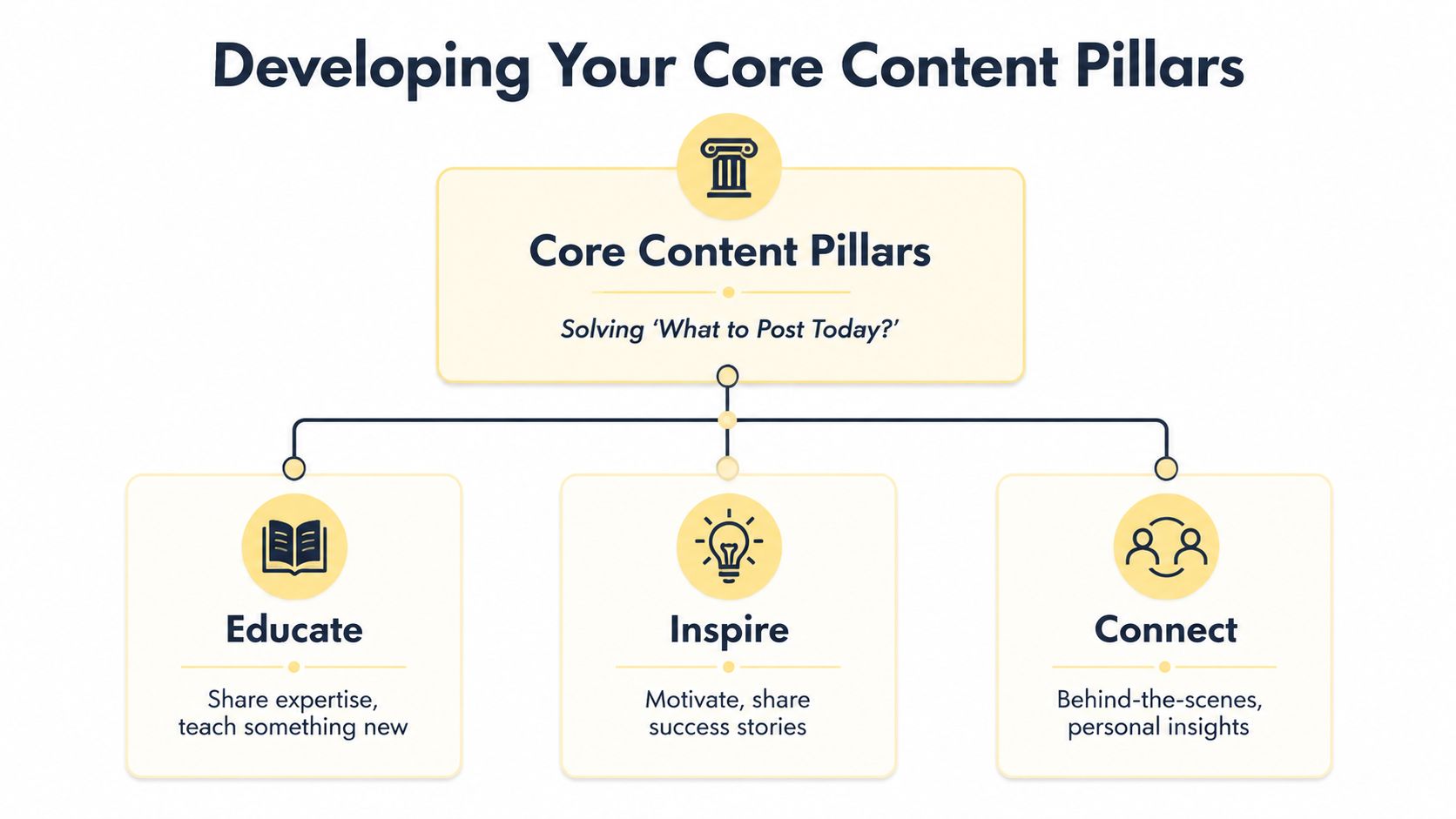
Choose pillars that match your paid work
Your pillars should come from the problems you solve in paid coaching, not from whatever content trend is floating around your feed.
A strong setup usually includes three to five recurring themes. For coaches, these often break down into:
- Problem awareness: Help prospects name what's going wrong
- Method: Show your framework, process, or philosophy
- Decision support: Address objections, timing, readiness, and fit
- Credibility: Share stories, lessons, and examples from real coaching work
- Connection: Let people understand your values and style
If you need inspiration on how to structure these, learn about Instagram content pillars for examples of how categories can keep content focused without making it repetitive.
Three coaching examples that work
A business coach might use:
Scaling systems
Posts on delivery bottlenecks, client capacity, and offer design.Leadership mindset
Content around decision fatigue, visibility fear, and hiring hesitation.Delegation mastery
Clear teaching on what to hand off, when, and how to stop micromanaging.
A wellness coach might build around:
- Mindful nutrition, such as simple meal decision strategies
- Stress resilience, including recovery routines and nervous system education
- Movement for energy, focused on consistency over perfection
A life coach could use:
- Building confidence
- Finding purpose
- Overcoming limiting beliefs
Each pillar should give you multiple post angles. “Building confidence” alone can become a myth-busting Reel, a carousel on self-trust, a Story Q&A, or a micro-blog caption about fear before hard conversations.
If your pillar can't produce at least ten useful post ideas, it's too vague.
Match pillar to format, not just topic
A lot of coaches miss the commercial side of content. Instagram isn't only an expression platform. It's also a buying environment. Carousels earn nine times more saves than other post types, and 80% of Instagram users use the platform to decide whether to buy a product or service, according to these Instagram statistics on content and buying behavior.
That means a pillar like “decision support” shouldn't live only in fleeting Stories. It belongs in saved content too. Think carousels like:
- “5 signs you don't need more motivation, you need a better weekly plan”
- “Why your team isn't ignoring you. Your communication is too abstract”
- “You're not bad at habits. Your environment keeps winning”
Those posts stick around. People revisit them. They share them with a colleague or friend. And when someone has been saving your content for weeks, the sales call is warmer before it starts.
Mastering Instagram's Key Content Formats
Coaches often assume they need to become entertainers to grow. They don't. They need to use each format for the right job.
That's the shift. Stop asking, “What do I feel like posting?” Start asking, “What outcome do I want from this post?”

Use carousels as mini coaching sessions
Carousels are where coaches can shine without performing. You already teach frameworks, sequences, mistakes, and patterns. A carousel packages that teaching into swipeable steps.
A few examples:
- Procrastination coach: “The 3 thought loops keeping you stuck”
- Executive coach: “What to say when your team keeps missing deadlines”
- Health coach: “Why your routine collapses by Thursday”
The best carousel posts feel like a useful excerpt from a paid session. They don't try to say everything. They solve one narrow problem cleanly.
Use Reels for reach without becoming a caricature
Instagram is heavily driven by short-form video. Reels account for 46% of total time spent on Instagram and are shared over 4.5 billion times daily, according to these Instagram format stats. For a coach, that makes Reels your discovery tool.
That doesn't mean dancing, lip-syncing, or trying to look younger than your market. It means giving people a fast hit of relevance. Strong Reel angles for coaches include:
- expectation versus reality
- one client misconception
- one unpopular truth
- one fast reframe
- one coaching mistake you see constantly
A business coach might say, “You don't have a lead problem. Your offer page assumes people already trust you.”
A life coach might open with, “Confidence isn't built by thinking about confidence.”
These don't need fancy editing. A direct-to-camera clip, a talking-over-B-roll clip, or text over simple footage can all work.
Stories build intimacy and momentum
Stories are where followers become prospects. Through them, you show the human texture behind your expertise. Not every Story needs a lesson. Some should create conversation.
Use Stories for things like:
- a poll about the problem your offer solves
- a quick behind-the-scenes view of your client process
- a DM prompt tied to a free resource
- a short answer to a common objection
Posts with location tags also achieve a 79% higher engagement rate, as noted in the Hootsuite data above. That's especially useful if you host local workshops, speak at events, run in-person intensives, or want to be associated with a city or business hub.
A simple example: an executive coach attending a leadership event in Austin can post a Story or Reel with the location tag, share one insight from the room, and invite local founders to DM for a private session.
A practical walkthrough helps here:
The easiest way to choose the right format
Use this decision filter.
| If your goal is... | Use this format |
|---|---|
| Teach a framework clearly | Carousel |
| Reach new people | Reel |
| Warm up existing followers | Stories |
| Handle objections softly | Carousel or Stories |
| Start DM conversations | Stories |
That structure lowers content stress immediately. You don't need more ideas. You need better placement.
Writing Captions That Connect and Convert
Many coaches often freeze. They can coach live for an hour, ask sharp questions, and shift someone's thinking in minutes. Then they sit down to write a caption and suddenly feel clumsy.
If that's you, the problem usually isn't talent. It's that you're trying to sound like “a content person” instead of sounding like a coach.

Write the way your clients think
The strongest captions usually start with a thought your buyer already has in their head.
For example:
- “I know what to do. I'm just not doing it.”
- “I'm good at my work, but I still undersell myself.”
- “I don't want more productivity advice. I want to stop feeling behind.”
That opening works because it creates recognition. The reader feels understood before you teach anything.
Then build the caption with a simple flow:
- Hook the problem
- Agitate the cost
- Reframe what's happening
- Give one useful shift
- Invite the next step
If you want a clean copywriting model for that middle section, this breakdown of the agitate and solve framework is a helpful reference.
Compare weak captions against stronger ones
Weak version
“Consistency is key. Keep showing up and believe in yourself.”
That sounds pleasant, but it doesn't create trust. It's too generic.
Stronger version
“You're not inconsistent because you lack discipline. You're inconsistent because your routine depends on motivation you don't have at 7 p.m. after a full day of client work. Build a routine that works when you're tired, not one that only works when you feel inspired.”
That sounds like coaching. It identifies the false assumption and replaces it with something useful.
Your caption doesn't need to impress people. It needs to make the right person say, “That's exactly me.”
Use longer captions when the idea deserves it
You don't have to cram every idea into two lines. For coaches, longer micro-blog captions often work well because they let you explain nuance, tell a story, or walk through a pattern your audience keeps repeating.
A simple structure for longer captions:
- line 1 with the emotional hook
- short paragraph with context
- short paragraph with the mistake or misconception
- short paragraph with the coaching reframe
- one CTA
Keep plenty of white space. Dense blocks get skipped.
If writing still feels slow, using an AI caption generator can help you draft faster. Just don't publish raw output. Use it to organize your thinking, then rewrite in your own voice.
Pick CTAs that start conversations
“Link in bio” is often too cold. Softer CTAs usually work better for coaches because they create interaction before the sale.
Try these instead:
- Comment “plan” if you want my weekly reset framework
- DM me “confidence” and I'll send the prompt I give private clients
- Tell me which part hits hardest
- What's harder for you right now, boundaries or follow-through?
These CTAs do double duty. They lift engagement and reveal buying signals. A coach can learn a lot from the exact word a follower sends in a DM.
Turning Your Audience Into Paying Clients
A coach can post strong content for months and still hear crickets when it is time to sell. The usual problem is not visibility. It is the gap between interest and action.
High-ticket clients rarely buy because a post got a lot of likes. They buy because your content shows clear expertise, your DMs confirm fit, and your booking path makes the next step easy. That is the standard to build for.
Sell through diagnosis
Coaches convert better when their content names the underlying problem, not just the surface frustration. Good prospects are often thinking, “I know something is off, but I can't quite explain it.” Your job is to explain it better than they can.
Use a simple progression in your posts and DMs:
Name the visible struggle
Use the words your client already uses.Expose the pattern underneath it
Show why the obvious fix has not worked.Describe the result they want
Make the outcome concrete and specific.Offer a low-friction next step
Invite a reply, a DM keyword, or a consult request.
For a leadership coach, that can sound like this:
- “Your team is not confused because you lack authority.”
- “They are confused because your message gets less direct when pressure rises.”
- “That leads to hesitation, rework, and avoidable tension.”
- “If you want the framework I use to fix this with clients, DM me ‘lead'.”
That approach works because it feels like coaching. It also filters out people who want free motivation and pulls in people who are ready for real support.
Use DMs to qualify, not chase
Comments and DMs are where Instagram starts acting like a sales channel instead of a content platform. A short exchange can tell you more than a week of passive engagement.
Do not rush to pitch. Ask one useful question first.
A practical flow looks like this:
- A prospect replies to a Story about burnout or inconsistency
- You ask what they have already tried
- They answer with something specific
- You give one pointed insight or small resource
- If the problem, budget, and urgency sound real, you invite them to book
That last part matters. Coaches waste a lot of time in long DM conversations with people who like advice but are not buyers. A few thoughtful questions protect your time and keep your sales process clean.
Make the booking path easy
Interest drops fast when the next step feels unclear. Coaches lose good prospects by sending them to a generic homepage, offering too many call options, or asking for too much information up front.
As noted earlier in the article, complicated onboarding pushes people away. On Instagram, that means one clear path usually beats a clever funnel.
Keep it simple:
- CTA: DM a keyword or tap one booking link
- Booking page: one offer or one call type
- Intake form: only the questions needed to assess fit
- Confirmation page or email: tell them exactly what happens next
If someone is not ready to book yet, do not let the relationship die inside the app. Build an owned audience at the same time. This guide on growing a coach email list is a smart next layer, because many serious buyers need more than one interaction before they commit.
The sale often happens after a prospect feels understood twice. Once in your content, and once in conversation.
A coach example
Say you are a health coach working with busy professionals.
Your Reel says, “You do not need a better meal plan. You need a weekday routine that still works after meetings, school pickup, and low energy.” The caption explains why discipline is not the actual issue. The CTA invites people to DM “routine” for your checklist.
Now the lead is warm. In the DM, you ask when they usually go off track. They say dinner and late-night snacking. You give one useful adjustment, then ask if they want to see how you would structure a plan around their actual schedule.
That is how Instagram blogging turns into signed contracts. Not through pressure. Through relevance, clarity, and a booking process that respects both your time and theirs.
Measure What Matters and Ignore the Rest
Follower count is seductive because it's public. It's easy to compare, easy to obsess over, and often disconnected from revenue.
A coach needs a tighter scoreboard. You're not trying to become broadly famous. You're trying to become highly trusted by the right people.
Track signals of buying intent
At the end of each month, review content through a practical lens.
Look for:
- Saves, because they show the content was useful enough to keep
- Shares, because someone thought it was worth passing on
- Qualified DMs, because that's where buying conversations start
- Booked calls, because that's the business outcome
Then ask narrower questions. Which pillar generated the most serious replies? Which Reel topic brought in profile visits from the right people? Which carousel got saved by prospects rather than peers?
Put more effort into fewer, stronger posts
A rushed content habit often creates activity without traction. Depth performs differently. Bloggers who spend 6+ hours on a typical article report “strong results” at a rate of one-third, whereas only 25% of all bloggers report strong results overall, according to these blogging effort and results statistics.
That doesn't mean every Instagram post needs six hours. It does mean thoughtful content usually beats filler. One sharp carousel that addresses a real buying objection can outperform a week of vague inspiration.
Ignore vanity loops
If a post gets strong saves, quality replies, and a few serious DMs, it worked. Even if it didn't explode publicly.
That's the part many coaches need to hear. The content that signs clients often looks quieter than the content that wins applause from other creators.
Review monthly. Cut weak themes. Keep the formats that start conversations. Build from evidence, not mood.
If you want a simpler way to run the business side behind your Instagram growth, Coachful gives coaches one place to manage onboarding, bookings, client communication, payments, notes, and program delivery without stitching together a pile of separate tools.