
Optimize Your Session Schedule: Boost Results & Energy

Coachful

Your calendar probably looks fine from the outside. Colored blocks. A booking link. A handful of clients locked in for the week.
But behind that clean grid, a lot of coaches are running on friction. You're answering “Does Thursday work?” in three places, squeezing in clients wherever there's space, letting one reschedule turn into five messages, then ending the day wondering why you're drained before you've even opened your notes.
That isn't a minor admin problem. It's a delivery problem.
A smart session schedule shapes how clients show up, how well you think, how consistently you enforce boundaries, and whether your practice feels spacious or constantly one step behind. If you've ever worried that structure will make you seem rigid, or that flexibility is costing you money and energy, you're asking the right question. The goal isn't to build a colder practice. It's to build a steadier one.
Beyond the Calendar The Strategic Heart of Your Practice
Scheduling chaos usually starts small. A client needs to move one call. Another wants evenings only. A prospect sends a DM instead of using your form. You try to stay accommodating, because you're a coach, not a robot. Then your week turns into a patchwork of favors.
That patchwork has a real cost. Before automating, managers often spend 6 to 11 hours per week on manual coordination, and automated systems can save users up to 15 hours weekly, according to Fortune Business Insights' appointment scheduling market analysis. For a coach, that isn't just lost admin time. That's lost prep time, lost recovery time, and often lost selling time.
What your schedule is really doing
A strong session schedule handles four jobs at once:
- Protects revenue: Fewer loose arrangements means fewer missed details, fewer forgotten calls, and fewer awkward exceptions.
- Protects attention: You don't waste mental energy renegotiating your week every day.
- Protects client momentum: Clients know when coaching happens and how to prepare for it.
- Protects your life: Your business stops leaking into every open pocket of time.
Practical rule: If booking a session requires back-and-forth messages, your schedule is doing too much manual labor.
Many coaches treat scheduling as housekeeping. It isn't. It's operating infrastructure. The same way your intake process affects trust, your session schedule affects the quality of every conversation that follows.
Freedom comes from design, not from endless flexibility
The fear underneath this is understandable. You don't want clients to think you're difficult. You don't want to lose someone because your availability is limited. You don't want to sound like you're “too business-like.”
In practice, clients usually trust clear structure more than vague availability. “I coach on Tuesdays, Wednesdays, and Thursdays between these hours” feels stable. “Message me and we'll figure something out” feels personal in the moment, but messy over time.
A useful way to think about it is this:
| Approach | What it feels like at first | What it creates over time |
|---|---|---|
| Open-ended flexibility | Generous | Decision fatigue |
| Fixed coaching windows | Restrictive | Reliability |
| Manual booking by message | Personal | Hidden admin load |
| Automated availability | Less intimate | More consistency |
If you're building a practice that can grow without swallowing your week, systems matter. That's the same logic behind scaling with systems for coaches. The point isn't to remove the human element. It's to remove avoidable friction so the human element gets your best energy.
Designing Your Ideal Coaching Week
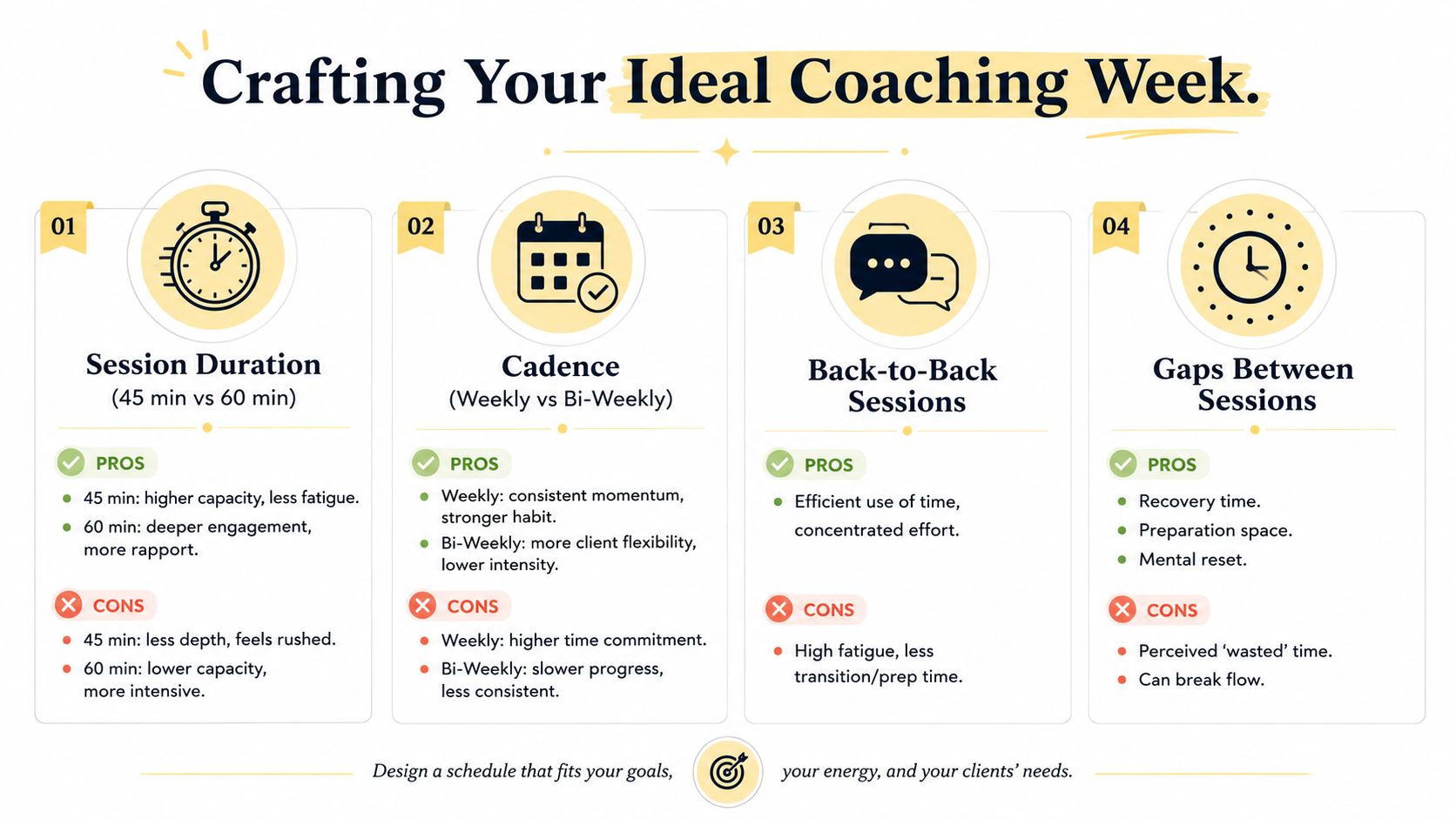
A schedule that looks efficient on paper can still wreck your brain by Wednesday afternoon. Many coaches find themselves stuck at this point. You ask practical questions like, “Should I offer 45 or 60 minutes?” but the underlying question is, “How do I keep delivering sharp coaching without burning out?”
Duration is a delivery choice
A coaching session has a built-in arc. The standard structure is Check-In and Review (5 to 10 minutes), Goal Setting for the Session (5 minutes), Main Content (30 to 35 minutes), and Commitment to Action (5 to 10 minutes), as outlined by Coaching Loft's guide to effective coaching schedules.
That structure makes one thing obvious. A “full hour” isn't 60 minutes of deep problem-solving. Part of the session is always accountability, focus-setting, and closing the loop.
So the trade-off is less about short versus long, and more about what kind of work the client is buying.
- A 45-minute session often works well when the client needs focus, accountability, and a decisive next step. It can feel cleaner and more energetic.
- A 60-minute session gives more room for layered reflection, emotional processing, or executive-level complexity where context matters.
A business coach helping a founder make one hard hiring decision may get better outcomes in a tighter format. An identity-focused coach working through a recurring relational pattern may need more runway.
Cadence changes the psychology
Weekly sessions create stronger rhythm. Clients stay closer to the work, and you catch drift earlier. Bi-weekly sessions create more room for integration, but they also leave more time for avoidance to sneak in.
That doesn't mean one is better. It means each one solves a different problem.
Weekly sessions are useful when the client needs momentum. Bi-weekly sessions are useful when the client needs implementation time. Monthly sessions often work only when the client already has strong self-management.
If you support teams or more operational environments, it's worth studying how other fields think about time pressure and scheduling logic. Even something like streamlining emergency shift operations shows how much good scheduling depends on matching urgency, capacity, and recovery instead of filling empty slots.
The hidden cost of back-to-back calls
This is the part most scheduling advice skips. It treats your calendar like a storage unit for appointments, not a performance system for your brain.
A 2026 study in coaching psychology found that 74% of coaches experience decreased insight quality in sessions scheduled within 45 minutes of each other because of cognitive fatigue, according to Prosperous Coach's discussion of scheduling fatigue.
That tracks with what many coaches already feel but rarely name. The problem isn't only that you're tired. It's that your questions get flatter, your listening gets narrower, and your notes become rushed.
Try building your week with energy in mind:
- Cluster by intensity, not just by availability. Put heavier clients in your strongest hours.
- Use a decompression gap. Even a short reset helps with notes, water, and clearing emotional residue.
- Cap consecutive deep sessions. Your fourth conversation isn't usually as sharp as your first.
- Leave one margin block each day. Use it for overruns, prep, or staying human.
A schedule that preserves your thinking isn't indulgent. It's professional.
Recurring Slots vs Cohort-Based Scheduling
Once you've decided on duration and cadence, the next decision is structural. Do clients get their own standing appointment, or do they move through a shared program calendar?

The recurring slot model
This is the classic one-on-one setup. Every client knows their time. Tuesday at 10. Thursday at 2. Same slot, same rhythm.
It works because it removes decision-making. Clients don't have to keep choosing. You don't have to keep negotiating. The session becomes part of their life, not a fresh logistical event every two weeks.
This model is especially strong when your work depends on continuity and trust. It also supports the natural four-part flow of a coaching conversation: check-in, goal-setting, main content, and wrap-up. Repetition helps clients arrive mentally prepared instead of spending the opening minutes reorienting.
A simple example:
- Executive client: Every Wednesday at 8 a.m. before their team day starts.
- Life coaching client: Every Thursday at 6 p.m. after work, when they can reflect without rushing.
- Leadership client: Same slot for a quarter, then review whether the cadence still fits.
The cohort-based model
Cohort scheduling is different. People join a program with a fixed path. Sessions happen on set dates for the whole group, often alongside curriculum, assignments, or peer discussion.
This model trades flexibility for shared momentum. That's usually the right trade when the offer itself is designed as a guided journey.
A cohort calendar doesn't just organize people. It creates commitment through shared timing.
Cohorts are useful when clients benefit from moving through the same milestones together. They also make your delivery cleaner because you're not reinventing the week for each person.
Which one fits which offer
Here's the cleanest way to choose:
| Model | Best for | Main strength | Main risk |
|---|---|---|---|
| Recurring slots | Private coaching | Stability and personalization | Can become hard to scale if every exception is manual |
| Cohort-based scheduling | Group programs | Shared pace and simpler delivery | Less flexibility for individual calendars |
What doesn't work well is mixing the two without a clear reason. If a group program runs like private coaching, clients get confused. If one-on-one work is scheduled like a rotating class, clients can feel like they're competing for your attention.
The right session schedule should match the promise of the offer. If your program promises personal depth, use a structure that holds that. If it promises collective progress and a clear roadmap, build the calendar accordingly.
Setting Up Your Automated Booking System
A booking system should do more than display available times. It should enforce the way you coach.
If your current setup lets clients book anything, anytime, with no context, it isn't saving you. It's just digitizing chaos. The fix is to make your system reflect your actual standards: how long sessions are, when they can happen, what kind of session is being booked, and what clients need to know before they arrive.
Start with the rules before the link
Set these rules before you send a booking page to anyone:
Availability windows
Decide which days are for coaching and which days are not. Don't open your entire calendar if you don't want your whole week bookable.Padding between appointments
Protect transition time. Notes, bathroom, tea, a short walk. That gap is part of delivery quality.Minimum lead time
Prevent same-day surprises unless your offer includes urgent support.Cancellation and reschedule limits
Your calendar should support your policy, not undermine it.Session type definitions
Discovery call, private coaching session, intensive, group office hours. Each one needs its own duration and rules.
Many coaches borrow ideas from other scheduling-heavy fields because the operational logic carries over. If you want a practical outside example, Vanta Sports' guide to team scheduling is useful for seeing how capacity, timing, and role-based logistics get translated into a system instead of handled ad hoc.
Add specificity so sessions don't drift
One of the most useful scheduling principles has nothing to do with time. It has to do with focus.
When creating a session, mandatory fields like Coaching Areas and Activity force the selection of a precise competency or topic, which helps keep the conversation grounded, as described in Sprinklr's coaching session setup documentation.
That matters because vague booking creates vague coaching.
A better setup looks like this:
- Session type: Leadership coaching
- Coaching area: Delegation
- Activity: Critical feedback prep
- Reference case: Upcoming performance conversation with direct report
Now the client arrives with context. You arrive with context. The session starts faster and lands better.
Build the communications once
Your automated emails should answer the questions clients are too busy to ask.
Use simple templates such as:
You're booked for your session on [day] at [time].
Please arrive with one concrete outcome you want from the conversation.
If you need to reschedule, use the booking link before the policy window closes.
And for reminders:
Tomorrow's session is your space to review progress, solve one live challenge, and leave with a clear next step.
Bring notes, metrics, or examples if relevant.
A platform like Coachful scheduling software can connect booking with client workflows such as reminders, packages, and progress tracking. The point isn't to add more software for the sake of it. The point is to stop rebuilding the same scheduling process manually every week.
After you've set the basics, watch this process in action and compare it to your current setup.
A practical setup example
Say you run a private coaching offer for senior professionals. Your automated booking system could look like this:
| Setting | Example choice | Why it works |
|---|---|---|
| Session length | 50 minutes | Leaves room for a reset |
| Booking days | Tuesday to Thursday | Keeps other days clear for admin and sales |
| Lead time | At least one business day | Reduces scramble |
| Intake fields | Coaching area plus current challenge | Creates focus before the call |
| Reminder flow | Confirmation plus reminder | Reinforces attendance and preparation |
When a booking system is configured well, clients don't experience it as bureaucracy. They experience it as professionalism.
Protecting Your Time When Plans Change
Nothing tests your boundaries like a late cancellation from a client you like. You want to be humane. You also don't want to train people to treat your calendar as optional.
Many coaches get emotionally tangled. They think a policy will make them sound punitive. In reality, the absence of a policy creates more tension, not less. You end up making case-by-case decisions while secretly resenting them.
Prevention is better than enforcement
Automated session scheduling and reminder systems reduce no-show rates by approximately 12% on average, and in some professional service settings they reduce missed appointments from 19% to 13%, a 32% relative improvement, according to Gitnux appointment scheduling statistics.
That matters because the cleanest no-show policy is the one you rarely need to use. Good reminders, clear confirmations, and easy rescheduling inside a defined window handle a lot of the problem upstream.
If clients miss sessions often, don't start by getting stricter. Start by checking whether your system is making attendance easy and obvious.
Policies that feel firm and fair
A strong session schedule includes boundaries clients can understand quickly. Keep the language plain.
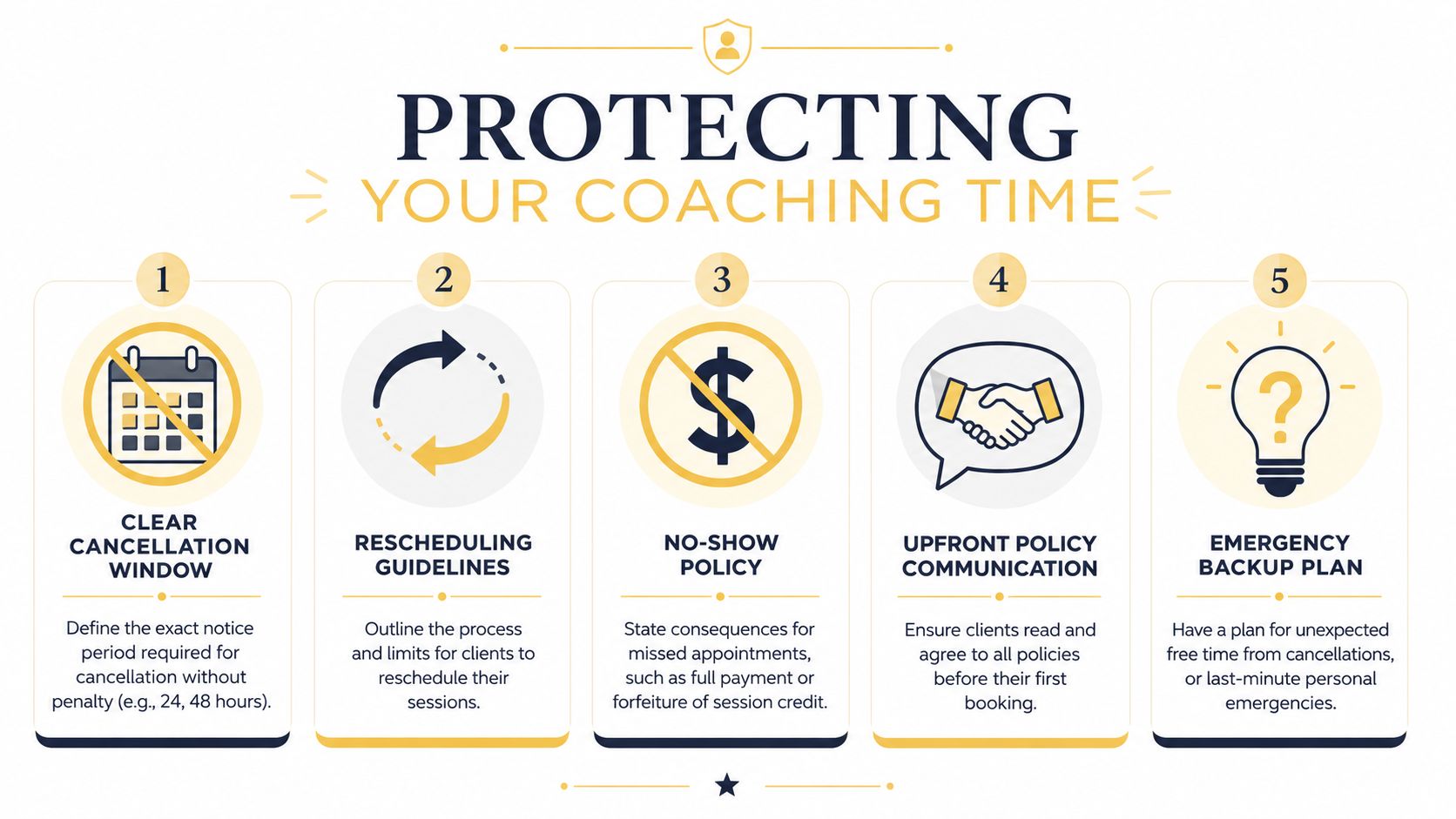
Consider including:
- A cancellation window: Clients can reschedule without penalty inside your stated notice period.
- A one-time grace option: Useful for long-term clients or the first genuine mistake.
- A missed-session rule: If they don't attend and don't notify you in time, the session is counted.
- A clear process: Rescheduling happens through the booking system, not by scattered text messages.
- Emergency discretion: Real emergencies happen. You can reserve judgment without removing the policy.
What doesn't work is a policy you apologize for. If you present it like a necessary evil, clients feel invited to negotiate it.
Scripts that sound professional
Use language like this during onboarding:
I keep a structured schedule so I can be fully present with every client. If you need to move a session, please do that within the stated window using your booking link.
Or this when someone asks for an exception:
I understand things come up. My policy helps me protect time I've reserved for your session, so this one will still count. Let's get your next session locked in now.
Short. Calm. No defensiveness.
What to do with cancelled time
The deeper issue behind cancellations isn't just lost income. It's the sudden emotional drop. You had mentally prepared for a session, and now you have a hole in the day.
Create a backup plan for freed-up slots:
- Use it for notes and follow-up.
- Record a resource for clients.
- Do pipeline work instead of doom-scrolling.
- Take the break if your body clearly needs it.
A good schedule doesn't eliminate change. It stops change from wrecking the rest of your week.
Your Schedule as a Statement of Value
Clients notice more than your questions. They notice your structure.
They notice whether booking feels clean or chaotic. They notice whether sessions start with purpose. They notice whether your boundaries are clear without being cold. All of that communicates value before you say a word about transformation.
What a strong schedule tells people
A well-built session schedule says:
- Your time matters
- Their time matters
- This work has a container
- Progress is intentional, not improvised
That's why scheduling isn't separate from coaching. It is part of coaching. The container affects the conversation inside it.
If you're unsure how your calendar supports the business side of your practice, tools like Coachful's session rate calculator can help you pressure-test whether your current schedule aligns with your pricing and capacity.
Sanity is a business metric
A lot of coaches wait too long to redesign their calendar because they think endurance is part of professionalism. It isn't. If your week leaves you cognitively flat, resentful of reschedules, and constantly “catching up,” your schedule is underperforming.
Your calendar is one of the clearest places where self-respect becomes visible.
The strongest coaches I know don't run the most packed calendars. They run the most deliberate ones. They know which offers belong in recurring slots, which belong in cohorts, which hours produce their best thinking, and which systems prevent avoidable mess.
Your session schedule isn't just admin. It's a strategic choice about the kind of practice you're building, the quality of coaching you can sustain, and the standard clients learn to meet.
If you're ready to turn scheduling from a recurring headache into a cleaner client experience, Coachful gives coaches one place to manage bookings, reminders, client workflows, and the structure around each session without stitching together multiple tools.