How to Track Progress in Coaching That Actually Works

Coachful

Most advice on how to track progress starts with the wrong question. It asks, “Which metrics should I add?” The better question is, “What decision should this measurement help me make?” A tracker that only records attendance, completed sessions, or percentage complete can look polished while telling you almost nothing about whether a client is changing.
Good tracking does more than document activity. It compares the client's current state with a reference point, exposes drift early, creates a reason to act, and gives the next coaching conversation a clear starting point. Done properly, the tracker becomes part of the intervention, not a clerical afterthought.
Why Most Coaches Track the Wrong Things
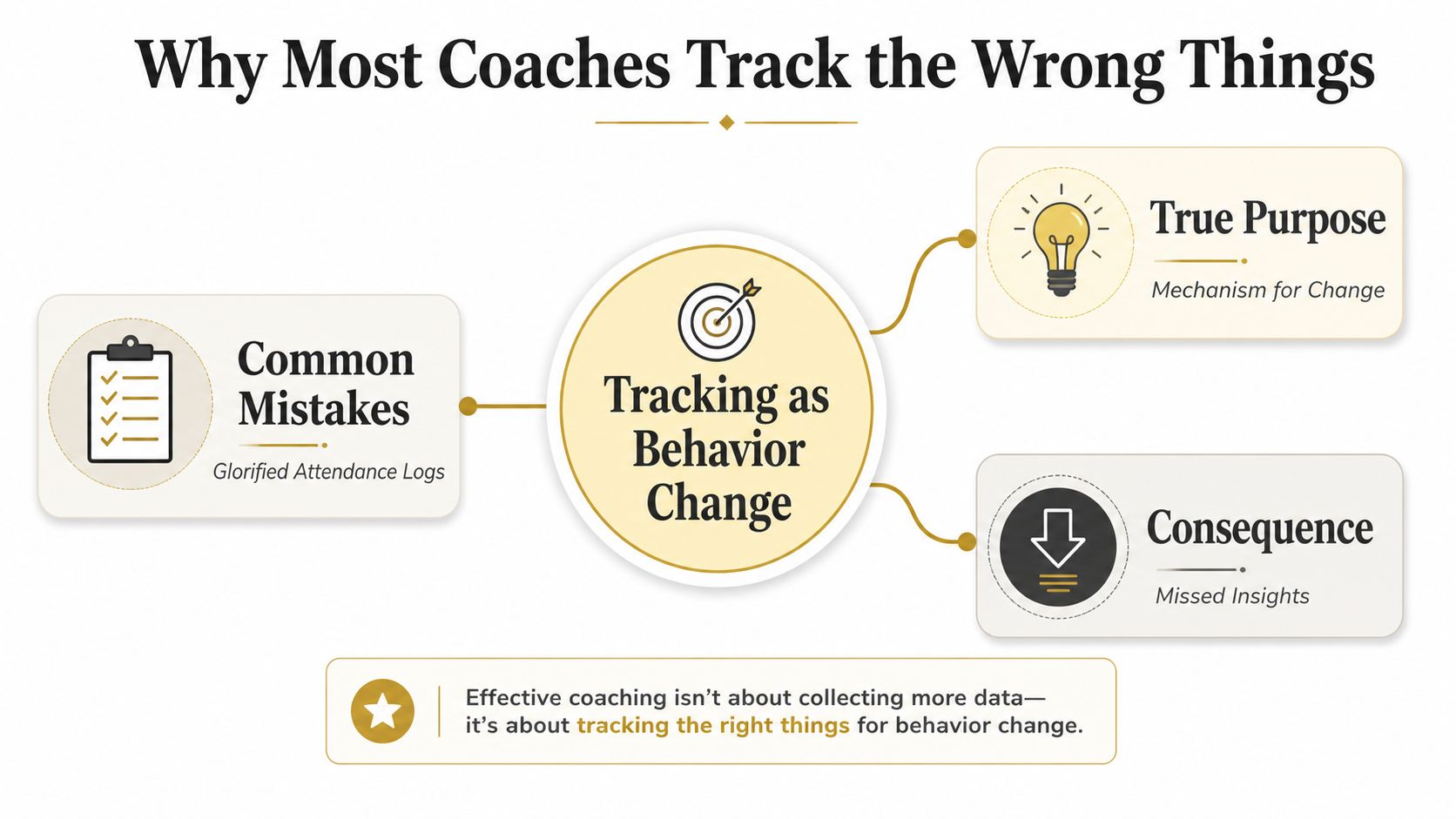
Most coaches track output instead of decisions. They record whether a client attended, whether a worksheet was submitted, or whether a session took place. Those facts may matter, but they don't answer the operational questions that keep a program effective: Is the client on pace? What changed? What's stuck? Should the coach persist, pivot, or stop?
Progress monitoring means comparing the current state with a reference value. In a coaching example, “two workouts completed” is only a raw number. The useful signal appears when the coach compares it with a target of four workouts per week, then decides whether the obstacle is scheduling, confidence, recovery, or commitment. The comparison creates the coaching signal, as explained in the psychological research on monitoring goal progress.
A meta-analysis of 138 randomized trials found that monitoring progress improved goal attainment with an effect size of d = 0.40, with a 95% confidence interval of [0.32, 0.48]. The same evidence base found a very large effect on the frequency of monitoring itself, d = 1.98, with a 95% confidence interval of [1.71, 2.24], as summarized in this evidence review of goal-progress tracking. That distinction matters. Tracking doesn't merely tell you what happened. The act of checking progress can help make goal-directed behavior more consistent.
The four jobs of a useful tracker
A coaching tracker earns its place when it performs four jobs:
- Detect variance: Show the gap between the current result and the agreed target.
- Trigger accountability: Make the client's commitment visible before memory smooths over missed actions.
- Support a decision: Indicate whether to continue the current plan, change the method, or revise the goal.
- Feed the next conversation: Give the coach a specific question to ask instead of another vague check-in.
Operational rule: If a metric won't change what you ask, assign, review, or recommend, remove it.
The historical logic is straightforward. Management by Objectives, introduced by Peter F. Drucker in 1954 and further developed by George S. Odiorne in 1965, moved management toward defined objectives, measurable targets, recurring reviews, and accountability for results, as described in this overview of Management by Objectives. Modern coaching dashboards inherit that logic. They work when they turn ambition into observable checkpoints, not when they accumulate more fields.
From Vague Goal to Measurable Outcome
“Become a better leader” is a valid aspiration and a useless tracker entry. You can't measure it directly, and you can't coach a dashboard that has no observable movement. Before choosing software or building a spreadsheet, translate the ambition into a behavior or outcome that someone can see, record, and discuss.
Take an executive who says, “I want to lead with more clarity.” Start by asking what clarity would look like in a real workweek. The executive might identify a target outcome: run more focused one-to-ones that end with clear ownership and next steps. That still needs a baseline and a way to recognize movement.
Use a one-page goal intake
Write the goal in five fields:
- Goal: Run clearer, more accountable one-to-ones.
- Baseline: Current self-assessment, existing one-to-one routine, and any available feedback from the client's normal work context.
- Target: A clearly described standard the client wants to demonstrate by the end of the coaching period.
- Milestones: Three observable checkpoints between intake and week eight.
- Owner: The person responsible for collecting each signal and acting on it.
The milestones might look like this:
- Early milestone: The client opens each one-to-one with a stated purpose and closes with an agreed next step.
- Middle milestone: The client uses a consistent agenda and asks the direct report to summarize ownership.
- Later milestone: The client reviews patterns across conversations and adjusts the format where accountability remains unclear.
Notice the difference between an activity, an outcome, and an aspiration. “Complete a leadership worksheet” is an activity. “Hold structured one-to-ones” is a behavior. “Direct reports leave with clear ownership” is an outcome. A strong tracker can include all three, but it shouldn't confuse them.
Apply the fuzzy-goal test
Ask three questions before adding the goal to your system:
- Could another person observe this change?
- Can the client compare current performance with a baseline?
- Would a result change the coaching plan?
If the answer is no, keep refining. This approach follows the Management by Objectives tradition of translating broad ambitions into measurable objectives and recurring review points, rather than waiting for an end-of-program judgment, as outlined in the research discussion of objective-based management.
A coach doesn't need a complicated goal architecture. The intake page should make the target, starting point, milestones, and responsibility obvious enough that both coach and client can repeat them without opening the tracker.
Choosing the Right Metrics Without Overtracking
The cleanest coaching tracker usually contains no more than five measures. A practical guide to measuring and reporting progress recommends capping the list at five so the coach and client can focus on meaningful signals instead of drowning in fields.
Use three lenses: the client's perception, an objective measure tied to the individual goal, and percentage of the goal attained. A 2023 paper distinguishes between subjective goal progress, idiosyncratic objective progress, and percentage of goal attained. The last measure is calculated as actual performance divided by the personal goal, multiplied by 100, as described in this paper on measuring goal progress.
Consider a client whose goal is to hold 4 weekly one-on-ones. A coach could log confidence in the behavior, the number of one-on-ones held, and percentage attainment against the personal target. If the client holds 3 meetings, attainment is 75%. The number shows execution, confidence shows the client's experience, and the attainment figure makes the gap easy to discuss.
| Lens | What it measures | Example for a “4 weekly one-on-ones” goal | Decision it triggers |
|---|---|---|---|
| Subjective goal progress | How the client believes progress feels or looks | Confidence in leading clear one-to-ones | Explore confidence, resistance, or perceived barriers |
| Idiosyncratic objective progress | A personal behavioral result linked to the goal | Number of one-on-ones held | Adjust scheduling, preparation, or accountability |
| Percentage of goal attained | Current performance relative to the client's target | 3 meetings divided by 4, or 75% | Decide whether the client is on pace or needs intervention |
A metric without a decision rule becomes theater. Define what each measure will tell you before you collect it. For example, low confidence with strong execution may call for reflection and skill development. High confidence with weak execution points toward planning or accountability.
Benchmarking requires discipline. Define 3–5 repeatable benchmarks, capture a baseline using the same test, setup, and equipment, then re-test on a fixed cadence. Each record should include the benchmark name, unit, target, re-test date, and responsible coach, according to this practical coaching progress-tracking method. If you change the test conditions halfway through the program, you haven't created a new insight. You've broken comparability.
For teams choosing a feedback or survey platform, it can also help to compare Medallia with Formbricks based on the type of feedback workflow you need. Keep the tool question separate from the metric question. Better software won't rescue a badly defined signal. For a broader framework on selecting outcome measures, review these client success metrics for coaching practices.
Capturing Data Around Every Session
The tracking failure usually happens after the conversation, not inside the dashboard. Useful information gets buried in a paragraph of notes, a text message, or the coach's memory. By the time someone updates the database, the decision context has already disappeared.
Treat each session as a small data event. Record the client's reported win, current blocker, committed action, required support, and one coach observation. Keep the format short enough to complete while the discussion remains fresh. The purpose is not to produce a polished narrative. It is to decide whether the plan should persist, pivot, or stop.
Use a session loop that closes itself
A reliable session loop has five points:
- Before the session: The client records the most important win, main blocker, and current progress against the target.
- During the session: The coach identifies the decision that matters, not every detail discussed.
- At commitment: The client names the next action, due point, and support required.
- After the session: The coach writes one concise observation and updates the relevant milestone.
- At the next review: The coach compares the commitment with the result and asks what changed.
A client might report, “I prepared for the one-to-one but avoided the ownership question.” Record the blocker as avoidance under pressure, assign a practice action, and note that the next session should examine the conversation's opening and close. That entry supports a decision. “Discussed leadership confidence” does not.
Use a structured session notes template to keep records consistent across clients and programs. Consistency lets the coach spot patterns without rereading every narrative note. It also makes missed commitments visible, which turns documentation into a behavior-change mechanism rather than administrative storage.
The best session note is short enough to finish immediately and specific enough to change the next action.
Capture signal, archive noise
Log information that supports a decision:
- Client-reported change: What improved, regressed, or remained stuck.
- Committed action: The next behavior, owner, and due point.
- Engagement signal: Whether the client responded, completed the action, or needed follow-up.
- Benchmark result: The relevant re-test score or observable outcome.
- Coach observation: One line about the pattern requiring attention.
Archive incidental detail that will not affect the plan. Do not track every mood variation, message, or discussion topic just because the software permits it. Excess tracking weakens comparability and hides the signal needed for action, as noted in the applied coaching guidance on tracking athlete progress.
The operating standard is simple: finish the session with the record updated. If the coach has to rebuild the tracker on Sunday, the process is too heavy. A record that cannot support the next decision is metric theater, regardless of how complete it looks.
Designing a Dashboard That Earns the Screen
A dashboard isn't a report. It's a decision surface. When you open it, you should know whether the client is on pace, plateauing, or ready to revise the goal without searching through separate notes, spreadsheets, and email threads.
A useful screen starts with the current outcome, then shows the leading behaviors that influence it. It should also make risk visible before the final review. Completion percentages belong somewhere, but they shouldn't dominate the page because a percentage can rise while the underlying behavior remains fragile.

Build five decision zones
A coaching dashboard should show:
- Current outcome: The latest result against the target.
- Leading indicators: Behaviors that predict or support the outcome.
- Session cadence: The last session, next session, and overdue review.
- Risk flags: Missed commitments, stalled benchmarks, or declining engagement.
- Last review summary: The previous decision and the next agreed action.
Consider an executive client with a goal of improving one-to-ones. The dashboard might show the latest attainment figure, the number of meetings held, the client's confidence rating, the last blocker, and the next practice action. The coach can answer, “What should I look at first?” by checking the current outcome, then the most recent behavior and blocker.
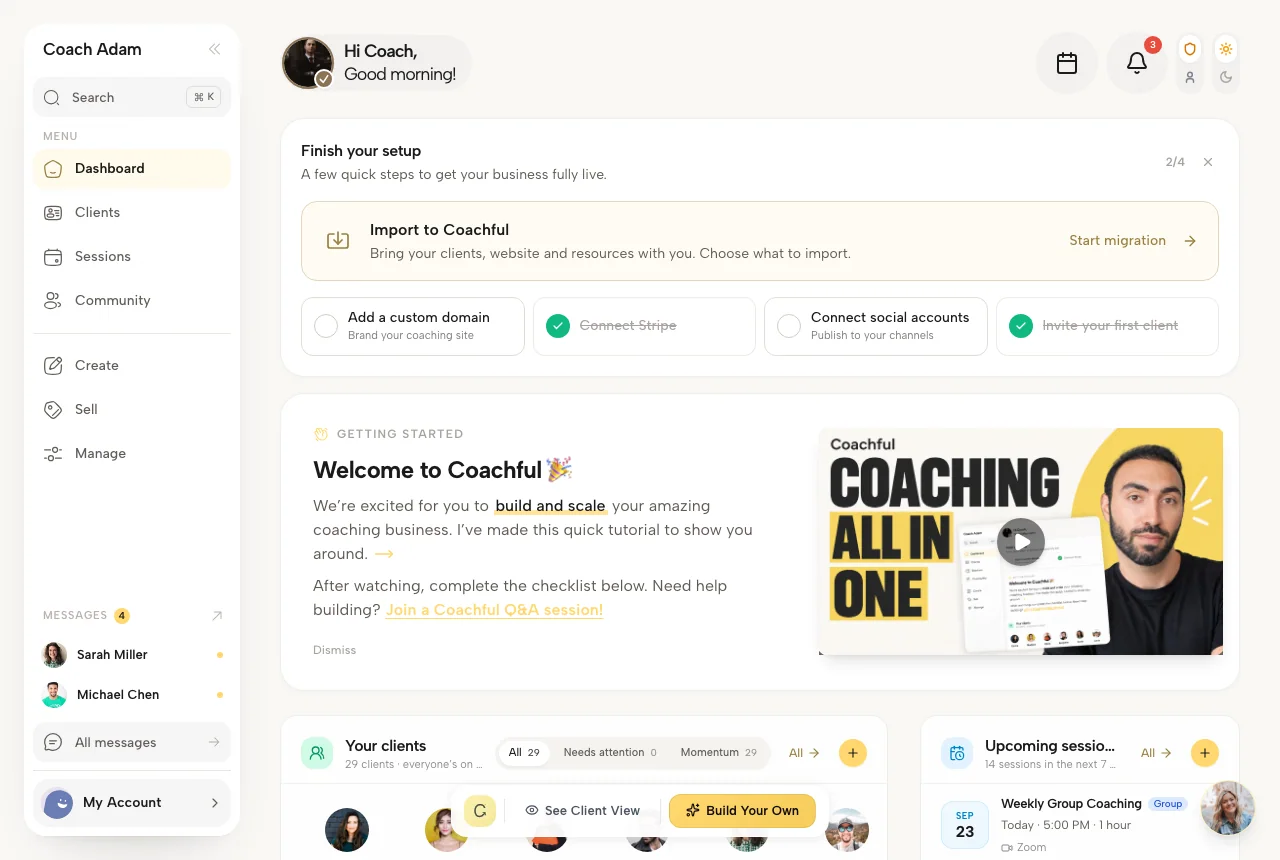
Coachful can keep goals, milestones, session notes, engagement, and progress tracking in one workspace, which supports the single-screen review model. Its progress tracker tool is relevant when a coach wants a structured template instead of stitching together notes, sheets, and email.
Keep raw conversation detail archived. The dashboard should surface the decision-ready summary, while the full note remains available when the coach needs context. That separation prevents the screen from becoming another document repository.
For health coaching, a similar layout might pair a client's target behavior with sleep quality, weekly habit completion, self-rated energy, and one performance measure. A planning tool such as an AI meal planner for weight loss can support a client's action plan, but the coaching dashboard still needs to show whether the client followed the agreed behavior and what decision follows from the result.
A short walkthrough can help your team judge whether the dashboard supports real review work rather than cosmetic reporting.
Open the dashboard and ask three questions: What moved? What didn't move? What will we do next? If the screen can't answer those questions quickly, remove charts before adding more.
Choosing the Right Review Cadence
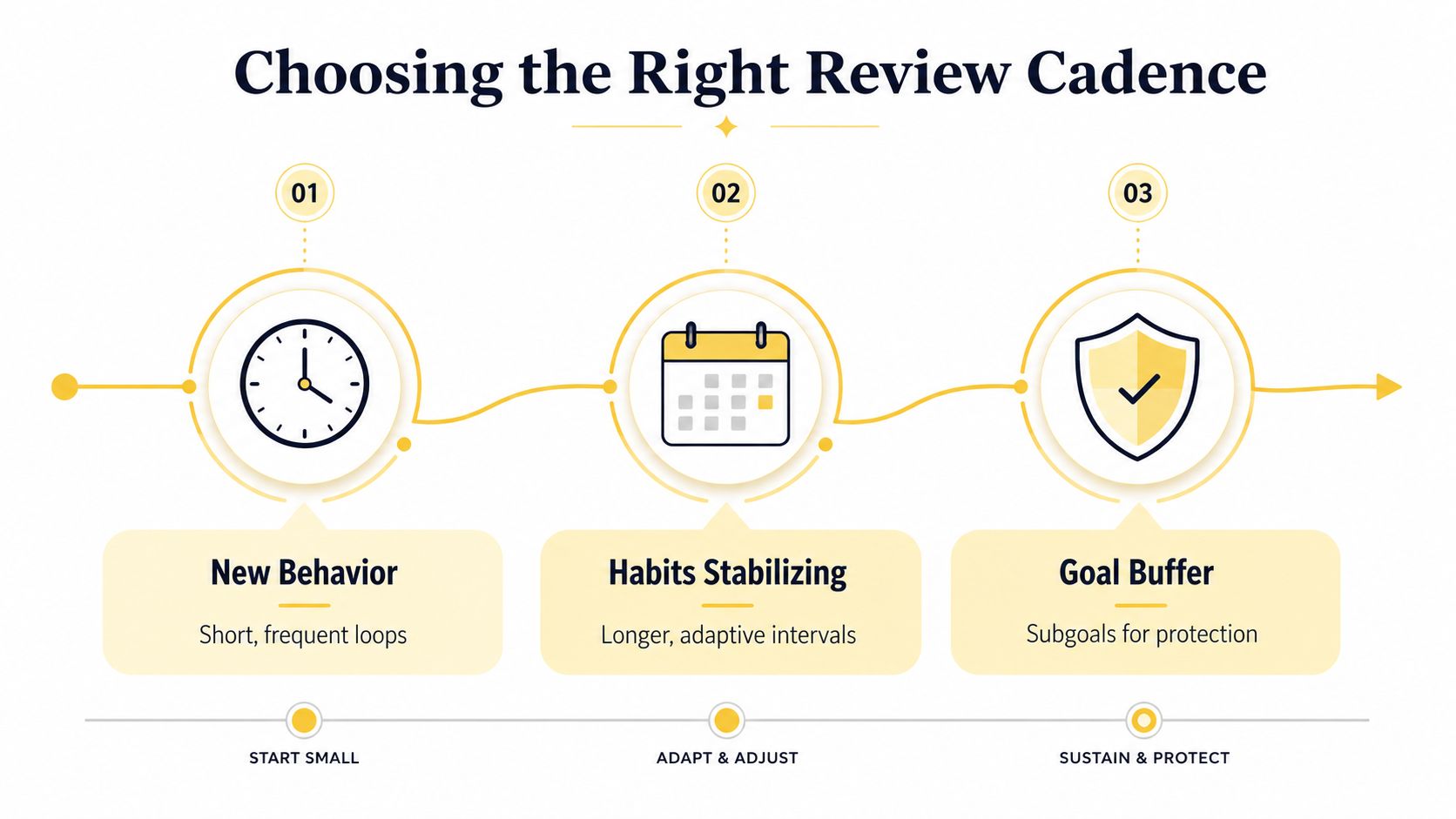
“Review weekly” sounds sensible until coaches apply it to every goal, every client, and every stage. A new behavior needs a short feedback loop. A stable habit needs enough space to reveal whether it holds without constant checking. The right cadence changes as the goal changes.
Early adherence deserves special attention. Research summarized by PubMed's review of goal-progress monitoring reports that behavior in the first 7 days can predict eventual success even for difficult long-term goals. That makes the opening week a high-value checkpoint, not a ceremonial onboarding period.
Use an adaptive cadence map
A practical rhythm looks like this:
- First 7 days: Use a daily or habit-level check for the behavior that is still being established.
- First month: Review weekly, focusing on adherence, obstacles, and the next adjustment.
- Main benchmark: Re-test every 4–6 weeks, using the same conditions and equipment.
- Larger outcome: Hold a quarterly outcomes conversation for the broader goal.
Subgoals matter when progress is low. A recent finding summarized in the Sustainable Development Goals progress dashboard notes that motivation can drop when progress is low and subgoals are absent, while subgoals can buffer that effect. A client who sees only a distant outcome may interpret a slow start as failure. A client who can see the next observable milestone has a nearer decision point.
Tracking can also backfire. The PubMed evidence includes an example involving UV-meter users who spent more time in the sun, used fewer protective measures, and experienced more sunburn. The lesson isn't to stop tracking. It's to check whether the metric changes behavior in the direction you want.
Safety check: Pair every metric with a decision rule and a maximum acceptable value.
For example, if a client tracks hours worked to improve focus, the rule might be to investigate when hours rise but meaningful output doesn't. If a health client tracks exercise volume, the coach should define when more volume becomes a recovery concern. A dashboard that only celebrates upward movement can reward the wrong behavior.
Automating Reminders, Renewals, and Reviews
The last mile breaks more systems than the metric design. Coaches forget the pre-session prompt, postpone the note, miss the re-test date, and discover a renewal decision only when the calendar forces it. Automation should handle the repeatable sequence so the coach can spend attention on interpretation.
Use this operating sequence:
- Pre-session prompt: Ask the client to record a win, blocker, current progress, and the action they want help with.
- Session close: Require the next commitment, owner, support needed, and relevant milestone update.
- Post-session note: Send or open a short note template within 24 hours of the session.
- Re-test reminder: Schedule the benchmark review for the agreed 4–6 week window.
- Renewal trigger: Start the renewal conversation from milestone completion rates and outcome movement, not from a calendar date alone.
Coachful supports goals, milestones, session notes, client engagement, reminders, and renewals in a connected coaching workspace. That structure lets the automation sit beside the goal it relates to, rather than scattering prompts across email, a calendar, and a separate spreadsheet.
Troubleshoot the failures that keep returning
| What breaks | Why it breaks | One-line fix |
|---|---|---|
| Condition drift on re-tests | The coach changes the test, setup, or equipment | Lock the benchmark instructions and record them with the baseline |
| Ghost metrics nobody reads | The metric isn't connected to a decision | Assign one action to every metric or remove it |
| Over-triggering reminders | The system sends prompts without regard to client behavior | Reduce prompts and trigger follow-up from missed commitments |
Automation shouldn't replace judgment. It should reserve judgment for the moments that need it: interpreting a plateau, identifying a harmful incentive, deciding whether the goal still matters, and choosing the next coaching move.
The finished system runs the boring 80% reliably and leaves the coach responsible for the meaningful 20%. That's how to track progress without turning a coaching practice into a data-entry job.
Coachful brings goals, milestones, session notes, client engagement, reminders, renewals, and progress tracking into one coaching workspace, so you can review movement and act before a goal drifts. Visit Coachful to build a tracking workflow that keeps routine updates organized and gives you more time for the coaching decisions that change outcomes.