Session Notes Template: Boost Your Coaching Workflow

Coachful

You finish a strong coaching session and feel that satisfying click of momentum. The client said something important. They made a real commitment. You noticed a pattern that could shape the next month of work.
Then the session ends, and you're staring at a blank page thinking, what exactly am I supposed to write down?
That moment matters more than most coaches admit. If your notes are messy, vague, or trapped in a template built for therapy instead of coaching, you lose usable insight fast. By the next session, you remember the breakthrough but not the language the client used, the hesitation before the commitment, or the condition attached to the goal.
A good session notes template doesn't exist to make you feel organized. It exists to help you coach better. It should capture movement, not just minutes. It should support accountability, not clinical compliance theater. And it should be simple enough that you will use it after every session.
Why Your Generic Notes Are Holding Your Clients Back
A coach finishes a strong session with clear movement on the call. Ten minutes later, the notes say: "Good conversation. Client wants more confidence. Follow up next week."
That record is technically a note. It is not much help.
Generic note systems fail because they flatten coaching into a summary. They capture topics, but miss traction. They record that a client talked about delegation, but not the belief underneath it, the experiment they agreed to run, or the condition that might derail follow-through before your next session.
I see this often with coaches who started with whatever was easy to grab. A Google Doc. A notes app. A repurposed therapy form. Even careful coaches end up with records that are hard to scan and harder to use. The problem is not effort. The format keeps pulling attention toward the wrong details.
Generic templates create the wrong kind of record
Clinical formats such as SOAP were built for diagnosis, treatment, and compliance. Coaching has a different job. You are tracking decisions, patterns, commitments, obstacles, and evidence of change over time. If the template is built for a medical or therapeutic setting, coaches either force their work into awkward categories or leave out the details that matter most.
That is why I recommend building from coaching logic first, not borrowing from therapy and trying to edit around it. If you want a starting point, these templates for coaches are much closer to the realities of goal-based client work.
The same principle shows up outside coaching. People doing technical work spend real time on designing lab notes templates because the structure changes what gets captured and what gets missed. Coaching is no different. A note format shapes attention. Attention shapes the session you run next.
Generic notes usually do not fail in one obvious way. They fail by hiding the thread between sessions.
What weak notes cost your clients
Loose notes create practical coaching problems, not just admin frustration:
- Sessions restart instead of progress. You spend the first ten minutes rebuilding context you should have at hand.
- Commitments lose force. "Client will work on boundaries" is not the same as "Client will decline one nonessential request before Friday and report what made that hard."
- Patterns stay blurry. Repeated rescuing, avoidance before visibility, or language that signals self-protection never becomes easy to spot.
- Reviewing progress takes too long. Looking back over eight sessions should show a clear arc, not a pile of disconnected summaries.
- Your coaching gets harder to refine. If your notes do not show what interventions led to action, you cannot improve your own process with much precision.
Clients feel this, even if they never read a single note. They experience it as repetition, vaguer accountability, and less momentum between sessions.
Coaching notes should follow transformation, not symptoms
A useful coaching note is built around movement. It helps you see what changed, what the client committed to, what resistance appeared, and what needs to carry into the next conversation.
That means a strong template should help you answer questions like these after every session:
- What shifted in the client's thinking, behavior, or decision-making?
- Which goal or milestone did this session move forward?
- What commitment did the client make, in specific terms?
- What obstacle, fear, or pattern is likely to interfere before next time?
- What do I want to revisit, challenge, or measure in the next session?
If your current notes cannot answer those questions in under a minute, the template is slowing down the coaching instead of supporting it.
Anatomy of an Effective Coaching Session Note
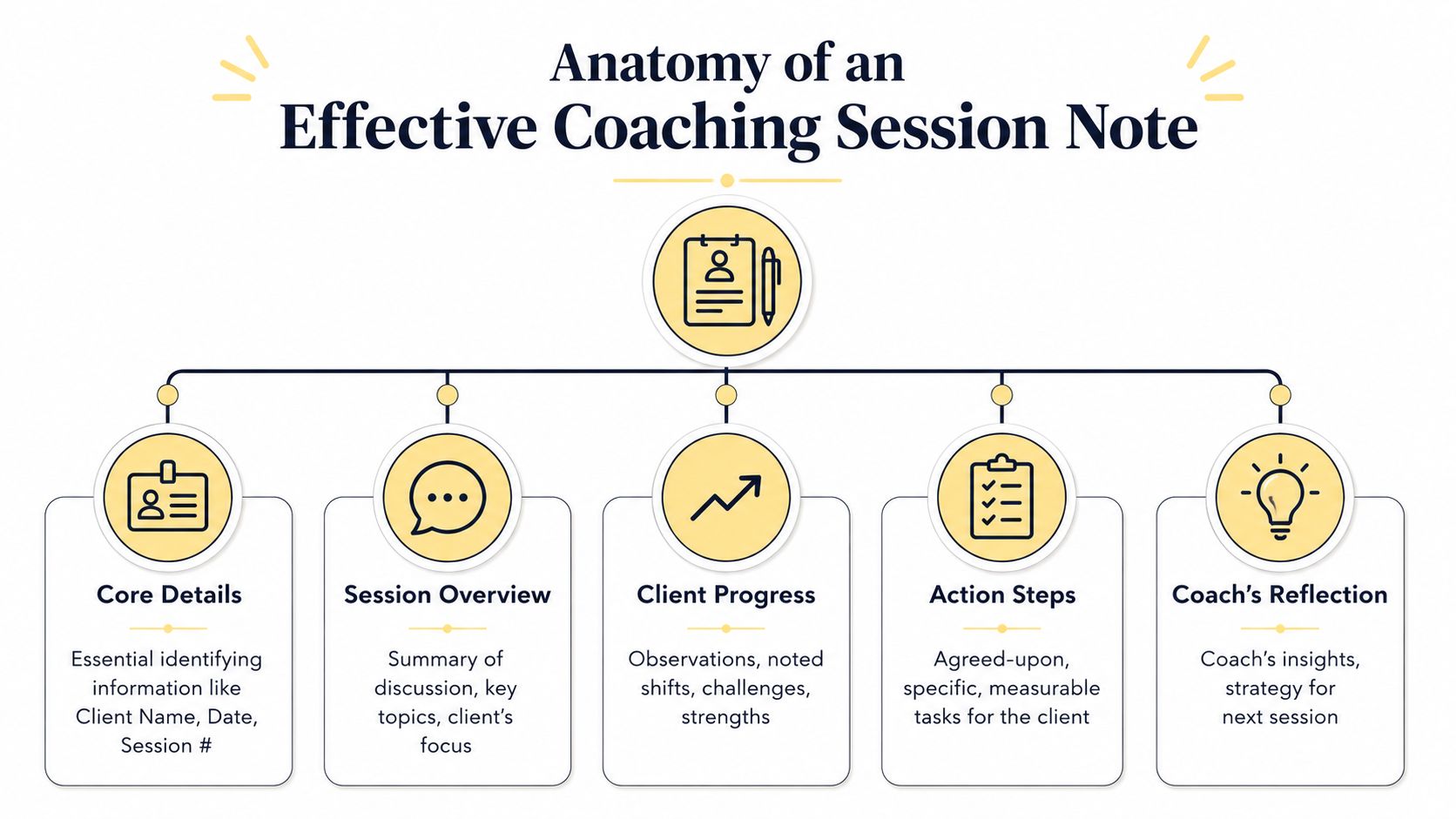
A useful coaching note needs structure, but not clinical rigidity. The simplest version I trust has five parts. Together, they give you enough detail to coach with continuity and enough restraint to avoid drowning in admin.
Clinical documentation often requires four core elements: objective data, individual responses, insights tied to patterns, and further steps, as described in Passage Health's overview of ABA session note structure. For coaching, that same logic is useful, but the language and focus should shift.
Core details
Start with the basics you should never have to hunt for later:
- Client name
- Date
- Session number or phase
- Program or coaching container
- Session length if you track it
- Primary theme
This section shouldn't become a mini biography. It's there to anchor the record. If you coach inside a program with milestones, add the milestone or current stage.
A practical example:
| Core detail | Example entry |
|---|---|
| Client | Maya R. |
| Date | 12 June |
| Session | Session 4 |
| Program | Career Transition Coaching |
| Theme | Decision-making and role clarity |
Session overview
This is your clean summary of what the client brought in and what the conversation covered. Keep it short, but make it specific.
Instead of writing, "We talked about work stress," write something like:
Client explored tension between staying in a stable role and pursuing a leadership opportunity. Main themes were fear of visibility, family expectations, and uncertainty about timing.
That gives you a real entry point next time. It also helps if you ever need to review a series of sessions before a renewal, debrief, or program evaluation.
If you're experimenting with note design in other structured fields, it's worth looking at how people think about designing lab notes templates. Different profession, same challenge. A template should help you retrieve meaning later, not just capture activity in the moment.
Client progress
Often, coaches become too vague here. "Good session" is useless. "Client seems more confident" is better, but still soft unless you anchor it in behavior, language, or a clear shift.
Write what changed, what stuck, and what resisted movement.
Examples:
- Client named a long-standing pattern of delaying decisions until external pressure forces action.
- Moved from "I should probably delegate" to a specific willingness to test delegation with one project this week.
- Became noticeably more tentative when discussing peer feedback.
- Identified values conflict between financial security and autonomy.
For coaches who want a starting structure, curated templates for coaches can help you turn these categories into repeatable fields without defaulting to therapy language.
Action steps
This section needs precision. A weak note says, "Client will work on boundaries." A strong note says, "Client will decline one nonessential meeting request and journal what made that difficult."
Good action steps are:
- Specific enough to observe
- Small enough to attempt
- Relevant to the session's core insight
- Owned by the client
You can list one action, or several. What matters is that the next session can begin with a real review.
Coach's reflection
This is the private professional layer. Not a diagnosis. Not a personality verdict. Just your working hypothesis about what to watch.
Examples:
- Client responds well to direct challenge when it follows reflection.
- Repeated concern about disappointing authority figures may be shaping career decisions.
- Next session should test whether the stated goal is genuine or borrowed from external expectations.
Practical rule: If a note won't help you coach more accurately next time, it probably doesn't belong in the template.
Customizing Your Template for Life Business or Executive Coaching
A life coach finishes a session about self-trust. An executive coach leaves a meeting about stakeholder conflict. A business coach wraps a call on pricing and sales friction. If all three open the same note template, one thing happens fast. The note starts serving the form instead of the client.
That is why generic note formats undermine coaching.
Coaching needs a template built for change over time. Clinical note models often push coaches toward documentation habits that do not match the work. SOAP notes are the usual example. They can be useful in clinical settings, but they tend to pull attention toward symptoms, assessment language, and treatment logic. Coaching notes need a different center of gravity: goals, patterns, commitments, follow-through, and what the client is learning in real life.
Why coaching templates should not mimic clinical detail
Clinical records often require narrow, measurable observations for compliance and treatment tracking. A note might say that a client completed shape-matching tasks independently or answered color-labeling prompts correctly, as shown in HeyBerries' ABA session note examples. That level of detail makes sense in a clinical setting.
For most coaching, it creates noise.
A coaching session note should help you pick up the thread next time. It should show what changed, what the client committed to, and where resistance is likely to appear. If the template pushes you to document coaching like treatment, you can end up with tidy records that miss the actual work of transformation.
I learned this the hard way. Early on, I borrowed note structures that looked professional but made my sessions harder to build on. The notes were full of topic summaries and thin on decisions, tension points, and evidence of movement. Once I changed the prompts by coaching type, follow-up became sharper and clients noticed the difference.
Life coaching example
Life coaching notes should track inner shifts and lived behavior together. A client may leave with insight, but insight alone is not progress if nothing changes between sessions.
Useful fields include:
- Values tension in play
- Belief or story named
- Emotional pattern
- Choice the client is postponing
- Evidence of self-trust
- Commitment before next session
A sample entry:
Client saw that saying yes to family requests out of guilt conflicts with her goal of building a more self-directed routine. Named belief: "If I disappoint people, I'll lose connection." Commitment: protect two evenings for herself this week and record the discomfort without reversing the decision.
That note gives you a real starting point for the next conversation. You can ask what happened, what she felt, and whether the belief still held.
Business coaching example
Business coaching templates need to connect reflection to execution. The note should help you track what the client is building, where they are stuck, and what they will test before the next session.
Useful fields include:
- Current business priority
- Constraint or bottleneck
- Decision made in session
- Metric or milestone to watch
- Area affected, such as sales, delivery, team, or operations
- Experiment to run before the next call
Example:
Client decided to focus on improving discovery calls instead of rewriting the full offer suite. The main issue is overexplaining before asking for commitment. This week's test is a shorter call structure with a written review of objections that came up.
That kind of note lets you measure coaching by business movement, not by how insightful the conversation sounded.
Executive coaching example
Executive coaching notes need more context than many coaches expect. Leadership behavior is shaped by reporting lines, incentives, power dynamics, and meeting culture. If your template ignores that, the notes become too abstract to be useful.
Fields that usually earn their place:
- Stakeholders involved
- Leadership behavior in focus
- Pattern observed in communication
- Organizational constraint
- Decision or conversation ahead
- Behavior to practice before next session
A sample entry:
Client is preparing for a difficult conversation with a senior peer after repeated confusion about decision ownership. Observed pattern: softens language to avoid friction, then leaves meetings frustrated. Commitment: start the conversation with a clear statement of ownership boundaries and propose a weekly operating rhythm.
Executive coaching notes should help you track behavior inside the system where the client works.
Template fields by coaching niche
| Field Type | Life Coaching Example | Business Coaching Example | Executive Coaching Example |
|---|---|---|---|
| Primary focus | Values conflict around work-life decisions | Offer positioning and sales consistency | Leadership presence in cross-functional meetings |
| Key pattern | People-pleasing under stress | Avoiding pricing decisions | Deferring too much to stronger personalities |
| Progress marker | Chose based on personal values instead of approval | Made one strategic decision and implemented it | Handled a difficult conversation with more clarity |
| Obstacle | Fear of disappointing others | Overthinking before action | Stakeholder tension and political caution |
| Commitment | Hold two boundaries this week | Test revised sales call flow | Prepare direct talking points for one meeting |
| Reflection prompt | What felt more honest this week | What created momentum in the business | Where did influence increase or weaken |
A good coaching template is specific enough to fit the coaching you do, and simple enough that you will still use it after a full day of sessions. That trade-off matters. If the form is too generic, your notes stay shallow. If it is too detailed, you stop completing it well.
The best template usually has a shared core and a few niche-specific fields. That gives you consistency without forcing life, business, and executive coaching into the same mold.
Keeping Client Notes Safe and Professional
You finish a strong session, jot a few rushed lines, and tell yourself you'll clean them up later. A week passes. Now you have half-memory, half-transcript, and one uncomfortable question. If a client ever asked to review this, would it read as clear, respectful, and coaching-specific?
That test helps.

Good coaching notes protect the client and protect the work. They should help you track progress over time without turning into a diary, a clinical chart, or a storage bin for every vulnerable detail someone shared. This is one reason I do not recommend lifting therapy formats like SOAP notes into coaching. They often pull coaches toward symptom-style documentation instead of goals, patterns, decisions, and follow-through.
Record what serves the coaching
A professional coaching note captures the pieces that matter for continuity:
- the client's stated goal or current priority
- the pattern that showed up in session
- a meaningful shift, decision, or resistance point
- the commitment before the next session
- any follow-up you need to remember as the coach
That is usually enough.
If a client spends fifteen minutes describing a painful family conflict, the note does not need the full story. It needs the coaching-relevant thread. For example:
Family pressure appears to increase second-guessing around career moves.
That version is easier to review later, more respectful to store, and far more useful in a coaching conversation than a detailed personal narrative.
Keep summary notes separate from private reflections
I keep a clear line between the client record and my own brief coaching reflections.
Session summary notes belong in the official record. They should be factual, readable, and tied to the client's goals and commitments.
Private process notes can include short reminders such as, "test a values conflict exercise next time" or "watch for approval-seeking when discussing pricing." Even then, restraint matters. Frustration, speculation, and raw personal reactions do not belong in either place.
If you would be uneasy rereading a note six months later, revise it before you save it.
Professional note habits are usually simple
Coaches do not need a hospital-grade documentation system. They do need consistent handling.
A sound setup usually includes:
- One secure place for notes. Avoid spreading client information across paper notebooks, loose docs, email drafts, and phone notes.
- Predictable file names. Client name, date, and session number or topic make retrieval fast.
- Limited access. Only people who need to see client information should have access.
- A retention policy. Decide how long you keep records, then apply that rule consistently.
- Care with exports and attachments. Downloaded files, forwarded emails, and screenshots create extra privacy risk.
Paper notes need discipline too. If you use them, store them in a locked location and transfer only the coaching-relevant summary into your main system.
Be careful with AI note tools
AI can speed up drafting. It can also create new privacy problems if you have not checked what happens to the data.
The first question is not whether the output sounds polished. The first question is where the information goes, who can access it, whether recordings are retained, and whether you review every draft before it becomes part of the client record. A tool can save time and still be the wrong fit for your practice.
If you want that kind of support, use an AI coaching assistant built for session follow-up and coach workflow only after you are clear on your own standards for consent, storage, and review.
A good rule is simple. Keep less. Keep it cleaner. Keep it tied to the coaching outcome. That gives you notes you can trust and records you can stand behind.
Automate Your Notes and Workflow in Coachful
A coaching note often gets lost in the last five minutes of the hour. The client leaves with a clear next step, your next session is about to start, and the useful details end up scattered across a notebook, calendar, and memory. That is usually not a discipline problem. It is a workflow problem.
Coachful works best when the note template matches coaching work itself. That means progress, decisions, patterns, and commitments. It does not mean forcing your sessions into a clinical format that was built for treatment documentation rather than client transformation.

Build the template once
Set up your structure around the questions you need answered before the next conversation.
A useful coaching template might include:
- Session theme
- Client insight
- Observed pattern
- Decision or commitment
- Action before next session
- Coach reflection
I recommend keeping it this lean at first. Coaches often overbuild templates, then avoid using them because every session starts to feel like form-filling. A shorter template gets completed. A completed template is far more useful than a perfect one you skip.
Attach notes to the session and client record
Notes become more useful when they live beside the rest of the client story. If the session record, goals, messages, and scheduling all sit in one place, preparation gets faster and follow-up gets sharper.
Before a call, you can scan the last commitment in seconds. After the call, you can record what changed while the conversation is still fresh. If you want drafting support without giving up judgment, an AI coaching assistant for session follow-up and coach workflow can help you create a first pass that you still review and edit yourself.
That last part matters. Automation should reduce clerical work, not dilute your thinking.
Use structure to move faster
Coaches do not need more blank pages. They need fewer repeated decisions.
Once your template is built into the platform, speed comes from small operational choices:
- Pre-filled client and session details
- Repeatable fields for commitments and action steps
- Linked goals and milestones
- Quick access to prior notes before the session
- Consistent prompts that surface patterns across sessions
Those features sound basic. In practice, they are what turn note-writing into a three-minute habit instead of a Friday catch-up task.
I have found that the biggest gain is not typing less. It is remembering better. When the template prompts the same coaching-relevant fields every time, you start spotting stalled goals, repeated avoidance, stronger follow-through, and changes in self-trust much earlier.
Keep your workflow reviewable
Good automation still needs to produce a record you can scan quickly and trust later. If a note is hard to edit, hard to search, or buried inside a long transcript, it does not help much in real coaching work.
A reviewable workflow helps answer questions that matter in the next session:
- What did the client commit to last time?
- Which pattern has repeated more than once?
- Where is progress visible?
- Which goal is active, stalled, or complete?
- What needs follow-up before the next meeting?
That is the standard I use for any coaching notes system. It should help you coach the next session better, not just store the last one.
Your Notes Are More Than Records They Are Tools for Transformation
A weak note looks backward. A strong note creates forward motion.
That's the shift most coaches need. Your session notes template isn't just an archive of what happened in conversation. It's a working instrument for memory, accountability, pattern recognition, and better follow-up. When it's built for coaching, it keeps your practice aligned with the actual work of transformation.
What a strong note does for your practice
A purpose-built coaching note helps you do three things well:
- Remember what mattered: Not every detail, just the turning points.
- Track commitments: So clients face what they said they would do.
- Coach with continuity: Each session begins from signal, not guesswork.
That changes the quality of the relationship. Clients feel held without feeling managed. You stay present in session because you trust the system behind you. And your records start reflecting the professionalism of the coaching itself.
Start simpler than you think
You don't need a perfect template on day one. You need a usable one.
A clean structure with core details, session overview, progress, action steps, and reflection will already put you ahead of scattered notebooks and borrowed therapy forms. If you also connect notes to visible client outcomes, tools like a coaching progress tracker make the record more actionable between sessions, not just after them.
Write notes that help the next conversation go deeper. That's the standard that matters.
Coachful gives coaches one place to manage session notes, goals, scheduling, communication, and client progress without stitching together multiple tools. If you're ready to turn your session notes template into a practical part of your workflow, explore Coachful.