Leather Apron Club: Franklin's Mastermind for Coaching

Coachful
Benjamin Franklin was 21 when he gathered a dozen tradesmen and artisans in Philadelphia for a Friday night conversation that didn't stay a conversation for long. He was trying to get ahead, and he built a room where ambitious people could think better together.
The Original Mastermind That Shaped a Nation
Franklin did not wait for a polished room or a perfect roster. He founded the Junto, also called the Leather Apron Club, in Philadelphia when he was 21 years old. The group began with 12 members, mostly tradesmen and artisans, and met on Friday evenings to discuss morals, politics, and natural philosophy. It continued for 38 years, a rare run for an 18th-century discussion society.
That detail matters for coaches because Franklin was not collecting prestige. He was shaping a practical setting for people who wanted to improve their judgment, their work, and their place in the world. The club's appeal came from momentum, not status.
A coach faces a familiar problem here. How do you build a group that does not slide into small talk, passive listening, or a pleasant idea that never changes anything?
Franklin's answer was direct. Start small. Meet regularly. Ask useful questions. Put people in a room who want to get better, then turn improvement into a shared habit instead of a private wish.
Practical rule: the strongest groups usually begin with a few committed people, not a crowd.
That is why the Leather Apron Club still resonates. It reads like an ancestor of the modern mastermind, but it was more disciplined than a networking circle and more active than a lecture. Franklin treated group learning as a machine for progress, and that mindset is the one coaches need when they build high-trust cohorts today.
What Exactly Was the Leather Apron Club
A simple label like “social club” misses the point. The Leather Apron Club was a mutual-improvement society, and that difference matters because it changes the whole design. Franklin's group brought members together to discuss reading, business, civic problems, ethics, and practical ways to help one another, so the room functioned as a structured peer-learning group rather than a casual hangout. Franklin's mutual-improvement model and discussion focus
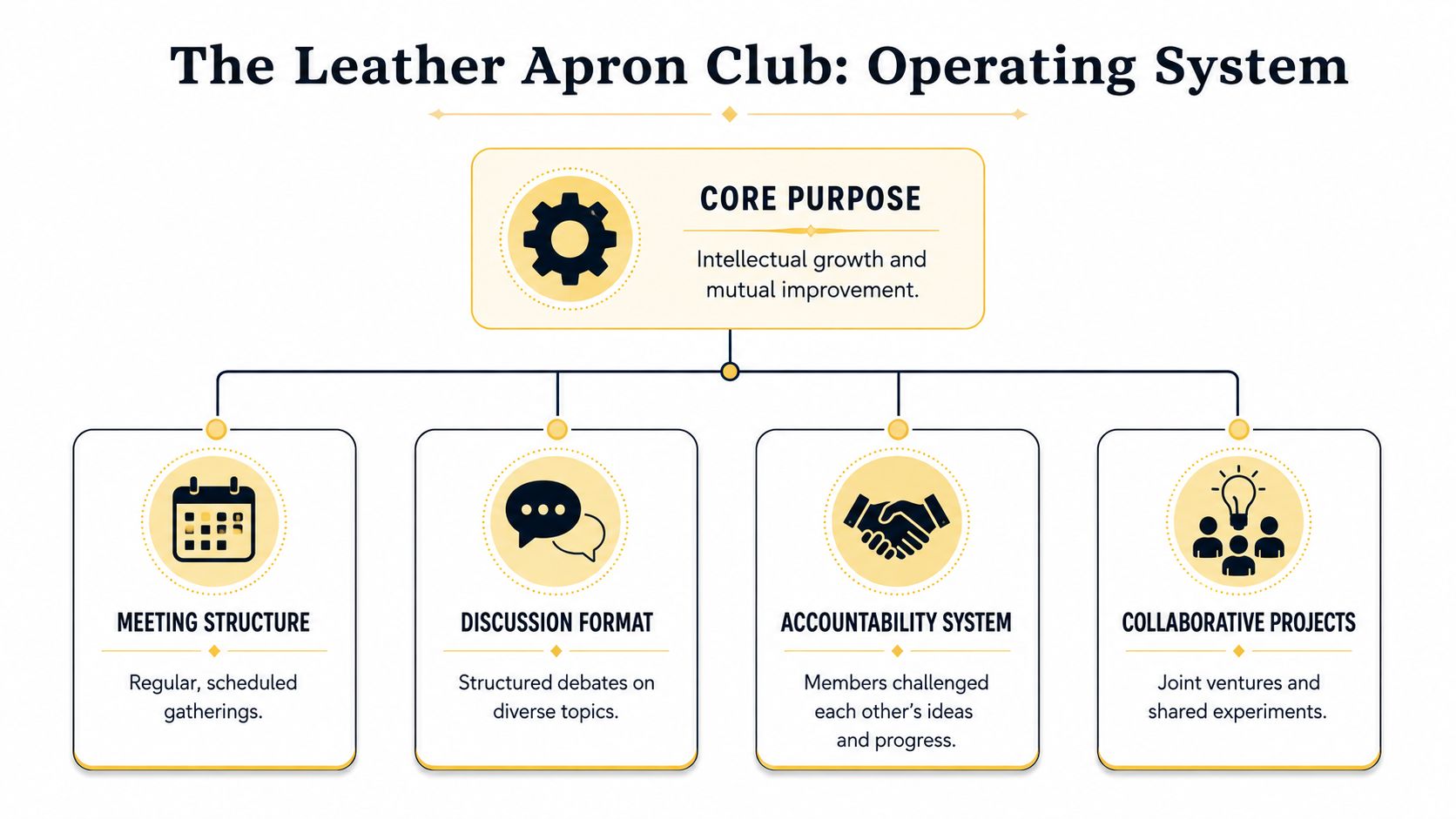
The operating logic behind the room
The club worked because its purpose was larger than conversation. Members came in with their minds, their questions, and their observations, then left with ideas sharpened by the group.
That is the first lesson for coaches. A group becomes useful when people know why they are there before the first call starts. If the purpose is vague, the room drifts into polite updates. If the purpose is clear, the room starts to build a shared culture.
The second lesson is structure. Franklin's circle did not rely on random access. It used a small, recurring, peer-learning format, which sits at the opposite end of a large lecture. A small room makes it easier for people to speak openly, challenge each other, and return with proof of progress. Why the small recurring format mattered
Why coaches should care about the format
A mastermind often loses strength when it turns into a loose forum for updates. Franklin's group points to a better design. Every meeting should do at least one of three things, and ideally all three.
- Surface practical problems. Members should bring real issues, not abstract ambitions.
- Exchange usable ideas. People need to leave with something they can test right away.
- Create social accountability. The room should make follow-through more likely, not less.
For a modern coach, that can look like a cohort that rotates between skill-sharing, hot-seat problem solving, and peer feedback. It can also mean asking members to report what they tried since the last meeting, what worked, and what did not.
The same principle shows up in memory and retention. People keep what they use, discuss, and explain to others, which is why tips for students and professionals fit this model so well.
A group gets stronger when participants are expected to contribute, not just consume.
That is the deeper logic of the Leather Apron Club. It was never about collecting smart people. It was about building a system where smart people improved one another through repetition, candor, and practical exchange.
The Impact Beyond Personal Growth
Franklin's model matters because it did more than inspire the people in the room. It helped produce institutions. Sources connect the club's circle and ideals to major public projects in Philadelphia, including the first lending library, the University of Pennsylvania, the volunteer fire company, and Pennsylvania Hospital. How the club's legacy reached civic institutions

Why that matters to a coach
A group program becomes more valuable when it leaves behind something usable. Franklin's club did that by turning discussion into action, then turning action into public infrastructure.
For a coach, that changes the design question. A strong mastermind is not only a place for encouragement. It can also generate shared tools, joint initiatives, client wins, collaborative content, and a stronger professional ecosystem around the members. Franklin's circle later became the American Philosophical Society, which shows how a discussion culture can grow into a lasting knowledge institution.
The business lesson hiding in plain sight
If your group only helps people feel supported, it is incomplete. If it helps them build, test, and contribute, it becomes memorable. That is why the Library Company of Philadelphia matters here. It is described as the first successful lending library in the United States, and that kind of downstream output changes the story from “good community” to “civic engine.” The lending library outcome tied to the Junto
A coach who wants that result should ask a simple question: what tangible thing does this group create together? It does not have to be a public institution, but it should be real. A shared framework, a member referral system, a community playbook, or a collaborative pilot all fit the same logic.
That same kind of community design shows up in Coachful's community guidance, which reinforces a practical truth. Communities last longer when they produce visible value.
Franklin's club also fits a broader learning principle. People remember what they use, discuss, and explain to others, which is why tips for students and professionals belongs in this conversation. A group that turns insight into action gives members more than motivation. It gives them proof.
How to Translate This Model for Modern Coaching
Franklin's club can guide a modern mastermind if you keep the mechanics and update the setting. The goal is not to copy the period style. The goal is to keep the small, recurring, peer-learning format that rewards practical exchange instead of passive attendance. The small-group format takeaway
A coach can treat the old club like a blueprint. Small groups work best when every member is expected to think, speak, and bring something useful to the room. That is the same principle behind building a community with clear contribution norms, where participation gives the group its shape.
Then and now
| Leather Apron Club Principles Then and Now | Franklin's Junto (1727) | Modern Coaching Group (2026) |
|---|---|---|
| Purpose | Mutual improvement through discussion | Clear outcomes, shared growth, and accountability |
| Group size | Small circle of committed members | Intimate cohort with strong participation norms |
| Meeting rhythm | Friday evenings, recurring gatherings | Weekly or biweekly sessions with a fixed agenda |
| Topic focus | Reading, business, civic problems, ethics | Skill-building, hot seats, strategy, decision-making |
| Value exchange | Practical ideas and observations | Weekly value contribution from every member |
| Social function | Peer learning, challenge, and support | Guided feedback, implementation, and accountability |
| Broader effect | Civic institutions and public projects | Client results, collaborations, and community assets |
What to build into the room
The modern coach can borrow Franklin's logic without turning it into a museum piece. Keep the group small enough that every person matters. Make the agenda predictable so people arrive prepared. Require each member to contribute something useful, not just update everyone on their life.
A useful structure looks like this.
- Opening check-in. Each person names one win and one constraint.
- Problem round. One or two members bring a live issue.
- Peer challenge. The group asks sharper questions, not softer ones.
- Commitment statement. Every person leaves with a next action.
- Contribution share. One member brings a template, resource, or insight the others can use.
That rhythm gives the room some pressure in a good way. It also answers the common objection, “Why should I pay for a group if I could just network?” A real group does more than connect people. It changes how they think and what they do next.
For coaches who also need the marketing side of the equation, the marketing playbook for high-ticket clients can help you position a mastermind as a premium environment instead of a general discussion forum.
Design principle: if nobody has to show up prepared, the group will slowly become decorative.
That is why the Leather Apron Club still maps well to executive cohorts, high-ticket masterminds, and founder groups. The model rewards action, reflection, and reciprocity. It does not depend on charisma alone.
Who This High-Impact Model Is For
A Leather Apron Club style group works best for people who want more than a pleasant room to talk in. It fits driven innovators who want direct feedback, intellectually curious members who enjoy serious discussion, and participants who are ready to grow in public. It also asks for a collaborative spirit, because the value comes from what each person brings as much as from what each person receives.
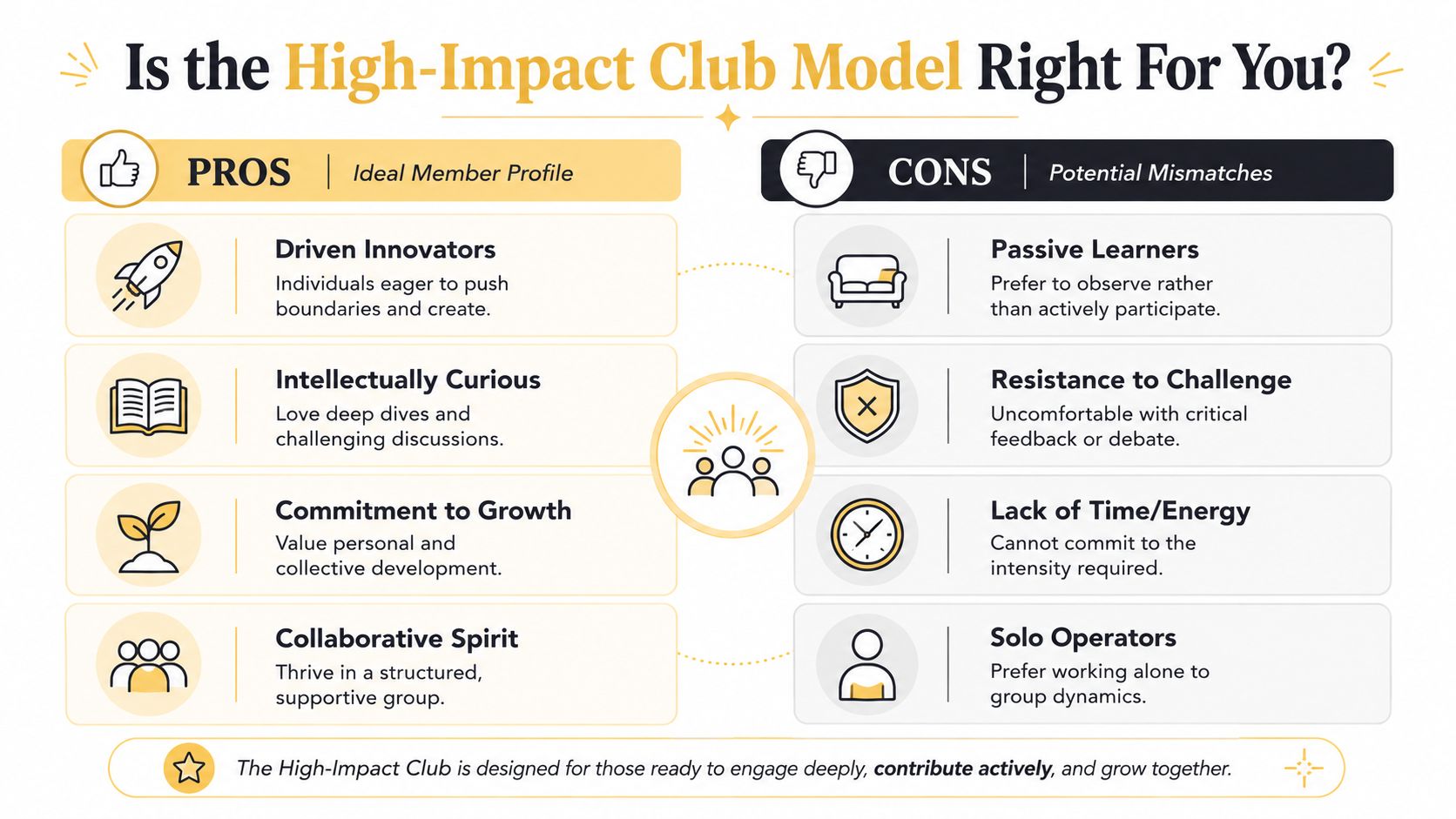
The right member profile
The strongest fit is usually someone with a bias for action. They do not just like the idea of growth, they want a room that helps them move faster and think more clearly. They also need enough steadiness to hear hard questions without treating every challenge as a personal attack.
Intellectual humility matters just as much. Franklin's club worked because people came to exchange ideas, not to win the room. A modern coach should screen for members who can sit with disagreement, think out loud, and stay present when another perspective pushes back. That matters most in high-trust groups, where one defensive participant can lower the quality of the whole conversation.
Who tends to struggle
Some people look interested at first, then strain against the format once the work begins.
- Passive learners. They like receiving information, but not shaping the discussion.
- Resistance to challenge. They want reassurance more than honest feedback.
- Lack of time or energy. They cannot keep pace with the rhythm the group requires.
- Solo operators. They prefer working alone and resent shared accountability.
A coach should take those signs seriously during screening. A strong group is not a place to rescue people from habits they are unwilling to change. It is a place to strengthen the discipline they already have.
For coaches building a deeper membership layer, custom community management helps with the operational side of keeping the right people engaged once they join.
Fit is the final test. When the room matches the member's temperament, they participate, contribute, and stay open. When it does not, they withdraw long before the program is over.
How This Differs From Other Group Formats
A Leather Apron Club-style group can look familiar at first glance, yet its purpose is different. Casual networking is built around contact. Traditional masterminds often center on each member's personal goals. Topic-based group coaching usually follows a curriculum. Franklin's model combines accountability, peer learning, and outward contribution in one structure.
The distinction that matters
A networking event asks, “Who can you meet?” A curriculum asks, “What can you learn?” A mastermind often asks, “What can you accomplish for yourself?”
The Leather Apron Club asks a harder question, “What can you improve, and what can you give back?” That shared focus is what makes the model durable. Members are not only solving their own problems, they are also strengthening the group's collective intelligence.
Side by side comparison
| Format | Main benefit | Main limitation |
|---|---|---|
| Casual networking | New contacts | Low depth, low accountability |
| Topic-based group coaching | Clear learning path | Can become passive if members only consume content |
| Traditional mastermind | Peer insight | Can drift toward goal talk without enough execution |
| Leather Apron Club model | Mutual improvement plus practical output | Requires discipline, candor, and the right member mix |
The modern coach can use this difference in positioning. If a prospect says, “I've been in masterminds before,” the answer is to clarify what changes here. This model is not just about access to smart people, it is about a culture where people build things together and hold one another to a higher standard. For the operational side of sustaining that culture, custom community management guidance can help shape the systems behind a healthier group experience.
The lesson from Franklin is simple. Good groups do not happen by accident. They are designed to reward the right behavior again and again.
Practical FAQs for Launching Your Group
A founder usually wants the same clear answer first. How many people should be in the room? Keep it small, close to Franklin's original 12 members. A compact group makes it easier to protect quality, maintain trust, and make sure each person speaks with intention.
Is there an official Leather Apron Club to join today? No. The strength of the model comes from building your own version. If you're a coach, the task is to adapt the structure for your members, not wait for a historical copy to appear.
How do you enforce the rules without sounding controlling? Build the charter with the founding members. Let the group define the behaviors it wants, the standards it expects, and the consequences for showing up unprepared. Shared rules feel different from rules handed down from above, because members help shape them.
What should you do first? Start with people who already value growth, challenge, and contribution. Then run the first meetings with a simple rhythm so the group learns what good participation looks like. A clear cadence works like training wheels. It keeps the group steady until the habits take hold.
For a coach deciding whether to build this as a private cohort or a broader membership, community platform planning for creators can help with the user experience decisions behind the structure.
The deeper answer is simple. Do not build a room for everyone. Build a room for the people who will use it to make real progress, then keep the standard high enough that the group remains worth the effort.