
Coaching Intake Forms: A Complete Guide for 2026

Coachful

You've probably lived this moment already.
A new client books, pays, and seems excited. You send over a Word doc or a rushed Google Form. Then nothing. The night before the first session, a half-completed form lands in your inbox with one-word answers like “clarity,” “balance,” and “not sure.” You start the session trying to sound grounded as you think, Am I underprepared? Did I ask too much? Did the form feel cold?
That awkwardness doesn't come from the client. It usually comes from the intake process.
Good coaching intake forms don't feel like paperwork. They feel like the first experience of being coached. The client should feel, before you ever meet, that you're organized, thoughtful, and paying attention to what matters. A weak form creates friction. A strong one creates relief. It tells the client, “You won't have to explain yourself from scratch. I already care enough to prepare.”
That shift matters more than most coaches realize. Intake is where clients decide whether your process feels safe, professional, and worth their energy. If your questions are generic, invasive, or too long, rapport drops before session one. If your questions are clear, relevant, and emotionally intelligent, trust starts early.
A simple example shows the contrast.
One coach sends a long intake form with scattered questions about goals, personal history, scheduling, and mindset, all mixed together. The client opens it on their phone, gets overwhelmed, and postpones it. Another coach sends a concise form with a short note: “These questions help me make our first session useful from minute one.” The questions are focused. The client finishes them quickly and walks into the session already reflecting.
Same service. Different experience.
From Paperwork to Partnership
The biggest mistake I see with coaching intake forms is treating them like admin cleanup. That's when coaches pull a template from an old folder, add a few niche-specific questions, and hope it's “good enough.”
It rarely is.
When a form feels clunky, the client notices. They may not say, “This onboarding lacks emotional precision,” but they feel it. They hesitate. They skim. They hold back. Then the first session starts with vagueness, and you spend valuable time trying to recover depth that should have been gathered earlier.
What the client is silently asking
Clients don't experience your form as a neutral document. They read it through emotion.
They're often wondering things like:
- Will this be easy to complete: If the form feels draining, they already suspect the coaching may feel demanding in the wrong way.
- Will I be understood: If your questions are generic, they assume your coaching might be generic too.
- Is this safe: If the form pushes for deep vulnerability too early, they may protect themselves instead of opening up.
- Did I make the right decision: Every step after booking either confirms their choice or weakens it.
That's why intake isn't separate from rapport. It is rapport.
Practical rule: Every question should earn its place by doing at least one of two jobs. Gather useful context or increase client trust.
The form is already coaching
A strong intake form starts the reflective process before the call.
For example, “What are your goals?” often gets shallow answers. But a question like, “What would make our first few sessions feel genuinely worthwhile to you?” does something different. It invites the client to think, prioritize, and reveal expectations. They're no longer just filling out a form. They're beginning the work.
That's the core shift. Your intake process can move from transaction to partnership.
A coach who understands this doesn't ask more questions. They ask better ones. They don't overwhelm the client to prove professionalism. They reduce noise so the right signals come through. They know the first session goes better when the client arrives feeling seen, not processed.
The True Purpose of Your Intake Form
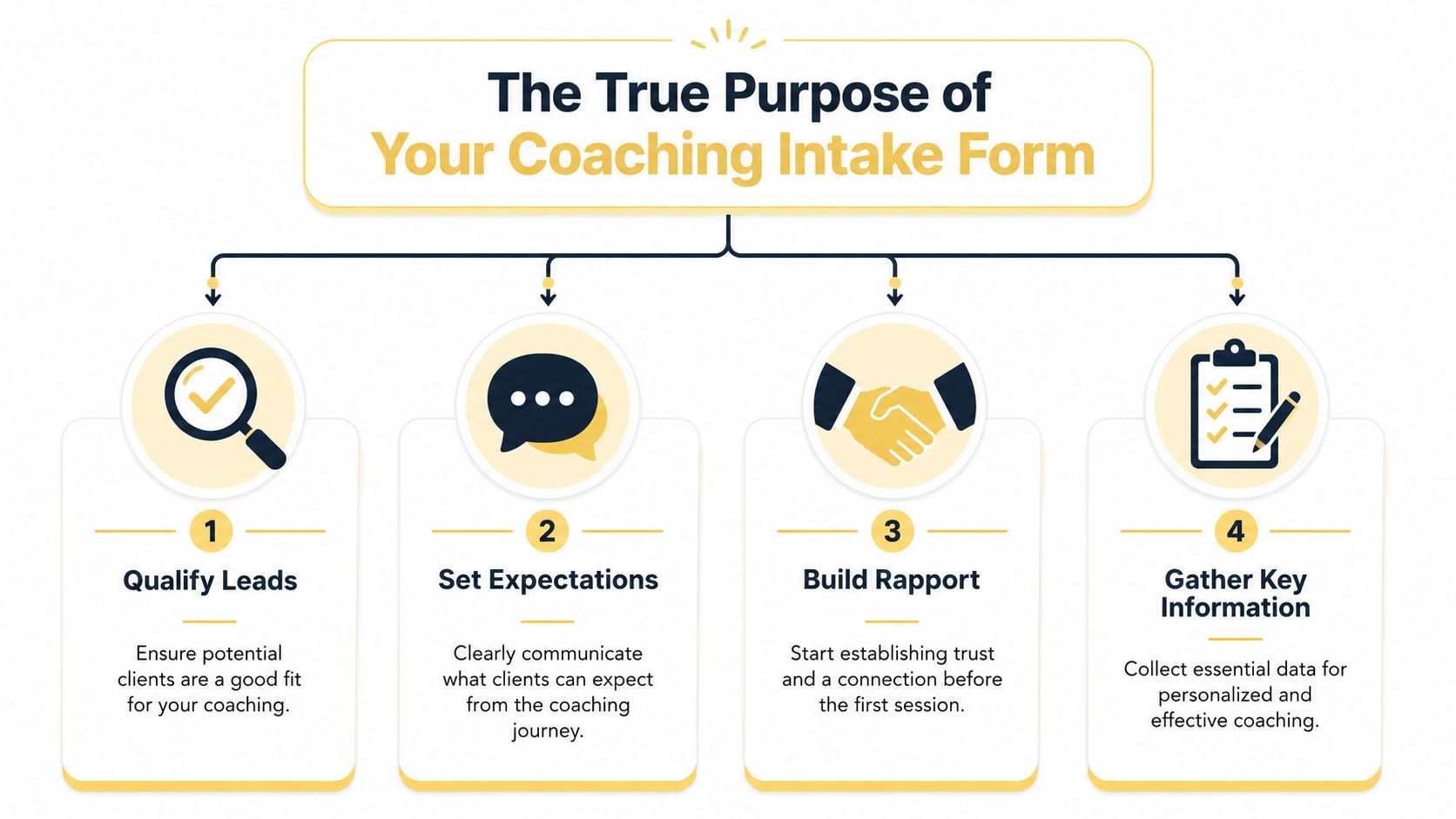
Many coaches think the purpose is obvious: get background information before the first session. That's true, but it's incomplete. The core job of a coaching intake form is broader and more strategic.
It should help you filter fit, establish tone, prepare for a better conversation, and strengthen the client's sense of commitment. A form that does only one of those jobs is underperforming.
It qualifies, not just collects
Some clients are ready. Some are curious but vague. Some want reassurance more than coaching. Your intake form helps you spot the difference without turning the process into an interrogation.
If a client can describe what they want, what they've already tried, and what kind of support works for them, you're seeing useful signs of readiness. If every answer is foggy or outsourced to you, that's useful too. It doesn't mean they're a bad person. It means you may need stronger expectation-setting before the relationship starts.
It sets the tone of your practice
The form tells clients what kind of coach you are.
If your questions are rushed and mechanical, your process feels rushed and mechanical. If your questions are thoughtful and well-paced, your coaching feels intentional. This is especially important for clients who feel nervous about being judged, oversharing, or “doing coaching wrong.”
A well-designed form says, “We can be direct here, and we can also be human.”
It makes the first session sharper
When the intake is strong, you don't spend the opening twenty minutes collecting facts you could have gathered earlier. You can go straight to tension, patterns, priorities, and momentum.
That doesn't mean the form should be bloated. In fact, the opposite works better. Co-Active notes that coaching intake forms should be concise enough for clients to complete in 10 to 20 minutes, typically spanning 15 to 25 questions, and that sending the form immediately after booking helps capitalize on peak motivation.
That guidance addresses a common fear coaches have: Won't a proper form scare people away? Usually, no. What scares people away is friction with no clear payoff.
A good intake form feels like a thoughtful preview of your coaching, not homework assigned by a stranger.
It builds commitment before session one
When a client names what they want, what they've struggled with, and what they hope this work changes, they become more invested in the process. The form acts like a quiet threshold. They stop being a buyer and start becoming a participant.
That's why the best coaching intake forms are not passive documents. They ask for enough reflection to matter, but not so much that the client stalls out.
A useful mental model is this:
- Qualification helps you see whether this is the right client relationship.
- Expectation-setting reduces confusion and hidden assumptions.
- Rapport-building creates emotional safety before the first live interaction.
- Preparation gives you material to coach from, not just biographical notes.
When those four functions are present, the form stops being admin. It becomes part of your method.
Crafting Questions That Actually Matter
Most intake forms fail in one of two ways. They're too vague to be useful, or too invasive too soon.
You don't need either extreme. You need questions that invite reflection, create clarity, and help you coach the actual human in front of you.
A solid structure starts with four categories: logistics, goals and vision, background and context, and coaching preferences. That mirrors the core sections many well-structured forms use: contact information, client goals, personal history, and coaching preferences, as outlined by AidaForm's intake form guidance.
Logistics that remove friction
This category isn't exciting, but it matters. Bad logistics create avoidable strain.
Ask for what you need to run the relationship smoothly. For example:
- Preferred name and contact details: Useful for communication and simple respect.
- Time zone and preferred communication method: Important if you coach remotely.
- Anything that may affect scheduling or responsiveness: Helpful for setting realistic expectations.
The key is restraint. Don't bury practical questions under a pile of optional details. The client should feel that every field has a purpose.
Goals that create specificity
Many forms go generic. “What are your goals?” often produces abstract answers because the question is too broad.
Try questions that force a useful frame:
- What does success from our work together look like in the near term
- If our coaching worked well, what would be different in your day-to-day life
- What feels most urgent for you right now
- What would make this investment feel worthwhile
These questions do two things. They sharpen your understanding, and they help the client move from vague desire to concrete intention.
A business coach might ask, “What decision are you postponing right now?” A life coach might ask, “Where do you feel stuck in a way that's become expensive emotionally?” A leadership coach might ask, “Where are you over-functioning, and what is that costing your team?”
The point isn't to sound clever. It's to help the client say something real.
Background that gives context without turning clinical
You need context, but you don't need a full autobiography before trust exists.
Good background questions stay relevant to the coaching work:
- What have you tried so far to move toward this change
- What has helped, even a little
- What tends to get in your way
- What strengths have helped you through previous challenges
These questions reveal patterns. You learn whether the client tends to avoid, overthink, push too hard, seek external approval, or abandon plans when discomfort rises.
They also protect rapport. You're asking for history in service of action, not for the sake of extraction.
Ask for the minimum amount of personal history needed to coach well. Earn the rest through the relationship.
Coaching preferences that reduce mismatch
This section is one of the most overlooked parts of coaching intake forms. Yet it can save you from subtle friction later.
Examples:
- How do you prefer to be challenged
- What helps you stay accountable without feeling pressured
- How do you usually respond to feedback when you're stressed
- What do you need from a coach to feel supported and honest
A client who says, “I need directness, but not surprise confrontation,” has told you something valuable. Another who says, “I shut down when I feel judged,” has saved you both from a preventable rupture.
If you want extra ideas on wording and structure, it helps to study adjacent examples in optimizing lead generation forms. The psychology overlaps more than coaches think. Clear sequencing, lower friction, and better prompts improve completion and answer quality.
How to assess readiness without sounding judgmental
Many coaches sabotage trust by asking, “Are you coachable?” or “How committed are you?” and wonder why clients get guarded.
A better approach is indirect and behavioral. The University of Oregon coaching intake resource recommends using commitment scales such as “On a 1–10 scale, how committed are you to making real changes now?” and behavioral prompts such as “What have you tried so far to move toward these goals?” This reveals readiness more effectively than blunt labels.
That question works because it gives the client room to tell the truth. A 6 can be more useful than a performative 10, especially if they explain what would help raise it.
Here's a practical table you can adapt.
| Category | Example Question | Why It Works |
|---|---|---|
| Logistics | What's the best email and phone number for coaching communication? | Keeps admin simple and reduces avoidable back-and-forth. |
| Goals and vision | What would make our work together feel successful in the near term? | Pulls the client toward specific outcomes instead of broad aspirations. |
| Goals and vision | What feels most urgent for you right now? | Surfaces priority and emotional charge. |
| Background and context | What have you tried so far to move toward these goals? | Reveals effort, patterns, and readiness without judgment. |
| Background and context | What tends to get in your way when you try to change this? | Exposes obstacles you'll likely coach around early. |
| Coaching preferences | How do you prefer to be held accountable? | Helps you tailor support instead of imposing your style. |
| Coaching preferences | What kind of feedback helps you stay open rather than defensive? | Builds safety and reduces avoidable tension. |
| Readiness | On a 1–10 scale, how committed are you to making real changes now? | Creates a clean readiness signal and opens a useful follow-up conversation. |
If you want a faster starting point instead of building from scratch, a practical option is using an intake form generator for coaches and then customizing the language to reflect your niche and style.
Designing Your Automated Onboarding Workflow
A client pays, gets no confirmation, receives the intake form a day later, then wonders if the first session is still happening.
That doubt starts before coaching starts.
A strong intake form cannot rescue a sloppy workflow. If scheduling lives in one tool, payment in another, forms in a third, and reminders depend on memory, clients feel every handoff. They do not call it a systems problem. They experience it as uncertainty. They start asking quiet questions you never hear out loud. Did my payment go through? Did I miss a form? Am I already chasing my coach for basics?
What a smooth workflow looks like
The best onboarding flow feels calm, clear, and expected. Clients should know what happened, what comes next, and what deadline matters.
A practical sequence looks like this:
- They book a session or package
- Payment is handled
- The right intake form is sent immediately
- A clear completion deadline is attached to the first session
- Reminders go out automatically if needed
- You review responses in one place before the call
Order matters. Send the form while commitment is fresh and the client is still mentally in decision mode. Wait too long, and completion rates drop because the task now competes with the rest of life.
I also recommend matching the form to the moment. A prospect who just booked a call needs a short, focused next step. A paid client can handle a deeper onboarding request because trust and commitment are already higher. That distinction saves energy on both sides and protects rapport before the first session.
Manual workflows create quiet trust leaks
Coaches often underestimate how much the back end shapes the relationship.
A manual process usually breaks in small ways. You send the invoice, then forget the form until later. A reminder does not go out. The client fills everything out ten minutes before the call, or worse, after it. You start the session skimming answers instead of listening well.
Nothing about that looks dramatic. It still changes the tone of the relationship.
Clients read process as a signal. If onboarding feels thoughtful, they expect thoughtful coaching. If onboarding feels scattered, they assume sessions may feel the same. That may not be fair, but it is real.
I have seen this repeatedly. Coaches work hard to sound warm on the call, while their intake experience signals disorganization before they ever speak.
Build for clarity first, then efficiency
Good automation is less about fancy tools and more about reducing ambiguity.
Start with three triggers. After booking, confirm the appointment. After payment, send the correct form. If the form is incomplete, send a reminder with the due date and the reason it matters. Once the form is submitted, confirm receipt and let the client know you will review it before the session.
That last message matters more than many coaches realize. It tells the client, “Your effort landed. I'm paying attention.”
If you want a clearer model for connecting those steps, this guide to client onboarding automation for coaches shows how to tie scheduling, forms, reminders, and follow-up into one client-facing experience.
Keep the back end intelligent, not cluttered
Automation should reduce friction, not create a maze.
Use one place to review responses. Use simple naming conventions. Store notes where you can find them fast. If your intake answers, session notes, and follow-up ideas are spread across inboxes, docs, and random folders, you will lose useful context that could have helped the client feel fully understood. For coaches who want a better way to hold that knowledge, create your second brain with AI can support note organization and retrieval without turning your practice into a tech project.
A short walkthrough helps make the operational side more concrete.
The standard is simple. Clients should never have to guess what happens next, where to send something, or whether you saw it. When the workflow is clear, the intake process does more than collect information. It starts building safety, confidence, and momentum before the first conversation.
The Two-Stage Intake Strategy for Better Clients
Most advice about coaching intake forms assumes there should be one form for everyone. That sounds efficient, but it creates the wrong kind of friction.
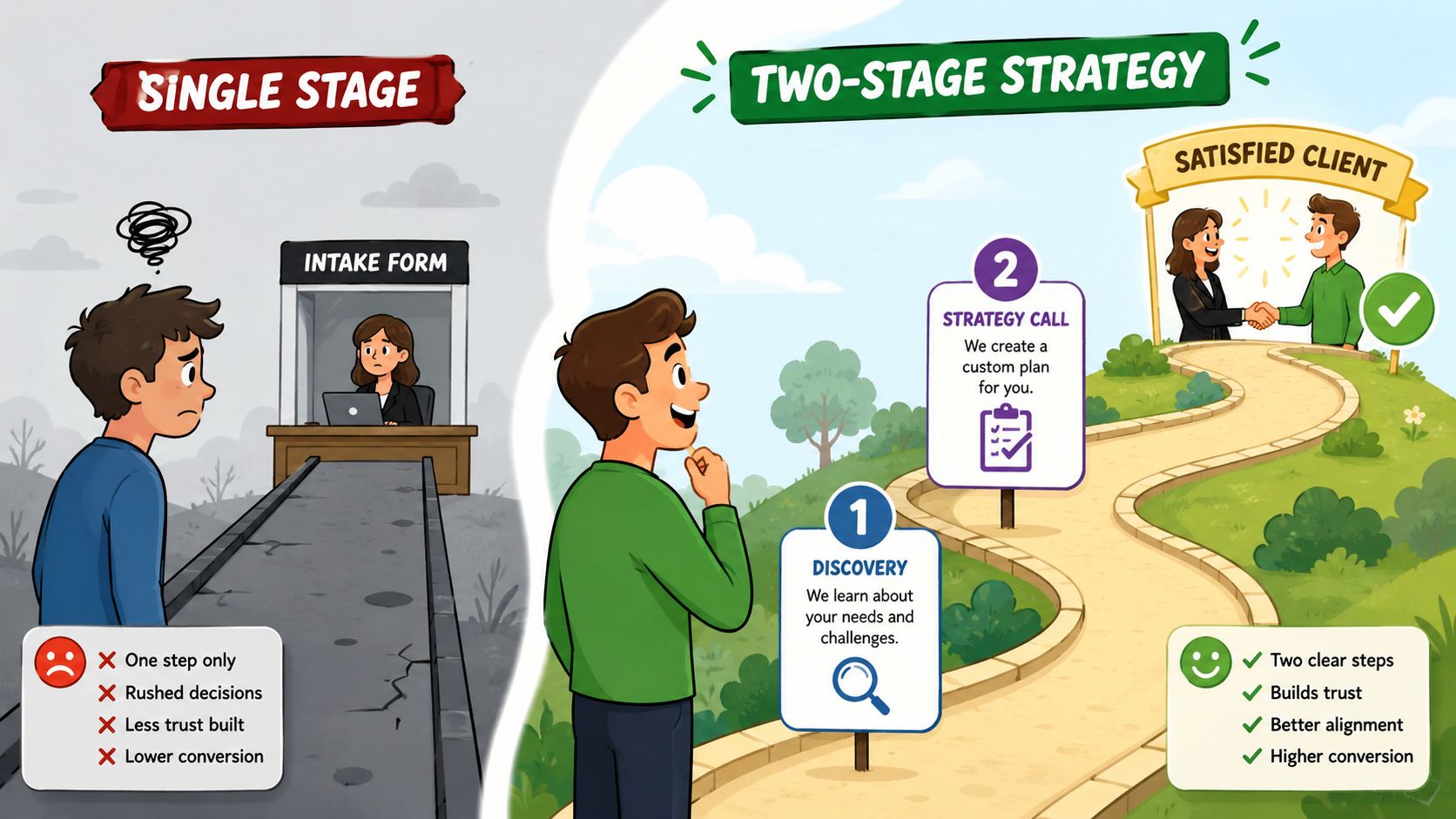
Prospects are not paying clients yet. They haven't earned or accepted a deep onboarding process. If you send a full intake form too early, you increase resistance. If you wait to ask any meaningful questions until the discovery call, you waste time on conversations that were never a fit.
That's why the two-stage model works better.
Stage one filters before the call
Top coaching educators advocate a two-stage intake system, using a short 5 to 6 question form for prospects before a discovery call and a more detailed form after booking, as discussed in this two-stage intake conversation.
The first form should be light and strategic. You're not trying to “know everything.” You're trying to answer a smaller set of questions:
- Why are they reaching out now
- What kind of problem are they trying to solve
- How urgent does this feel
- Are they likely to be a fit for your style and offer
- Can they articulate what they want help with
A pre-discovery form might ask:
- What prompted you to seek coaching right now
- What would you like help making progress on
- What have you tried so far
- Why does this matter at this point in your life or work
- What would make a discovery call feel useful to you
That's enough to spot seriousness, clarity, and fit.
Stage two deepens after commitment
Once someone books and pays, the relationship changes. Now a fuller intake makes sense because the context has changed. The client has said yes. They're ready to invest effort, not just attention.
This second form can go deeper into goals, patterns, preferences, and constraints. It prepares you to coach, not just to qualify.
The hidden benefit is psychological. The client experiences a clean progression. First, low-friction contact. Then, once commitment exists, more meaningful reflection. That sequencing feels respectful. It matches the stage of the relationship.
You don't need one perfect form. You need the right form at the right moment.
Coaches often resist this because it sounds like more setup. In practice, it saves energy. You stop having discovery calls with people who can't explain what they want. You stop sending full onboarding to people who aren't committed. Your process gets lighter and smarter at the same time.
Your Form Is Your First Promise
Clients don't separate your coaching from your onboarding as neatly as coaches do. To them, it's one experience.
That's why your form matters so much. It's the first promise you make about what it will feel like to work with you. It says whether you're thoughtful or generic, whether you're organized or improvised, whether you ask with care or ask out of habit.
A strong intake process does more than gather facts. It lowers anxiety. It increases reflection. It helps the client arrive with language for what matters. It helps you start from signal instead of noise.
A quick audit for your current form
If you want to improve your current process, ask yourself:
- Does every question have a clear job: If not, remove it.
- Would a nervous client feel safe answering this: If not, rephrase it.
- Am I asking for context or just collecting data: The difference shows in the quality of answers.
- Does the sequencing respect the stage of the relationship: If not, consider a two-stage system.
- Would this form make me feel understood if I were the client: That question catches more than most checklists.
Sometimes the fix is small. One question changes. The order improves. The language softens. The delivery becomes immediate and structured. Suddenly the first session feels cleaner, warmer, and more useful.
If you want more practical assets for refining your process, a library of templates for coaches can help you pressure-test your wording and structure without defaulting to generic forms.
Your intake form won't do the coaching for you. But it can make the client more ready, make you better prepared, and make the relationship feel solid from day one.
If you're ready to turn scattered onboarding into one polished client experience, Coachful gives you a practical way to do it. You can bring scheduling, payments, intake forms, reminders, notes, and client progress into one place, so your process feels as professional as your coaching.