White Label App: A Coach's Guide to Client Portals

Coachful
You're probably already doing excellent coaching and delivering uneven operations.
A client books through one tool. You send prep work from another. Session notes live in a doc you swear you'll organize later. Payments go through a separate link. Between sessions, accountability happens in text messages, DMs, voice notes, and email threads you can't fully track. Your coaching may be premium. Your delivery system can still feel patched together.
That mismatch matters more than most coaches admit. Clients don't separate your wisdom from the way they experience it. If they have to hunt for the worksheet, ask again for the Zoom link, or forget where to log progress, they feel friction. Friction lowers follow-through. Lower follow-through weakens results. Then you end up working harder to create momentum that your systems should have supported in the first place.
A white label app can fix that. Not because apps are trendy, but because a branded client portal can turn your coaching process into something coherent, visible, and easier to stick with.
The End of Digital Chaos for Your Coaching Business
You know the pattern.
A new client signs up on Friday. You email the intake form, manually send the payment link, paste your calendar booking page, then remember on Sunday that you forgot the welcome resources. On Monday, the client asks where to upload their goals. During the first session, you're toggling between notes, worksheets, and a habit tracker that lives somewhere else.
None of this means you're disorganized. It means your business has grown past the point where tool-stacking feels clean.
When your systems dilute your coaching
A coach can be brilliant in conversation and still create a clunky client experience. That's common. The problem isn't your expertise. It's that disconnected tools force clients to manage the process themselves.
Consider a few everyday moments:
- A busy executive client misses a reflection prompt because it was buried in email.
- A health coaching client forgets where to log meals, so they stop tracking for a week.
- A leadership client wants to revisit a breakthrough from session three, but your notes aren't visible to them in any structured way.
Those aren't small misses. They chip away at accountability.
Clients rarely say, “Your delivery stack is fragmented.” They say, “I got busy,” or “I wasn't sure where to find it.”
That's why more businesses are moving toward app-based delivery. The global mobile application market is projected to reach $614.40 billion by 2026, according to Statista's forecast cited here. For coaches, the signal is simple. People increasingly expect a smoother digital experience, and businesses want faster ways to deliver it without building software from scratch.
If you're feeling the strain of too many moving parts, you're not behind. You're at the stage where operations need to catch up with your reputation. A more unified setup, whether through a portal or client management software for coaches, gives your practice something every mature business needs: one place where the client journey lives.
What clients feel on the other side
Your clients don't wake up wanting “better software.” They want certainty.
They want to know:
- Where do I go next
- What should I focus on this week
- How do I measure whether I'm making progress
- How do I stay connected between sessions without chasing my coach
A branded app won't make you a better coach. It will make your coaching easier to receive, easier to act on, and easier to value.
What a White Label App Actually Means for You
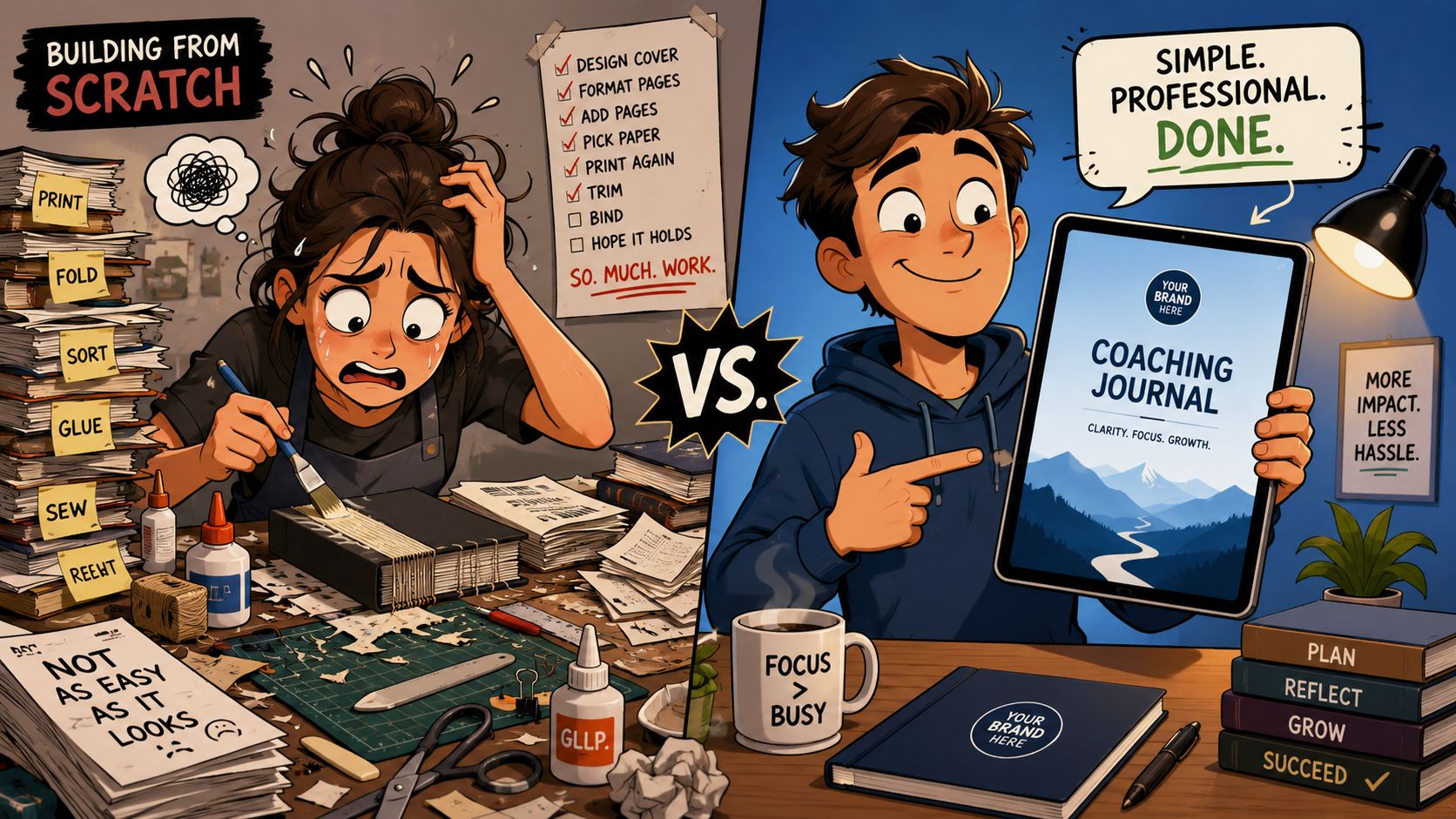
A white label app is a pre-built application that another company develops, maintains, and updates. You license it, add your brand, and present it to clients as part of your business.
That's the plain-English version.
If custom development is commissioning a private architect to design your dream house from bare land, a white label app is buying a well-built home in a strong neighborhood and remodeling the interior so it looks and feels like yours.
What you're actually buying
You're not buying code. You're buying speed, structure, and presentation.
A decent white label app usually gives you a branded client environment where people can access things like:
- Session materials such as worksheets, recordings, and action plans
- Progress tracking for goals, habits, milestones, or check-ins
- Messaging or communication between sessions
- Scheduling and access so clients stop hunting through old emails
- A more premium container for your methodology
Your client opens the app, sees your logo, your colors, your language, and your framework. To them, it feels like your system. That matters because coaching is partly transformation and partly environment. The container shapes the commitment.
Why coaches get drawn to it fast
The main attraction is speed. The primary benefit of a white label solution is reducing time to market from months or years to just days by using pre-built technology with minimal upfront investment, as outlined in this explanation of white label app development.
That has real coaching implications.
If you've been thinking:
- “I want a proper client portal, but I'm not starting a software company.”
- “I need something polished without disappearing into a tech project.”
- “I want clients to feel like they entered my world, not a pile of links.”
Then white labeling makes sense.
Practical rule: If your core offer is coaching, your tech should support delivery, not become your second career.
What it changes for the client experience
A white label app gives your work a home.
That changes how clients perceive your offer. A weekly mindset coach can feel more structured when clients see check-ins, milestones, and resources in one place. A fitness coach can feel more credible when plans, progress, and communication all happen inside a branded environment. An executive coach can feel more discreet and premium when confidential notes and next steps aren't floating across inboxes.
You're still doing the coaching. The app makes your process visible.
And for a tech-hesitant coach, that's the key point. This isn't about replacing your craft. It's about packaging your craft in a way clients can trust, use, and return to between sessions.
Choosing Your Path Custom Build vs White Label
Most coaches ask the wrong first question. They ask, “Should I build an app?” The better question is, “What level of control do I need, and what burden am I willing to carry?”
There are really three paths: custom build, white label app, or an all-in-one platform.
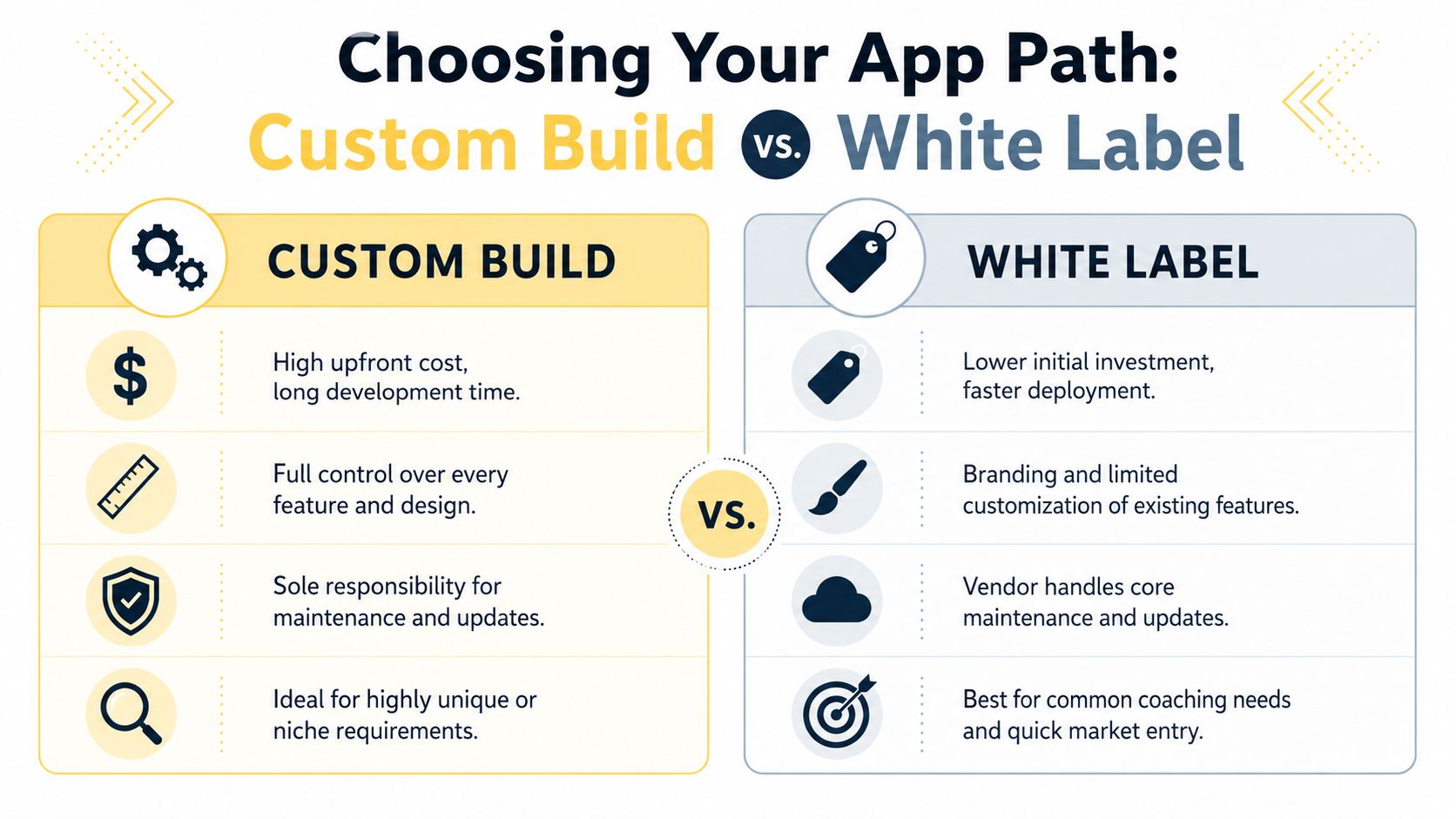
Coaching Platform Options Compared
| Criteria | Custom Build | White Label App | All-in-One Platform (e.g., Coachful) |
|---|---|---|---|
| Cost | Highest upfront commitment and ongoing technical spend | Lower initial investment, usually subscription-based | Predictable subscription cost |
| Time to Launch | Slowest | Fast | Fast |
| Brand Control | Full control | Strong branding control, within vendor limits | Limited to platform branding options |
| Feature Flexibility | Highest flexibility | Moderate flexibility based on available modules | Moderate, based on built-in feature set |
| Maintenance Burden | You own it | Vendor handles core maintenance | Platform handles maintenance |
Custom build is for unusual needs, not normal ambition
Custom software sounds seductive because it promises total control. And yes, if you want a coaching workflow with exacting requirements, unusual permissions, a proprietary methodology engine, or unique client-side interactions, custom can do that.
It also puts you in the software business.
That means someone has to manage bug reports, product decisions, updates, testing, and infrastructure. If you're a coach with a clear method but no appetite for product management, custom is often an ego decision disguised as a strategic one.
If you want a grounded view of what agencies quote for app projects, review these understanding agency app development quotes. Not because you need exact numbers from every provider, but because seeing how scope expands will sober up vague app fantasies quickly.
White label works when your method is distinct but your mechanics are common
This is the sweet spot for many coaches.
Your brand, voice, and process may be highly differentiated. But the mechanics often aren't. Clients still need onboarding, content access, check-ins, scheduling, messaging, notes, reminders, and progress tracking. Those are common delivery needs.
A white label app lets you own the presentation without funding the entire machine underneath it.
Choose this route if:
- You care about brand presence and want clients inside your ecosystem
- You want to launch fast instead of waiting through a long build cycle
- Your process is structured enough to fit inside an existing framework
- You don't want technical ownership of every future problem
All-in-one platforms are often the most practical option
Some coaches resist this route because they think it's less “theirs.” That's the wrong lens.
If the platform creates a smooth client journey, protects data, handles admin, and helps you coach better, ownership becomes less important than reliability. Plenty of successful coaches don't need a public-facing branded app. They need one place to run the business cleanly.
If your clients care more about clarity than custom icon colors, don't overspend chasing the feeling of owning software.
The decision in plain terms
Go custom if your business has uncommon requirements and you're prepared for ongoing technical responsibility.
Go white label if you want a branded experience and faster launch without coding.
Go all-in-one if you want the operational benefits most coaches need and you'd rather spend your energy coaching, selling, and refining your program.
That's the honest hierarchy. Start with the least complex option that still supports your client experience.
How Coaches Use Branded Apps in the Wild
The value of a white label app becomes obvious when you stop thinking about features and start thinking about moments.
A client wakes up anxious before a board presentation. Instead of digging through email, she opens her coach's app, reviews her preparation prompts, checks the confidence routine they built together, and reads the notes from their last session. That's not just convenience. That's coaching becoming available at the moment it matters.
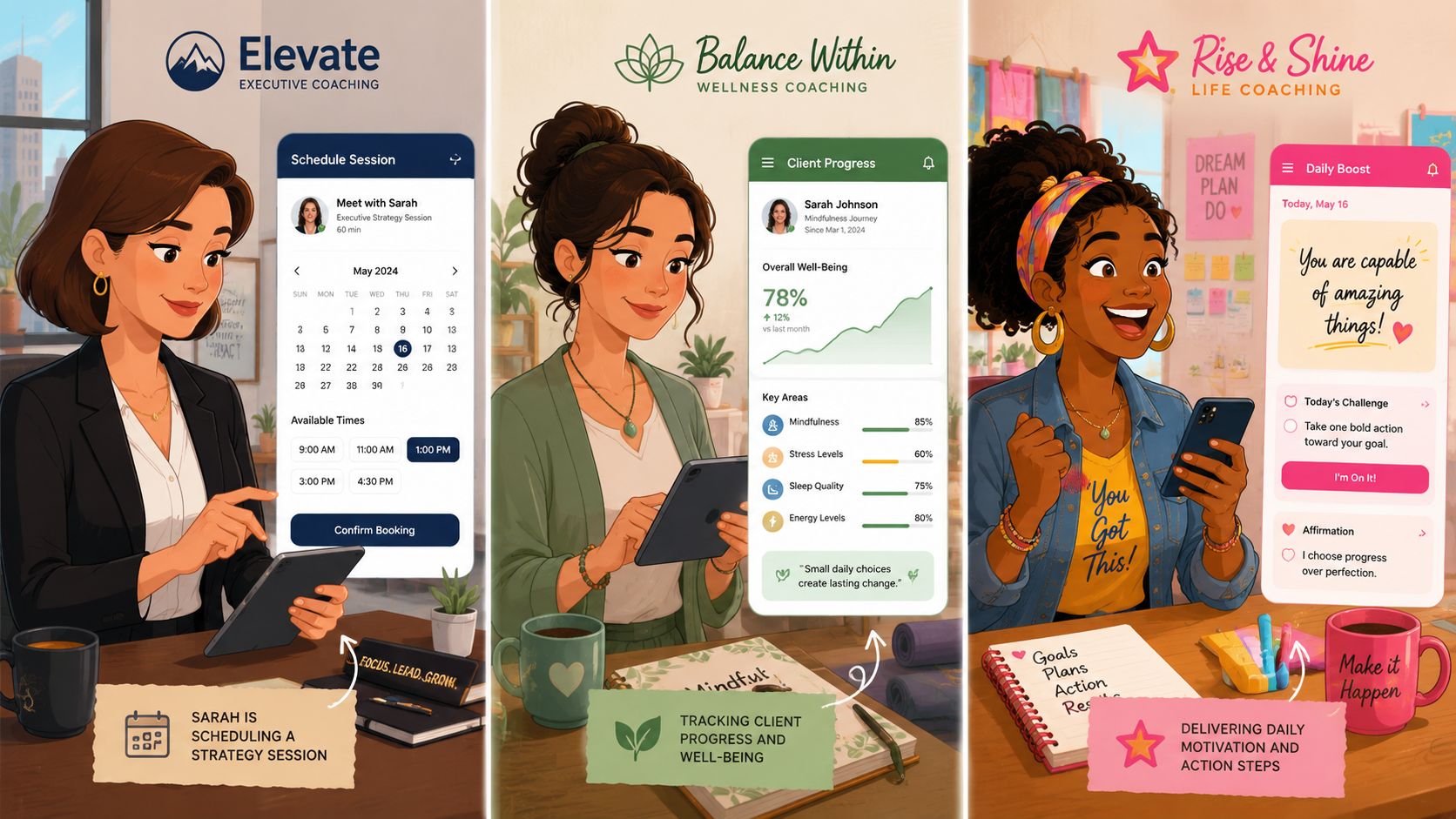
Executive coaching that feels premium
Take an executive coach serving senior leaders. Her clients don't want clutter. They want a private, polished environment where each engagement feels intentional.
Inside her branded app, she organizes:
- Session summaries so clients can revisit decisions fast
- Leadership goals with visible milestones
- Private reflection prompts between meetings
- Resource libraries for communication, delegation, and presence
For that client, the app strengthens brand perception. It signals discretion, structure, and seriousness. That matters when the buyer is already paying for high-trust advice.
Group coaching that keeps people moving
Now look at a wellness business running cohort programs. Their challenge isn't only delivery. It's momentum.
Clients often start strong, then drift when life gets messy. A branded app can become the home for weekly plans, check-ins, content, and community prompts. That's especially useful when coaches want to reduce the chaos of trying to host accountability in scattered channels.
If you're comparing community-based experiences with familiar discussion tools, looking at apps similar to Discord for coaches and communities can help clarify what your clients need versus what feels active.
A short walkthrough helps make this more concrete:
Education, academies, and multi-coach programs
Larger coaching organizations use branded apps differently. They're often less concerned with one-to-one intimacy and more concerned with consistency.
A coaching academy might use an app to give each student:
- access to curriculum
- mentor messaging
- milestone tracking
- assignment delivery
- a central place for program materials
That kind of structure protects the client experience when multiple coaches or facilitators are involved. The app becomes the operational spine of the program.
The strongest use case isn't “I have an app.” It's “my clients always know where to go, what to do next, and how to stay engaged.”
That's a key win. A white label app can increase the visibility of your method, reinforce accountability, and make your coaching feel more complete between live sessions.
The Hidden Costs in Licensing and Pricing Models
A white label app often feels affordable right up until your clients start relying on it.
That is the moment pricing stops being a software question and becomes a coaching delivery question. If your app is where clients check goals, message for support, track wins, and stay accountable between sessions, every extra fee and every vague support term affects your client experience, not just your ops budget.
Low monthly pricing can hide expensive growth
Entry pricing is designed to calm your concerns. That makes sense. You are a coach, not a product manager, and you should not need a technical education to buy software.
But you do need clarity.
Many vendors start with a simple subscription, then layer in charges for setup, branded onboarding, premium support, integrations, extra admin seats, custom workflow changes, or higher usage. The problem is not that vendors charge for these things. The problem is that many coaches buy based on the starting number instead of the full operating cost six months later, when the program is fuller and the app has become part of the client journey.
If your business grows, your software bill can grow with it. That may still be the right trade-off. Just make sure you are paying for better delivery, not paying a penalty for your own success.
“Maintenance included” rarely covers what coaches assume it covers
Deals go sideways at this stage.
A provider may say they handle maintenance, but that phrase can exclude third-party tools, branded customizations, rush fixes, data recovery, or support tied to user error. A useful discussion in this thread on white label responsibility gaps shows how quickly confusion appears when ownership is not spelled out.
For a coaching business, the risk is practical and immediate:
- A booking integration fails and clients miss sessions
- A payment connection breaks and renewals do not process
- A progress tracker stops updating and clients lose momentum
- A branded feature behaves oddly and your app looks unreliable
- A client cannot access notes or messages and your support team takes the heat
Your clients will not blame the vendor first. They will blame your brand.
That is why you should ask one direct question before signing: what, exactly, gets fixed under standard support, and what triggers a new invoice?
Ask contract questions, not sales-demo questions
You already know how to protect client outcomes in your coaching. Apply that same discipline here.
Ask these questions in writing:
- What counts as a bug, and what counts as a paid change request?
- Who is responsible for broken third-party integrations?
- What support response times are promised in the contract?
- How do fees change if my client count or program usage increases?
- Can I export client messages, notes, and progress data in a usable format if I leave?
- What branded changes are included, and what becomes custom development?
- Who is liable if a technical issue disrupts the client experience?
Also review the provider's privacy and data handling terms before you commit. Cost and data responsibility belong in the same conversation.
Making the final pricing decision
Choose the pricing model that supports the way you coach.
If your offer is still changing, white label software can be a smart way to launch a branded experience without funding a custom build. If your method is established, your workflows are specific, and your clients expect a polished high-touch journey, recurring fees and fuzzy support boundaries can become expensive fast.
A cheap app that weakens accountability, creates friction between sessions, or makes your brand look generic is not cheap. A higher monthly cost can be the better decision if it protects structure, consistency, and trust.
You are not paying for technology for its own sake. You are paying for a delivery system your clients will feel every week.
Keeping Your Client Data Safe and Private
Coaching runs on trust. Clients tell you things they don't tell colleagues, partners, or sometimes even themselves. If your tech stack handles that carelessly, your brand takes the hit, not the software vendor.
That's why privacy can't be an afterthought when you choose a white label app.
What secure architecture looks like in plain English
A secure white-label architecture needs a tenant-aware data model, where every piece of information is tied to a unique client ID so data stays isolated. It also needs dynamic branding logic and feature flags so customization doesn't break the shared codebase, as explained in this guide to the white-label software development process.
In normal language, that means your client's notes, goals, messages, and files should be walled off from every other business using the same platform.
That structure is often called multi-tenant architecture. Don't let the term intimidate you. It means many businesses can use the same software system, but each one should only see its own data.
What to check before you trust a provider
Ask direct questions and expect direct answers.
- Data isolation: How does the platform ensure one coach's client records never appear in another account?
- Access controls: Can you limit what assistants, subcontractors, or team members can see?
- Compliance support: If you work with regulated clients, can the system support requirements such as GDPR or HIPAA at the tenant level?
- Brand customization: Can they adjust branding safely without introducing security mess?
A responsible provider should also explain permissions clearly. If you run a team, role-based access matters. An admin may need full visibility. A support person may only need scheduling access. A junior coach may only need access to their own client roster.
Your privacy standard should be at least as high as your coaching standard.
If a vendor can't explain how they separate client data, don't reward the sales pitch. Walk away.
And if you want to understand how a platform publicly frames its handling of privacy and permissions, review the provider's privacy commitments and data practices before you put sensitive client information inside any system.
The test is simple. If a client asked, “Where does my data go, who can see it, and how is it protected?” you should be able to answer without bluffing.
Your Decision Checklist and Next Steps
The right app should strengthen how you coach, make it easier for clients to stay engaged, and support the business you want to build.
If it looks polished but weakens accountability, confuses clients, or makes your delivery feel generic, it is the wrong choice. Your coaching is the product. The app is the delivery system.
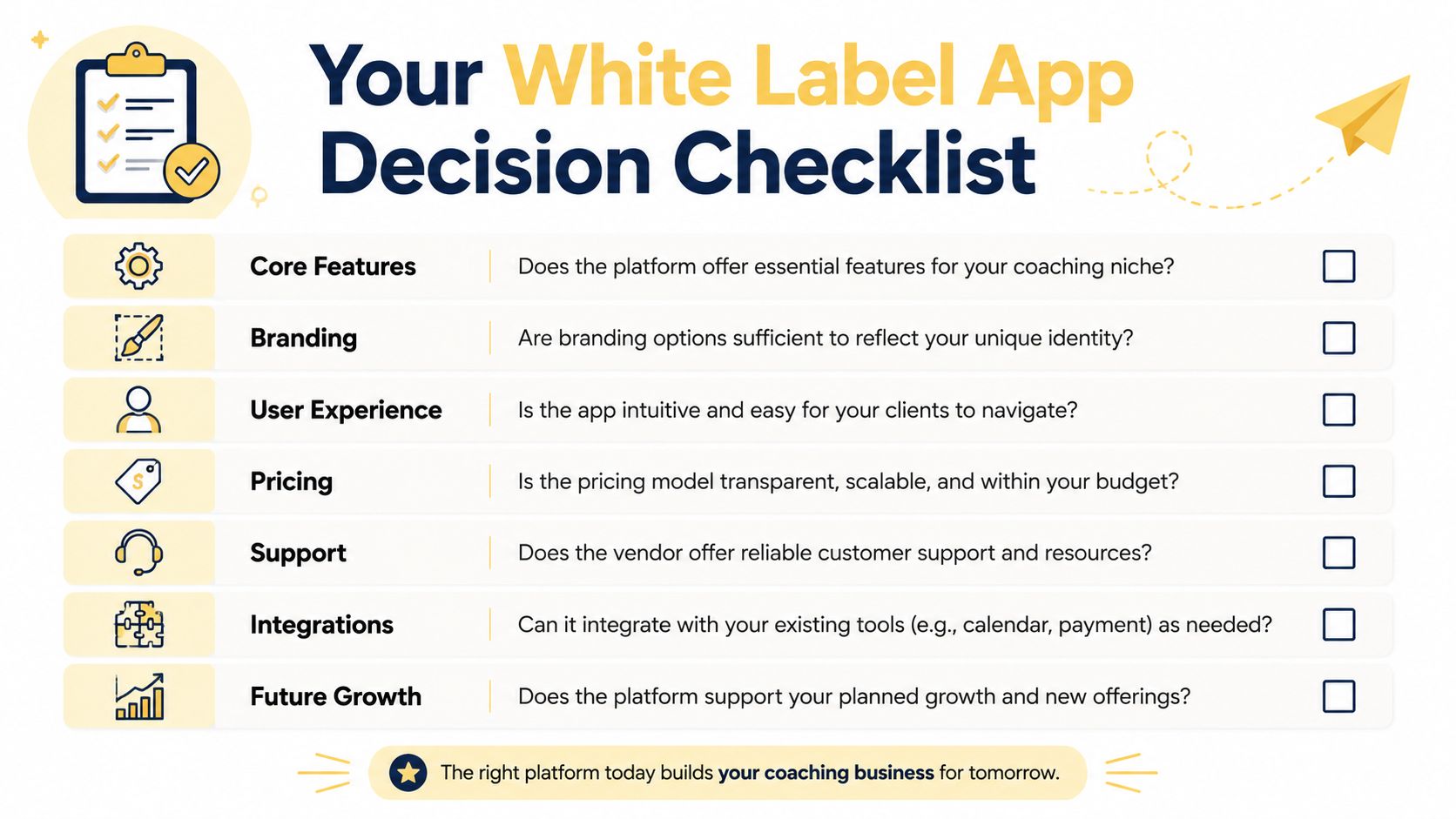
Your short decision checklist
Use this before you book another demo.
- Method fit: Does the platform support how you coach, including accountability, session cadence, homework, and progress review?
- Client ease: Can a busy client open it, know what to do next, and follow through without hand-holding?
- Brand quality: Does the experience feel consistent with the trust, care, and professionalism your clients expect from you?
- Program structure: Can you shape a clear client journey, or are you stuck working around someone else's logic?
- Operational relief: Does it remove admin from your week, or does it just relocate the mess into a nicer interface?
- Contract clarity: Do you know who fixes bugs, handles integrations, and owns problems when something breaks?
- Growth logic: Can it support new offers, group programs, or a team model without forcing a rebuild later?
What to do next
Start on paper.
Map your client journey
Write down what happens from signup to offboarding. Include onboarding, scheduling, session prep, accountability check-ins, messaging, resources, and progress reviews. If the app cannot support that flow cleanly, keep looking.Set a real budget
Include setup, monthly fees, support, admin time, and any integration work. Cost matters, but so does drag. A cheaper tool that creates client confusion or adds manual follow-up costs more than it looks.Book a small number of serious demos
Bring your real coaching workflow into the call. Ask the vendor to show how a client completes tasks, tracks progress, and stays accountable between sessions. That is where the client experience is won or lost.
Modern platforms increasingly use modular microservices architecture and APIs to connect with systems like CRMs and other tools, and many now include AI capabilities such as chatbots and predictive analytics at a subscription price, as described in this overview of modern white-label applications. For coaches, that means the gap between off-the-shelf and bespoke is narrower than it used to be. You may not need as much custom software as you assume.
Choose the platform that protects your time, supports your coaching method, and helps clients follow through.
Choose the app that fits your coaching business. It should reinforce your brand, reduce friction for clients, and make your service easier to deliver at a high standard.
If you want a simpler way to deliver coaching without stitching together scheduling, notes, payments, messaging, and progress tracking across multiple tools, take a look at Coachful. It gives coaches one organized place to run the client journey, keep accountability visible, and deliver a more professional experience without turning technology into a second job.