
Mentoring Program Software: A Coach's Guide to ROI in 2026

Coachful
You're probably managing more moving parts than you want to admit.
A mentor signs up through a form. A mentee emails asking who they've been matched with. Someone misses the kickoff because the calendar invite never went out. Three weeks later, you're chasing updates in Slack, searching old spreadsheets, and trying to remember which pair wanted career development support versus onboarding help. The program still matters. The admin just keeps swallowing the work that makes it effective.
That's the point where mentoring program software stops looking like “one more platform” and starts looking like relief. Not because software replaces the human side of mentoring. It doesn't. It creates enough structure that the human side has a chance to work.
From Spreadsheets and Chaos to Structured Impact
Most mentoring programs don't struggle because the idea is weak. They struggle because the operating system is messy.
When matching lives in one spreadsheet, scheduling sits in Outlook or Google Calendar, resources are buried in a shared drive, and progress updates arrive by email, the program manager becomes a traffic controller. Coaches and HR leaders then ask the same frustrated question: Is this helping people grow, or am I just running admin?
That frustration is valid. Manual systems work for a tiny pilot. They break when participation grows, when multiple program types run at once, or when leaders start asking for evidence that the program is doing something meaningful.
What chaos usually looks like
A typical manual mentoring setup creates familiar problems:
- Matching gets shallow: People are paired based on availability or job title because there isn't time to review goals properly.
- Follow-through gets inconsistent: Some pairs meet regularly. Others go quiet and nobody notices early enough.
- Program visibility disappears: You know people enrolled, but you can't easily see which relationships are healthy and which need support.
- Reporting becomes painful: When leadership asks what changed, you have anecdotes but not a clean picture.
- The participant experience feels fragmented: Mentors and mentees bounce between forms, inboxes, docs, and calendar threads.
That's why many teams eventually look for systems similar to broader client management software for coaches. Not because mentoring is identical to coaching operations, but because both break down when the process lives across too many disconnected tools.
Practical rule: If you're spending more time coordinating the relationship than supporting its quality, the process needs a system.
What structure changes
Good mentoring program software centralizes the operational load. Matching, scheduling prompts, reminders, resource sharing, check-ins, and reporting move into one environment. That doesn't make the program less human. It makes the human work more intentional.
Here's the shift:
| Manual approach | Structured software approach |
|---|---|
| Pairings tracked in spreadsheets | Pairings managed in one system |
| Follow-ups depend on memory | Reminders and workflows keep momentum moving |
| Resources live in scattered folders | Shared materials are organized in one place |
| Problems surface late | Program managers can spot stalled engagement earlier |
| Reporting is assembled manually | Data is easier to review and explain |
For a coach, this means more energy for goal quality, accountability, and relationship repair. For HR or L&D, it means the program becomes governable instead of fragile.
What Is Mentoring Program Software Really
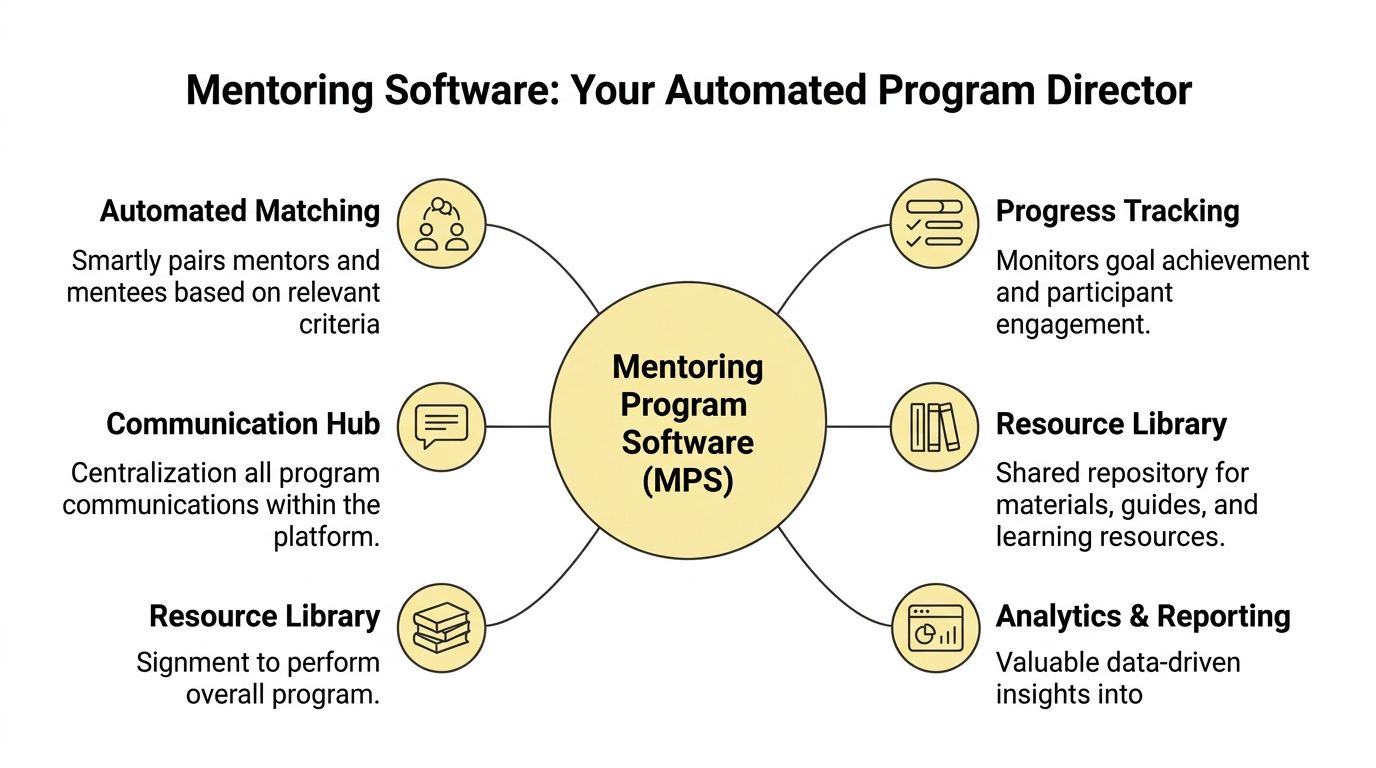
The cleanest way to think about mentoring program software is this: it's a digital program director.
Not a database. Not just a matching tool. Not a glorified signup form. A program director.
A strong platform handles the repeatable mechanics that wear people down. It helps you pair participants, guide them through milestones, keep communication organized, and surface what needs your attention. You still design the experience. The software keeps that design from collapsing under operational weight.
The job it does day to day
If you're a coach, your inner dialogue might sound like this:
“I don't need fancy tech. I need people to stay engaged and do the work.”
That's exactly why the right platform matters. The software isn't there to impress anyone. It's there to reduce the friction that causes mentoring relationships to drift.
A useful platform typically does five jobs well:
- It structures matching: So pairings aren't based only on convenience.
- It holds goals in view: So conversations connect to real development, not vague good intentions.
- It keeps communication visible: So people know where to go and what happens next.
- It organizes resources: So mentors and mentees can use prompts, templates, and curriculum without hunting for them.
- It makes outcomes easier to inspect: So you can see participation, progress, and areas of concern.
The best systems feel less like software training and more like operational clarity.
Why adoption keeps growing
The category is growing because the need is real, not trendy. The global mentoring software market was valued at USD 747.94 million in 2025 and is projected to reach USD 854.82 million in 2026, with growth dominated by cloud-based SaaS platforms that enable quick deployment with low IT overhead, according to 360iResearch's mentoring software market analysis.
That cloud-based shift matters for ordinary buyers. It means a coach, academy, or HR team doesn't need a giant implementation project just to get started. You can launch without building internal infrastructure first.
For the coach who says I'm not technical
You don't need to become a systems person to run a better program.
If you've ever used a shared client portal, online scheduler, or habit tracker, you already understand the principle. Structure supports consistency. In mentoring, that same logic applies to goals, meeting cadence, check-ins, and accountability. If you want a useful companion read on the accountability side of behavior change, Habit Huddle's accountability partner guide is worth a look.
A simple example: a coach running a leadership mentoring circle might use the platform to assign pre-session reflection prompts, log goals after each conversation, and trigger reminder messages before monthly meetings. Nothing flashy. But now the relationship has rhythm.
That rhythm is often what people mistake for “engagement.” In practice, it's structure.
The Tangible ROI for Coaches and Businesses
The investment question shows up fast.
A solo coach asks, “Will this save enough time to justify another subscription?” An HR leader asks, “Can I defend this budget when every tool is under scrutiny?” Both are fair questions. The answer depends less on the feature list and more on whether the platform helps you run a program people actually complete.
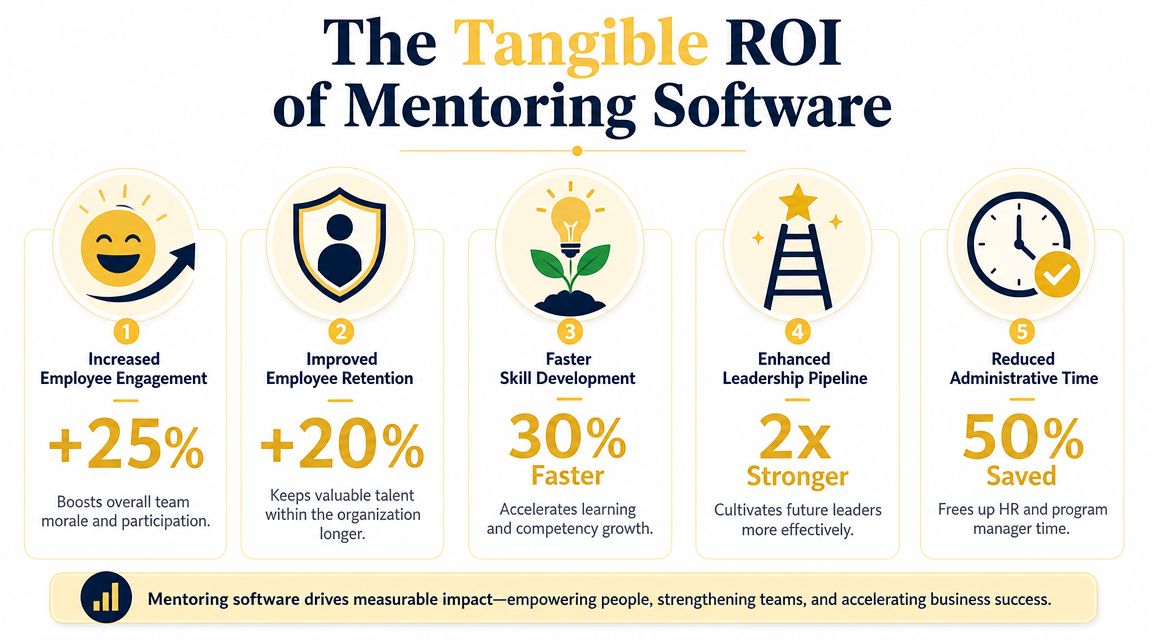
Early in the business case, visual summaries help stakeholders grasp the upside quickly.
Where the return comes from
The strongest ROI usually shows up in four places.
- Time returned to the program owner: Admin drops because reminders, enrollment workflows, and tracking no longer live across multiple tools.
- Stronger participant follow-through: A structured environment makes it easier for pairs to keep meeting and working toward goals.
- Better visibility for intervention: You can notice stalled relationships sooner instead of discovering them at the end.
- A program you can explain to leadership: Reporting becomes easier because the evidence isn't scattered.
For coaches, this can mean serving more clients or running a higher-touch group program without feeling buried. For businesses, the return often ties directly to retention, engagement, development, and internal mobility.
The numbers leaders care about
The strongest published case for formal mentoring is hard to ignore. Companies with formal mentoring programs see significantly higher retention rates for mentees (72%) and mentors (69%) compared to non-participants (49%), and 67% of businesses report increased productivity after implementing such programs, according to Mentorloop's mentoring statistics roundup.
That changes the tone of the budget conversation. You're no longer defending a “nice extra.” You're discussing infrastructure for talent development.
Later in that same conversation, it helps to show stakeholders what a structured mentoring model looks like in practice.
What ROI looks like in real decisions
A solo executive coach may use mentoring program software to package a premium leadership experience. Instead of sending PDFs and follow-up emails manually, the coach can guide clients through milestones, shared resources, check-ins, and progress reviews inside one system. The value isn't only convenience. It's the sense that the program has shape.
A corporate HR manager sees a different return. They need fewer dropped pairings, more consistent communication, cleaner reporting, and a way to compare what happened for participants against non-participants. That's the difference between a program leaders tolerate and one they expand.
If the program can't show what changed, people eventually treat it like a morale initiative instead of a talent strategy.
If you're trying to frame the business case before buying, a simple ROI calculator for coaching investments can help turn broad value into a more disciplined internal discussion.
Evaluating Software and Finding Your Perfect Match
Most platforms sound great in a demo.
They all promise smart matching, easy administration, and better engagement. The problem is that buyers often evaluate mentoring software the way they evaluate a website. They ask whether it looks clean, not whether it will hold up under real program pressure.
The better approach is to treat the demo like an operational stress test.
Start with matching, but don't stop there
Matching gets the headline attention because it's visible. And yes, it matters. Modern mentoring software uses AI-powered matching algorithms that analyze skills, goals, and even personality traits to reduce bias and improve pairing accuracy, which improves relationship quality and program outcomes, as described by Mentorcliq's review of mentoring software features.
But buyers make a mistake when they assume matching is the whole story. A good match can still fail in a weak system. A decent match can succeed in a strong one.
Ask this during the demo:
- How does the platform explain a match? You want some transparency, not a black box.
- Can participants express preferences? Coaches and HR teams often need a balance between algorithmic logic and human judgment.
- What happens after the match is made? If the answer is vague, engagement may depend too heavily on manual follow-up.
Questions that reveal whether the platform fits
Use questions that expose workflow reality.
User experience for participants
If mentors and mentees need training just to complete basic actions, adoption will drag.
Ask:
- Can a first-time mentor see exactly what to do next?
- Where do goals, messages, resources, and meeting history live?
- What does the mobile experience feel like?
A practical example: if a busy senior leader can't accept a match, schedule a first conversation, and review the mentee's goals in a few clicks, they'll delay it.
Program flexibility
Some teams run one-to-one mentoring. Others need peer mentoring, group formats, onboarding support, ERG programs, or cohort-based learning. The platform has to fit your model, not force you into its default.
Look for:
- Custom workflows
- Different program templates
- Branding options
- Role-based permissions
Administrative control
Here, software either helps you breathe or creates new work.
| Demo question | What you're really checking |
|---|---|
| Can I automate reminders and nudges? | Whether follow-through depends on you |
| Can I see which relationships are active or stalled? | Whether intervention is possible before failure |
| Can I segment reports by cohort or program type? | Whether the software supports actual analysis |
| Can I export data cleanly? | Whether reporting will become a bottleneck later |
Buyer filter: Don't ask only whether the tool has the feature. Ask how many manual steps still remain after the feature is turned on.
Watch for the hidden trade-offs
Every platform makes trade-offs. Some are elegant but rigid. Some are flexible but clunky. Some are built for enterprise governance and feel heavy for a coach or small academy.
Three warning signs come up often:
- Beautiful front-end, weak reporting
- Strong admin controls, confusing participant experience
- Good matching, poor goal and progress structure
The right fit is the one that supports your actual program behavior. If your mentoring success depends on milestone tracking, reflective prompts, and ongoing accountability, don't get seduced by a platform whose main strength is signup automation.
From Launch to Success A Practical Implementation Guide
Buying mentoring program software solves almost nothing by itself. Implementation decides whether the platform becomes a useful operating system or an expensive shelf item.
Programs succeed when the rollout is concrete, boring in the right places, and clear about expectations.
Build the program before you announce it
Start with the practical questions people often skip:
- Who is this for?
- What problem is the program trying to solve?
- What does a good mentoring cycle look like from kickoff to close?
- What should mentors and mentees do in the first month?
If those answers aren't clear, software won't rescue you. It will just organize confusion.
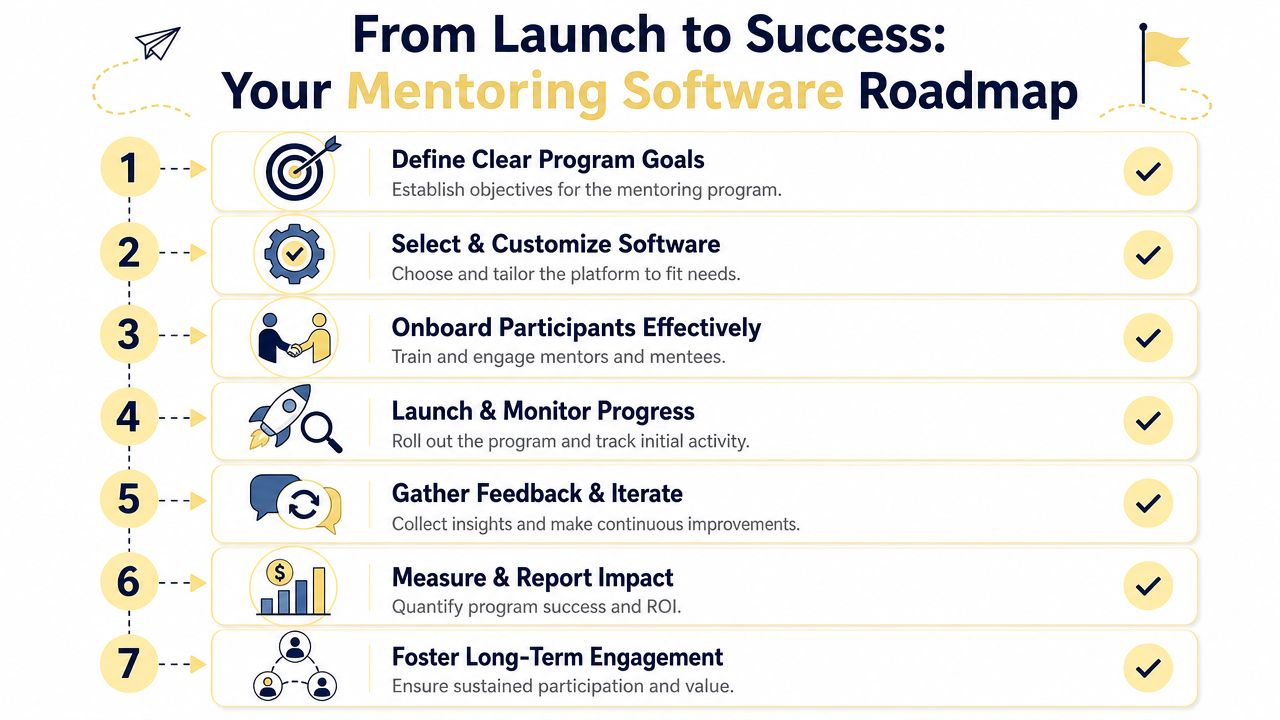
A solid rollout usually follows this sequence:
Define the purpose
Example: support early-career managers, strengthen internal mobility, or improve onboarding relationships.Configure the platform around that purpose
Matching questions, onboarding messages, resource libraries, and check-in cadence should reflect the program's goals.Pilot with a contained group
A smaller launch lets you catch friction points early, such as unclear instructions or poor questionnaire design.Train for behavior, not just navigation
Don't only show people where to click. Show them how to set expectations, prepare for meetings, and use the system between sessions.
Measure what actually matters
A lot of programs over-report participation and under-measure impact.
The more credible approach is to track outcomes that matter to the organization and sentiment that explains why those outcomes are moving. To prove impact, success metrics should include hard data like retention and promotion rates for participants versus non-participants, alongside qualitative survey data on engagement levels and individual drive, according to Chronus on measuring mentoring program success.
That means your dashboard should not stop at enrollments.
Use a balanced scorecard like this:
| Metric type | Useful examples |
|---|---|
| Quantitative | Retention, promotion movement, completion status, meeting consistency |
| Qualitative | Confidence, engagement, sense of momentum, perceived support |
| Operational | Response times, stalled pairings, onboarding completion |
| Developmental | Goal progress, milestone completion, resource usage patterns |
Programs become credible when they connect relationship activity to business outcomes, not when they report high logins.
Common rollout mistakes
The same implementation problems show up again and again:
- Launching too broadly too soon: A pilot gives you time to fix your own assumptions.
- Writing vague goals: Participants need structure from day one. If onboarding is weak, the relationship starts fuzzy.
- Treating communication like an afterthought: People need reminders, examples, and a clear path when they get stuck.
- Ignoring participant feedback: If mentors say the prompts feel generic or mentees say meetings lack direction, believe them and adjust.
If your wider client systems already rely on workflow consistency, the lessons from client onboarding automation for coaches carry over neatly here. Good automation doesn't remove the human element. It protects it from preventable friction.
Mentoring Software in Action Real World Use Cases
Abstract feature lists don't help much when you're trying to imagine your own program. Real use cases do.
The solo executive coach
A coach running a leadership mentoring offer often hits the same ceiling. The sessions are strong, but the experience between sessions feels thin. Notes live in one place, exercises in another, and accountability depends on manual follow-up.
With mentoring program software, that coach can turn a loose service into a structured journey. Each client gets a goal area, milestone checkpoints, session prep prompts, and a shared resource library. SMART goal design is especially helpful here. Software can reinforce Specific objectives, Measurable checkpoints, Achievable action steps, Relevant priorities, and Time-bound deadlines, as outlined in MentorCity's guide to enterprise mentorship software features.
Example: instead of “become a better leader,” the client works toward “lead cross-functional meetings with clearer decision follow-up over the next quarter,” with defined review points.
The corporate L&D manager
A company launches mentoring to support inclusion, development, and cross-functional connection. Without a platform, HR spends most of its time collecting applications, coordinating introductions, and chasing updates.
Inside a dedicated system, the manager can gather matching data up front, assign orientation resources, set check-in prompts, and monitor whether pairs are progressing. The human outcome is easy to miss if you focus only on features: people who would never have met now have a structured reason to learn from each other.
The coach's inner question here is often, “How do I keep this from becoming performative?” The answer is structure plus support. Give people a reason to meet, a way to define goals, and enough visibility to step in when momentum fades.
The academy or coaching school
An academy running cohort-based certification or mentor-supported learning has a different problem. It needs curriculum, assignments, discussion flow, and individual support to coexist without becoming chaotic.
Here, mentoring software can act as the container. Faculty mentors review progress, participants submit reflections, and the organization keeps every cohort working through a repeatable sequence. One group may need peer mentoring around practice-building. Another may need supervisor feedback on applied coaching conversations.
The strongest programs don't just create access to mentors. They create a repeatable path for productive conversations.
That's the “so what” of the software. It gives each setting a structure that fits the work people are trying to do.
Your Partner in Purposeful Mentoring
Mentoring fails unnoticed when the structure is weak.
Not because people don't care. Usually they do. Mentors want to help. Mentees want guidance. Coaches want clients to follow through. HR teams want programs that develop people, support retention, and strengthen culture. What gets in the way is the gap between intention and execution.
That's where mentoring program software earns its place. It turns scattered admin into a repeatable system. It gives mentors and mentees a clearer path. It gives coaches a way to hold goals, milestones, and accountability in one place. It gives program owners visibility without forcing them to micromanage every relationship.
What works and what doesn't
What works is straightforward:
- Clear purpose
- Thoughtful matching
- Strong onboarding
- Visible goals
- Simple participant workflows
- Early intervention when engagement slips
- Measurement tied to real outcomes
What doesn't work is just as clear:
- Launching with vague expectations
- Buying software before defining the program
- Assuming matching alone creates momentum
- Relying on manual follow-up for everything
- Reporting activity as if it were impact
The anxiety many coaches and HR leaders feel is reasonable. You don't want more admin. You don't want another login. You don't want a platform that promises transformation and delivers a prettier spreadsheet.
You want help creating relationships that actually go somewhere.
The better standard
A good platform should make three things easier.
First, it should reduce operational friction. People need to know what to do next.
Second, it should support better mentoring behavior. Goals, prompts, resources, check-ins, and progress tracking should help the relationship mature instead of drift.
Third, it should help you prove the program matters. Not with inflated claims. With cleaner visibility into participation, development, and business-relevant outcomes.
If you're evaluating tools in 2026, keep your standard high. Don't ask whether the software has features. Ask whether it helps people build trust, maintain momentum, and turn good conversations into measurable development.
That's what the best mentoring program software does. It doesn't replace the relationship. It protects it, organizes it, and gives it a better chance to succeed at scale.
If you want a platform that helps you deliver structured programs without juggling disconnected tools, Coachful is worth exploring. It brings onboarding, scheduling, messaging, progress tracking, resources, payments, and program management into one workspace so coaches and teams can spend less time coordinating and more time helping people grow.