Coaching Brochure Template: 7 Sections and a Filled Example

Coachful
Editorial Team
What should you put in a coaching brochure so a prospective client can decide whether to contact you, rather than admire the design and forget the offer? Explain who the coaching is for, the situation it addresses, how the engagement works, what is included, why you are qualified to deliver it and one useful next step.
A coaching brochure is a decision document, not a compressed autobiography. Someone may receive it from a colleague without hearing your introduction. They need enough information to judge relevance and ask a sensible question. They do not need every certification, framework and service you have ever offered.
This guide gives coaches a seven-section brochure template, a complete hypothetical example and practical checks for a readable PDF or printed version. The layouts are illustrative examples, not print-ready artwork or a claim that Coachful designs brochures.
Choose the brochure’s job before choosing a template
Decide who will receive the document and what decision they should make after reading it. A private client exploring career coaching has different questions from an HR manager comparing leadership-development providers. A general brochure can introduce your practice, but the main offer still needs an identifiable buyer.
Write this internal brief: “This brochure helps [reader] decide whether [specific coaching offer] is relevant enough to [next action].” For example: “This brochure helps newly promoted managers decide whether a six-session coaching engagement fits the management conversations they are struggling to prepare.”
Choose the smallest format that answers that brief:
- One-page PDF: a focused offer that someone can forward after an introduction.
- Two-page PDF: an overview plus enough detail about process, inclusions and fit to support comparison.
- Folded print brochure: a physical handout for a real event, partner location or meeting where people will take information away.
- Longer services brochure: a genuinely varied practice serving a buyer who needs to compare services. Do not add pages merely because the template has them.
For a new offer, start with a short PDF and a matching web page. Print a batch only when you know where it will be used. A cupboard of brochures is not evidence that your marketing is working.
Coaching brochure template: seven sections to include
Use these sections as a writing sequence. They do not have to become seven equal boxes. The reader’s questions should determine the emphasis and layout.
1. A specific audience and recognizable situation
Lead with who the offer serves and what brings them to coaching. “Coaching for new managers preparing for delegation and difficult conversations” tells a reader more than “Unlock the leader within.” Name the work without diagnosing the person or promising an identity transformation.
Template: “[Offer name] is for [specific audience] who want support with [practical situation or decision].” Add one sentence describing an ordinary moment they recognize. Avoid opening with a list of your values before explaining their relevance.
2. The work you can responsibly support
Describe the priorities you can help a client investigate, practice or review. These are not guaranteed outcomes. A career coach can support a structured career decision; they cannot guarantee an employer will hire the client. A leadership coach can help someone rehearse feedback; they cannot guarantee how an employee will react.
Template: “We can work on [priority one], [priority two] and [priority three], choosing a focus that fits your role and goals.” Say when another professional or service is more appropriate. Keep clinical, legal and regulated financial claims outside your competence.
3. A concrete engagement structure
State the format, duration, session length, location or online delivery, and who attends. If you offer between-session support, define it. “Support whenever you need it” can create an expectation of constant availability you never intended.
Template: “[Number] [length]-minute sessions over [period], delivered [where/how]. Between sessions, [specific inclusion and limits].” Check these details against what you actually sell before exporting the brochure.

4. A short explanation of your process
Show what working together looks like. “Agree a goal, explore the situation, choose an experiment and review what happened” is understandable without a branded acronym. If you use an assessment, explain its purpose and any separate fee or eligibility conditions accurately.
Template: “We begin by [first step]. During sessions, we [working method]. We review [evidence or learning] and agree [next step].” Keep the explanation grounded in client participation rather than making the coach sound like the person who delivers change to them.
5. Relevant qualifications and honest proof
Include a short bio tied to this audience, accurately named current qualifications and relevant experience. Use a client quotation only with appropriate permission and context. Do not use a company logo to imply an endorsement or commercial relationship you cannot substantiate.
If you are new, explain your training and approach honestly. You can show a sample exercise or describe the working process. Do not invent a testimonial to fill a template’s quotation slot. An AI-generated portrait must never be presented as you or as a client.
6. Price or a clear route to a quote
For a standardized package, an accurate price can reduce uncertainty. State the currency and material inclusions, exclusions and payment terms. Explain applicable taxes or additional charges as required for your market. Do not quote an attractive installment amount while hiding the total commitment.
For a tailored corporate engagement, explain what determines the quote: participant count, delivery format, scope, assessment costs and preparation. “Contact for pricing” is more useful when the buyer knows what information to provide. A brochure is still not the final agreement.
7. One next step and reliable contact details
Choose an action that fits the reader’s stage: read the service details, request an employer brief or book a fit conversation under your actual terms. Tell them what will happen. “Book a call” is incomplete if they cannot tell whether it is paid, how long it lasts or what it is for.
Include your professional name, business email and a readable web address. A QR code is optional, not a substitute for those details. Add a version date somewhere discreet so an outdated PDF is easier to identify.

A complete coaching brochure example you can adapt
The following offer is hypothetical. It demonstrates copy and structure, not a real Coachful package, practitioner, price or result. Replace every detail with your own checked terms before using it.
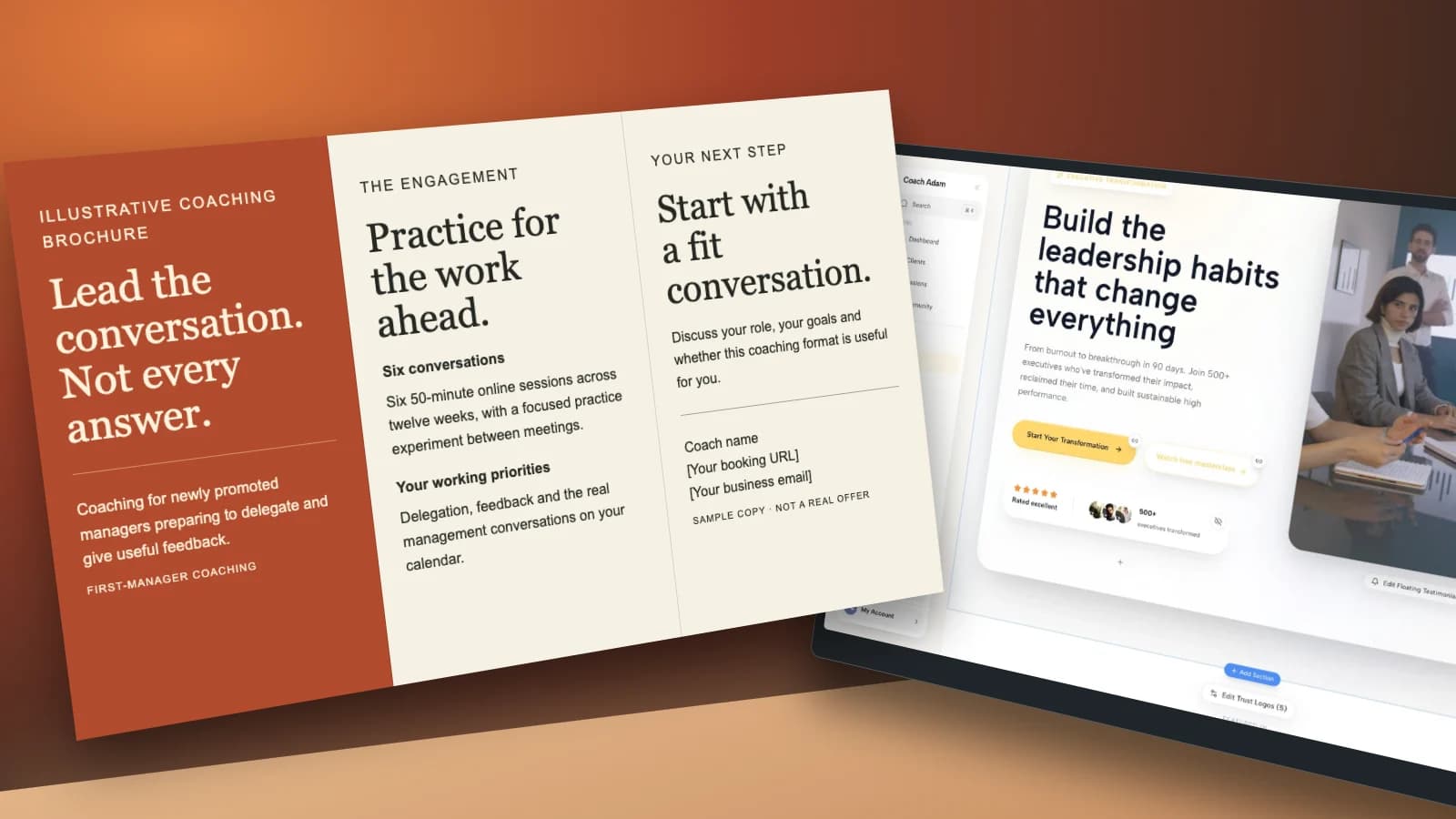
Front: relevance before biography
First-Manager Coaching
Lead the conversation. Not every answer.Coaching for newly promoted managers preparing to delegate, set boundaries and give useful feedback.
You have taken on a team, but you are still doing too much of the work yourself. These conversations give you space to examine what is happening, prepare a different approach and learn from trying it.
The headline is memorable, but the sentence beneath it does the practical work. A stranger can identify the audience and subject without knowing the coach’s personal story.
Inside: process and inclusions
Six conversations across twelve weeks
Six 50-minute online sessions focused on your current management priorities.We agree a working goal, examine a real situation and choose a manageable practice experiment. You might prepare a delegation conversation, rehearse feedback or review how you are setting expectations.
Between sessions, you choose an experiment to try at work. At the next meeting, we review what happened and what you want to do differently. The engagement includes a short preparation prompt before each session.
Coaching supports reflection and practice. It does not guarantee a promotion, replace therapy or substitute for legal advice or an employer’s HR process.
Notice the difference between an inclusion and an aspiration. The preparation prompt is something the coach can supply. Becoming a universally confident manager is not a deliverable the coach can promise.

Back: credible identity and a manageable next step
About your coach
[Your name] works with [accurate audience description]. [Add relevant experience and any current qualification, using its correct name.]Explore whether it fits
Book a [duration and actual price/free status] introductory conversation to discuss your role, goals and whether this format is suitable.Package fee: [actual amount, currency, applicable tax treatment and material inclusions]. Payment and cancellation terms: [plain-language summary or direct link to current terms].
[Your booking URL]
[Your business email]
Updated: [month and year]
Brackets are instructions, not publishable copy. If you have not decided the fee, format or introduction terms, finish those decisions before designing a brochure around them. Design cannot resolve an offer you have not defined.
Make the brochure and website tell the same story
A brochure often travels further than you expect. Someone forwards it, saves it for later or opens the website without mentioning the original referral. Your public page should confirm the same audience, package and next step, even if the website contains more detail.
Compare the two side by side. Check the offer name, session count, support boundaries, fee, availability and introductory-call terms. A polished PDF promising twelve weeks of support should not lead to a page advertising a different package with no explanation.

If you use Coachful for your website, the live editor is relevant to this consistency check. It is not evidence that a brochure export exists. Create the document in a suitable design or document tool, then maintain its facts alongside the public page.
Keep brand choices recognizable across both surfaces. The same practice name, restrained color palette and clear typography help a reader recognize they have reached the right business. You do not need to reproduce the PDF layout on a phone screen.

Give every version a useful destination
A brochure does not need five competing calls to action. Choose the step that matches its promise. A services overview can lead to a page explaining fit. A corporate brochure can lead to a focused inquiry. A specific coaching package can lead to its current details and introduction process.

A compact links page can work, but put the promised destination first. Do not send a reader who wants package details to an undifferentiated list of social profiles, unrelated downloads and old events. The link must work without your account or editing access.
For inquiries, collect enough information to respond usefully: name, contact route, broad goal and the service they are asking about. A corporate buyer may also need to provide the organization, approximate participant count and intended timing. Do not request confidential employee histories or sensitive personal disclosures in a first inquiry.

The demo above shows an existing wellness form in Coachful’s form editor. It illustrates the editing surface, not a ready-made brochure-inquiry template. Configure questions suitable for your own purpose rather than copying the demo’s health-related fields.
If you want to inspect the website, links and form surfaces before choosing how to handle this handoff, Try the interactive demo. The useful test is whether you can explain the service and receive a proportionate inquiry, not whether the platform makes the brochure for you.
Export a PDF people can actually read
Design for reading before decoration. Give headings a clear hierarchy, use strong contrast and keep essential information at a comfortable size. If the text only fits when it becomes tiny, shorten it or choose another format.
Export selectable text rather than flattening every page into an image. Check the document’s reading order, link descriptions and accessibility features in the software you use. An attractive export is not automatically an accessible PDF. Provide a readable web equivalent when possible.
Open the exported file on a phone and laptop. Test each link in the PDF itself, not just in the design editor. Check that the filename is descriptive, the file opens without permission requests and the download does not reveal a private editing workspace.
For print, use your chosen printer’s current specifications for folds, panel widths, trim, bleed, safe areas and export. Folded panels may need different widths; do not assume three visually equal columns will fold correctly. Print and fold a proof at actual size before ordering a batch.
Follow up on a conversation, not an assumed intention
Sending a brochure does not establish that someone wants to buy coaching. Record the action they actually agreed to: review the details, discuss the offer with a sponsor or contact you after a particular date. Ask whether a follow-up would be welcome.

A prospects workspace or simple spreadsheet can hold the contact, offer version and agreed next action. Do not treat every download as a qualified opportunity. Likewise, requesting a brochure is not blanket permission to enroll someone in a newsletter. Follow the privacy and marketing rules that apply to your practice.
When an inquiry goes nowhere, examine the handoff. Did the brochure explain fit? Did the destination match? Could the reader ask a question easily? Those are useful improvements to investigate before paying for more copies or a more elaborate design.
Frequently asked questions
How long should a coaching brochure be?
Start with one or two pages for a focused offer. Use more space only when the buying decision genuinely requires it. That is an editorial recommendation, not an industry rule. A folded handout needs a layout based on the actual print product, not a PDF squeezed into narrow panels.
Should I include coaching prices?
Include them when you sell a standardized offer and can keep the document current. For tailored work, explain how quoting works and what information you need. Do not hide material costs or print a price you cannot honor under the stated terms.
Is a brochure the same as a coaching proposal?
No. A brochure introduces an available service to a class of prospective buyers. A proposal responds to a particular buyer’s brief, scope and commercial discussion. You may reuse accurate service descriptions, but the documents serve different decisions.
Can I use the same brochure for private clients and employers?
You can reuse verified facts, but change the emphasis. Employers need to understand participants, sponsorship, delivery and purchasing. Private clients need personal fit and commitment details. Explain confidentiality carefully rather than implying the sponsor receives private session content.
Finish the offer before polishing the brochure
Write the seven sections, choose the matching destination and ask someone unfamiliar with your practice to explain the offer back to you. If they cannot say who it is for, how it works and what to do next, revise the words before the colors.
Sources and limits: Hughes Solutions’ brochure page demonstrates the distinction between a concise coaching-services summary and a broader firm brochure. Leadership Circle’s executive-coaching brochure provides an example of explaining approach and engagement stages. The template, hypothetical offer and design recommendations here are original editorial guidance, not claims about those providers’ outcomes. No search volume, conversion rate or client result is asserted.