Coaching Workshop Sponsorship Proposal: Template and Example

Coachful
Editorial Team
Can a sponsor help pay for your coaching workshop without turning it into a sales pitch or giving someone access to your clients? Yes, if the proposal sells a small, defined partnership: a relevant audience, specific acknowledgement, a clear contribution and an honest delivery report. It should not sell private coaching conversations or promise customers you cannot deliver.
A workshop sponsorship proposal is an offer to support an event, not permission to influence the coaching. Write the boundaries before you approach a company. Otherwise an apparently helpful contribution can become a request for attendee data, an unplanned product demonstration or editorial control.
This guide is for coaches seeking third-party support for a public educational workshop. It includes five sponsorship options, a copyable proposal and a fictional example. It is not a proposal for an employer purchasing coaching for employees, and none of the example sponsors, attendance or arrangements are real.
Decide whether sponsorship belongs in this workshop
Sponsorship makes sense when the partner has a legitimate reason to support the audience and you can acknowledge that support without compromising the session. A coworking venue might contribute space for a workshop serving independent professionals. A professional association might help fund an event relevant to its members. Neither arrangement requires a promise that participants will buy anything.
Start with the participant benefit. What will the contribution make possible: an accessible venue, a smaller ticket price, materials, captioning or a limited number of supported places? Then ask what reasonable visibility the sponsor could receive. Do not reverse the process and reshape the coaching around whatever a company wants to promote.
Decline a partnership when the product conflicts with your scope, the sponsor wants confidential information, the claims are misleading or the commercial segment would displace the workshop’s purpose. A financial contribution does not make an unsuitable relationship suitable. Consider professional obligations, conflicts of interest and the laws relevant to your practice.
Five sponsorship offers a coach can realistically deliver
Choose an option because it fits an actual cost or audience relationship. You do not need three metallic tiers just because a proposal template includes them. One clearly bounded offer is easier to deliver than a menu of benefits you have not checked.
1. A venue partnership
A suitable local organization contributes a room, agreed equipment or refreshments. You acknowledge the contribution on the event page and at the opening. Specify access times, setup, accessibility, cancellation, staffing and any conditions attached to the space.
The trade-off is operational dependence. A free room that becomes unavailable at short notice can cost more than a paid booking. Confirm the actual arrangement in writing and have a fallback before selling tickets. A venue contribution does not automatically give the venue rights to participant details or recordings.
2. A materials contribution
A partner pays for a defined set of workbooks, accessible handouts or equipment. Set a quantity, specification, delivery date and contribution cap. Distinguish useful workshop materials from promotional items the sponsor merely wants distributed.
Keep the teaching materials yours unless you deliberately negotiate otherwise. A logo on an acknowledgement page is different from permission to rewrite exercises, add claims or reuse your workbook commercially. Clarify ownership and approval before production begins.
3. Supported workshop places
A partner underwrites a specified number of places using eligibility criteria you can explain fairly. Agree how places are allocated and what happens if they are not used. Keep the reporting proportionate; the sponsor can receive an aggregate account of supported places without receiving applicants’ personal circumstances.
The risk is turning access support into a public gratitude requirement. Do not require recipients to disclose hardship, endorse the sponsor or appear in publicity as the price of attending. Be careful that a small group or detailed description does not identify someone indirectly.
4. A disclosed event-support contribution
A company contributes cash toward the workshop in exchange for named acknowledgement surfaces. For example, you might agree an event-page credit and a brief host thank-you. State their wording, placement and duration rather than promising vague “exposure.”
This is suitable when the sponsor values a relevant community relationship. It is unsuitable when the company expects guaranteed leads from a small educational event. If it asks for a product pitch, discuss that as a separate, disclosed commercial activity that participants can identify and choose.
5. A distribution partnership with a defined commitment
An association or community partner promotes the event through an agreed channel. In return, you may provide a member booking route or acknowledgement. Specify the actual communication, intended audience and timing; “we will share it” is too vague to build a launch around.
Distribution is not cash, and a partner’s total membership is not the number of people who will see or attend your event. Keep confirmed promotional commitments separate from projected registrations. Do not treat a shared link as permission to import the partner’s contacts into your mailing list.
A workshop sponsorship proposal template
For a small workshop, begin with a short document that the contact can forward to a decision-maker. The following sections are a writing template, not a legal agreement. Replace every bracket with a verified fact or an explicitly labeled plan.
1. The event and the reason for this partner
Template: “I am organizing [workshop] for [specific audience] on [date], delivered [format/location]. Participants will work on [concrete learning or practice task]. I am approaching [organization] because [verified audience or community connection].”
Explain relevance without manufacturing familiarity. A publicly stated community program is a reason to investigate fit, not proof that the organization has budget available. Ask who manages partnerships if you do not know.
2. What is confirmed and what is projected
Template: “Confirmed arrangements: [venue, facilitator or other completed decisions]. Planned capacity: [number]. Current registrations: [number, as of date], if available. Promotion commitments: [specific confirmed channels]. Forecasts, where included, are estimates rather than guarantees.”
Capacity, registrations, attendance and sponsor interest are different counts. Do not combine social followers, newsletter subscribers and partner members into a single claimed audience without understanding overlap and actual reach.

3. The contribution and the deliverables
Template: “We are requesting [cash amount and currency, or precisely specified in-kind support]. In return, we will deliver [placement, wording, timing and quantity]. The contribution supports [named cost or access benefit]. It does not include [important exclusions].”
Check that every promised surface exists. If acknowledgement belongs on an event page, prepare that page. If it belongs in a participant email, identify the actual message. Do not sell a mailing that would be inappropriate for the people receiving it.

4. Independence, privacy and permissions
Template: “The coach retains responsibility for workshop content and facilitation. Sponsorship does not include private session information, participant responses, an attendee contact list or the right to contact participants. Any separate voluntary interaction will be explained before people choose it.”
Also specify logo approval, recording rights, use of photographs, category exclusivity if any and the limits of sponsor review. A sponsor may check that its name is spelled correctly without receiving control over your teaching or private feedback.
5. Terms, evidence and next step
Template: “The written arrangement will confirm payment or delivery dates, cancellation, changes, approvals and what happens if a promised benefit cannot be delivered. After the event, we will provide [specific report] by [agreed date]. The next step is [a short fit discussion or review of the proposed arrangement].”
Use a real decision date only when there is a practical reason, such as a print deadline or venue commitment. Do not invent scarcity to accelerate a signature. Obtain qualified legal or tax advice where the arrangement requires it.

A filled example for a fictional coaching workshop
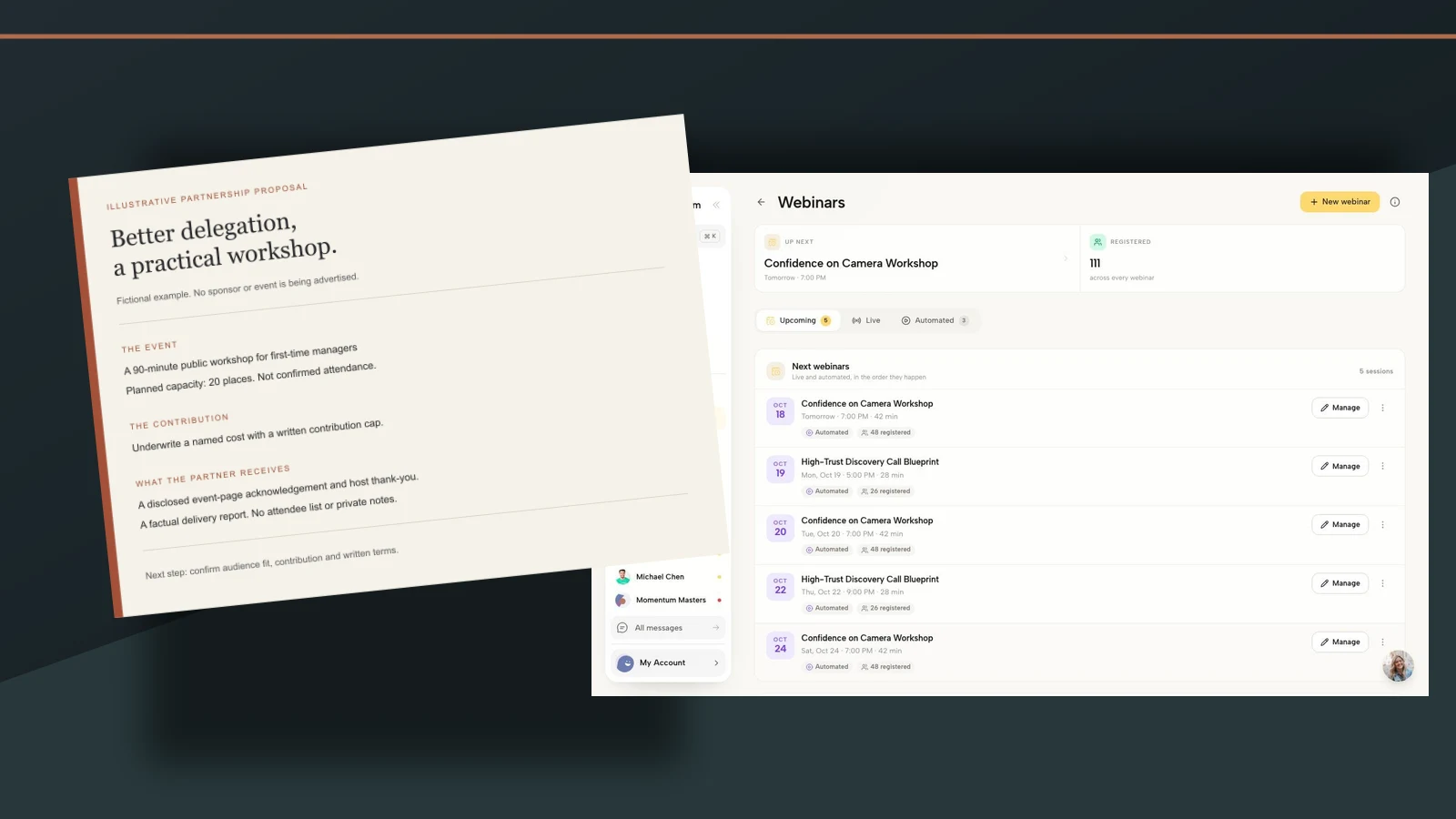
Illustrative example only: A leadership coach plans “Better Delegation, a Practical Workshop,” a 90-minute public session for first-time managers. It has a planned capacity of 20 places. There are no confirmed attendees or sponsors in this example.
The coach approaches a fictional coworking venue because it serves local professionals and has a suitable meeting room. The proposed contribution is use of that room for the workshop plus agreed setup time. The venue would receive a clearly disclosed event-page acknowledgement and a brief opening thank-you.
The participant task is to draft a delegation brief covering the intended outcome, decision authority, constraints and review point. The sponsor does not select participants’ goals, review their drafts or give a sales presentation during the exercise.
The proposal states: “This workshop is supported by [venue], which is providing the meeting space. Workshop content and facilitation remain the coach’s responsibility. Participant details and written exercises will not be shared with the venue.” The final wording would need to match the actual arrangement and applicable requirements.
The coach asks the venue to confirm room access, equipment, accessibility, responsibilities and cancellation conditions. The report would confirm whether the acknowledgement appeared, whether the event ran and an aggregate attendance count where appropriate. It would not claim recruitment leads, purchases or business outcomes.
This example works because the exchange is small and inspectable. If the venue wants a broader partnership, negotiate it separately. Do not quietly add attendee marketing rights to a room booking.
How to set the sponsorship contribution
There is no universal rate for a coaching workshop sponsorship. Audience fit, deliverables, scarcity, event maturity, fulfilment effort and the sponsor’s objective all matter. A cost you need covered is a starting point for your decision, not proof of what a sponsor should pay.
List the cost or contribution you are seeking. Then list the work needed to fulfil the benefits: page updates, approvals, materials, coordination and reporting. Decide whether the arrangement remains worthwhile if registrations are lower than hoped. Do not fund a guaranteed payment obligation using an unconfirmed sponsor conversation.
For in-kind support, describe what is being contributed rather than presenting an inflated promotional valuation as cash revenue. Check accounting and tax treatment with an appropriate adviser. For cash support, agree currency, invoicing details, payment timing and any conditions before relying on it.

Corporate workshop pricing is a separate question. When an employer hires you to deliver training to its staff, you are selling a service to that buyer. A third-party sponsor supporting a public workshop is purchasing an agreed partnership, not becoming the client in every participant’s coaching relationship.
Approach sponsors without sending a generic funding plea
Make a short list based on audience relevance and reputation, not on which companies look wealthy. Look for a plausible relationship between the workshop and the organization’s actual work. Check whether it publishes partnership criteria or has a named contact.
A first message can be brief: “I am planning [workshop] for [audience]. Your work on [verified relevant activity] made me wonder whether a defined event-support partnership could fit. I have a short outline covering the contribution, acknowledgement and participant-privacy boundaries. Are you the right person to ask?”
This is a hypothetical outreach pattern, not an instruction to send unsolicited marketing indiscriminately. Follow applicable contact and marketing rules. Do not add a contact to a newsletter, use private scraped information or imply an existing partnership.

Record the contact, relevance, latest response and agreed next step. If they decline, accept it. If they ask to review a proposal, tailor it to that conversation and confirm who can approve the arrangement. A contact liking the idea is not the same as a signed commitment.
Keep sponsor contact and participant consent separate
A registration form collects what you need to run the event. A sponsor inquiry form collects what you need to discuss a partnership. Neither should hide a broad permission for unrelated contact or collect sensitive coaching information merely because it might interest a sponsor.

The form screenshot above shows a real Coachful editing surface with sample wellness fields. It is not a sponsorship form. For your own inquiry, use proportionate questions such as organization, contact route, intended contribution and questions about the proposed benefits.
If participants can separately choose to hear from a sponsor, explain who will contact them, for what purpose and under which arrangements. Check the applicable privacy and marketing requirements rather than assuming one checkbox solves them. Attending a sponsored workshop must not be treated as blanket permission to transfer contact data.
Disclose the relationship where participants encounter it
Participants should understand the commercial relationship before it affects their decision. A clear statement such as “Supported by [organization], which is providing the venue” explains more than a row of unexplained logos. State paid or in-kind support accurately.
When you endorse a sponsor or recommend its product in social promotion, check the relevant advertising-disclosure requirements. The FTC’s US guidance emphasizes making material relationships clear and not burying disclosures where people are unlikely to see them. Other jurisdictions have their own rules.

A promised email acknowledgement should use the agreed wording in a relevant message to the appropriate audience. Do not insert an unrelated promotion into sensitive client correspondence or use a sponsorship agreement as an excuse to send a platform-wide newsletter. The commercial arrangement does not erase your obligations to recipients.
Report delivery without inventing sponsor results
Agree the report before the event. Start with fulfilment: the page credit, host acknowledgement, agreed materials and any other actual commitment. Preserve an appropriate receipt, such as a dated page capture or delivery record, without including private participant information.

Then report only the event measures you can support. Define attendance and the source of the count. If you report link activity, explain what the data actually records; clicks are not necessarily unique people, qualified leads or purchases. Avoid implying that an acknowledgement caused a later sale.
If a benefit was not delivered, say so and address the agreed remedy. Low attendance is not a reason to relabel registrations as attendees. A candid, limited report gives both parties a better basis for deciding whether to repeat the partnership.
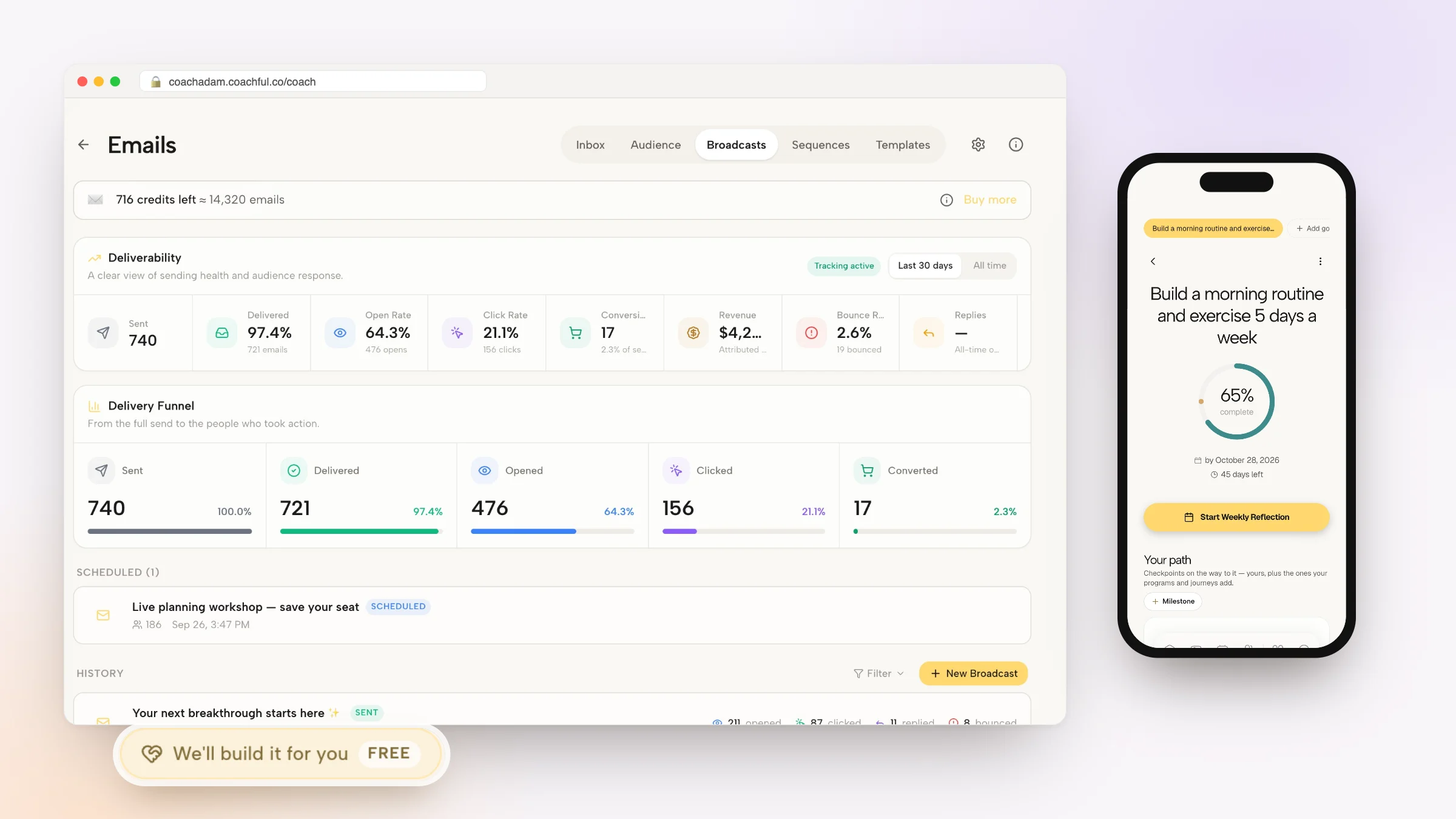
If you want to inspect the event, website, email and contact surfaces supporting this handoff, Try the interactive demo. Bring one proposed partnership and check where each promised action would actually happen. Coachful is not being presented as a sponsor marketplace, proposal generator or guarantee of funding.
Frequently asked questions
Can a new coach get a workshop sponsor?
It is possible, but a new event needs honest expectations. Start with a modest contribution that matches a relevant partner and a credible delivery plan. Do not invent past attendance, client endorsements or sponsor returns to compensate for a short track record.
Should I promise the sponsor attendee leads?
Not by default. Offer deliverables you control, such as disclosed acknowledgement, rather than a guaranteed commercial result. Any optional participant interaction needs its own clear explanation and appropriate privacy arrangements.
Do I need several sponsorship tiers?
No. Use tiers only if they help compare genuinely different, deliverable options. A single venue or materials partnership can be more sensible for a small workshop than a complicated package hierarchy.
Is the proposal enough to confirm the partnership?
Do not assume so. Confirm the agreed arrangement, responsibilities, rights, financial terms and contingencies in appropriate written terms. The right form depends on the deal and jurisdiction; this article is operational guidance, not legal advice.
Make the smallest honest offer first
Choose a relevant partner, name the contribution, list the exact benefits and protect participant independence. If you cannot explain the exchange without promising private access or speculative results, change the proposal before approaching anyone.
Sources and limits: HeySummit’s sponsorship proposal guide supports the event, audience, deliverables, reporting and next-step structure. FTC disclosure guidance informs the US endorsement-disclosure caution. The templates, options and fictional workshop are original editorial examples, not evidence of sponsorship rates, guaranteed demand or Coachful customer results.