
Coaching in Groups: How It Works, Models and Pricing

Coachful
Your private calendar is full, and five clients keep describing the same stuck point. You repeat the questions, they nod, and next month the task is still on their desk. You start wondering whether one room could hold them without turning coaching into a class. That doubt is the right one. Coaching in groups fails when you treat headcount as the win. Attention, safety, and a clean way to show what changed are the constraints that decide whether the room works.
What Coaching in Groups Means and Why It Works
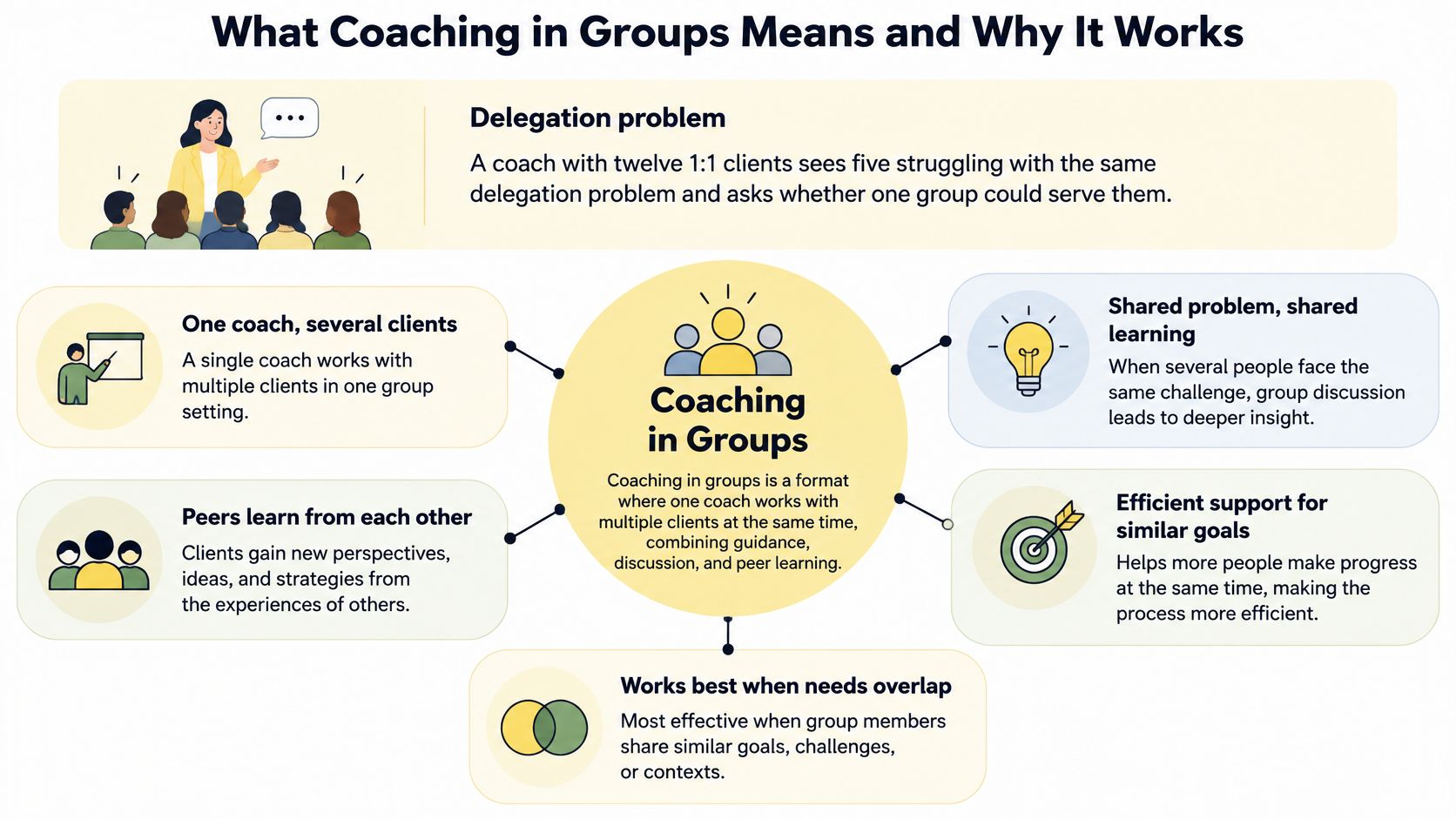
Say you hold twelve private clients, and five of them are stuck on delegation. Each hour you hear a version of "I keep doing the work myself." You already know the pattern. The question in your head is simple. Could one group serve those five without shortchanging them?
Coaching in groups is a facilitated process. You work with several clients at once on their own goals, inside a shared structure, while peers add challenge. Think of a rowing crew. You steer the boat. The rhythm only shows up when everyone pulls on the same stroke.
Three parts do the actual work.
- Coach-led framing: You name the focus, the time limits, and what useful participation looks like.
- Individual goal work: Each person still owns a goal. The group is the room, not a substitute for that goal.
- Peer challenge: Other members question assumptions and offer a view you don't have.
A 2008 global survey of group executive coaching treated the practice as a regular leadership method, not a side experiment. 70% of that activity sat inside leadership-development initiatives, and 52% of respondents had coached for at least five years.
What it is not
A lecture is not this. A webinar with breakout rooms is not this. A support circle with no coaching structure is not this. Those rooms can feel social. They don't require an individual goal, a return date, or a commitment someone will review.
A program passes three tests. Each participant has an individual goal. Sessions recur. Commitments get reviewed at the next meeting. Miss one test and you're hosting a conversation, not coaching a group.
Cohorts, Masterminds and Workshops Compared
Coaches usually reach for one of four formats, then wonder why the room feels wrong. The split is size, length, and purpose, not the label on the sales page.
| Format | Size and rhythm | What it's for |
|---|---|---|
| Cohort program | Fixed group, six to twelve weeks, weekly calls plus assignments | A shared skill learned on live cases |
| Mastermind | Four to eight experienced people, monthly or every two weeks | A rotating live problem, not a syllabus |
| Workshop | 10 to 30 people, one day or a short series | Teaching, exercises, a doorway into a longer offer |
| Coaching circle | Open drop-in, one theme per session | Practice after a program ends |
What each room feels like in practice
Cohort. Eight sales managers spend ten weeks on difficult conversations. Everyone works the same skill on their own case and comes back with evidence. You can see who practiced.
Mastermind. Six founders meet every second Thursday for 90 minutes. One person takes the hot seat with a live problem. The others respond. You facilitate. You don't teach a curriculum. If you're still choosing between a closed run and an open membership, this comparison of cohort-based courses and ongoing coaching programs is the structural decision to make before you sell either one.
Workshop. A half-day on goal-setting, mostly teaching, with short breakouts. It can feed a paid cohort. It isn't the container where behavior gets reviewed week after week.
Coaching circle. People drop in around one theme. Membership shifts. That's useful for momentum after a program, and weak if you promised the same follow-through as a closed group.
Match the room to how long the outcome takes, how experienced the people are, and how many voices you can actually hold.
A founder who wants a monthly sounding board doesn't need a ten-week syllabus. A manager learning a skill does. If you can't picture the follow-up, you picked the wrong format.
What You Gain and What You Trade
You want a lower cost per client and the extra brains in the room. You also don't want to give away the privacy that made private work valuable. Both wants are reasonable. They don't fit in the same hour.
| Criterion | Group coaching | 1:1 coaching |
|---|---|---|
| Cost per client | Lower, shared across participants | Higher, one coach hour per client |
| Individual airtime | Limited, and it shrinks as the group grows | Full session for one client |
| Peer learning | Built in, with feedback and different perspectives | Absent unless you add it on purpose |
| Accountability | Peer visibility plus recurring check-ins | Driven by you alone |
| Privacy and depth | Lower, so sensitive topics need explicit boundaries | Higher, and better for deeply personal issues |
| Scalability | One coach serves a full cohort at once | One coach serves a fixed client load |
| Best fit | Shared goals, skill-building, peer-rich learning | Crises, complex personal goals, high privacy needs |
The hour you no longer own
Airtime is the trade you feel first. In a six-person cohort running 75 minutes, each member gets roughly ten minutes of direct attention. That same hour in private work belongs to one client. Peers fill some of the gap. They don't restore the minutes you gave away.
A 2023 randomized trial in JAMA Network Open tested a four-month online group-coaching program for women physician trainees in the United States. Compared with controls, participants had an estimated 4.13-point greater reduction in emotional exhaustion (95% confidence interval 2.32 to 5.94). The program also reduced the probability of burnout by 18% relative to controls (odds ratio 0.47). That's one professional group, coached online. It shows a group can move a real outcome. It doesn't show a group beats private work in every setting.
Practical rule: Use a group when goals are shared and skill-based. Stay in 1:1 when the issue is sensitive, complex, or deeply personal.
Peer contact is a mechanism, not a free extra. Scored with Kirkpatrick's four-level model, 71.79% of participants said learning transferred into workplace behavior, and learning with or through peers explained 43.53% of the variance in perceived impact, according to SAGE Journals. A University of Wisconsin research brief reports that more frequent group meetings increased accountability and produced longer-lasting behavior change. Irregular calls give away airtime and keep none of that advantage.
How to Design a Group Session, Step by Step
A recurring 75-minute call only works if the minutes are designed before anyone speaks. If you're thinking "we'll see where it goes," the loudest voice will decide.
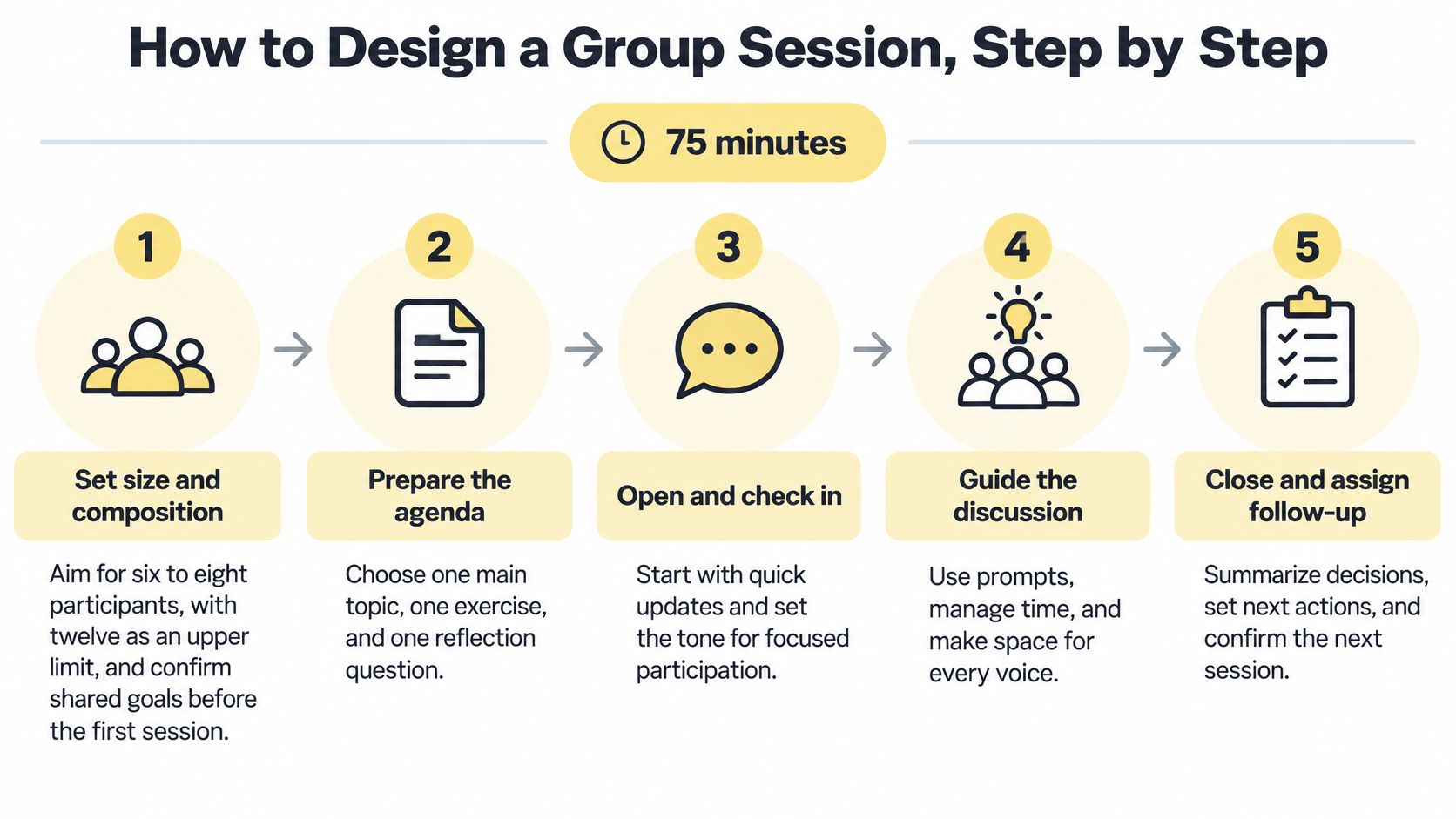
Set size and composition. Aim for six to eight participants, with twelve as the ceiling when people must both share and stay connected. A 2024 development study on group health and wellness coaching scored that range 4.32 out of 5, including the twelve-person maximum. Confirm the goals overlap before session one. Six to eight is the honest reply to "can everyone speak without this becoming rushed updates?"
Name the module outcome. Write the result of this block in one line, then the exercise that produces it. A call without an outcome turns into a status meeting, and you'll feel it by minute twenty.
Run five blocks. Five minutes of opening norms. About forty minutes of check-ins, roughly six minutes each in a group of six. Fifteen minutes of peer challenge on one case. Ten minutes of your synthesis. Five minutes of written commitments. Check-ins protect depth. The single case creates learning you couldn't supply alone.
Make the commitment specific. One action, one owner, one deadline, one next check-in. "By Friday I will transfer the weekly reporting task to Alex, send a written brief, and report what happened at our next meeting." "Work on delegation" dies between calls.
Log it the same day. Record the commitments, flag a missed review, and let that flag set the next agenda. Otherwise the group applauds intentions and never sees follow-through.
When twelve people break the clock
Twelve members force shorter turns or breakout pairs. Depth, confidentiality, and equal airtime all get harder. Choose in-person, video, or phone before you sell the seat, then watch who speaks and who goes quiet. The delivery mode doesn't add minutes. You still design them.
Facilitation That Keeps Every Voice in the Room
People learn in a group when they can admit a miss. You build that with what you do in the first ten minutes, not with a slide that says "be kind."
In Edmondson's field study, researchers surveyed 427 members across 51 work teams. Psychological safety accounted for 63% of the variance in self-reported learning behavior and 35% of the variance in observer-rated learning. Learning behavior sat between that safety and team performance. Your reactions are part of the intervention.
Three behaviors follow from that.
Challenge the idea, not the person. Open with a spoken rule. "Challenge ideas, not character. Share one experiment that failed. Ask for help before the problem is urgent."
Answer a miss with a question. Someone says, "I avoided a difficult conversation with my direct report." You ask, "What did you notice?" and "What will you test next?" You don't let the room score them.
Thank the uncertain voice first. If you only nod at fluent speakers, everyone else updates the risk. Candor shrinks on the next call.
Keeping the quiet half in the conversation
- Fixed turn order: The quiet person isn't waiting for a gap that never opens.
- A written prompt beforehand: Introverts arrive with one sentence ready, instead of composing under pressure.
- A visible time signal: When one voice runs long, you point at a group rule, not at their personality.
Disclosure needs a fence. Agree what stays in the room. When a need is bigger than the format, offer a private check-in and a route to individual coaching or a mental-health professional. Pushing for more intimacy can make people perform vulnerability instead of telling the truth.
Dismiss one concern and you teach the whole group that candor is expensive.

How to Price a Group Program Without Underselling It
Price the seats you can fill. The hours you think you've saved are not the product. Prep stays roughly the same whether six people join or eight.
| Pricing model | How it is calculated | Watch-out |
|---|---|---|
| Per participant | Fee times seats. Eight seats at $400 is $3,200 | Revenue depends on filling every seat |
| Flat cohort fee | One price for the whole group, such as $2,800 | Can attract people who wouldn't pay that full price alone |
| Tiered access | Separate prices for self-study, the group, and a 1:1 add-on | The group tier must stay clearly different so it doesn't swallow private sales |
| Monthly retainer | A monthly fee for ongoing membership, such as $150 | Churn, unless each month delivers something new |
The fill-rate maths
Take the $400 seat. Eight people means $3,200. Six people means $2,400. Your preparation didn't shrink with the two empty chairs. That's the fear underneath "groups are more profitable." They are, when the room fills. They aren't, when you price a fantasy roster.
A cheaper group can look like a discount on private work. Don't sell it that way. Sell a different outcome and a different amount of your attention. The private hour stays the private hour. Before you publish a number, read this guide on how to price your coaching program and pressure-test the fee against a half-full room, not a full one.
Tiers help if each one is clearly different. Self-study, the group, and a VIP private add-on each get their own price. If the group tier includes the private sessions, buyers will skip the higher tier and you'll have taught them to.
Run one cohort at the price you chose. Track how many seats fill and who is still there at the end. Change the fee before you copy the offer. You won't get a trustworthy published number to paste into your niche.
Measuring Client Outcomes Beyond Satisfaction Scores
Kind words tell you people liked the room. They don't tell you the coaching did the work. A motivated group can look successful because it arrived motivated.
A research review indexed in PMC calls for randomized comparisons among group coaching, individual coaching, group education, support groups, and waiting controls, plus comparisons of in-person, phone, and video delivery. It also flags missing evidence on cost-effectiveness, ideal size, session length, frequency, duration, and who fits a group. Completion rates can't settle attribution, and the evidence is still largely exploratory. Publishing plain numbers is an advantage because a polished claim isn't earned yet.
What else could explain the result
Three rival stories sit in every cohort. People learned information. They liked belonging. You attracted clients who would have changed anyway. Your measures have to make those stories harder to believe.
| Measure | When to collect | What it shows |
|---|---|---|
| Goal rating on a 1-10 scale | Intake, midpoint, and 90 days | Movement from each person's own starting point |
| Behaviour milestones | Each session | Whether the new behaviour appears on the job |
| Attendance and assignments | Weekly | Engagement that comes before results |
| Peer interaction | Weekly | Whether peers, not only you, are in the change |
| Retention and dropouts | Ongoing, reported in full | An honest denominator for every outcome claim |
| Follow-up outcome | 90 days after the last session | Whether the change lasts after the program ends |
Say eight people rate difficult-conversations skill at 3 out of 10 at intake, 5 at midpoint, and 7 at 90 days. Two leave. You report the two. Hide them and every average gets kinder than the room was. A larger cohort can improve the maths and blur who changed because of the coaching. Compare one cohort with the next on the same measures. A waitlist, when you can hold one, is the cleanest benchmark you can build without a lab. The operational side of keeping those records straight sits in cohort management, separate from what you do on the call.
Choose Your Format and Launch Your First Cohort
Pick one model, one size, and one price. Pilot that combination. Review it before you scale. Adding a second curriculum in week two only hides which decision failed.
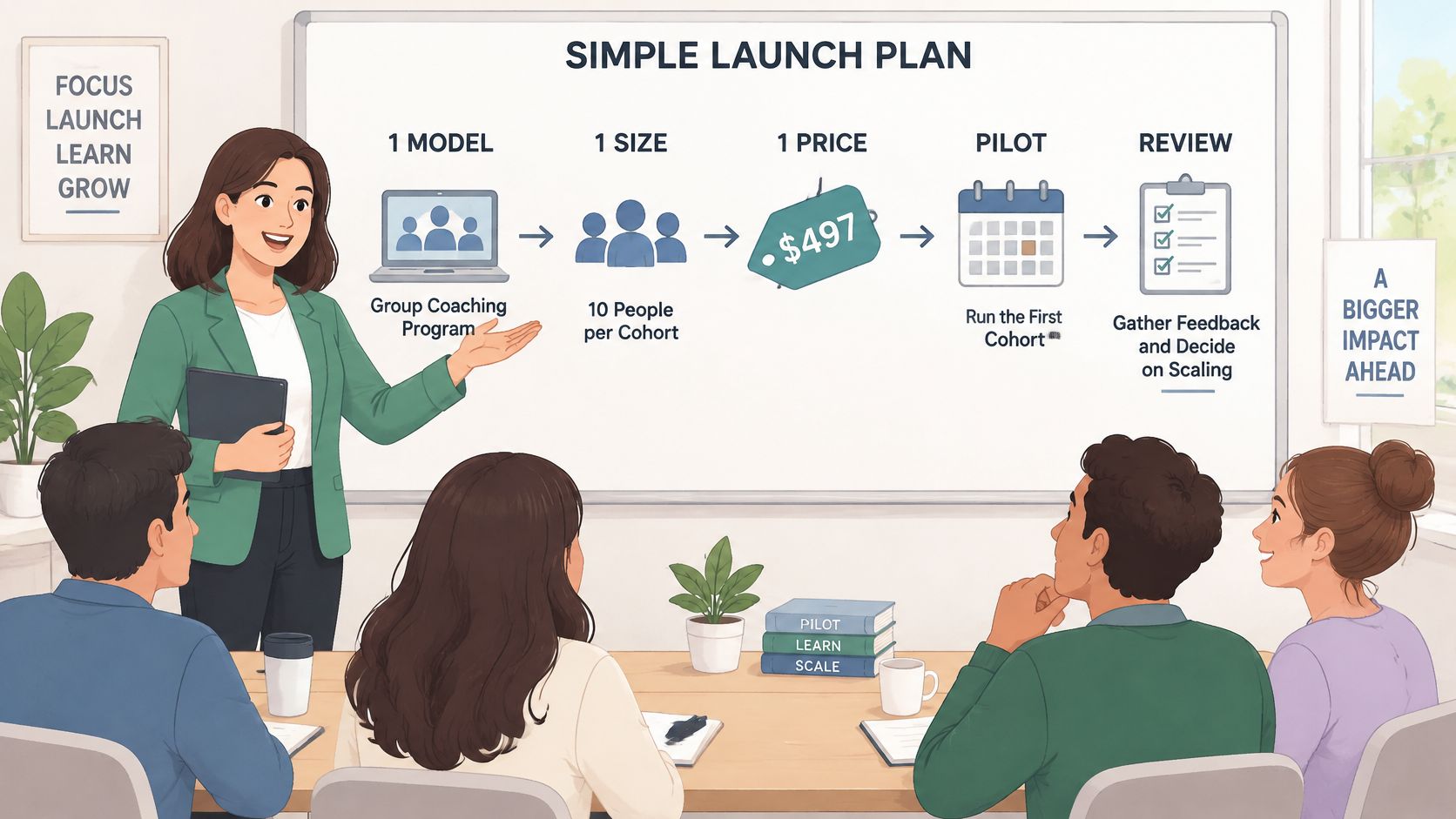
- Decide the offer. Match format to the outcome timeline, and price it for a roster you can fill, not a full room you hope for.
- Pilot six to eight people on the five-block call. Live with that design before you invent another one.
- Review after the first cohort. Look at completed commitments and the outcome measures. Then change size, price, or curriculum. Change one, or you won't know what moved.
You still need the right people in those seats. A practical piece on how to attract ideal coaching clients from Wojo Media is worth using so the pilot isn't full of the wrong problem.
What software will not do for you
When a client completes checkout on a payment-plan offer linked to a program, we enroll them in the program and add them to the group chat if a cohort squad is configured. Cohort groups are created when clients enroll, so you aren't building each group by hand. Trying that setup takes 15 minutes. Enrolment and the group workflow can run without you clicking each person in. You still design the session, set the norms, and review the commitments. No tool does that part.
If you want a short look at how a simple group offer gets explained out loud, this walkthrough is a useful companion before you write your own.
Test enrolment and group setup on one small cohort before you lock a full curriculum. A modest pilot tells you whether people finish commitments. A big launch mostly tells you whether you can survive the admin.
Coachful keeps group programs, cohort squads, scheduling, payments, and each client's goals in one workspace, so coaching in groups doesn't sprawl across five tools. Use it to enroll a small pilot, run the calls, and see who follows through. Visit Coachful and set up that first cohort before you scale the room.


