
Coaching Inquiry Response Email: 5 Templates to Adapt

Coachful
Coachful Editorial
Someone has finally asked about your coaching. Do you answer their questions, send your calendar, or write the long explanation of your approach that somehow takes forty minutes?
Reply to the actual question first, establish whether your service could fit, and offer one proportionate next step. A first enquiry is not an invitation to deliver free coaching, diagnose the person, or launch a sales sequence. Your job is to make the next decision easier.
Below are five coaching inquiry response email templates for the period before a discovery conversation: a general enquiry, a price question, an unclear request, a referral and an employer enquiry. The examples are original editorial templates, not tested conversion scripts. Replace every bracketed field with something true.
What should your first response include?
A useful reply has four parts: acknowledge the specific request, answer what you can answer, state any relevant limit, and give one next step. You do not need a paragraph about your passion for transformation. The person already made the effort to contact you.
For example, “Thanks for asking about returning to work after a career break” is more useful than “Thank you for your interest in my services.” It confirms that a human has read the message. Mention only the minimum context needed; do not repeat sensitive disclosures unnecessarily.

If someone asks for your price, give an accurate price or explain the information needed to quote. If they ask whether you work with new managers, answer that. A booking link without an answer can feel like another hoop to jump through.
Keep the response short enough to read on a phone. That is an editing principle, not a strict word count: a straightforward enquiry needs less explanation than an employer asking about a multi-person engagement. Do not remove an important boundary simply to meet an arbitrary length.
Choose the right reply before choosing the words
- Their need and your service seem aligned: answer the question and offer a fit conversation.
- They ask about cost: explain the relevant price, scope and any applicable conditions before inviting a call.
- You cannot tell what support they want: ask one focused clarifying question.
- A previous client referred them: welcome the enquiry without disclosing anything about that client.
- An employer is enquiring: clarify the commissioning request and who would participate before proposing an engagement.
A clear scope mismatch is a different decision. Use the separate guide on declining a potential coaching client rather than adapting these replies to keep an unsuitable sale alive.

1. General enquiry: answer, then offer a fit conversation
Use this when the person has named a coaching goal that plausibly matches your practice. Do not imply that a single message establishes suitability or that you can promise the result they want.
Subject: Your enquiry about [specific coaching area]
Hi [Name],
Thanks for getting in touch about [brief, non-sensitive summary of their request]. I work with [the people you actually serve] on [relevant area within your scope].
[Answer their specific question in one or two sentences.]
If that sounds relevant, you can book [accurate duration and purpose of the conversation] here: [tested booking URL]. [State whether there is a fee.] We can discuss what you need and whether my coaching is a suitable option, with no obligation to purchase.
[Coach name]
If your first conversation is paid, say so plainly. Do not call it a free consultation if payment appears at checkout. If it is a fit conversation rather than a coaching session, name that distinction so the prospect does not arrive expecting a complete action plan.
Suppose a new manager asks whether you can help with difficult conversations. You might answer: “Yes, that is part of my leadership coaching. We would explore your own approach and practise decisions and conversations; I do not manage the employee or provide employment-law advice.” That is a service description, not a diagnosis or guarantee.

2. Price enquiry: do not make them book to get an answer
“How much does it cost?” is a legitimate buying question, not proof that someone fails to value coaching. Give them enough information to decide whether continuing is realistic.
Subject: Coaching fees and what is included
Hi [Name],
Thanks for asking. [The relevant package or service] costs [price and currency, with the applicable tax position made clear]. It includes [number and length of sessions, delivery period and the relevant support limits].
[Clarify an important exclusion or payment condition if needed.]
If you would like to explore whether that support matches your goal, you can book [purpose, duration and any fee] here: [tested booking URL]. There is no obligation to buy a package.
[Coach name]
When you genuinely quote by scope, replace the fixed-price sentence with a real explanation: “Fees depend on the number of participants and the delivery format. Could you confirm those two details so I can provide a relevant quote?” Do not insert a made-up starting price simply because a template seems to require one.
Check the total commitment, not just the smallest instalment. If a package is paid in parts, make the total and the payment structure understandable. Discuss cancellation, refunds and other contractual details through the appropriate written terms rather than improvising promises in an enquiry email.

3. Unclear enquiry: ask one question, not for their life story
“I think I need coaching. Can you help?” is not enough to recommend an engagement. It is enough to respond kindly and find out what kind of support they are seeking.
Subject: A question about the support you are looking for
Hi [Name],
Thanks for reaching out. Before I suggest a next step, what is the main situation or decision you would like coaching to help you work on?
A short answer is enough. Please do not send medical records, private information about other people, or anything you would rather discuss through an appropriate confidential channel.
Once I understand the request, I can tell you whether it falls within my coaching service and what the next step would be.
[Coach name]
Choose the question that resolves the actual uncertainty. If they want someone to write a business plan, ask whether they want coaching on their own planning or a provider to write it. If timing is the issue, ask what start window they have in mind. Do not send a long assessment to answer a simple availability question.
If the message suggests an immediate safety concern, stop treating it as an ordinary sales enquiry. Follow the safeguarding, emergency and professional procedures appropriate to the situation and jurisdiction. An email template is not crisis assessment, clinical advice or a substitute for relevant training.
4. Referral enquiry: acknowledge the introduction without sharing a client relationship
A referral can make the first exchange warmer, but it does not give you permission to discuss the referrer's coaching. Even confirming what they worked on can disclose information they expected you to keep private.
Subject: Thanks for getting in touch about coaching
Hi [Name],
Thank you for contacting me and mentioning [referrer's name, only if appropriate]. I would be glad to understand what you are looking for.
You mentioned [brief summary of the prospect's own request]. [Answer their question or state the relevant service boundary.]
If you would like to explore fit, you can book [purpose, duration and any fee] here: [tested booking URL]. We will focus on your circumstances and what you want from the work.
[Coach name]
Do not write “I helped Sam with exactly the same problem” unless you have an appropriate basis and specific permission for that disclosure. You do not need borrowed proof to answer this new person's enquiry.
If a referrer copied both of you into an email, consider whether the prospect wants to continue privately before inviting personal detail. Move the discussion to the appropriate direct channel. Do not report progress back to the referrer because they made the introduction.

5. Employer enquiry: distinguish the buyer, participant and sponsor
An HR lead asking for coaching is not necessarily the person who will receive it. Your first reply should establish the brief without inviting an informal dossier on an employee.
Subject: Your coaching enquiry for [team or organization]
Hi [Name],
Thanks for enquiring about [the stated requirement]. I offer [relevant service and audience, accurately described].
To identify a useful next step, could you confirm whether this is for an individual or a group, the intended start window, and who is commissioning the work? Please keep personal or sensitive employee details out of this initial email.
Once that is clear, I can suggest a scoping conversation and explain how participant agreement, confidentiality, reporting boundaries and fees would be established before work begins.
[Coach name]
Those are brief-defining questions, not a request to assess someone through their manager's account. Agree who the client and sponsor are, what may be reported, and what each party understands about the relationship. Do not imply that an employer payment purchases access to session content.
If the buyer asks for a proposal immediately, explain what is missing and why you need it. “I need the participant count and delivery format to scope an accurate proposal” is clearer than sending a generic deck and hoping the request fits.
How quickly should you respond to a coaching enquiry?
Choose a response window you can consistently meet and state it on your contact page or acknowledgement. During your stated working hours, check enquiries at planned intervals. Do not promise around-the-clock attention to win a sale you cannot sustainably support.
An automatic acknowledgement may confirm receipt and set an expectation. It should not pretend you have read or accepted the request. “I have received your message and normally reply within [truthful working-day window]” is different from “You are a perfect fit.”
If you are away, say when you will review enquiries and whether the inbox is monitored. Avoid a booking invitation that leads to no available appointments. If you have no suitable capacity, tell the person rather than leaving them in a queue you do not manage.

What if they do not reply or book?
For an ordinary inbound enquiry, a proportionate default is one brief follow-up after a few working days, then close the active loop. This is an editorial starting point, not a universally optimal timing rule. Respect any objection, stop request or channel preference.
You could write: “Hi [Name], I wanted to make sure my reply about [topic] reached you. If you want to continue, the next step is [the same relevant action]. If not, no response is needed, and I will close this enquiry.” Do not invent a deadline or suggest that silence means resistance to personal growth.
A reply to an enquiry is not permission to add someone to a newsletter. Use a separate valid marketing-permission process and apply the rules relevant to the recipient and your practice. Do not automatically move silent prospects into a nurture campaign.

After a discovery conversation, the context changes: you have discussed an offer and can agree a follow-up plan with the prospect. The separate guide to following up after a coaching discovery call addresses that later stage. Do not assume its cadence is appropriate for someone who has only asked one question.
Keep the enquiry record small and useful
Record the source, date, stated request, response and agreed next step. Add the next review date when one is actually needed. Keep the note factual: “Asked about evening availability; sent current options” is useful. “Uncommitted lead” is an interpretation that adds little.
When the person answers or books, review any pending follow-up. If someone else helps manage your inbox, agree who owns the next action. Two polite replies from different people can still create a confusing experience.

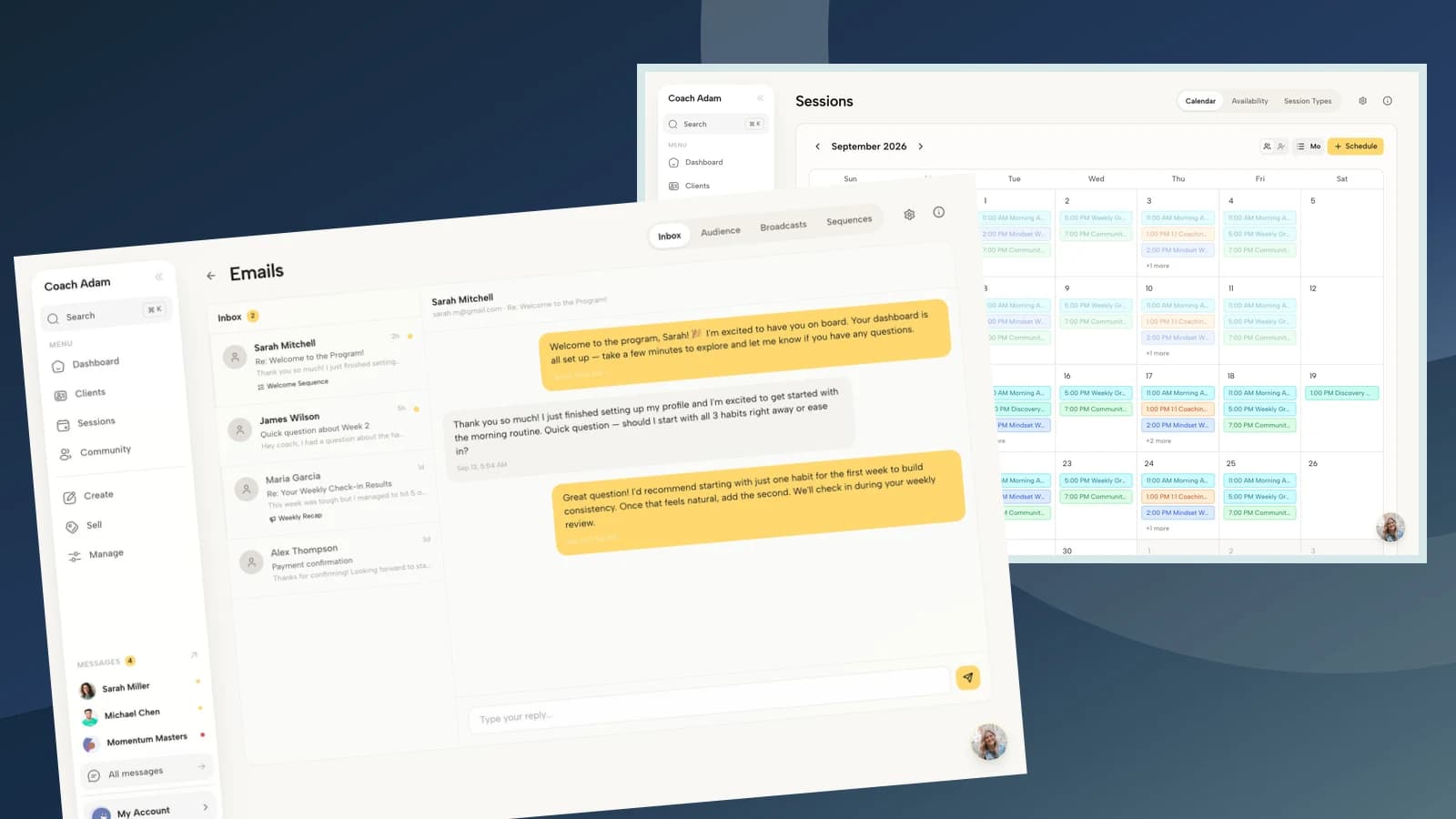
Coachful's real demo email, prospects, scheduling, links and leads screens illustrate these administrative steps. They do not prove that every enquiry is automatically captured, that a reply stops every sequence, or that a particular template converts. Check your actual configuration and permissions before relying on an automated action.
A first-reply check you can use today
- Did I answer the question the person asked?
- Are the price, availability, scope and call description accurate?
- Did I avoid repeating unnecessary sensitive details?
- Is there one clear action, or one focused question when information is missing?
- Does the link open the intended destination, with the correct fee and available times?
- Have I kept newsletter permission separate?
- Is the next action recorded, without speculative labels?
Read the message once as a stranger with three other tabs open. Can they tell whether you answered, whether your service might help, and what happens next? If not, remove the biography, extra links and persuasive padding before adding more explanation.
Frequently asked questions
Should I send a calendar link in every first reply?
No. A calendar link fits when a conversation is the useful next step and the request plausibly matches your service. Ask a clarifying question first when the essential information is missing. Decline clearly when the request is outside your scope.
Can I use a saved response?
Yes, as a starting structure. Replace every placeholder and write the sentence that answers this person's question. Recheck prices, call details and links whenever your offer changes. A template is not permission to pretend you reviewed details you have not read.
Should I attach my entire coaching brochure?
Only when it answers the request. For most simple enquiries, a concise answer and one relevant page are easier to act on. An attachment should support the answer, not conceal price, scope or the next step inside a document.
Is the enquiry itself confidential?
Handle it with care, minimize what you collect and explain the relevant privacy arrangements. The precise legal and professional duties depend on your practice and jurisdiction. Do not promise absolute confidentiality you cannot provide.
Make the next enquiry easier to answer
Save the template you actually need, replace its fields, and test the next-step link before using it. If you want to see how you could organize the conversation, prospect record and booking step around that reply, Try the interactive demo. The point is not to send more messages. It is to answer the right question and leave neither person guessing.
Source boundaries: the templates and timing suggestions are original editorial guidance. For broader examples of coaching-email use, see GetResponse's coaching email overview; it is not evidence that these scripts produce any particular outcome. Software screenshots show genuine Coachful demo states with sample data.












