What Is a Discovery Call? Meaning, Length and What to Ask

What is a discovery call? It is a short first conversation, usually 15 to 30 minutes and usually free, between a coach and a potential client to see whether they are a good fit before any paid work begins. The coach learns what the person wants to change and what is in the way; the person gets a feel for the coach and how the coaching would work; and the call ends with a clear next step, which is either an offer, a referral elsewhere or a polite no.
The term comes from sales, where a discovery call is the first meeting in which a seller learns a buyer's situation before proposing anything. Coaches borrowed it because the purpose is the same: understand first, recommend second. This guide explains what happens on a discovery call, how long it lasts and whether it should be free, how it differs from a consultation, intake or chemistry call, what to ask from either side, the common mistakes, and what happens next. If you are a coach looking for the full script, see our coaching sales script; for the booking setup, the discovery call funnel.
Discovery calls at a glance
| Question | Short answer |
|---|---|
| What is it for? | Testing fit before coaching starts: the goal, the situation, the approach and the terms |
| How long is it? | Usually 15 to 30 minutes; some coaches use 45 minutes for complex or high-priced work |
| Is it free? | Usually. Some coaches charge for a longer first session instead |
| Is it a coaching session? | No. It may feel useful, but its job is diagnosis and fit, not coaching |
| Who leads it? | The coach, with a simple structure |
| How is it held? | By video or phone, booked from the coach's website, profile or link page |
| What happens at the end? | A recommendation and price, a referral elsewhere, or agreement that it is not a fit |
What happens on a discovery call
Most coaching discovery calls follow the same shape, whatever the niche:
- Framing, a minute or two. The coach explains how the call will run and that at the end they will say honestly whether they can help.
- Where you are now. What made you book the call, what is going on, what you have already tried.
- Where you want to be. What would be different in three or six months if this went well.
- What is in the way. Why it has not happened yet.
- The recommendation. If it is a fit, the coach describes how they would work with you, for how long and at what price. If not, they say so, ideally with a suggestion of where to go instead.
- The next step. Time to think, a follow-up email, or booking the first session.
A good discovery call feels more like a focused conversation than a pitch. You should talk more than the coach.

How long should a discovery call be?
Fifteen to 30 minutes covers most coaching. Twenty minutes is enough for a simple offer and a clear problem. Thirty minutes suits most life, health and career coaching. Some executive and business coaches book 45 minutes, because the situation takes longer to understand and a sponsor may join. Longer than that, and the call usually drifts into free coaching, which helps nobody: the person leaves with a little relief and no plan.
If you are a coach deciding on length, put it on the booking page, end on time, and keep the structure the same for everyone. Our guide to session length covers paid sessions.
Should a discovery call be free?
Usually yes, because it lowers the barrier for someone deciding whether to trust you. But a free call has costs: no-shows, calls with people who were never going to buy, and the temptation to coach for free. Some coaches charge for a first session instead, which filters for commitment and pays them for their time.
| Free discovery call | Paid first session | |
|---|---|---|
| Length | 15 to 30 minutes | Usually a full session |
| Purpose | Fit and recommendation | Real coaching, then a recommendation |
| Best for | Programs and higher-priced packages | Coaches with demand or a waitlist |
| Watch out for | No-shows and free coaching | Fewer bookings at the start |
Our comparison of discovery sessions and paid first sessions goes through the decision in detail, and whether to show prices before the call covers the other common question.
Discovery call vs consultation, intake, strategy session and chemistry call
| Name | What it usually means | Paid? |
|---|---|---|
| Discovery call | A short call to test fit before buying | Usually free |
| Consultation | Often the same as a discovery call; in health coaching it can mean a longer first assessment | Either |
| Strategy session | Marketing language for a discovery call, sometimes with a bit more advice | Usually free |
| Chemistry call | Executive coaching term for a fit call, often one of several the leader holds with different coaches | Usually free |
| Intake session | The first session after someone has signed up, gathering background and goals | Part of the paid work |
The ICF advises people looking for a coach to meet with at least three and notes that "Qualifications are important, but chemistry is what makes a coaching relationship really work" (ICF). Whatever the call is named, that is its real job.
If you are about to have a discovery call with a coach
Ten minutes of preparation makes the call far more useful.
- Write down the change you want in one or two sentences.
- Note what you have already tried, and what got in the way.
- Know your budget and timing, so you can react to a price honestly.
- Bring your questions. Who do they usually work with? How would they approach your goal? What happens between sessions? How will you both know it is working? What training do they have? What does it cost in total, and what are the cancellation and refund terms?
Our list of questions to ask a coach before hiring has more, and what happens in a coaching session explains what comes after. Notice how the call feels: did the coach listen, ask at least one question that made you think, and give you space to decide? Pressure to pay before you hang up, or a discount that expires on the call, is a warning sign; see red flags when hiring a coach.

If you are still looking for coaches to talk to, Coachful's Find a Coach directory lets you browse coaches by topic and category, and many profiles include a calendar to book a discovery call or a form to send a message.
If you are a coach running discovery calls
A few principles keep discovery calls useful for both sides:
- Ask a few questions on the booking form, such as what they want help with and what made them book now, so you start informed.
- Diagnose, do not coach. Reflect back what you heard and say what you would work on; save the coaching for the program.
- Say the price as a plain sentence, then stop talking.
- Be willing to say no. If you are not the right coach, say so and suggest someone better. Our templates for saying no to a potential client help.
- Follow up the same day with a short recap and the offer link. See how to follow up after a discovery call.
- Track the numbers: calls booked, calls held, and calls that became clients. The conversion rate tells you whether the call or the marketing needs work.
The discovery call script generator drafts a script for your style and niche if you want a starting point. If a prospect does not know what they want, our guide to prospects who do not know what they want covers that conversation.

Common discovery call mistakes
- Turning it into a free session. The person feels helped and has no reason to buy.
- Talking too much. If the coach talks for more than a third of the call, they learned too little.
- Hiding the price, or making it hard to find out. Vagueness reads as pressure.
- No clear next step. "Let me know" usually means nothing happens.
- Taking everyone. A poor fit becomes an unhappy client and a refund request.
- No reminder. Without reminders, no-shows rise. See how to prevent no-shows.
What happens after a discovery call
If both sides want to go ahead, three things usually follow:
- The offer. A link to the specific program or package discussed, with the price and what is included.
- The agreement. The ICF's Code of Ethics asks coaches to agree roles, responsibilities, confidentiality and financial arrangements with clients before coaching begins (ICF Code of Ethics, standard 1.1). See client contract templates.
- Onboarding. Payment, an intake form and the first session booked. Our client onboarding checklist lists the steps, and how to run a first coaching session covers the session itself.


Setting up discovery calls on Coachful
Coachful handles the whole path from booking to first session:
- Intake call types with availability rules, buffers, minimum notice and time-zone detection, intake questions on the booking form, and email reminders, plus SMS and WhatsApp reminders once messaging is turned on. See booking software for coaches.
- The Intakes page, which lists every discovery call with its status (upcoming, completed, converted, no-show or cancelled) and your conversion rate.
- Missed calls: when an intake call is marked as a no-show, you can send a warm note with a fresh booking link from the session pop-up.
- Funnels with a discovery call template, a strategy session application and a paid consultation option. See funnel software.
- Offers, agreements and onboarding that start when the client pays.
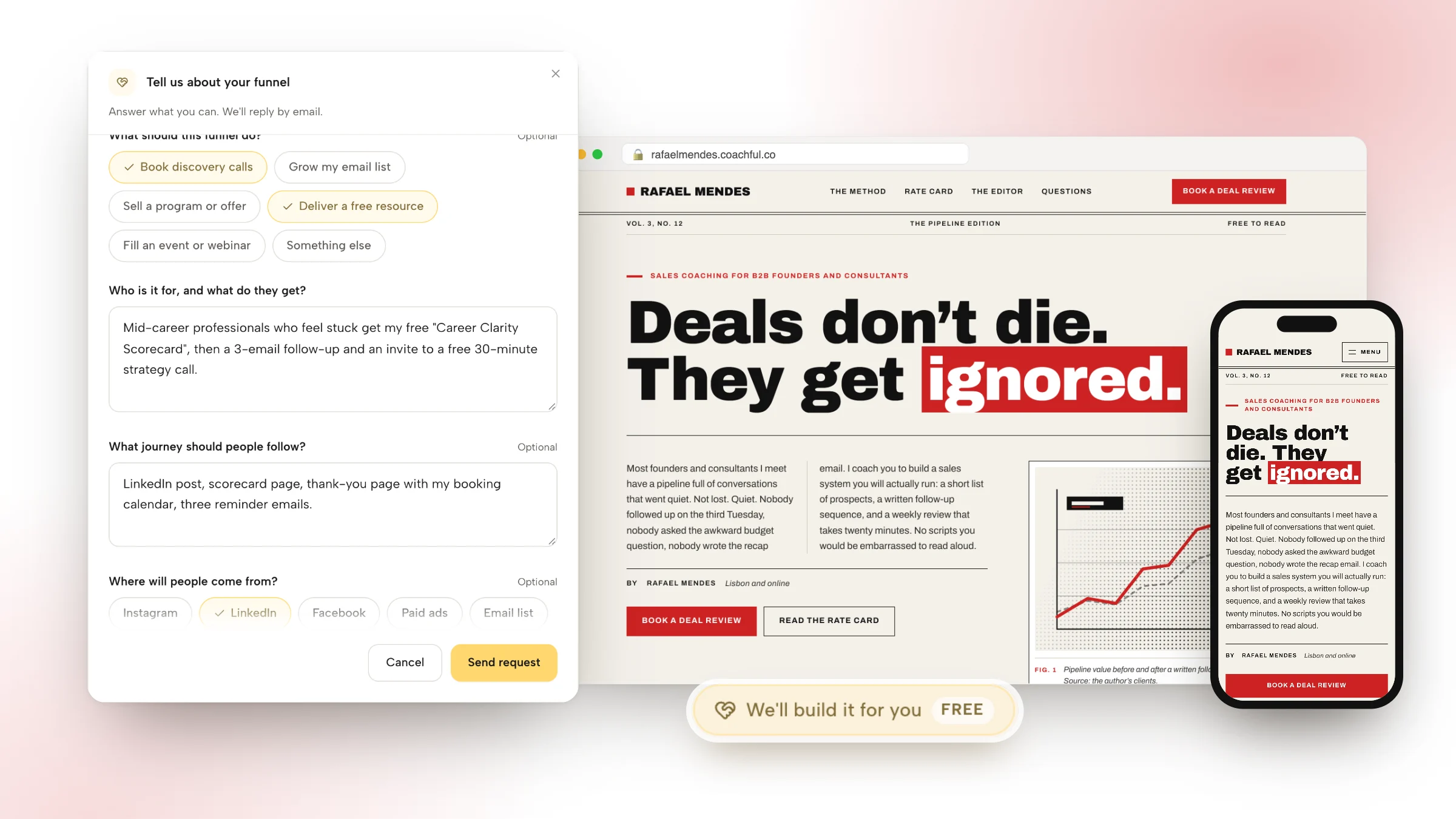
If you would rather have the website and booking funnel built for you, every Coachful plan includes a free white-glove build: describe what you want in a short form, and the Coachful team builds it in your account, usually within about 24 hours. A recent example is a five-page site for a menopause and midlife coach where every button leads to a free 20-minute consultation.

Frequently asked questions
What is a discovery call in coaching?
A short first conversation, usually 15 to 30 minutes and free, where a coach and a potential client find out whether they are a good fit. The coach learns the goal and obstacles, the client learns how the coaching would work, and the call ends with a recommendation or a referral.
What happens on a discovery call?
The coach frames the call, asks where you are now, where you want to be and what is in the way, then recommends a way of working together with a price, or says it is not a fit. You get time to ask your own questions.
How long is a discovery call?
Usually 15 to 30 minutes. Some executive and business coaches use 45 minutes for complex situations. Much longer and it tends to become a free coaching session.
Are discovery calls always free?
Most are free. Some coaches charge for a longer first session instead, which includes real coaching and filters for commitment. The coach's booking page should say which.
What should I ask on a discovery call?
Ask who they usually work with, how they would approach your goal, what happens between sessions, how you will know it is working, what training they have, and the total price with cancellation and refund terms.
What is the difference between a discovery call and a consultation?
Often nothing. Both usually mean a short first call to test fit. In health coaching, "consultation" can mean a longer paid first assessment, so check the description before you book.
Can Coachful build my discovery call booking page for free?
Yes. Every Coachful plan includes a free white-glove build. Fill in the funnel or website form, choose "Book discovery calls", and the team builds it in your account, usually within about 24 hours.